
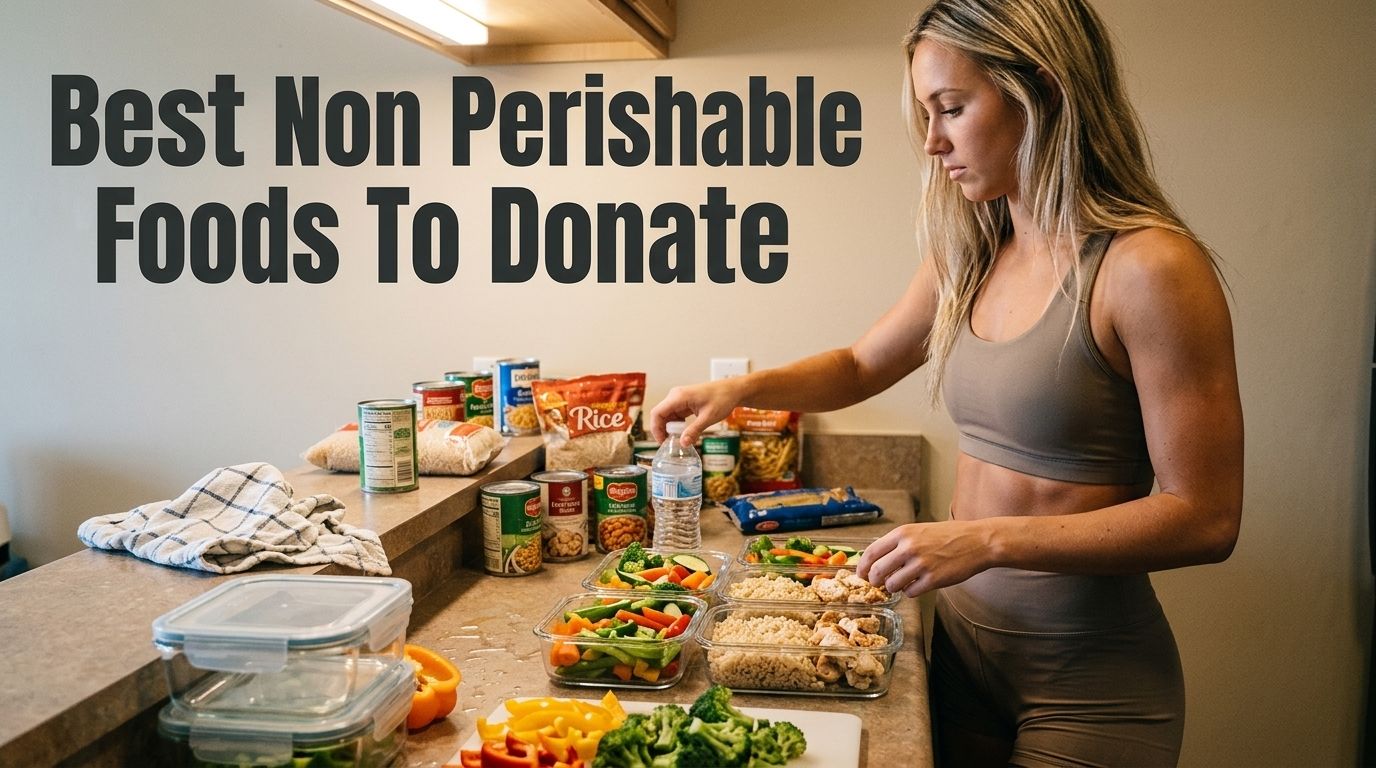
Food banks across the country rely on shelf-stable donations to feed millions of families each year. Choosing the right items means every box dropped off delivers real nutrition, not just bulk. This guide breaks down exactly what to bring and why it matters.
Not all donations carry equal weight. A can of low-sodium black beans feeds a family twice over and delivers 15 grams of protein per serving. A bag of instant ramen fills a shelf but leaves the body undernourished. The difference between the two choices is the difference between real support and a missed opportunity. Our nutritionists at Eat Proteins built this list to close that gap.
Whether it’s a spontaneous pantry cleanout or a planned food drive, this article covers proteins, grains, canned produce, cooking essentials, and budget tips. Read to the end for a complete checklist and a free tool to put nutrition to work every day.
What Are the Best Non-Perishable Foods to Donate?
The best non-perishable foods to donate are items that combine long shelf life, dense nutrition, and broad kitchen versatility. Proteins, whole grains, and low-sodium canned produce consistently top every food bank wish list because they build complete meals without refrigeration. Thoughtful donors check three things before the box leaves the door: nutrition density, usability, and quality relative to cost.
Food banks report that protein items move fastest off shelves. Grains stretch limited groceries into several filling dinners. Produce adds vitamins that dry goods alone cannot deliver. Together, the three categories form the backbone of any donation that truly helps.
Usefulness matters as much as nutrition. Pop-top cans eliminate the need for a can opener, which not every household owns. Smaller portion sizes suit single adults and elderly recipients. Kid-friendly packaging helps caregivers without cooking experience prepare meals in minutes.
Which Proteins Top Every Food Bank Wish List?
Water-packed canned tuna, salmon, and chicken deliver iron, zinc, and all nine essential amino acids in a format that requires zero refrigeration. These items rank first on nearly every food drive list because protein costs more per serving than any other macronutrient, yet it is the nutrient most families in crisis run short on first. Peanut butter and canned beans round out the category at a lower price point.
Canned beans deserve special attention. Black beans, chickpeas, kidney beans, and pinto beans are low-cost, culturally versatile, and high in both protein and fiber. A single 15-ounce can costs under a dollar and delivers four servings. No-salt-added or reduced-sodium varieties are the preferred choice for any donation box.
Shelf-stable nut butters serve recipients who have peanut allergies. Almond butter, sunflower butter, and cashew butter all supply healthy fats and protein in familiar formats that children accept readily. Donating a variety gives pantry staff flexibility to match items to individual dietary needs.
Top Protein Donations:
- Canned tuna or salmon (water-packed, low-sodium)
- Canned chicken (pop-top preferred)
- Peanut butter or almond butter (no added sugar)
- Canned black, pinto, or kidney beans (no-salt-added)
- Canned chickpeas or lentils
- Canned chili or stew with beans
What Grains Do Food Pantries Need Most?
Whole-grain pasta, brown rice, and rolled oats provide fiber, sustained energy, and the meal-stretching versatility that feeding programs depend on most. White rice has a longer shelf life and remains widely accepted, but whole-grain versions deliver at least 5 grams of fiber per serving, a benchmark pantry nutritionists flag as meaningful. Instant oatmeal packets in low-sugar varieties suit recipients with minimal cooking equipment.
Quinoa, farro, and barley add variety that monoculture grain donations cannot. These ancient grains supply complete or near-complete amino acid profiles, which matters in households where protein donations run low. Single-serving pouches are especially practical for seniors and solo adults managing portion sizes on fixed incomes.
Top Grain Donations:
- Whole-grain pasta (penne, spaghetti, fusilli)
- Brown rice or instant brown rice
- Rolled oats or low-sugar instant oatmeal
- Quinoa (packaged, rinsed variety)
- Low-sugar whole-grain cereal (5g+ fiber per serving)
Are Canned Goods the Best Foods to Donate to Food Pantry?
Yes. Canned goods rank as the single most efficient donation format because they combine shelf stability, portion accuracy, and nutrient retention in one sealed unit. Modern canning locks in vitamins at peak ripeness, so a can of diced tomatoes or green beans often outperforms fresh produce that has traveled hundreds of miles. Food banks process canned donations faster than any other category, cutting labor costs and getting food to families sooner.
The caveat is label reading. High-sodium soups and syrup-packed fruits negate much of the nutritional benefit. Donors who spend 10 extra seconds checking the sodium and sugar panels make a measurably larger impact than those who grab whatever is on sale. Low-sodium and no-salt-added labels are the two markers worth prioritizing every time.
Which Canned Vegetables Make the Biggest Impact?
Low-sodium canned corn, green beans, carrots, peas, and diced tomatoes supply vitamins A, C, and K alongside dietary fiber at a cost of roughly 50 cents per can. Vegetables are the least-donated food category despite being nutritionally essential, which means every can a donor brings fills a genuine gap on pantry shelves. Tomato products pull double duty as cooking bases for pasta, stews, and soups.
No-salt-added labels are the gold standard. Standard canned vegetables contain 300 to 400 milligrams of sodium per half-cup serving. Families managing hypertension, a condition disproportionately common in food-insecure populations, benefit enormously when donors choose the lower-sodium option. Pull-tab lids eliminate access barriers for elderly recipients and those with limited hand strength.
Which Canned Fruits Are Worth Donating?
Canned peaches, pears, mandarin oranges, and mixed fruit packed in 100% juice or water deliver vitamin C, potassium, and natural sugars without the heavy syrup that spikes blood glucose. These items give pantry clients year-round access to fruit regardless of season or refrigeration availability. Unsweetened applesauce in individual cups is one of the most practical formats for families with young children.
Juice-packed fruit contains roughly 30% fewer calories than syrup-packed equivalents while preserving the same micronutrient profile. Donors who make this one swap across an entire food drive box meaningfully improve health outcomes for every family that receives it. Small, family-friendly sizes with easy-open lids are preferred over large institutional cans.
Do Nutrition Labels Matter When Donating Food?
Yes. Nutrition labels directly determine whether a donated item supports health or simply fills shelf space with empty calories. Food banks increasingly use nutrition scoring systems to evaluate incoming donations, and items that fail minimum thresholds get deprioritized or discarded. Reading a label takes 15 seconds and transforms a generic donation into a targeted health intervention for the family that opens it.
The three numbers that matter most are sodium (under 480mg per serving), added sugars (under 5g per serving), and fiber (above 3g per serving for grains and legumes). Items that hit all three benchmarks consistently outperform the average donation and help pantry nutritionists build balanced meal bundles for clients with chronic conditions.
What Sodium Levels Should Donors Look For?
Donors aiming for maximum impact target canned items with 140mg of sodium or less per serving, the FDA’s ‘low sodium’ threshold that most food banks now recommend explicitly. Standard canned soups often contain 800 to 1,000mg per serving, nearly half the daily recommended intake for adults. Families eating two or three canned meals per day reach dangerous sodium levels quickly when donations skew high in salt.
The practical rule is straightforward. ‘No-salt-added’ beats ‘low-sodium,’ and ‘low-sodium’ beats ‘reduced sodium.’ Regular-sodium options are acceptable only when a lower version is unavailable. Rinsing canned beans before use reduces sodium content by up to 40%, a tip pantry staff share with clients regularly to extend the value of existing stock.
Sodium Quick Reference:
| Label | Max Sodium per Serving |
|---|---|
| No-Salt-Added | 0-35mg |
| Low Sodium | 140mg |
| Reduced Sodium | 25% less than original |
| Regular | 300-900mg (varies) |
What Non-Perishable Foods Give the Most Nutrition Per Serving?
Canned salmon, peanut butter, and dried lentils deliver the highest nutrient density per dollar of any shelf-stable category, measured by protein, fiber, and micronutrient content combined. A two-tablespoon serving of peanut butter contains 8 grams of protein, 2 grams of fiber, and meaningful amounts of magnesium and vitamin E for under 20 cents per serving. Dried lentils cost even less and supply folate, iron, and plant-based protein in a single versatile ingredient.
Canned salmon outperforms tuna on omega-3 fatty acid content, supplying roughly 1,200mg of EPA and DHA per 3-ounce serving. These essential fats support cardiovascular and cognitive health, two areas where food-insecure populations face elevated risk. Pink salmon in water is the most affordable variety and widely available in standard grocery stores year-round.
Want to get a proven nutrition plan for high-impact health that goes beyond pantry basics? The same principles that guide smart donations apply directly to everyday eating patterns.
Which Shelf-Stable Items Pack the Most Protein?
Per 100 calories, canned tuna delivers 22 grams of protein, making it the highest-density shelf-stable protein available at standard retail prices. Canned chicken follows closely at 19 grams per 100 calories. Dried beans and lentils average 7 to 9 grams per 100 calories, lower per calorie but far cheaper per gram of protein when purchased in bulk bags rather than cans.
Powdered peanut butter is an underrated donation. It has a longer shelf life than standard peanut butter, ships lighter, and reconstitutes easily with water. Some pantries prefer it for clients on calorie-restricted diets, as the powder form delivers the same protein with roughly 70% fewer calories than the full-fat spread.
Protein Per 100 Calories (Shelf-Stable):
| Item | Protein (g) per 100 cal |
|---|---|
| Canned tuna (water) | 22g |
| Canned chicken | 19g |
| Canned salmon | 17g |
| Dried lentils | 9g |
| Canned beans | 7g |
| Peanut butter | 5g |
Can Nut Butters Replace Animal Protein in Donations?
Yes. Nut butters supply complete healthy fat profiles and 7 to 8 grams of protein per two-tablespoon serving, making them a practical stand-alone protein source for vegetarian and vegan recipients. Natural peanut butter with no added sugar or hydrogenated oils is the most cost-effective option. Almond and sunflower butter serve recipients with peanut allergies, a population food banks actively accommodate in mixed-distribution environments.
The key donation rule for nut butters is to avoid single-serve packets when possible. Standard 16- to 18-ounce jars offer more servings per dollar and less waste. Plastic jars are preferred over glass containers, which food banks typically reject due to breakage risk during transport and distribution.
What Are the Best Canned Goods to Donate for Complete Meals?
The best canned goods combination for complete meals pairs a canned protein with a tomato-based sauce, a canned bean, and a starchy vegetable to deliver macronutrients, fiber, and micronutrients in a single no-cook assembly. Food banks build ‘meal bundle’ kits using exactly this formula, grouping items that require minimal preparation and zero cooking equipment beyond a bowl and spoon. Canned chili with beans is the single most complete individual can in this category.
Low-sodium canned soups and stews occupy a practical middle ground. They function as standalone meals, base sauces for grains, or protein extenders when recipients have access to a stove. Volunteers and staff specifically flag soups with visible vegetables and legumes as the most nutritionally efficient items in this subcategory.
Do Cooking Essentials Belong in a Donation Box?
Yes. Cooking oils, dried herbs, and pasta sauce transform donated staples from isolated ingredients into actual meals that families prepare with confidence and minimal skill. Pantries receive enormous quantities of pasta and rice but far fewer sauces or seasonings, creating a gap that leaves recipients with bland, repetitive meals. A jar of tomato sauce or a bottle of olive oil dramatically increases the number of distinct dishes a family makes from a single donation box.
Shelf-stable broth is another underdonated essential. It turns dry rice, lentils, or quinoa into flavorful dishes and reduces the monotony that food insecurity imposes on mealtimes. Our coaches at Eat Proteins recommend including at least one cooking essential per donation box alongside proteins and grains to ensure recipients build complete, satisfying meals from what they receive.
Cooking Essentials to Include:
- Olive oil or avocado oil (small bottles)
- Pasta sauce or crushed tomatoes
- Shelf-stable vegetable or chicken broth
- Dried herbs and no-salt spice blends
- Honey or 100% fruit juice (small sizes)
Are There Non-Perishable Foods Kids Actually Need?
Yes. Children need iron, calcium, zinc, and B vitamins in formats they recognize and will eat, making kid-familiar shelf-stable items a distinct donation priority. Low-sugar whole-grain cereal, individual applesauce cups, and 100% fruit juice boxes hit all four nutritional benchmarks while coming in packaging children open independently. Food banks serving families with young children request these items year-round.
Iron deficiency affects roughly 8% of American children under age 5, with rates significantly higher in food-insecure households. Iron-fortified cereals with at least 25% daily value per serving represent one of the easiest and most affordable targeted donations a food drive participant makes. Pairing them with 100% vitamin C-rich juice improves iron absorption by up to three times, a nutritional synergy pantry staff actively promote in client education materials.
What Kid-Friendly Formats Work Best for Pantries?
Individual portion cups, easy-open pull-tab cans, and resealable pouches reduce preparation barriers for caregivers managing meals with minimal equipment and limited time. Applesauce cups, single-serve peanut butter squeeze packs, and 4-ounce 100% juice boxes allow children to eat independently and help parents track portions without measuring tools. Pantry staff consistently rank easy-open packaging among the top three practical considerations for family distributions.
No-cook items matter enormously in this segment. Granola bars with under 8 grams of added sugar, whole-grain crackers, unsalted nuts, and shelf-stable cheese snacks require zero preparation and give children calorie-dense, nutrient-adequate options for school mornings and after-school snacks. Low-sugar options prevent the energy crashes that interrupt learning and concentration throughout the school day.
What Items Should Donors Always Skip?
Donors achieve the most impact when they avoid ramen noodles, frosted cereals, syrup-packed canned fruit, and glass-container items that fail basic nutritional and logistical standards food banks enforce. Ramen noodles deliver negligible protein and fiber while containing up to 1,800mg of sodium per packet. Frosted cereals contain more added sugar per serving than most desserts. Glass containers break in transit and expose volunteers and clients to injury risk. Food banks routinely discard these items rather than distribute them.
Expired items waste volunteer labor and warehouse space. Every expired can entering a donation barrel requires a staff member to inspect, reject, and dispose of it. That time directly delays food from reaching families. Donors who check dates before packing a box eliminate an entire layer of administrative burden that food banks cannot absorb at scale.
Does Packaging Type Affect a Donation’s Usefulness?
Yes. Pop-top lids, resealable pouches, and standard-size cans consistently rank above glass jars, oversized institutional cans, and damaged packaging in every food bank usability assessment. Pop-top cans eliminate the can-opener barrier entirely, which matters for elderly clients, individuals with arthritis, and households that do not own one. Foil-pouch proteins like tuna and salmon packets are an increasingly popular format that distributes cleanly and stores compactly on pantry shelves.
Avoid donating items with dented, bulging, or rusted cans. These are safety hazards regardless of the expiration date. A bulging can indicates potential botulism contamination, and food banks follow strict protocols to reject and destroy such items. Donors who inspect cans before loading them into a collection box remove a safety risk that protects every volunteer and recipient in the distribution chain.
How Do Donations Fit Any Budget?
Every budget finds a meaningful contribution in the shelf-stable category because the most-needed items are also the most affordable: a jar of peanut butter costs under $3, a can of beans under $1, and a box of oats under $4. Food banks operate on the principle that volume and consistency matter more than occasional large gifts. A donor who brings 10 well-chosen cans every month creates more sustained impact than one who donates a full box twice a year.
Generic and store-brand items perform identically to name-brand equivalents in nutritional value. Buying the pantry’s most-wanted list in store-brand formats allows a $20 donation to stretch to 15 to 20 individual items instead of 6 to 8 name-brand equivalents. The families receiving those items do not benefit from brand recognition. Nutritional content is what matters, and store brands match it.
Does Organic Always Beat Conventional for Donations?
No. Organic and conventional canned goods deliver nutritionally equivalent outcomes for the micronutrients food banks prioritize, meaning budget is better spent increasing donation volume than upgrading to organic labels. USDA data consistently shows that the mineral and vitamin profiles of organic versus conventional canned vegetables differ by less than 5% after processing. Spending an extra $1.50 per can on organic black beans, when the same dollar buys a second can of conventional no-salt beans, reduces the total nutrition delivered per dollar spent.
The exception is produce with thin, edible skins where pesticide residue concerns are highest, such as peaches and pears. In canned form, the washing, peeling, and heat-processing steps during manufacturing reduce surface pesticide levels dramatically. Donors on tight budgets serve recipients better by choosing conventional low-sodium items in larger quantities than premium organic items in smaller quantities.
Ready to Build Your Donation Food List?
Building a donation box takes less than 20 minutes with the right checklist, and every item chosen with nutrition in mind multiplies the benefit reaching real families. Start with proteins, add grains, layer in canned produce, and finish with one cooking essential. That four-part formula covers macronutrients, micronutrients, and meal-building versatility in a single trip down the grocery aisle.
Our nutritionists at Eat Proteins use the same evidence-based framework for donation planning as for personal nutrition coaching: density per dollar, versatility per serving, and accessibility for the person eating it. Those three principles turn any budget into a high-impact contribution. The free Eat Proteins plan applies these principles to personal goals with the same precision.
Check the specific wish list of the food bank or pantry nearby before every donation. Pantries know their clients best and often flag seasonal or demographic gaps that a generic list cannot capture. Monetary donations supplement food drives by giving organizations the purchasing power to fill gaps in real time. Together, physical donations and financial support build the most resilient and nutritious food supply a community can maintain.