
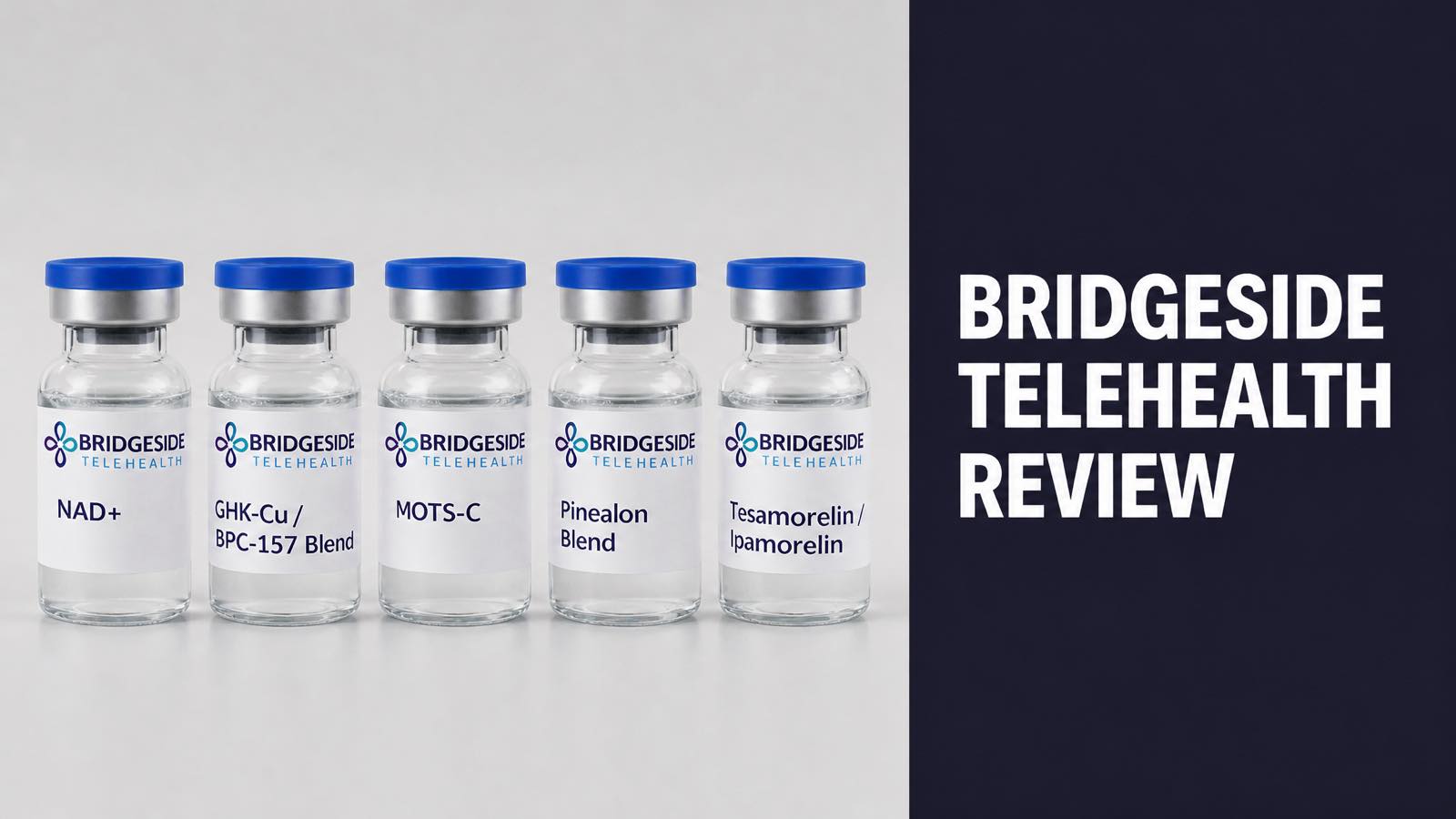
Bridgeside Telehealth is a physician-led telehealth clinic offering peptide and GLP-1 weight-loss evaluations. Licensed providers screen each patient by video before prescribing any therapy. Medication ships from licensed U.S. compounding pharmacies directly to the patient’s home address.
Bridgeside lists four peptide categories and GLP-1 care. The peptide program costs $300 with the consultation included. Compounded medications are not FDA-approved, and independent reviews are scarce. The clinic does operate with licensed providers and licensed pharmacies. Visits that end without a prescription cost the patient nothing at all today.
Reviews of this clinic are thin, so the details matter more than star ratings. This guide covers how the process works, what the pricing includes, and where the real risks sit. Read on to decide if Bridgeside fits your health goals, your budget, and your comfort level with the risks.
What Is Bridgeside Telehealth?
Bridgeside Telehealth is a physician-led telehealth clinic that evaluates patients for peptide and GLP-1 weight-loss therapies. Licensed medical providers review every patient before any prescription is issued. The clinic says biochemists inform its protocols, but only licensed providers hold prescribing authority over any therapy. Care is individualized.
Bridgeside says it is not a retail peptide platform. Why does that matter? Patients start with a medical intake, not a checkout button. In fact, our team at Eat Proteins saw this message repeated across the whole site.
Who Is Bridgeside Telehealth For?
Bridgeside Telehealth targets active adults who want physician oversight instead of self-directed supplementation. The clinic lists gym-goers and people focused on recovery and performance as typical patients. A prescription is never guaranteed, because appropriateness is decided only after a full provider evaluation of the patient. Care is individualized.
Here’s the thing: the audience also includes people seeking weight loss. The GLP-1 program covers semaglutide and tirzepatide when clinically appropriate. Anyone with a complex medical history needs a full provider review first.
Typical Patient Profiles:
- Active adults who attend the gym regularly
- People focused on performance and recovery
- Patients who want licensed pharmacy fulfillment
- Adults seeking GLP-1 weight-loss evaluation
How Does Bridgeside Telehealth Work?
Bridgeside Telehealth works through a short virtual consultation with a licensed provider, followed by pharmacy fulfillment if therapy is prescribed. The provider reviews medical history, current medications, and health goals first. A licensed U.S. compounding pharmacy then ships the approved medication directly to the patient’s home address. Intake first.
The process is simple on paper. Is it really that straightforward? Mostly, yes. The clinic lists no automatic subscriptions and no hidden fees. To be clear, therapy still depends entirely on the provider’s decision.
Process Steps:
- Book a virtual consultation with a licensed provider.
- Complete a medical intake covering history and medications.
- Meet the provider for an individual evaluation.
- Receive a prescription only if therapy is clinically appropriate.
- Wait for the compounding pharmacy to ship the medication.
What Happens in the Consultation?
The consultation is a brief virtual visit where a licensed provider reviews medical history, medications, goals, and lifestyle. The provider then decides whether peptide therapy is safe and appropriate for that individual patient. No treatment is recommended without this physician evaluation, and no prescription is issued without physician approval.
Think of it this way: the visit is a screening step. Does the provider always say yes? No. If peptide therapy is not clinically appropriate, Bridgeside charges nothing for the visit.
What Happens After the Prescription?
After approval, the prescription goes to a licensed U.S. compounding pharmacy that ships the medication directly to the patient’s home. Bridgeside states that shipping typically takes 3-7 business days after the prescription is sent. The provider stays involved through follow-up evaluations during ongoing therapy. Follow-up care continues afterward.
Follow-ups review progress and adjust therapy when needed. What about adding more peptides? Bridgeside says additional peptides are typically considered after the first month. Stacking several peptides on day one is not part of the plan.
Which Therapies Does Bridgeside Telehealth Offer?
Bridgeside Telehealth offers evaluation for four peptide categories plus GLP-1 weight-loss therapy. The peptide categories cover growth hormone, recovery, metabolic support, and neuro peptides. Every therapy requires a physician evaluation first. Providers prescribe a therapy only when it is clinically appropriate for the individual patient. Intake first.
So what does the lineup look like? The table below maps each category to the compounds named on the clinic’s site. Bridgeside labels all of them as compounded and not FDA-approved.
Therapy Categories:
| Category | Named Compounds | Stated Focus |
|---|---|---|
| Growth hormone | CJC-1295 with Ipamorelin, Sermorelin, Tesamorelin | Growth hormone signaling |
| Recovery | BPC-157 protocols, GHK-Cu, KPV, TB500 | Tissue repair signaling |
| Metabolic | NAD+, MOTS-C | Cellular energy support |
| Neuro | Selank, Semax, DSIP, Epitalon | Stress and sleep signaling |
| GLP-1 | Semaglutide, Tirzepatide | Weight loss |
Which Peptides Does Bridgeside Offer?
Bridgeside Telehealth lists growth hormone, recovery, metabolic, and neuro peptides as its evaluated therapy categories. The site names CJC-1295 with Ipamorelin, Sermorelin, Tesamorelin, BPC-157 protocols, GHK-Cu, and NAD+. The neuro category also lists Selank, Semax, DSIP, and Epitalon for evaluation. Prices appear on the clinic’s own pages too. Read them.
Now, watch this. The site describes these peptides as studied for signaling roles, not proven cures. In plain English, the claims are cautious. The clinic uses phrases like potential support and studied in research settings.
Does Bridgeside Offer GLP-1 Treatment?
Yes. Bridgeside Telehealth offers GLP-1 weight-loss evaluation covering semaglutide and tirzepatide when clinically appropriate. The clinic advertises GLP-1 programs starting as low as $199. A licensed provider still decides eligibility after reviewing the patient’s medical history and current medications in the consultation. Care is individualized.
The good news? GLP-1 care has its own page and entry price. The catch is that the $199 figure is a starting point. Final cost depends on the prescribed medication, so confirm the number during booking.
What Do Bridgeside Telehealth Reviews Say?
Bridgeside Telehealth has very little independent review data available online. Trustpilot shows an average TrustScore of 3 out of 5 from only 2 reviews. That sample size is far too small to support firm conclusions. Most detailed claims about the service come from the clinic’s own website instead. Care is individualized. Checks happen before treatment.
Why does the sample size matter? Two reviews can swing the average wildly. Bottom line: treat the score as a weak signal. Our experts at Eat Proteins recommend reading the clinic’s own terms before booking.
What Are the Positive Signals?
The clinic shows several positive signals in its structure and transparency. It requires a licensed provider evaluation before any prescription and uses licensed U.S. compounding pharmacies for fulfillment. The clinic publishes its prices openly and states that screenings ending without a prescription carry no visit charge at all. Providers review each case.
Positive Signals:
- Licensed multi-state providers
- Published consultation pricing
- No charge if therapy is not appropriate
- Licensed U.S. pharmacy fulfillment
- No automatic subscriptions or hidden fees
What Are the Common Concerns?
The main concerns are the thin review record and the unapproved status of compounded medications. Bridgeside itself states that compounded drugs are not FDA-approved and may have limited long-term safety data. Individual results vary, and the site makes no outcome guarantees. Buyers weigh these limits against the clinic’s transparency. Intake comes first.
Here is the kicker: the clinic is upfront about these limits. Is that reassuring? Partly. Honest disclaimers help, but they also confirm that evidence for many listed peptides is still limited.
Is Bridgeside Telehealth Safe and Legit?
Yes. Bridgeside Telehealth operates as a real physician-led clinic with licensed providers and licensed pharmacy fulfillment. It requires a medical intake, and it discloses regulatory limits openly on its pages. Safety still depends on the individual patient, the specific therapy, and the quality of provider follow-up care. Providers review each case.
Look, legit does not mean risk-free. Are the medications approved by the FDA? No. They are compounded. Bridgeside says its pharmacies are NABP and LegitScript listed, which is a meaningful quality signal.
Safety Safeguards Listed by Bridgeside:
- Physician approval before any prescription
- Medical intake and medication review
- Licensed U.S. compounding pharmacies
- Follow-up care and monitoring
Are Compounded Peptides FDA-Approved?
No. Compounded peptide medications are not FDA-approved for the diagnosis, treatment, cure, or prevention of disease. Bridgeside states this directly on its peptide pages and in its frequently asked questions. Compounded drugs may also skip the review process that applies to approved medications, and long-term safety data stays limited. Intake comes first.
What’s more, long-term safety data is limited. Pay attention to this: cheap ‘research use only’ peptides sold online are a different risk. Bridgeside notes those products are not intended for human use and raise purity questions.
How Much Does Bridgeside Telehealth Cost?
Bridgeside Telehealth charges $300 for the peptide program, which includes the consultation and one peptide medication if prescribed. GLP-1 programs start as low as $199. The clinic reports no automatic subscriptions and no hidden fees. Patients pay nothing for the visit if peptide therapy is not clinically appropriate. Checks happen before treatment.
Here’s the pricing at a glance. Notice that the visit itself is bundled in, so there is no separate consultation fee for peptide patients. Extra peptides after the first month may add cost.
Published Pricing:
| Program | Price | Includes |
|---|---|---|
| Peptide program | $300 | Consultation plus one peptide if prescribed |
| GLP-1 program | From $199 | Evaluation when clinically appropriate |
| Ineligible visit | $0 | Consultation when therapy is not appropriate |
Is Bridgeside Telehealth Worth the Price?
Yes. Bridgeside Telehealth delivers fair value for patients who want physician oversight and licensed pharmacy sourcing. The $300 bundle covers both the medical visit and the medication. Buyers who only want the cheapest peptide will find lower prices elsewhere. Those sellers skip clinical screening and pharmacy standards. Care is monitored closely.
So what does that mean for you? You pay for oversight, not just a vial. Is that worth it? For most cautious buyers, yes. The no-charge screening policy also removes the risk of paying for an unsuitable plan.
Why Should You Trust Eat Proteins With Your Research?
Eat Proteins gives buyers plain-language reviews built from the facts brands publish and the signals independent sources provide. Our team flags thin evidence and unapproved status instead of hiding them. Our approach helps you compare options before spending money on any telehealth service, supplement, or protein product. Providers review each case.
Is Bridgeside Telehealth Right for You?
Short answer: it fits you if you want a licensed provider, published pricing, and pharmacy-sourced peptides. Confirm eligibility, ask about follow-up, and read every disclaimer. Our experts at Eat Proteins say informed buyers win. Book smart, ask questions, and keep exploring our guides today.