
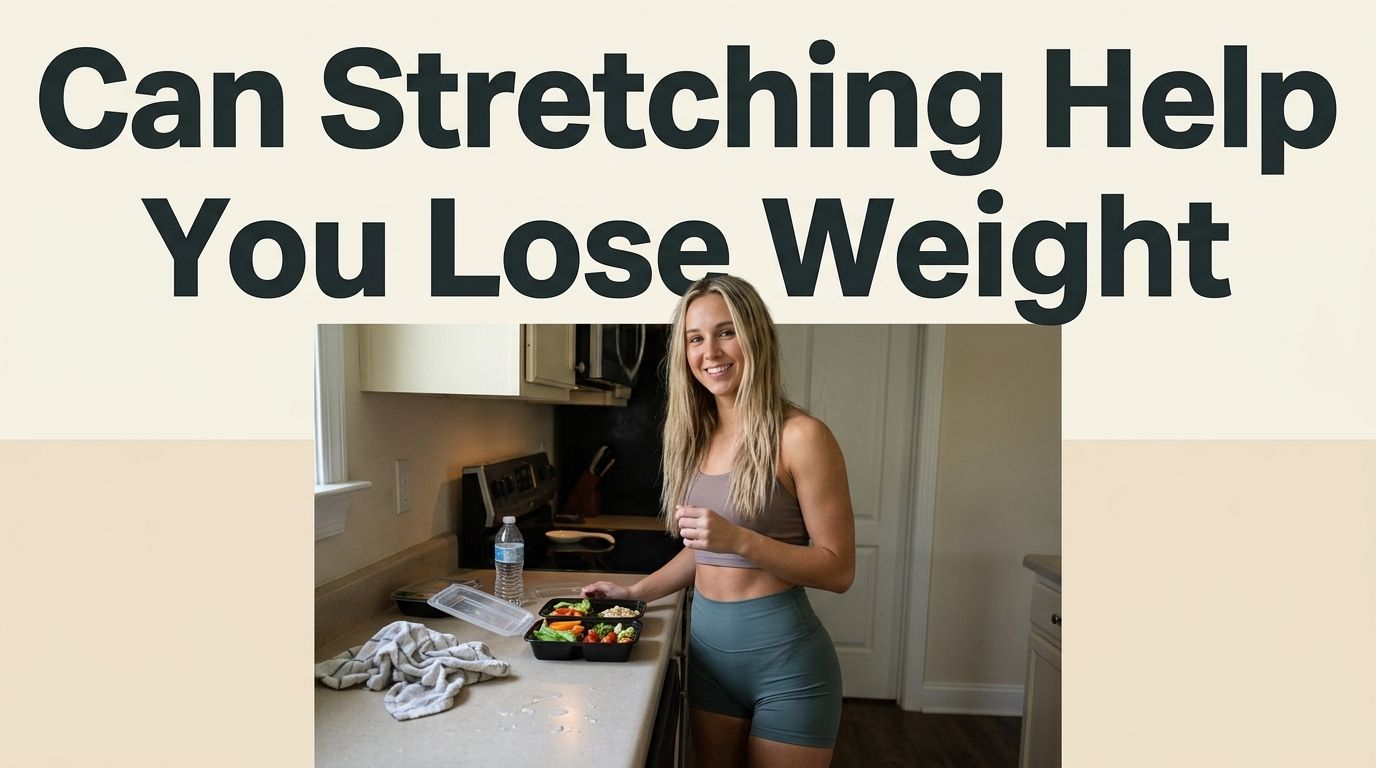
Stretching contributes to weight loss indirectly by reducing cortisol, improving mobility for more intense exercise, and burning a modest number of calories during each session. It is not a primary fat-loss tool, but it plays a supporting role that most weight loss plans undervalue.
Stretching lowers cortisol — the hormone that drives abdominal fat storage when chronically elevated. Regular flexibility training improves range of motion, reducing injury risk and allowing greater training volume. Dynamic stretching raises heart rate and burns more calories per minute than static holds. Research on yoga, which combines stretching with mindfulness, consistently shows meaningful weight loss outcomes in clinical studies.
This guide covers how many calories stretching burns, which types of stretching support fat loss most effectively, what science shows about flexibility training and body composition, and how to build stretching into a weight loss program that produces results.
Can Stretching Help You Lose Weight?
Yes. Stretching can help with weight loss by burning calories during sessions, reducing cortisol-driven fat storage, improving mobility for higher-intensity exercise, and supporting the consistency needed for long-term fat loss. Stretching alone is not sufficient for significant weight loss, but it meaningfully supports every other weight loss strategy.
The caloric contribution of stretching is modest — 100-300 calories per hour depending on intensity and body weight. But the indirect effects are substantial. People who stretch regularly report fewer injuries, greater training consistency, and lower stress levels, all of which translate to better weight loss outcomes over time.
Dynamic stretching — active movements through full range of motion — burns meaningfully more calories than static stretching. Yoga and mobility flows that combine stretching with strength and balance work deliver the highest caloric output in the flexibility training category.
Does Stretching Burn Enough Calories to Cause Weight Loss?
Stretching burns 100-300 calories per hour depending on body weight and stretch type, which is not sufficient on its own to create the 500-calorie daily deficit needed for meaningful fat loss but adds meaningfully to total daily energy expenditure as part of a broader program.
A 70-kilogram (154-pound) person burns approximately 150 calories during 30 minutes of active dynamic stretching. The same person burns closer to 80 calories during 30 minutes of passive static stretching. Neither number produces weight loss alone, but both contribute to a daily caloric deficit when combined with dietary changes and other activity.
What Type of Stretching Burns the Most Calories?
Dynamic stretching burns the most calories of any flexibility training type, elevating heart rate through active movement patterns that engage multiple muscle groups simultaneously rather than holding passive positions.
Stretching Types Ranked by Caloric Burn (per 30 minutes, 70 kg / 154 lb person):
| Stretching Type | Calories Burned | Heart Rate Effect |
|---|---|---|
| Power yoga / flow yoga | 180-250 calories | Moderate elevation (60-70% max HR) |
| Dynamic stretching routine | 130-180 calories | Light-moderate elevation |
| Static stretching | 70-100 calories | Minimal elevation |
| Yin yoga / passive holds | 60-90 calories | Minimal — near resting rate |
How Does Stretching Affect Body Composition?
Stretching improves body composition by reducing cortisol levels that drive visceral fat storage, increasing the range of motion needed for effective strength training, and improving muscle recovery rates between higher-intensity sessions.
Body composition improvements from stretching are most pronounced in people who combine regular flexibility work with resistance training. Stretching alone does not build significant muscle or create major fat loss. Its value is as a force multiplier for other training modalities.
Does Stretching Build Muscle or Just Flexibility?
Stretching produces minimal direct muscle hypertrophy compared to resistance training, but longitudinal stretching — holding muscles under tension for extended periods — has been shown to trigger measurable increases in muscle fiber length and cross-sectional area in recent research.
Studies using prolonged stretching (20-30 minute holds) show modest hypertrophy in the stretched muscles over 6-8 weeks. The mechanism is mechanical tension stimulating satellite cell activity. The effect is smaller than conventional resistance training but relevant for people who cannot perform loaded exercise.
Can Stretching Reduce Belly Fat?
Stretching reduces belly fat indirectly by lowering cortisol — the primary hormonal driver of visceral (abdominal) fat accumulation — rather than burning abdominal fat directly during the stretching session itself.
Cortisol-reduction through yoga and mindful stretching has been documented in multiple randomized controlled trials. Studies show 8-12 weeks of regular yoga practice reduces salivary cortisol by 15-30%. Lower cortisol reduces the hormonal signal that deposits fat around the abdominal organs, leading to measurable reductions in waist circumference independent of overall caloric deficit.
What Are the Metabolic Benefits of Stretching?
Stretching delivers metabolic benefits including reduced cortisol, improved insulin sensitivity, enhanced blood flow to metabolically active tissues, and lower resting muscle tension that reduces background energy waste from chronic muscular contraction.
These metabolic effects are cumulative. A stretching routine practiced 4-5 times per week over 8 weeks produces measurably different cortisol profiles, blood glucose regulation, and parasympathetic nervous system activity compared to a sedentary baseline — all factors that influence body weight over time.
Does Stretching Boost Metabolism?
Stretching does not significantly boost resting metabolic rate the way resistance training does, but it maintains metabolic health by reducing chronic cortisol, improving sleep quality, and reducing systemic inflammation — all of which support normal metabolic function.
The post-stretch metabolic boost is modest: approximately 5-10% above resting metabolic rate for 30-60 minutes after an active session. For comparison, resistance training elevates metabolism by 15-30% for several hours post-session. Stretching’s metabolic contribution is meaningful as a supplement, not a replacement, for higher-intensity training.
How Does Stretching Affect Cortisol and Weight?
Regular stretching reduces chronic cortisol levels, which directly supports weight management by decreasing the hormonal signal that promotes abdominal fat storage and appetite for calorie-dense foods.
Cortisol drives fat storage around the visceral organs when chronically elevated. Parasympathetic activation from stretching — especially yoga and slow-flow flexibility work — suppresses cortisol production via the HPA axis. Studies show a single 60-minute yoga session reduces cortisol by 14-27% in participants with elevated baseline levels.
How Stretching Lowers Cortisol and Supports Weight Loss:
- Activates parasympathetic nervous system, suppressing HPA-axis cortisol output
- Reduces perceived stress scores, lowering psychological cortisol triggers
- Improves sleep quality, cutting overnight cortisol production
- Lowers resting muscle tension, reducing sympathetic nervous system activation
What Does Science Say About Stretching and Weight Loss?
Research on stretching and weight loss shows consistent indirect benefits — cortisol reduction, improved mobility, and enhanced training adherence — but limited direct caloric contribution, making stretching a high-value adjunct to a weight loss program rather than a standalone intervention.
The strongest evidence comes from yoga research, where controlled trials consistently show weight loss outcomes. A meta-analysis of yoga intervention studies found an average weight reduction of 2.7 kilograms (6 pounds) over 12-week programs, driven by cortisol reduction, mindful eating improvements, and increased physical activity — not caloric burn from the stretching itself.
What Do Studies Show About Yoga and Weight Loss?
Studies on yoga and weight loss consistently show reductions of 2-5 kilograms (4-11 pounds) over 8-16 week interventions, with the strongest outcomes in overweight adults practicing yoga 3+ times per week combined with mindfulness-based eating awareness.
A 2016 systematic review of yoga for weight management found that yoga practice reduced body mass index (BMI) by an average of 0.77 kg/m2 across 12 studies. The mechanisms identified were cortisol reduction, improved body awareness reducing emotional eating, and increased physical activity from improved mobility and energy levels.
Does Flexibility Training Support Fat Loss?
Yes. Flexibility training supports fat loss by enabling higher training volumes in other modalities, reducing injury-related training interruptions, and improving the hormonal environment for fat oxidation through cortisol and inflammation reduction.
Research on exercise adherence shows that people who include regular stretching and flexibility work sustain exercise programs 40% longer than those who skip flexibility training entirely. Sustained exercise is the strongest predictor of long-term fat loss — making injury prevention and recovery optimization, which stretching directly provides, critically important for weight management outcomes.
How Should You Use Stretching in a Weight Loss Plan?
Stretching belongs in a weight loss plan as a daily recovery and cortisol-management tool, not as a primary caloric-expenditure activity. Used correctly, it extends the sustainability of a weight loss program by reducing injury risk, improving sleep, and lowering stress-related fat storage. Ready to build a complete plan? Get a proven weight loss plan that integrates stretching with nutrition and exercise correctly.
The optimal placement for stretching in a weight loss program is daily — 10-15 minutes of dynamic stretching before strength or cardio sessions to improve performance and reduce injury risk, plus 10-20 minutes of static or yoga-based stretching in the evening to reduce cortisol and improve sleep quality.
How Much Stretching Do You Need to Lose Weight?
To support weight loss through cortisol reduction and mobility improvements, 20-30 minutes of intentional stretching per day — split between dynamic pre-workout and static post-workout or evening sessions — produces measurable hormonal and physical benefits within 4-6 weeks.
People using stretching as a primary exercise modality (yoga-only programs) need 45-60 minutes per session, 4-5 times per week, to generate sufficient caloric expenditure and cortisol reduction for weight loss outcomes. Below this threshold, yoga and stretching produce health benefits but minimal weight change without dietary support.
What Is the Best Stretching Routine for Weight Loss?
The most effective stretching routine for weight loss combines dynamic stretching before training sessions with yoga-based or static stretching in the evening, targeting the hip flexors, hamstrings, thoracic spine, and shoulders — the areas where restriction most limits training performance and posture.
Sample Daily Stretching Routine for Weight Loss:
- Morning (5 min): dynamic leg swings, hip circles, arm circles — activates joints before daily movement
- Pre-workout (10 min): dynamic lunges, leg swings, thoracic rotations — prepares muscles for training
- Post-workout (10 min): static quad, hamstring, hip flexor holds — 30-60 seconds per position
- Evening (10-15 min): yoga-based forward folds, supine twists, pigeon pose — activates parasympathetic system
How Long Before Stretching Shows Weight Loss Results?
Stretching shows measurable weight-related results within 4-8 weeks when practiced consistently, primarily through waist circumference reduction from cortisol lowering rather than scale weight change from caloric burn.
Scale weight changes from a stretching-only program are modest — typically 0.5-2 kilograms (1-4 pounds) over 8-12 weeks. Waist circumference improvements are more reliable and often visible before scale weight shifts, because cortisol reduction preferentially removes visceral abdominal fat.
Is Stretching Alone Enough to Lose Weight?
No. Stretching alone is not sufficient to produce significant weight loss without dietary changes or higher-intensity exercise, because the caloric deficit generated from stretching alone (80-250 calories per session) falls well short of the 3,500-calorie deficit needed to lose 0.45 kilograms (1 pound) of fat.
Stretching becomes a powerful weight loss tool when combined with a moderate caloric deficit and 2-3 weekly resistance or cardiovascular training sessions. In that context, its cortisol-lowering, injury-preventing, and sleep-improving effects significantly accelerate outcomes compared to diet and exercise without any flexibility component.
Want Your Free Stretching and Weight Loss Plan?
You have the science. Now get the plan. Our coaches at Eat Proteins built a 7-day stretching and weight loss guide that shows exactly where to place flexibility work in your week, which stretches target cortisol most effectively, and how to combine stretching with nutrition for faster results.
Most weight loss programs skip stretching entirely and wonder why results stall. A structured routine that includes daily flexibility work reduces cortisol, protects lean muscle, and makes every other part of your weight loss effort work better. Get our free guide — built by our nutritionists at Eat Proteins — sent straight to your inbox.