
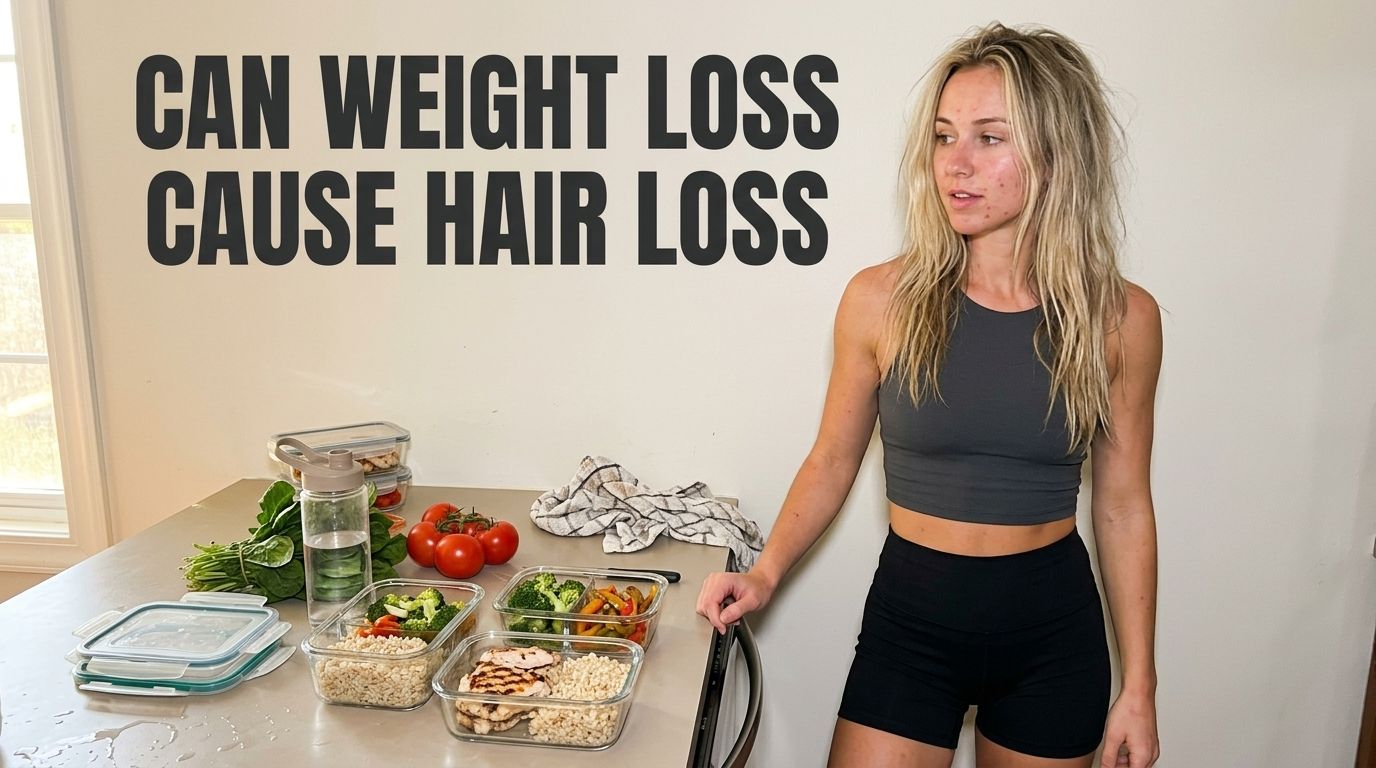
Yes, weight loss can cause hair loss. Rapid fat loss triggers telogen effluvium, a temporary condition where physiological stress forces hair follicles into the resting phase, producing visible diffuse shedding 2-4 months after dieting begins.
Crash dieting, low protein intake, and deficiencies in iron, zinc, and vitamin D are the primary nutritional drivers of follicle disruption. Bariatric surgery affects 30-60% of patients. GLP-1 medications like Ozempic report hair thinning in 3% of users. Hair loss peaks 3-6 months in, then reverses.
This guide covers every cause, how long shedding lasts, which nutrients protect follicles, and what regrowth timeline to expect. The right nutrition strategy prevents most weight-loss hair loss before it starts.
Can Weight Loss Cause Hair Loss?
Yes. Weight loss triggers telogen effluvium, a temporary condition where physical and nutritional stress pushes hair follicles prematurely into the resting phase, causing increased shedding 2-4 months after the triggering event. It is one of the most common and least-discussed side effects of rapid fat loss.
Risk is highest for those losing more than 15 lbs (7 kg) in under 3 months. Women are more commonly affected than men due to hormonal sensitivity to caloric stress. The faster the weight loss, the more follicles are disrupted simultaneously.
Here’s the good news. In most cases, this hair loss is temporary. The shedding phase self-resolves as the body stabilizes. Hair regrowth typically begins within 6-9 months once the triggering stressor is removed and nutrition is corrected.
Why Does Hair Fall Out After Losing Weight?
A significant caloric deficit signals the body to redirect resources toward vital organs, leaving hair follicles — considered non-essential — with reduced nutrients and forcing them into the resting (telogen) phase of the growth cycle. Hair is essentially deprioritized when the body is under energy stress.
Rapid weight loss creates physiological stress comparable to illness or major surgery. This stress abruptly disrupts the hair growth cycle, causing up to 30% of active follicles to enter the resting phase simultaneously. The result is visible, diffuse shedding 2-4 months later.
Is Hair Loss After Weight Loss Permanent?
No. Hair loss triggered by weight loss is temporary in the vast majority of cases, with follicles re-entering the growth phase naturally once the nutritional deficit resolves and body weight stabilizes. The follicles are not destroyed — they are dormant.
Regrowth begins 6-9 months after the triggering event. Full hair density typically restores within 12-18 months. Correcting protein and micronutrient deficiencies early accelerates the regrowth timeline considerably.
What Is Telogen Effluvium?
Telogen effluvium is the primary mechanism behind weight-loss-related hair loss, occurring when a systemic stressor forces a large proportion of hair follicles to simultaneously exit the active growth phase and enter the dormant resting phase. It is the clinical name for what most people experience as ‘hair falling out after dieting.’
Normally, only 5-10% of follicles are in the resting phase at any time. Telogen effluvium pushes 30% or more into resting simultaneously. The result is visible diffuse shedding 2-4 months after the triggering event, as all those resting follicles shed their hairs at once.
How Does Telogen Effluvium Differ From Normal Hair Loss?
Normal daily hair shedding runs 50-100 hairs per day, while telogen effluvium produces noticeably higher shedding of 200-300 hairs per day, with clumps visible in the shower drain, on pillows, and in the hairbrush. The volume difference is usually what prompts people to seek answers.
Telogen effluvium also differs from androgenetic alopecia in pattern and reversibility. Telogen effluvium causes diffuse, uniform thinning across the entire scalp and is fully reversible. Androgenetic alopecia follows a genetic pattern — recession at the hairline or crown — and is permanent without treatment.
How Long Does Telogen Effluvium Last?
Shedding typically peaks 3-6 months after the triggering event and slows naturally, with most cases resolving within 6-9 months once the underlying cause — nutritional deficiency or rapid caloric restriction — is corrected. The body restores the normal follicle distribution on its own.
If shedding continues beyond 6 months or hair density does not recover within 12 months, medical evaluation is warranted. Persistent shedding can indicate thyroid disorders, iron deficiency anemia, or an underlying androgenetic component that requires separate treatment.
What Causes Hair Loss During Weight Loss?
The main causes are crash dieting, very low protein intake, micronutrient deficiencies in iron, zinc, biotin, B12, and vitamin D, bariatric surgery, and GLP-1 medications — each stressing follicles through different but overlapping mechanisms. Most cases involve more than one trigger operating simultaneously.
Caloric intake below 1,200 kcal (5,020 kJ) per day significantly increases hair loss risk. At severe deficits, the body enters conservation mode, prioritizing organ function over follicle maintenance. Extreme diets push far more follicles into the resting phase than moderate approaches.
Primary Causes of Hair Loss During Weight Loss:
- Crash dieting or very low calorie diets (below 1,200 kcal/day)
- Inadequate protein intake (below 1.2 g/kg of body weight)
- Iron, zinc, biotin, B12, or vitamin D deficiency
- Bariatric surgery (nutrient malabsorption)
- GLP-1 medications (Ozempic, Wegovy) via rapid weight loss
Does Crash Dieting Cause Hair Loss?
Yes. Crash dieting causes more severe hair loss than gradual weight loss because the sudden, extreme caloric restriction creates acute physiological stress that abruptly disrupts the hair growth cycle across a large percentage of follicles simultaneously. The shock to the system is disproportionate to the weight lost.
Losing 0.5-1 kg (1-2 lbs) per week through moderate caloric restriction causes far less follicle disruption than losing 2+ kg (4+ lbs) per week through very low calorie diets or prolonged fasting. The rate of loss matters as much as the total amount lost.
Can Low Protein Intake Cause Hair Loss?
Yes. Hair is composed of approximately 95% keratin, a protein, and inadequate protein intake reduces keratin production, weakening existing hair shafts and forcing follicles into the resting phase to conserve amino acids for vital organ functions. Protein is the structural material hair is literally made from.
Research supports a minimum of 1.2-1.6 grams of protein per kilogram (0.5-0.7 g per pound) of body weight daily during weight loss. Post-bariatric surgery guidelines recommend a minimum of 60-80 grams of protein per day to counter malabsorption effects on follicle health.
Can Nutritional Deficiencies Trigger Hair Thinning?
Yes. Iron deficiency is the most common nutrient-related cause of hair loss, particularly in women, with zinc, biotin, vitamin B12, and vitamin D deficiencies also linked to diffuse hair thinning during periods of dietary restriction. Restrictive diets often produce multiple deficiencies at once.
Testing and correcting specific deficiencies — iron, ferritin, zinc, B12, vitamin D — can significantly reduce hair shedding during weight loss. Supplementing nutrients already at normal levels provides no additional benefit and is not a substitute for identifying actual deficiencies through blood testing.
Does Weight Loss Surgery Cause Hair Loss?
Yes. Hair loss affects 30-60% of bariatric surgery patients, typically beginning 3-4 months post-surgery and peaking around months 4-6 due to the combined stress of surgery and reduced nutrient absorption capacity. It is the most commonly reported non-surgical complication after bariatric procedures.
Bariatric procedures reduce the gut’s nutrient absorption capacity. Even with adequate dietary intake, patients absorb less protein, iron, zinc, and B12 post-surgery. This creates the sustained nutritional deprivation that drives prolonged telogen effluvium, often more severe than diet-only hair loss.
Which Bariatric Surgeries Cause the Most Hair Loss?
Gastric bypass (Roux-en-Y) causes the most significant hair loss among bariatric procedures due to the greatest degree of nutrient malabsorption, with hair loss rates reaching 30-60% of patients in the first 6 months post-surgery. The more malabsorption, the more follicle disruption.
Gastric sleeve surgery produces less nutrient malabsorption than bypass. Hair loss still occurs in a significant proportion of sleeve patients but tends to be less severe and shorter in duration. Both procedures require aggressive nutritional supplementation to minimize hair loss risk.
Can GLP-1 Medications Cause Hair Loss?
Yes. GLP-1 medications cause hair loss primarily through the rapid weight loss they enable rather than through direct drug action on hair follicles, meaning the mechanism is telogen effluvium triggered by the speed of caloric reduction. The drug accelerates weight loss — and that acceleration is what stresses the follicles.
Clinical trials for semaglutide (Ozempic, Wegovy) reported hair loss in approximately 3% of participants. The FDA lists hair loss as a known side effect. Most cases resolved without discontinuing the medication, consistent with a temporary telogen effluvium pattern.
Does Ozempic or Wegovy Cause Hair Thinning?
Yes. Both Ozempic and Wegovy are associated with hair thinning as a reported side effect, attributed to the speed of weight loss the drugs enable rather than the semaglutide molecule itself acting directly on follicles. Slow the weight loss, slow the hair loss.
GLP-1-induced hair thinning typically resolves faster than post-bariatric hair loss because nutrient malabsorption is not a compounding factor. Hair regrowth begins once the rate of weight loss slows and protein intake is consistently maintained throughout treatment.
How Do You Prevent Hair Loss While Losing Weight?
The most effective prevention strategies are maintaining adequate protein intake at 1.2-1.6 grams per kilogram (0.5-0.7 g/lb) daily, avoiding extreme caloric restriction below 1,200 kcal (5,020 kJ) per day, and testing and correcting specific micronutrient deficiencies before starting a weight loss program. Prevention is far easier than treating active shedding.
Rate of weight loss also matters. Limiting loss to 0.5-1 kg (1-2 lbs) per week significantly reduces hair loss risk. Gradual loss gives follicles time to adapt and minimizes the physiological stress signal that triggers the telogen phase shift. Ready to speed up fat loss without losing hair? Get a proven weight loss plan built around sustainable deficits and full nutritional support.
Hair Loss Prevention Checklist for Dieters:
- Eat at least 1.2 g of protein per kg (0.5 g/lb) of body weight daily
- Keep caloric deficit between 300-750 kcal below maintenance
- Test ferritin, iron, zinc, B12, and vitamin D before starting a diet
- Aim for gradual weight loss: 0.5-1 kg (1-2 lbs) per week maximum
- Be gentle with hair styling — avoid heat and tight styles during shedding phases
How Much Protein Should You Eat to Prevent Hair Loss?
The evidence-based minimum to protect hair during active weight loss is 1.2 grams of protein per kilogram (0.5 g per pound) of body weight daily, with those in larger caloric deficits or post-surgery targeting 1.6 g/kg (0.7 g/lb) to offset accelerated keratin demand. Most people eating for weight loss fall well short of this target.
Spreading protein across 3-4 meals of 25-40 grams each maximizes amino acid availability for keratin synthesis. A single large protein meal is less effective than distributed intake throughout the day. This pattern keeps circulating amino acids consistently available to hair follicles.
Which Vitamins Help With Hair Loss During Dieting?
Iron deficiency is the most common correctable cause of diet-related hair loss, with ferritin levels below 30 ng/mL associated with increased shedding — and restoring ferritin to 70+ ng/mL producing measurable improvement in hair density. Get ferritin tested, not just hemoglobin.
Zinc, biotin, vitamin D, and B12 each play supportive roles in follicle health. Zinc supports follicle cell repair. Biotin supports keratin production. Vitamin D receptors are present in follicles. B12 supports red blood cell formation. Deficiencies in any of these four amplify hair loss from dietary stress.
Key Nutrients for Hair Health During Weight Loss:
| Nutrient | Role in Hair Health | Deficiency Threshold |
| Iron (Ferritin) | Oxygen transport to follicles | Below 30 ng/mL |
| Zinc | Follicle cell repair and protein synthesis | Below 70 mcg/dL |
| Biotin (B7) | Keratin infrastructure | Below 200 pg/mL |
| Vitamin B12 | Red blood cell production | Below 200 pg/mL |
| Vitamin D | Follicle receptor activation | Below 20 ng/mL |
What Results Can You Expect When Treating Hair Loss After Weight Loss?
Most people see measurable regrowth within 6-9 months of correcting the triggering cause, with full restoration of pre-loss hair density typically occurring within 12-18 months and earlier nutritional intervention producing faster outcomes. The timeline is predictable — patience and proper nutrition are the main variables.
Correcting protein and micronutrient deficiencies accelerates the regrowth timeline significantly. Patients who address iron and protein levels within 1-2 months of shedding onset recover hair density faster than those who delay. Early action consistently produces better outcomes than waiting for shedding to stop on its own.
How Long Does It Take for Hair to Grow Back?
New hair grows approximately 1 cm (0.4 inches) per month once follicles re-enter the anagen growth phase, meaning meaningful length recovery from a full telogen effluvium episode takes 12-18 months from the point of follicle reactivation. Growth rate is fixed — the only lever is when reactivation starts.
Short new hairs appearing at the hairline and temples are the first visible sign of follicle reactivation. These baby hairs typically appear 3-4 months after the shedding phase peaks and nutritional correction is underway. Their appearance is a reliable signal that the recovery process is working.
Ready for Your Free Nutrition and Hair Health Plan?
You now have the full picture. Hair loss from weight loss is preventable — but only if your nutrition plan is built to support it from day one. Unstructured dieting creates the exact gaps in protein and micronutrients that trigger shedding.
Our nutritionists at Eat Proteins built a free plan that covers protein targets, key micronutrient checkpoints, and a gradual weight loss structure designed to keep hair healthy throughout the process. The difference between losing weight and losing hair is the plan. Get yours free, straight to your inbox.