
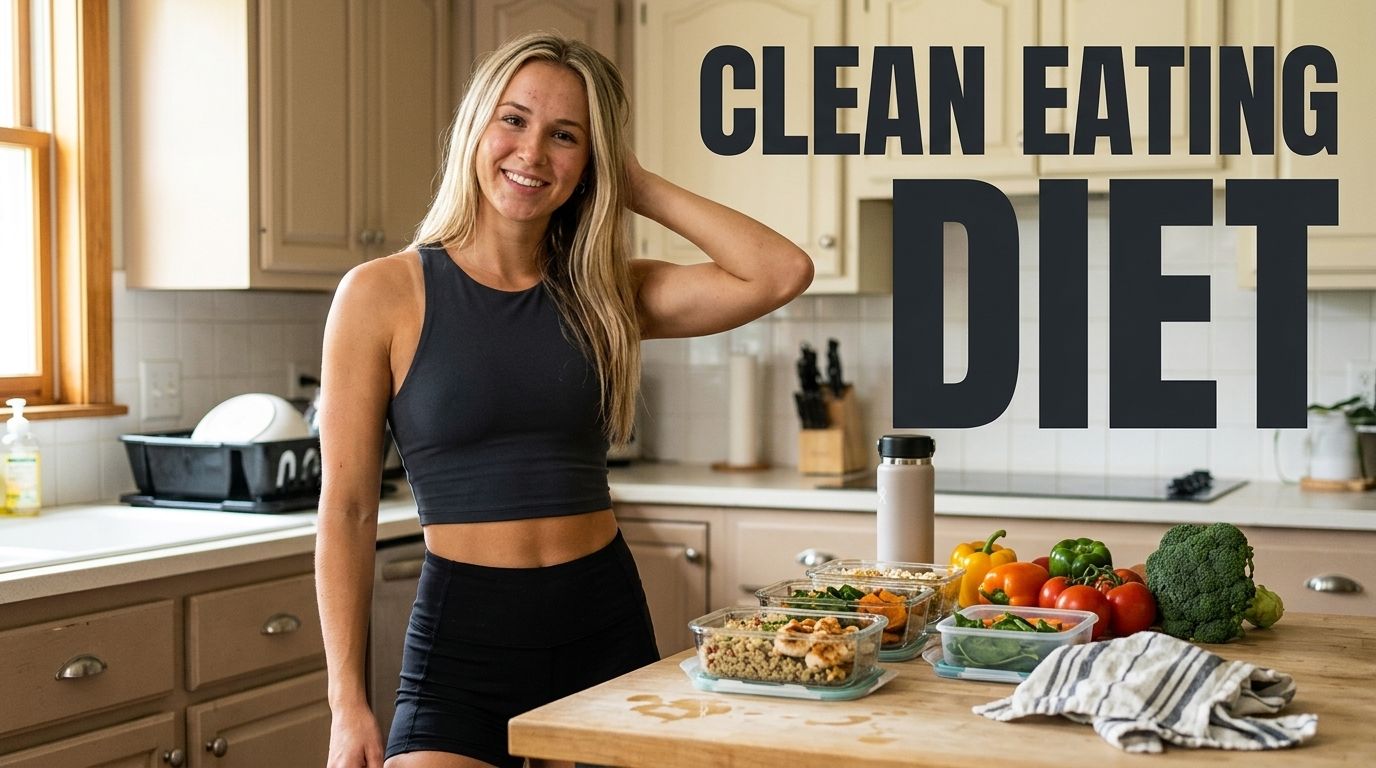
Clean eating is a dietary lifestyle focused on consuming whole, minimally processed foods — fruits, vegetables, lean proteins, whole grains, and healthy fats — while avoiding artificial additives, added sugars, and ultra-processed items. No food groups are restricted; food quality is the only rule.
The approach supports weight loss by replacing calorie-dense processed foods with fiber- and protein-rich whole foods that reduce hunger naturally. Research links whole grain consumption to a 5% lower mortality risk per daily serving and produce intake above 569g (20 oz) per day to a 10% reduction in mortality risk. Clean eating also prevents cardiovascular disease, type 2 diabetes, and cancer through its emphasis on anti-inflammatory, nutrient-dense foods.
This guide covers what clean eating means in practice, what foods to eat and avoid, how to start and shop for it, where the risks lie including orthorexia nervosa, and how it compares to paleo, keto, and Whole30 — so the full picture is clear before committing to the approach.
What Is Clean Eating?
Clean eating is a dietary approach centered on consuming whole, minimally processed foods — fruits, vegetables, lean proteins, whole grains, and healthy fats — while avoiding added sugars, artificial additives, and ultra-processed items. It’s not a federally regulated term, so interpretation varies. But the core principle stays the same: food as close to its natural state as possible.
Here’s what sets clean eating apart from most other approaches. No food group is off-limits. Any food qualifies as long as it’s minimally processed and free of artificial chemicals, preservatives, and added sugars. That makes it far more flexible than keto, paleo, or Whole30.
The approach was made mainstream by health advocate Tosca Reno, whose Eat-Clean Diet centered on cutting anything artificial and eating grown-from-the-ground nutrients. The foundational rule: if it wouldn’t have existed in a kitchen a century ago, question whether it belongs in the diet today.
Is Clean Eating a Diet or a Lifestyle?
Clean eating is a lifestyle, not a diet — it does not cut food groups, restrict macronutrient ratios, or require pre-packaged meal replacements; the foundation is a permanent shift toward whole, natural foods eaten in their least processed form.
Unlike paleo or keto, clean eating allows all food groups as long as they’re minimally processed. Grains, legumes, dairy, and even occasional treats are permitted. The emphasis is on enjoying food in its most natural form — not eliminating categories. That’s a meaningful distinction.
And because it’s incremental by design, clean eating can be followed for life. Gradually replacing processed foods with whole alternatives supports long-term weight management and chronic disease prevention without the burnout that restrictive diets always produce eventually.
Where Did the Clean Eating Movement Come From?
Clean eating was popularized by health advocate Tosca Reno, who at age 40 transformed her body through the Eat-Clean Diet — a program built around minimally processed foods free of artificial ingredients, added chemicals, and preservatives.
The movement grew from a niche wellness concept into a mainstream eating style. Food companies adopted clean label marketing and wellness bloggers amplified the message across social media, significantly expanding both the reach and — unfortunately — the interpretation of the term.
And here is where it got complicated. Food companies now use phrases like food should be clean and don’t eat ingredients you can’t pronounce to sell products, tapping into safety fears. The result: a term that covers everything from genuinely nutritious eating to misleading packaging on processed junk food.
What Are the Principles of Clean Eating?
The core principles of clean eating are eating whole unprocessed foods, limiting added sugar below the American Heart Association’s guidelines of 6 teaspoons (25g) for women and 9 teaspoons (38g) for men per day, avoiding artificial additives, and reading ingredient labels before buying anything packaged.
The ingredient list rule is the most practical clean eating tool. Any ingredient that’s hard to pronounce, unrecognizable, or missing from a basic kitchen pantry signals the presence of chemical additives, artificial sweeteners, trans fats, or hidden sugars. If the ingredient list reads like a chemistry textbook, the food doesn’t qualify as clean.
Clean eating also includes choosing organic and local foods when possible, eating seasonally, hydrating with water rather than sweetened drinks, and cooking at home more frequently. Each of these reduces reliance on the packaged food supply and puts control back where it belongs — in the kitchen.
Clean Eating Core Principles:
- Eat whole, minimally processed foods as close to their natural state as possible
- Limit added sugar to no more than 6-9 teaspoons (25-38g) per day
- Avoid artificial colors, flavors, preservatives, and trans fats
- Read ingredient lists — shorter lists signal cleaner foods
- Choose organic and local produce when available
- Cook at home more frequently to control ingredients
- Hydrate with water, not sweetened drinks
What Foods Does Clean Eating Focus On?
Clean eating focuses on fresh fruits and vegetables, whole grains, lean proteins from fish, poultry, eggs, and beans, healthy fats from olive oil, avocado, and nuts, and full-fat dairy from quality sources — all consumed with minimal processing.
Seasonal, colorful vegetables are the cornerstone. Root vegetables in fall, summer produce in summer — variety across the season ensures broad micronutrient coverage including vitamin C, folate, and potassium. The more variety on the plate, the more complete the nutrient profile.
For protein, clean eating emphasizes fish, poultry, eggs, and beans while limiting red meat and processed meats like bacon and cold cuts. Processed meats carry higher sodium and saturated fat loads that conflict directly with clean eating’s cardiovascular and disease-prevention goals.
Clean Eating Food Examples:
- Vegetables: spinach, kale, broccoli, sweet potatoes, tomatoes, cucumbers
- Fruits: berries, apples, oranges, bananas, grapes
- Proteins: chicken, turkey, salmon, tuna, eggs, lentils, chickpeas
- Whole grains: oats, brown rice, quinoa, whole-wheat bread, whole grain pasta
- Healthy fats: olive oil, avocado, walnuts, almonds, chia seeds
- Dairy: plain Greek yogurt, hard cheese, milk (quality sourced)
What Foods Does Clean Eating Avoid?
Clean eating avoids ultra-processed foods, refined grains like white rice and white bread, added sugars, artificial colors and flavors, chemical preservatives, and trans fats — all concentrated in the packaged goods found in the middle aisles of the grocery store.
Hidden sugars are the most overlooked issue. Added sugars appear under dozens of different names on ingredient labels — corn syrup, dextrose, maltose, sucrose, cane sugar — across cereals, granola bars, flavored yogurts, and salad dressings that are marketed as healthy. Reading the full ingredient list is the only reliable way to find them.
Refined carbs are replaced with whole grain alternatives. White bread, white rice, and white pasta give way to whole-wheat bread, brown rice, and whole grain pasta. The swap preserves fiber and B vitamins removed during refining, and it supports blood sugar stability and sustained energy across the day.
What Are the Benefits of Clean Eating?
Clean eating delivers three primary benefits: it supports natural weight management by reducing calorie density and increasing fiber and protein intake; it prevents chronic diseases including type 2 diabetes, high blood pressure, obesity, and cardiovascular disease; and it is linked to measurably longer lifespan through whole grain and produce consumption.
The longevity numbers are worth knowing. Each additional 28g (1 oz) serving of whole grains per day is linked to a 5% lower risk of dying from any cause, according to a JAMA Internal Medicine report. Research in the American Journal of Epidemiology found that increasing produce intake above 569g (approximately 20 oz) per day reduces mortality risk by 10%.
And the daily benefits compound quickly. More energy, better sleep, stronger immunity, and improved mental clarity are consistently reported when people transition from a processed-food diet to whole-food eating. The micronutrient density of whole foods supports every major body system simultaneously. Our nutritionists at Eat Proteins see this consistently with clients who make even gradual shifts toward clean eating.
Does Clean Eating Help with Weight Loss?
Yes. Clean eating promotes weight loss by replacing calorie-dense processed foods with nutrient-dense whole foods that are naturally higher in fiber and protein, reducing total calorie intake without requiring calorie counting or active restriction.
Here’s why it works. A clean eating plan providing at least 55 grams of protein and 32 grams of fiber per day promotes satiety, reduces overeating, and supports body composition alongside weight loss. Both protein and fiber extend fullness between meals, naturally limiting excess intake without deliberate effort.
Clean eating is also more sustainable than fad diets. It does not deprive, restrict food groups, or require unrealistic calorie deficits. Weight loss happens as a natural consequence of replacing high-calorie, low-nutrient processed foods with whole-food alternatives that satisfy the body more completely. Get a proven weight loss plan built on these exact clean eating principles.
Can Clean Eating Prevent Disease?
Yes. Clean eating supports prevention of cardiovascular disease by limiting sodium and saturated fat from processed foods and increasing omega-3 intake from fish, olive oil, and nuts — all directly linked to reduced heart disease and blood pressure risk.
Limiting added sugars and refined carbs helps regulate blood glucose and insulin levels over time. This reduces type 2 diabetes risk substantially. The American Heart Association’s sugar target — no more than 6 teaspoons (25g) for women and 9 teaspoons (38g) for men — serves as the practical clean eating benchmark for sugar intake.
Increased whole grain and produce consumption, central to clean eating, is also linked to reduced cancer risk. Fiber, antioxidants, and phytonutrients abundant in vegetables and fruits interfere with cancer cell development through multiple biological pathways confirmed in clinical research.
How Do You Start a Clean Eating Plan?
Starting clean eating begins with auditing the pantry for unpronounceable ingredients, replacing refined grains with whole grain alternatives, swapping sugary drinks for water, and cooking at home more frequently instead of relying on packaged convenience foods.
Weekly meal prep makes the difference. Spending 10-15 minutes cooking proteins like chicken or beef and prepping vegetables once a week puts clean eating options immediately available when hunger hits. Pre-prepared food removes the convenience advantage that processed food currently holds. That shift alone changes the default choice.
The most sustainable start is incremental. Replacing one processed food at a time — rather than overhauling the entire diet at once — reduces overwhelm and prevents the all-or-nothing abandonment that derails most dietary changes. One cleaner swap per week compounds into a fundamentally different diet within months.
How Do You Shop for Clean Eating?
Shopping for clean eating means focusing on the perimeter of the grocery store — produce, dairy, meat, and seafood departments — where fresh, preservative-free whole foods are concentrated, and avoiding the middle aisles where packaged goods with additive-heavy labels dominate.
Buying local and organic when possible reduces pesticide exposure. The Environmental Working Group’s Dirty Dozen list identifies the produce with the highest pesticide residues — strawberries and spinach are consistent entries — for priority organic purchase. Local buying also supports sustainable farming and typically means fresher food.
When fresh is unavailable or too expensive, canned or frozen foods with minimal added ingredients are perfectly acceptable clean eating choices. Frozen vegetables retain most of their nutrients and cost less than fresh. The single check: look at the ingredient label. No added sugar, minimal sodium, no preservatives.
How Do You Read Labels for Clean Eating?
Label reading for clean eating starts with the ingredient list: shorter lists signal cleaner foods, and any ingredient that is hard to pronounce, unrecognizable, or absent from a basic kitchen is a clear signal the product contains chemical additives, artificial sweeteners, or hidden sugars.
Added sugars appear under at least 60 different names — corn syrup, dextrose, maltose, sucrose, cane sugar among them — across cereals, sauces, and snack bars marketed as healthy. Scanning past the front-of-pack claims and reading the full ingredient list is the only reliable way to find them.
And don’t stop at ingredients. Check the serving size before eating anything. Organic or GMO-free labeling does not make junk food clean. A clean product is determined by ingredient quality alone — not by marketing claims, certifications, or price point.
How to Read a Clean Eating Label:
- Check the ingredient list first — shorter means cleaner
- Look for unpronounceable chemical names and reject them
- Scan for hidden sugar names: corn syrup, dextrose, maltose, sucrose, cane sugar
- Check sodium — processed foods often hide excess salt
- Verify the serving size before evaluating any nutrition numbers
- Ignore front-of-pack claims like organic, natural, or GMO-free as the sole measure of cleanliness
What Are the Risks of Clean Eating?
The primary risks of clean eating are orthorexia nervosa — an obsessive fixation on correct eating that causes anxiety, social avoidance, and functional impairment — and nutrient deficiencies that develop when extreme versions eliminate entire food groups like grains, dairy, or legumes.
Research on college students found that clean eating produced emotional distress — negative emotions when unable to follow the diet — and functional impairment including rigid eating schedules that interfered with school and social activities. A diet approach that generates distress works against health, not for it.
Extreme versions banning grains, dairy, or legumes are not supported by nutritional research. These eliminations remove calcium, B vitamins, fiber, and prebiotic compounds essential for gut health and bone density. The evidence base for clean eating supports inclusion of these food groups in minimally processed forms — not their removal.
Can Clean Eating Lead to Disordered Eating?
Yes, in extreme forms. Clean eating becomes disordered when increased anxiety around food, avoidance of social situations involving eating, or preoccupation with food quality begins to interfere with daily functioning — these are warning signs of orthorexia nervosa requiring professional support.
When clean eating becomes an identity rather than a practice — amplified by wellness bloggers and celebrities with no nutrition credentials making unsubstantiated health claims — it escalates. The line between health-conscious eating and obsessive restriction requires honest self-monitoring. If the diet is creating more stress than it relieves, that’s the signal to seek professional guidance.
What Happens When Clean Eating Goes Too Far?
Extreme clean eating that eliminates entire food groups like grains, dairy, or legumes removes fiber, calcium, B vitamins, and prebiotic compounds — creating nutrient deficiencies that have no evidence base and directly contradict the original clean eating framework.
The clean versus dirty food framing is itself the problem. Labeling foods as toxic, dirty, or dangerous creates a binary moral framework not supported by nutrition science. Even organic agriculture uses pesticides. Even processed foods occupy a nutritional spectrum. The evidence-based position is nuance — not absolutism.
How Does Clean Eating Compare to Other Diets?
Clean eating is less restrictive than paleo, keto, and Whole30 because it allows all food groups as long as they are minimally processed — it does not restrict carbohydrates, eliminate grains or legumes, or require a time-limited elimination protocol.
Paleo eliminates grains and legumes based on ancestral eating theory. Clean eating does not restrict food groups at all — whole grains, legumes, and dairy are all acceptable in their minimally processed forms. The distinction is processing level, not food category. That’s a meaningfully different framework.
Clean eating is more flexible than keto, too. Keto caps carbs at under 50 grams (1.8 oz) per day to induce ketosis. Clean eating does not target macros at all. Food quality across all macronutrient categories is the sole criterion — carbs from whole grains and vegetables are not only allowed but encouraged.
Clean Eating vs. Other Diets:
| Approach | Food Groups Eliminated | Macro Rules | Time Limit | Processing Rule |
| Clean Eating | None | None | None — indefinite | Minimize ultra-processed |
| Paleo | Grains, legumes, dairy | None | None | Whole foods preferred |
| Keto | High-carb foods | Under 50g (1.8 oz) carbs/day | None | Not a core rule |
| Whole30 | Grains, dairy, legumes, sugar, alcohol | None | 30 days | Whole foods required |
How Is Clean Eating Different from Paleo or Keto?
Clean eating allows any food — including whole grains, legumes, and dairy — as long as it is minimally processed and free of artificial additives, while both paleo and keto apply elimination rules that restrict entire food groups or macronutrient categories regardless of processing level.
Whole30 is a 30-day elimination protocol with a defined end date and strict rules. Clean eating has no time limit and no elimination rules. It’s a permanent dietary orientation, not a reset program. The 30-day framing makes Whole30 a sprint; clean eating is the sustainable, lifelong version of the same underlying principle.
What Are Common Mistakes with Clean Eating?
The three most common clean eating mistakes are assuming organic or GMO-free labels make junk food acceptable, adopting an all-or-nothing mindset that treats any processed food as a failure, and eliminating entire food groups like grains or dairy without medical justification.
Organic labeling is not a clean eating pass. The certification covers pesticide use in farming — not the added sugar, artificial flavors, or processing level of the finished product. An organic cookie is still a cookie. Ingredient quality is the only reliable clean eating measure, full stop.
And dropping the all-or-nothing mindset is the single biggest practical shift. The 80/20 approach — mostly clean, with occasional flexibility — is more sustainable and nutritionally complete than any rigid elimination version of clean eating. Perfection is not the goal. Progress is.
Should You Avoid All Processed Foods on Clean Eating?
No. Clean eating targets ultra-processed foods with long, additive-heavy ingredient lists — not all processed foods; whole grain crackers, pasteurized milk, frozen vegetables, and canned beans are processed but retain their nutritional value and are perfectly acceptable clean eating choices.
Minimally processed foods with short, recognizable ingredient lists are fully compatible with clean eating. Frozen fruit, canned beans with no added salt, and whole-grain bread are processed but preserve nutrient density. The judgment is based on ingredient quality and processing level — not on whether any processing happened at all.
Want Your Free 7-Day Clean Eating Meal Plan from Eat Proteins?
You have the principles. Now you need the plan. The Eat Proteins nutritionist team built a free 7-day clean eating meal plan — whole grains, lean proteins, fresh produce, and healthy fats organized into practical daily meals for real schedules and real lives.
No elimination rules. No macro counting. No complexity. Just clean whole-food meals that actually work — and the structure our coaches at Eat Proteins designed to make the transition from processed foods as frictionless as possible. Get it sent straight to your inbox.