
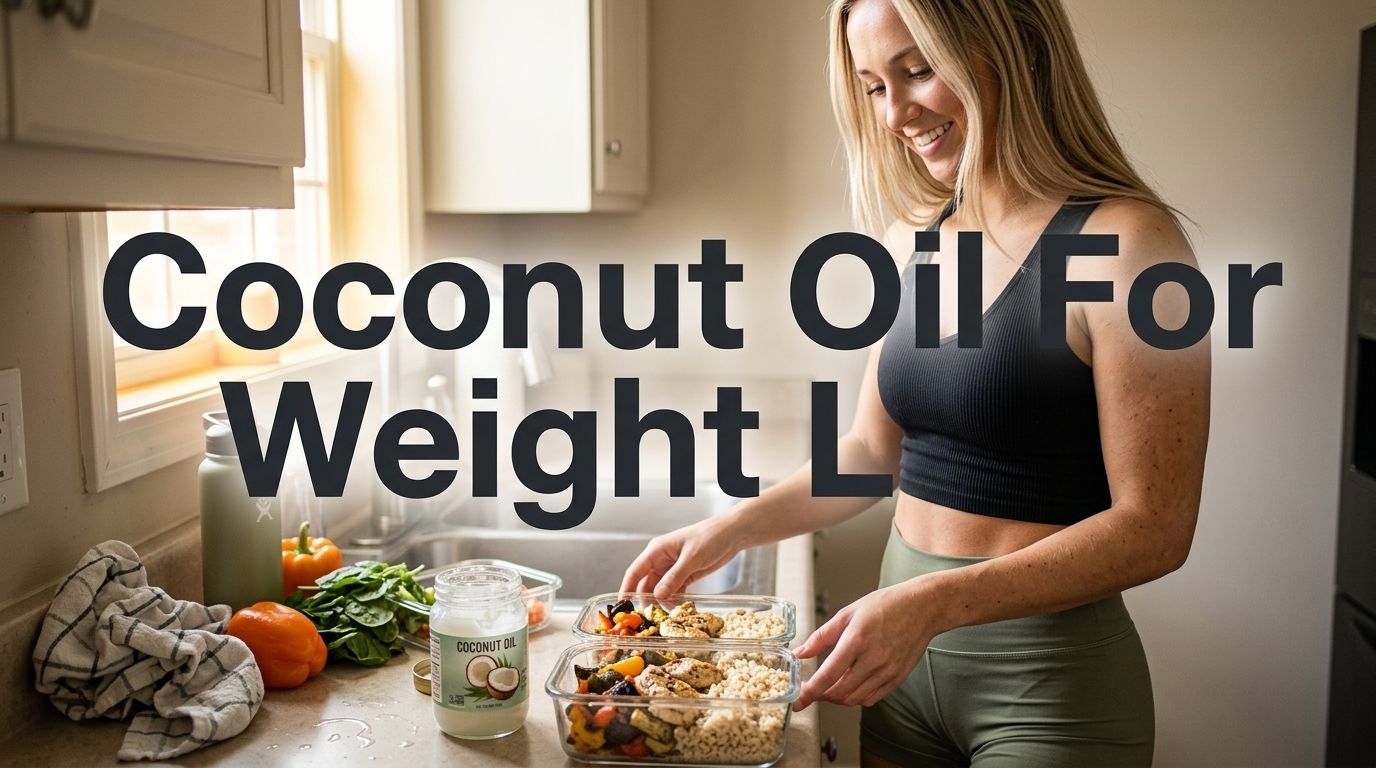
Coconut oil is a plant-based fat from the coconut palm, composed of nearly 100 percent fat, with saturated fat making up the majority. It contains medium-chain triglycerides (MCTs), a class of fats proposed to support weight loss through faster metabolism and reduced hunger.
Research on coconut oil and weight loss is mixed. Studies using pure MCT oil show promising metabolic effects, but coconut oil contains only 15 percent true MCTs. Placebo-controlled trials have found no significant fat-loss benefit from coconut oil itself. One tablespoon provides 117 calories and 11.6 grams of saturated fat, which is more than half the daily recommended limit.
This guide covers what the science actually shows about coconut oil for weight loss, how it compares to MCT oil, how much to use daily, who should be cautious, and how to build it into a plan that works. Expect clear answers backed by clinical research.
What Is Coconut Oil?
Coconut oil is a plant-based fat extracted from the dried flesh of the coconut palm, composed of nearly 100 percent fat, with 82 to 92 percent of that total classified as saturated fat. Unlike most liquid vegetable oils, it’s solid at room temperature and resembles vegetable shortening in texture. It’s used in cooking, baking, skincare, and as a dietary supplement.
What Nutrients Does Coconut Oil Contain?
Coconut oil contains no cholesterol or fiber, and delivers significant saturated fatty acids including lauric acid, capric acid, and caprylic acid, with no protein or meaningful vitamins. Lauric acid accounts for roughly 50 percent of the total fat content. Capric and caprylic acids are present in smaller portions and are classified as medium-chain triglycerides (MCTs).
Here’s what that means practically. Coconut oil’s caloric value comes entirely from fat. All three of these fatty acids behave differently in the body, and that distinction matters a lot when evaluating weight-loss claims about coconut oil.
Fatty Acid Breakdown in Coconut Oil:
- Lauric acid (C12): approximately 50 percent of total fat
- Capric acid (C10): smaller portion, classified as MCT
- Caprylic acid (C8): smaller portion, classified as MCT
- Total true MCT content: approximately 15 percent
How Many Calories Are in Coconut Oil?
Coconut oil contains 117 calories per tablespoon (14 grams), with 13.9 grams of total fat and 11.6 grams of saturated fat per single serving. That one tablespoon delivers about 105 calories from saturated fat alone. Based on a 2,000-calorie diet, the American Heart Association sets the daily saturated fat limit at 200 calories total.
So a single tablespoon of coconut oil covers more than half that daily limit. Add coconut oil without cutting other fats, and total calorie and saturated fat intake rises quickly. That’s the part most people miss when adding it to their routine.
Does Coconut Oil Help with Weight Loss?
Coconut oil is widely promoted for weight loss due to its MCT content, but clinical evidence remains mixed and inconclusive, with no placebo-controlled trial confirming a fat-loss benefit specific to coconut oil. Proponents base their claims on studies of pure MCT oil. Coconut oil contains some MCTs, but it’s not the same product, and the research doesn’t transfer cleanly.
What Does the Research Say About Coconut Oil and Fat Loss?
Research on coconut oil and weight loss has produced inconsistent results across every major trial design attempted, from open-label studies to randomized controlled trials. A 2011 study gave 20 people two tablespoons per day for one month. Men showed a possible waist reduction. But the study was open-label with no control group, making results inconclusive.
A 2015 study enrolled about 100 men and women, giving one tablespoon of coconut oil daily for three months. The group lost nearly one inch (2.5 centimeters) off their waist compared to a control group. The problem? The control group received nothing, not a placebo, and the coconut oil group was also encouraged to eat more fruit.
A 2017 placebo-controlled trial found no significant changes in weight, waist, hip, or body fat. A 2020 randomized controlled trial by Vogel et al., published in Food and Function, confirmed no difference in body weight or waist circumference between a coconut oil group and a soybean oil group over 45 days on an isoenergetic diet.
Summary of Key Coconut Oil Weight Loss Trials:
| Study | Design | Result |
|---|---|---|
| 2011 open-label | No control group | Inconclusive |
| 2015 controlled | No placebo in control | Inconclusive |
| 2017 placebo-controlled | Randomized | No benefit found |
| Vogel 2020 RCT | Randomized, 45 days | No weight difference |
Can Coconut Oil Reduce Belly Fat?
Coconut oil has not been confirmed to specifically reduce abdominal fat in any placebo-controlled research, according to physician and educator Michael Greger, MD. No study has shown that coconut oil targets belly fat. The 2017 placebo-controlled trial found no significant reduction in abdominal fat compared to placebo. Harvard T.H. Chan School of Public Health and Brigham and Women’s Hospital both confirm this.
Short answer: the evidence isn’t there. Further research is needed before any firm conclusion can be drawn. Eating coconut oil in moderation is reasonable, but it’s not a belly-fat solution on its own.
Why Might Coconut Oil Support Weight Loss?
The MCTs in coconut oil are metabolized differently from long-chain fats, which is the core mechanism proposed for any potential weight-related benefit from coconut oil consumption. The body transports MCTs directly to the liver, bypassing the lymphatic system entirely. This faster processing is what drives theories about increased calorie burning and fat oxidation.
Does Coconut Oil Boost Metabolism?
MCTs in coconut oil may increase the number of calories the body burns because their shorter carbon chains allow the liver to oxidize them more rapidly than long-chain fatty acids. A 2023 study found that MCT supplementation during a low-calorie ketogenic diet significantly decreased body weight, BMI, and waist circumference. That research used concentrated MCT supplements, not standard coconut oil.
And here is the kicker. Coconut oil contains only about 15 percent true MCTs. Approximately 50 percent is lauric acid, which has 12 carbon atoms and metabolizes more slowly than capric or caprylic acid. Lauric acid sits between a medium-chain and long-chain fatty acid. That structural difference limits how much MCT research applies to coconut oil specifically.
Does Coconut Oil Reduce Hunger?
MCTs may reduce food intake by producing ketones, which suppress appetite and increase satiety signals in the brain, but coconut oil does not reliably replicate this effect. A 2017 study confirmed that coconut oil is less filling than pure MCT oil. Evidence does not support coconut oil as having the same appetite-suppression effect as concentrated MCT supplements.
One study found that participants who ate ice cream with higher coconut oil content ate less dinner. The bad news? They consumed more calories from snacks later that evening, which fully offset the earlier reduction. No net calorie reduction occurred.
How Do You Use Coconut Oil for Weight Loss?
Coconut oil produces the best results for weight management as part of a balanced diet rich in fish and fresh produce, not as a standalone supplement added to an otherwise unchanged eating pattern. This means it works when it replaces less healthy fats, not when it’s layered on top of existing intake. That distinction changes everything.
How Much Coconut Oil Should You Eat Per Day?
Health guidelines recommend limiting coconut oil to no more than two tablespoons (28 grams) per day, since a single tablespoon already provides 11.6 grams of saturated fat toward a daily limit of roughly 22 grams on a 2,000-calorie diet. Two tablespoons delivers 234 calories and 23 grams of saturated fat. That leaves virtually no room for other saturated fat sources like butter, cheese, or meat.
The practical approach is to use coconut oil as a swap, not an add-on. Replace butter in cooking. Use it instead of vegetable shortening in baking. That way, the calorie and saturated fat totals stay within range rather than climbing past the daily target.
What Are the Best Ways to Eat Coconut Oil?
Coconut oil can be incorporated into the diet through high-heat cooking, baking, blending into beverages, or spreading in place of butter and mayonnaise, with each method offering practical benefits. It performs well in stir-fries and roasting because its saturated fat structure stays stable at high temperatures. This makes it more versatile than MCT oil, which breaks down under heat.
Adding one teaspoon to morning coffee or tea provides quick energy and may curb early hunger. Using it in baking produces flaky crusts and crispy results. Mixing into smoothies or drizzling over roasted vegetables are simple daily additions that keep portion sizes in check.
Ways to Add Coconut Oil to Your Diet:
- Use it for cooking stir-fries, sautés, and pan-frying at high heat
- Replace butter or vegetable shortening in baked goods
- Stir one teaspoon into coffee, tea, or a protein shake
- Use it as a spread on toast in place of butter or margarine
- Mix into salad dressings or drizzle over roasted vegetables
How Does Coconut Oil Compare to MCT Oil?
Coconut oil contains approximately 15 percent true medium-chain triglycerides, while pure MCT oil is composed of 65 percent or more MCTs, making them significantly different products with distinct metabolic effects. Weight-loss claims about coconut oil frequently rely on MCT oil research. The two are not interchangeable, and the distinction matters before making dietary decisions based on those claims.
Is MCT Oil More Effective Than Coconut Oil for Fat Loss?
MCT oil delivers a higher concentration of the specific medium-chain fatty acids linked to increased calorie burning and reduced appetite compared to standard coconut oil, making it the stronger option for those targeting metabolic effects. A 2017 study confirmed that coconut oil is less filling than pure MCT oil. Research on MCT oil’s weight-loss potential shows more consistent results than equivalent research on coconut oil.
By comparison, coconut oil wins on culinary versatility. MCT oil has a low smoke point and cannot replace cooking fats in high-heat applications. For everyday cooking, coconut oil is the better choice. Those specifically targeting fat metabolism may benefit from adding MCT oil as a supplement rather than expecting coconut oil to deliver the same effect.
Coconut Oil vs. MCT Oil Comparison:
| Feature | Coconut Oil | MCT Oil |
|---|---|---|
| True MCT content | Approx. 15 percent | 65 percent or more |
| Smoke point | High (suitable for cooking) | Low (not for high heat) |
| Satiety effect | Moderate | Stronger |
| Weight-loss evidence | Inconclusive | More consistent |
| Best use | Cooking and baking | Supplemental addition |
What Are the Risks of Using Coconut Oil for Weight Loss?
Coconut oil is high in saturated fat, which the American Heart Association and U.S. Dietary Guidelines link to increased LDL cholesterol levels and elevated cardiovascular risk when consumed in excess. One tablespoon contains 11 grams of saturated fat. That’s not a small amount when the daily limit for a 2,000-calorie diet is approximately 22 grams from all sources combined.
Is Coconut Oil Safe for Heart Health?
Coconut oil raises both LDL and HDL cholesterol levels, creating a mixed cardiovascular risk profile that differs from the effects of unsaturated liquid plant oils. The 2020 Vogel RCT found coconut oil increased HDL cholesterol and improved the total cholesterol to HDL ratio compared to soybean oil. But the American Heart Association still advises replacing coconut oil with olive oil or canola oil for heart health.
This is important. Raising HDL is a positive signal. Simultaneously raising LDL is not. Unsaturated fats found in olive oil, nuts, seeds, and avocados lower LDL without raising it. For most people watching cardiovascular risk, unsaturated fat sources remain the stronger long-term choice.
Ready to speed things up with a plan built around the right fats? Get a proven weight loss plan built around these exact dietary principles.
Who Should Avoid Coconut Oil?
People with elevated LDL cholesterol, existing cardiovascular disease, or a history of heart attack should use coconut oil with caution and consult a physician before adding it to a weight-loss plan. The saturated fat in coconut oil behaves similarly to animal fats like butter and lard in terms of LDL cholesterol effects. Those managing cardiovascular risk factors benefit more from switching to unsaturated fat sources.
Also worth noting: coconut oil is calorie-dense at 117 calories per tablespoon. Adding it without reducing other calories causes weight gain rather than weight loss. That’s not a theoretical risk. It’s math.
Who Should Limit Coconut Oil Intake:
- People with high LDL cholesterol or heart disease history
- Those on a calorie-restricted diet without accounting for fat additions
- People already consuming high amounts of other saturated fat sources
- Anyone not tracking total daily saturated fat against the 10 percent guideline
Want Your Free Coconut Oil Weight Loss Plan from Eat Proteins?
You’ve got the science. Now you need the plan. Research is clear: coconut oil works only inside a structured, calorie-controlled approach. Our nutritionists at Eat Proteins built a free guide showing you exactly how to balance healthy fats and reach your weight goals without guesswork.
How Does the Eat Proteins Free Plan Help You Lose Weight?
The Eat Proteins free plan provides a structured daily nutrition framework built around the dietary principles that weight-loss research consistently supports: calorie control, whole food emphasis, and strategic fat intake management. The plan tells you which fats to prioritize, how to portion coconut oil without exceeding your saturated fat budget, and how to structure meals for sustainable results.
Don’t leave this page without getting it. Our coaches at Eat Proteins have worked with thousands of people making exactly the dietary changes you’re researching. The difference between results and frustration is almost always the plan.