
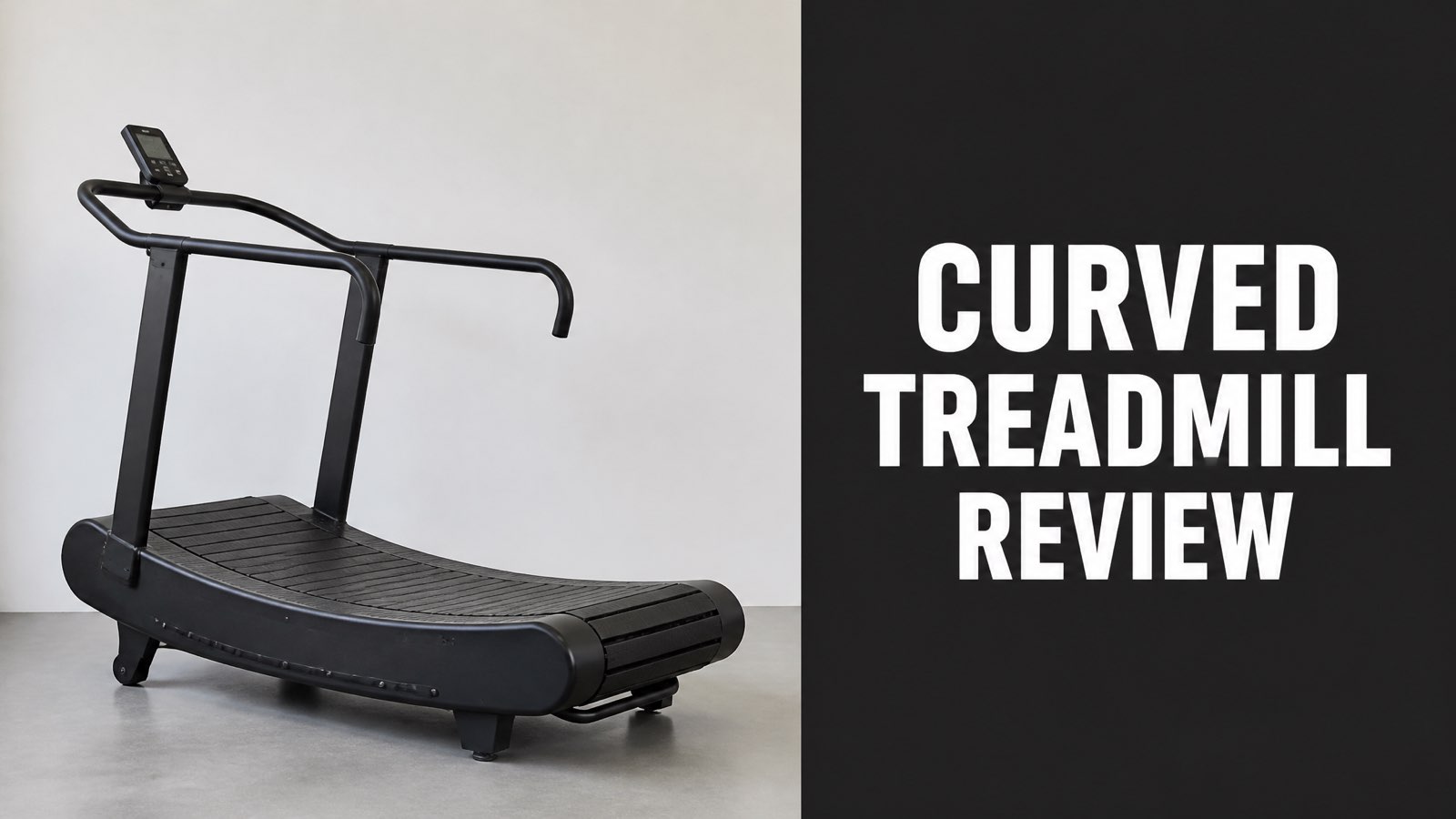
A curved treadmill is a motorless running machine with a concave slat belt that the runner drives with each stride. Brands like TrueForm, Assault Fitness, SB Fitness and Sole sell them for home gyms. Quality models cost about $1,500 to $7,000. Most do not fold and need no outlet.
A curved treadmill turns foot strikes into belt motion. The design burns more energy than a flat motorized belt and cushions each landing. Reviewers praise the workout and the build, then flag size, noise and price. Models differ in belt size, weight capacity and warranty. Four simple checks decide the right buy. Eat Proteins sorted the facts first.
The biggest risks are a steep learning curve and a heavy, loud frame. Hard-training buyers get strong value from the durability and low upkeep. Read on to learn how these machines work, what they cost and where to buy one with confidence. Our experts at Eat Proteins answer the common questions below.
What Is a Curved Treadmill?
A curved treadmill is a self-powered running machine with a concave slat belt that moves with your stride. The deck bows like a smile. No motor drives the belt, so the machine needs no electricity. The runner sets the speed, and the top speed has no cap at all. Many models also skip the fold-up frame. Reviewers call the format a different training tool.
In plain English: you are the engine. The belt moves only when your feet push it back. Stop pushing and the belt stops. Woodway built the first non-motorized treadmill in 1974, and many brands now sell their own curved designs.
Core Traits:
- Concave slat belt
- No motor and no power cord
- Speed set by the runner
- Fixed frame on most models
Is a Curved Treadmill Motorized?
No. A curved treadmill has no motor at all. Your leg drive moves the slats around the curve. Many displays run on batteries and track speed, time, distance and calories. Bluetooth and ANT+ pair heart rate monitors on several models. The power cord never enters the picture, so the machine works in any corner of the room. Assembly is the only real chore.
Here’s the thing: no motor means no motor failure. Does that cut upkeep? Yes. Reviewers say the SB Fitness CT400 needs no belt lubrication and no motor service. Fewer moving parts mean fewer repair bills.
How Does a Curved Treadmill Work?
A curved treadmill works by turning your foot strike into belt motion. You step onto the curve, and a firm push sends the slats sliding back. Each stride keeps the belt moving around the frame. Faster legs mean a faster belt. A slower stride lets the belt coast to a stop. The curve and the slats do the rest. The result is a workout that matches your effort.
Think of it this way: the belt follows your effort. Is that hard at first? Yes. Your glutes and hamstrings must drive the belt, so form matters from the first step. Runners who slouch feel the belt stall.
How the Belt Moves:
- Step onto the lower front section of the belt.
- Push back with one foot to start the slats moving.
- Stand tall and drive with the glutes and hamstrings.
- Quicken the stride to raise the belt speed.
- Slow the legs to let the belt coast to a stop.
Why Does the Belt Curve?
The concave shape replaces a motor with the runner’s own leg drive. The curve engages the glutes and hamstrings in ways flat belts don’t. The deck also rewards an upright posture. Reviewers say the design trains a more natural stride than a flat deck. Poor form stalls the belt, so runners learn quickly. Runners adjust quickly or the belt slows down fast.
To be clear, curve depth differs by brand. The TrueForm Trainer has the subtlest curve of any manual treadmill, per its reviewers. One tester reported knee strain from the steeper pitch on another model. Does curve depth matter? Yes, it changes the feel.
What Are the Benefits of a Curved Treadmill?
A curved treadmill delivers a harder, lower-impact cardio session than a flat motorized belt. Runners burn more energy at the same pace. The slat belt absorbs shock. Sloppy form stalls the belt, so technique improves. Upkeep stays low because no motor needs service. Experts at BarBend note stronger glutes and hamstrings too. Gyms love the simple design.
The good news? One machine handles walks, jogs and sprints. Speed has no limit. Intervals feel natural. Why? The runner simply pushes harder. Trainers like the design for HIIT and sprint work.
Main Benefits:
- Higher calorie burn per minute
- Cushioned slat belt for lower impact
- Better running form
- No motor to repair
- Unlimited top speed
Does a Curved Treadmill Burn More Calories?
Yes. A curved treadmill raises the effort needed at any given pace. A study in the Journal of Science and Medicine in Sport found 32% higher oxygen use. Heart rate ran 16% higher than on a motorized belt at the same pace. Reviewers also cite up to 30% more calories burned. Runners also step faster, which raises the workload further. Step rate rises too.
Why does that happen? Runners move the belt themselves. Cadence also rose 2.5% in that study. TrueForm claims a 44 percent edge, but the maker supplies that number. In fact, the independent study is the safer anchor.
Is a Curved Treadmill Easier on the Knees?
Yes, for many runners. A curved treadmill cuts joint impact with a cushioned slat belt and a form-first stride. Heel striking on a hard flat belt stresses the knees. A curved belt punishes that habit by stalling. Some runners report less knee and shin pain after the switch. Shock-absorbing slats help here. Soft landings add up over many easy, steady miles.
Now, there’s a catch. Cushioning is not a guarantee. Is it safe for every body? Not automatically. A steep curve or a poor stride still strains joints, so beginners start with short, easy walks.
What Do Curved Treadmill Reviews Say?
Curved treadmill reviews praise the workout quality and build, then flag price and size. BarBend, Garage Gym Reviews and Jacked Gorilla all rank curved models highly for durability and calorie burn. Common complaints cover footprint, noise, weight and cost. The core concept earns steady praise from testers and owners alike. Verdicts stay consistent.
In fact, testers agree the first session feels odd. Does it get easier? Yes. Once form settles, the workout becomes as hard as the user wants. The learning curve is real, but it fades.
What Reviewers Report:
| Topic | Verdict |
|---|---|
| Workout intensity | Harder than flat belts |
| Joint comfort | Cushioned slats earn praise |
| Noise | Loud at sprint speeds on some models |
| Footprint | Large, and most do not fold |
| Price | $1,500 and up |
What Do Users Love?
Users love that a curved treadmill responds to effort and trains better form. One runner dropped her usual knee pain and shin splints. Others like a simple display with pace, distance and time. Walkers and sprinters both enjoy the unlimited top speed. Several owners also like the quick start with no programs to cycle through. Quick starts win many fans.
And here’s the best part: setup stays simple. Several five-star owners of one model cite easy assembly and a whisper-quiet tread. No programs and no cords. Users step on and go.
What Do Users Complain About?
The top complaints are size, weight, noise and price. The TrueForm Runner weighs 350 pounds (159 kg). The TrueForm Trainer weighs 280 pounds (127 kg), and one person struggles to assemble it. Sprinting on some models gets loud, and a few reviewers call the cost steep. Most curved models do not fold away either. Moving one takes at least two strong people.
Bottom line: the footprint is the common gripe. The CT400 is light at 165 pounds (75 kg) but spreads wide. Does a big base matter? In a small room, yes. Measure first.
How Do Curved Treadmills Compare?
Curved treadmills differ mainly in belt size, weight capacity, resistance and warranty. The Sole C80, SB Fitness CT400 and CT700, AssaultRunner Pro and Sunny Health SF-X7110 each trade one strength for another. Buyers match the spec to the goal, then check the price. The table below lays out the numbers. Warranty terms range from three years to a lifetime.
Model Comparison:
| Model | Belt Size | Weight Capacity | Frame Warranty |
|---|---|---|---|
| Sole C80 | 62 x 19 in (157 x 48 cm) | 330 lb (150 kg) | Lifetime |
| SB Fitness CT400 | 66.6 x 17 in (169 x 43 cm) | 375 lb (170 kg) | 10 years |
| SB Fitness CT700 | 66.6 x 19 in (169 x 48 cm) | 475 lb (215 kg) | 10 years |
| AssaultRunner Pro | 62 x 17 in (157 x 43 cm) | 350 lb (159 kg) | 5 years |
| Sunny Health SF-X7110 | 59 x 17.7 in (150 x 45 cm) | 330 lb (150 kg) | 3 years |
To put it simply: the CT700 wins on capacity and width. The Sole C80 wins on warranty with lifetime frame cover. The CT400 wins on entry price. Each pick fits a different buyer.
Which Is Better: Curved or Motorized?
A curved treadmill wins on effort, form and upkeep, while a motorized treadmill wins on space, features and comfort. Curved machines burn more energy and skip motor repairs. Motorized machines fold, run quietly and hold a steady pace. Training goals decide the winner. Garage Gym Reviews tests both types on their own merits. Each type has real strengths.
Here’s the kicker: one reviewer pegs a motorized treadmill with incline at $1,000 to $1,500. Does a curved machine justify double or triple that price? For sprint training, yes. For casual walking, no.
What Are the Risks of a Curved Treadmill?
The main risks of a curved treadmill are a steep learning curve, joint strain and a loud, heavy frame. Beginners often feel unsteady on the belt. Early sessions also tire users beyond the actual workload. Safety improves with practice. Low upkeep does not mean zero risk. Reviewers warn that the first sessions feel foreign to most users. Practice helps.
Let me explain: the belt moves only when pushed, so a stalled stride feels abrupt. Does that raise fall risk? Early on, yes. New users hold the rails and keep strides short until the rhythm clicks.
Common Drawbacks:
- Steep learning curve
- Large footprint
- Heavy frame
- Loud at sprint speeds
- High upfront cost
- Thin slats built for intervals, not long runs, on some models
Who Should Avoid a Curved Treadmill?
Anyone who needs a quiet, compact or foldable machine fits a motorized treadmill better. Most curved models do not fold. Apartment dwellers with thin floors hear the slats. Runners chasing steady long miles may prefer a flat belt. Anyone with an injury needs a doctor’s clearance first. Reviewers also flag a large footprint. Heavy frames add to the hassle.
Short answer: beginners can still use one. Walkers do well on gentler curves like the TrueForm Trainer. Who truly needs to skip it? Anyone who can’t place a 280-pound (127 kg) frame, or who wants a preset speed.
How Much Does a Curved Treadmill Cost?
A curved treadmill costs about $1,500 to $7,000 depending on build quality and brand. Reviewers call $1,500 the floor for a quality model. Heavy-duty machines built for longevity run $4,000 to $7,000. Prices rise with weight capacity, warranty and console features. Sales shift the numbers often. Delivery fees add to the total. Delivery fees can add more.
Reported Prices:
| Model | Reported Price |
|---|---|
| SB Fitness CT400 | $1,795 |
| AssaultRunner Pro Classic | $2,799 |
| AssaultRunner Pro | $3,499 |
| AssaultRunner Elite | $3,999 |
| TrueForm Runner | $6,149 |
The reason is simple: slat belts, steel frames and long warranties cost money. Delivery adds more. Sole charges $200 for room-of-choice delivery, or $350 with assembly. Is shipping included? Some brands include it, like the Grit Runner at about $2,500.
Is a Curved Treadmill Worth the Price?
Yes, for buyers who train hard. A curved treadmill pays back through durability, low upkeep and a tougher workout per minute. Warranties back the claim. The AssaultRunner Elite carries a lifetime belt warranty and a 10-year frame warranty. The CT400 offers a 10-year frame warranty for less. Fewer repairs lower the long-term cost. Fewer repairs help.
But for casual walkers, no. A basic motorized machine costs far less. Does value depend on use? Absolutely. Sprinters and HIIT fans get the most from a premium model.
Where Can You Buy a Curved Treadmill?
Buyers can purchase a curved treadmill from brand sites, Amazon and specialty gym retailers. TrueForm sells direct. The Rogue | Woodway Curve LTG sells exclusively at Rogue Fitness. SB Fitness models appear on Amazon. Stock changes often, so confirm availability before planning delivery. Direct sales often include delivery. Prices vary by seller, so compare.
Now here is the thing: delivery matters as much as price. Curved models weigh from 165 to 415 pounds (75 to 188 kg). Does the seller deliver to the room? Confirm that before checkout.
What Should You Check Before Buying?
Four checks decide the right curved treadmill: space, capacity, belt size and warranty. The TrueForm Trainer needs 64 by 31 inches (163 by 79 cm) of floor. Garage Gym Reviews wants a deck of at least 55 by 18 inches (140 by 46 cm). Weight limits vary widely. The TrueForm Runner holds 450 pounds (204 kg) while running. Brands publish these limits online.
Buying Checklist:
- Measure the floor space for the full in-use footprint.
- Check the weight capacity against the heaviest user.
- Compare belt length and width to your stride.
- Confirm warranty terms for frame, belt and labor.
- Confirm delivery and assembly options before paying.
Why Should You Try Eat Proteins?
Eat Proteins gives you honest, research-backed reviews for gear and nutrition that support hard training. Our team at Eat Proteins reads the research and weighs the claims. You get clear verdicts without hype. A curved treadmill covers half the plan. Recovery and fuel decide the rest. Join the readers who train smarter. Join the readers who train smarter.
Ready to train smarter? Browse more Eat Proteins reviews today and fuel every sprint you earn.
How Does Eat Proteins Support Your Training?
Eat Proteins pairs gear reviews with protein guidance for recovery. Hard intervals on a curved treadmill stress the legs. Protein supports muscle repair after those sessions. Our experts break down products so you pick what fits your goals. Don’t leave your results to chance. Fuel the work you put in. Fuel the work you put in. Read on. Fuel your effort.
Start with one Eat Proteins review. Your next workout will thank you.