
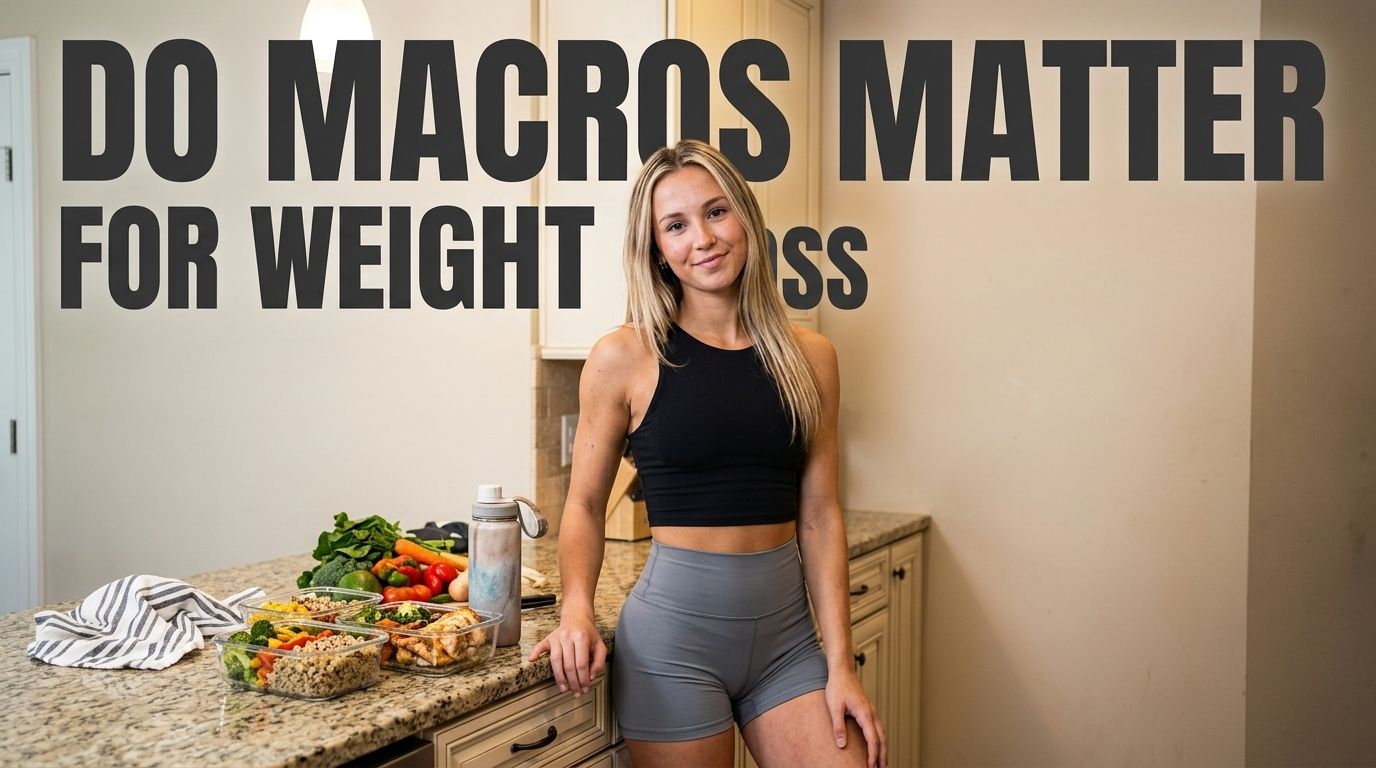
Macros, short for macronutrients, are the three nutrients the body uses for energy: protein, carbohydrates, and fat. Each macro plays a distinct role in weight loss, and the balance between them shapes hunger, energy, and how much muscle a person keeps while losing fat.
Tracking macros adds precision that calorie counting alone doesn’t provide. A high protein intake preserves lean muscle and reduces appetite through measurable hormonal effects. Carb and fat ratios shift depending on activity level, hormones, and hunger patterns. The standard starting point for fat loss is 30-35% protein, 35-45% carbs, and 25-35% fat, but adjustments are common. Women over 40, athletes, and people with specific body composition goals each respond differently to the same macro split. Tracking methods range from digital food scales and apps to the plate method and hand portions.
This article breaks down how macros work, what the research says about protein’s role in fat loss, and how to set a macro ratio that fits real life. Whether someone is just starting out or hitting a plateau, understanding macros gives a clearer picture of why food choices matter beyond the calorie count.
What Are Macros and Why Do They Matter for Weight Loss?
Macros are the three macronutrients that supply the body’s energy: protein, carbohydrates, and fat. Every food contains one or more of these, and the ratio in which they’re consumed directly affects body composition, hunger levels, and metabolic rate during a calorie deficit.
Calories set the overall energy budget, but macros determine the quality of that budget. Two people eating 1,800 calories per day can have very different outcomes depending on how those calories are distributed. One person eating mostly refined carbs may lose muscle and feel hungry constantly. Another person eating mostly protein and fiber can preserve muscle and feel satisfied on the same intake.
This is why macros matter. They don’t override calories, but they control how well a calorie deficit actually works. A poorly distributed calorie deficit leads to fatigue, cravings, and rebound weight gain. A well-distributed one supports fat loss while keeping energy and lean mass intact.
What Do Protein, Carbs, and Fat Each Do?
Protein is the macro most responsible for preserving lean muscle during weight loss. It provides 4 calories per gram, increases satiety hormones like peptide YY, and requires 20-30% of its own calories for digestion, a process called the thermic effect of food.
Carbohydrates provide the body’s preferred fuel for high-intensity activity and brain function. They supply 4 calories per gram and break down into glucose, which powers muscles and supports mood. Complex carbs digest slowly and stabilize blood sugar, while refined carbs spike it quickly and increase hunger soon after eating.
Fat provides 9 calories per gram and supports hormone production, fat-soluble vitamin absorption (vitamins A, D, E, and K), and long-lasting satiety. Dietary fat becomes a problem only when total calories exceed what the body burns, not because fat itself is inherently fattening.
Calories Per Gram by Macro:
| Macronutrient | Calories per Gram | Primary Role |
|---|---|---|
| Protein | 4 kcal/g | Muscle preservation, satiety, thermic effect |
| Carbohydrates | 4 kcal/g | Energy for exercise and brain function |
| Fat | 9 kcal/g | Hormone production, vitamin absorption, satiety |
Do Macros Matter More Than Calories?
No. Calories are the primary driver of weight loss, and a calorie deficit is required for fat loss regardless of macro composition. Macros determine the quality and sustainability of that deficit, but they don’t replace the need to consume fewer calories than the body burns.
Here’s the thing: macros shape how easy or difficult it is to stay in a deficit. A diet high in protein and fiber makes it easier to eat less without feeling deprived. A diet high in processed carbs and added sugar makes it harder to control hunger, even at the same calorie total. Can someone lose weight on any macro split? Yes, as long as the calorie deficit is maintained. But do macros affect whether that weight is fat or muscle? Absolutely.
Research consistently shows that total calorie intake drives weight change, while protein intake drives body composition. Someone can lose weight on nearly any macro ratio, but higher protein ratios tend to produce better fat loss with less muscle loss. Macros are the strategy. Calories are the rule.
What Are the Best Macro Ratios for Weight Loss?
The best macro ratio for weight loss is one that keeps protein high enough to preserve muscle, carbs appropriate for activity level, and fat sufficient for satiety and hormone function. A commonly used starting point is 30-35% protein, 35-45% carbs, and 25-35% fat of total daily calories.
No single ratio works for everyone. Activity level, hunger patterns, age, and hormonal status all affect which split produces the best results. The starting point gives structure, but most people need to adjust after 2-3 weeks based on how their body responds. That’s not a failure. That’s how macro dialing is supposed to work.
Common Macro Splits for Weight Loss:
| Split Name | Carbs | Protein | Fat | Best For |
|---|---|---|---|---|
| Balanced 40/30/30 | 40% | 30% | 30% | Moderately active adults |
| High-Protein 30/40/30 | 30% | 40% | 30% | Muscle preservation during fat loss |
| Low-Carb 20/40/40 | 20% | 40% | 40% | Insulin resistance, carb sensitivity |
| Low-Fat 50/30/20 | 50% | 30% | 20% | Endurance athletes |
How Should You Adjust Macros Based on Activity Level?
Activity level is one of the strongest signals for adjusting macro ratios. Sedentary individuals do better with moderate carbs and higher protein, while high-intensity athletes need more carbohydrates to fuel performance and support recovery between sessions.
For sedentary or low-activity lifestyles, keeping carbs at the lower end of the range, around 35-40% of calories, and setting protein at 35% improves satiety without excess fuel that won’t be used. For people doing strength training or cardio 4-5 days per week, carbs can rise to 45-55% to power workouts and speed recovery. The body’s carbohydrate needs track closely with how much energy it actually expends.
Hunger is also a valid adjustment signal. If hunger is constant despite hitting calorie targets, increasing protein by 5% and reducing carbs or fat by the same amount usually helps. Protein is the most filling macro gram for gram, and small increases make a measurable difference in appetite control.
What Are the Best Macro Splits for Fat Loss?
The most effective macro split for fat loss is one that prioritizes protein at 35-40% of total calories, keeps carbs between 30-40%, and allocates 25-30% to fat. This combination supports muscle retention, controls hunger, and sustains energy through a calorie deficit.
For women over 40 or those going through perimenopause, a slightly higher protein target, around 35-40%, helps offset the natural decline in muscle protein synthesis that comes with hormonal changes. Carbs in this group are often better kept at 30-35% to manage insulin sensitivity and reduce fat accumulation around the midsection.
Fat loss macro splits work best when protein targets are met first, then carbs and fats fill in the remaining calories. This approach ensures the most metabolically important macro is never sacrificed to fit other preferences. Prioritizing protein is the single most consistent recommendation across fat loss research.
Signs Your Current Macro Plan Isn’t Working:
- Constant hunger despite hitting daily calorie targets
- Energy crashes after meals, especially in the afternoon
- Losing weight but also losing visible muscle tone
- No scale or measurement progress after 3 or more weeks
- Cravings strong enough to break the plan most days
How Do Macros Influence Hormones and Hunger?
Macros directly regulate key hunger hormones including ghrelin, leptin, and insulin. Protein lowers ghrelin, the hormone that signals hunger, while raising peptide YY and GLP-1, two hormones that signal fullness. Carbohydrate quality affects insulin spikes, which drive hunger and fat storage when chronically elevated.
Fat intake supports the production of sex hormones like estrogen and testosterone, both of which influence body composition and fat distribution. Diets too low in fat can disrupt hormonal balance and make weight loss harder to sustain over time, particularly for women in perimenopause and menopause. The body needs dietary fat to manufacture hormones. Cutting it too aggressively creates a downstream problem that calorie counting alone won’t reveal.
In fact, the combination of high protein and moderate fat is what makes most successful weight loss diets work, regardless of what they’re called. Whether it’s a Mediterranean approach, high-protein, or lower-carb eating, the diets that consistently produce results tend to share high protein and limited refined carbs as common traits. The names differ. The mechanism is largely the same.
How Do You Calculate Your Macros for Weight Loss?
Calculating macros starts with estimating total daily energy expenditure (TDEE), which is the number of calories burned per day based on weight, height, age, sex, and activity level. A calorie deficit of 300-500 calories below TDEE is then applied, and macro percentages are assigned from that reduced total.
The Mifflin-St Jeor equation is the most commonly used formula for estimating basal metabolic rate (BMR). BMR is then multiplied by an activity factor, from 1.2 (sedentary) to 1.9 (very active), to get TDEE. Most people targeting fat loss use a multiplier between 1.3 and 1.55.
Once the calorie target is set, converting percentages to grams is straightforward. Protein and carbs each provide 4 calories per gram, and fat provides 9 calories per gram. For a 1,600-calorie target with 35% protein: 1,600 x 0.35 = 560 calories from protein, divided by 4 = 140 grams of protein per day.
Step-by-Step Macro Calculation:
- Calculate BMR using the Mifflin-St Jeor equation
- Multiply BMR by your activity factor (1.2 to 1.9) to get TDEE
- Subtract 300-500 calories from TDEE to set your deficit target
- Apply macro percentages: for example, 35% protein, 40% carbs, 25% fat
- Convert to grams: protein and carbs = calories divided by 4, fat = calories divided by 9
- Reassess every 3-4 weeks as body weight drops and TDEE changes
What Is a Good Starting Calorie Target?
A good starting calorie target for weight loss is TDEE minus 300-500 calories per day, which creates a deficit sufficient to lose approximately 0.3-0.5 kg (0.6-1.1 lbs) per week without triggering significant muscle loss or metabolic adaptation.
Larger deficits of 700-1,000 calories per day accelerate short-term weight loss but increase the risk of muscle breakdown, fatigue, and metabolic slowdown. The body responds to large deficits by reducing non-exercise activity thermogenesis (NEAT) and lowering resting metabolic rate. Both of these adaptations slow future fat loss and make maintenance harder.
A moderate deficit combined with a high protein intake is the approach most consistently supported by research. This combination allows steady fat loss while preserving lean mass, which keeps the metabolism functioning at a higher rate over the long term. Slower is often actually faster when the goal is keeping the weight off.
What Are the Most Common Macro Tracking Mistakes?
The most common macro tracking mistake is underestimating portion sizes, which causes calorie and macro counts to fall short of reality. Research on self-reported food intake consistently shows people underestimate consumption by 20-40%, which explains why many people believe macros ‘aren’t working’ when they’re actually eating more than they think.
Another frequent mistake is hitting macros on paper but spreading protein poorly across the day. Eating 140 grams of protein in one or two meals is not the same as eating 45 grams across three meals. Muscle protein synthesis responds to protein availability throughout the day, and front-loading or back-loading protein wastes much of its anabolic potential.
Tracking only on weekdays and estimating on weekends is also a common error that erases weekly progress. Weekend meals and social eating often add 500-1,000 extra calories, enough to offset an entire weekday deficit. Consistent tracking, even rough tracking, outperforms perfect weekday tracking with weekend gaps. Done is better than perfect when it comes to long-term adherence.
Which Tracking Method Works Best for You?
The best tracking method is the one a person will actually use consistently. App-based tracking with a digital food scale gives the most accurate data, but the plate method and hand portion system are more sustainable for people who find detailed tracking stressful or obsessive.
Apps like MyFitnessPal or Cronometer provide macro breakdowns for thousands of foods and allow barcode scanning for packaged items. This method is most accurate but also the most time-intensive. It works well for people who are just starting and need to build a clear picture of what they’re actually eating, then gradually internalize those patterns.
The hand portion method assigns rough macro categories to palm-sized portions: one palm of protein, one cupped hand of carbs, one thumb of fat, and two fists of vegetables per meal. Our nutritionists at Eat Proteins recommend this method for people who want structure without the stress of weighing every meal. It’s not perfectly precise, but it’s consistent, and consistency beats precision when it comes to long-term results.
Macro Tracking Methods Compared:
| Method | Accuracy | Time Required | Best For |
|---|---|---|---|
| Digital scale + app | High | 10-15 min/day | Beginners and people with specific goals |
| App without scale | Medium | 5-10 min/day | Intermediate trackers comfortable with estimates |
| Hand portion method | Moderate | 1-2 min/meal | People who want structure without obsession |
| Plate method | Low-moderate | Minimal | Maintenance or people new to healthy eating |
How Long Does It Take to See Results From Tracking Macros?
Most people see measurable changes from macro tracking within 2-4 weeks when they follow a consistent calorie deficit with adequate protein. Initial changes are often water weight and reduced bloating, with fat loss becoming visible on the scale and in body measurements by weeks 3-4.
The timeline varies by starting body fat percentage, deficit size, protein intake, and activity level. People with more body fat to lose typically see faster initial results. Those closer to their goal weight lose more slowly and need to pay closer attention to smaller variables like sleep, stress, and hydration. Sleep deprivation alone can blunt fat loss by raising cortisol and increasing hunger hormones. It’s not just about food.
If no progress appears after 3-4 weeks of consistent tracking, the most common causes are underreporting food intake, inadequate protein, or a calorie target set too high. Recalculating TDEE after significant weight loss is also important, as calorie needs decrease as body weight drops. A target that created a deficit at 90 kg (198 lbs) may be at maintenance at 80 kg (176 lbs).
Who Benefits Most From Tracking Macros?
People who benefit most from macro tracking are those who have tried calorie counting alone without success, those who lose weight but also lose significant muscle mass, and those with specific performance goals alongside fat loss. Macro tracking adds a layer of precision that pure calorie counting doesn’t provide.
Beginners often benefit from tracking for 4-8 weeks to build awareness of what’s actually in their food. Even after stopping formal tracking, the habits formed during a tracking period tend to persist. Eating more protein, choosing whole foods, and recognizing portion sizes become instinctive. This makes temporary tracking a high-value investment even for people who don’t want to track indefinitely.
People who don’t benefit as much from macro tracking include those with a history of disordered eating, where detailed food measurement can reinforce unhealthy patterns. For this group, an intuitive eating approach focused on protein-rich whole foods is more appropriate. The goal is a sustainable relationship with food, and macro tracking is a tool, not a requirement for everyone.
What Macro Ratio Works Best for Women Over 40?
Women over 40 benefit most from a macro ratio that emphasizes protein at 35-40% of total calories, with carbs at 30-35% and fat at 25-30%. This distribution supports muscle preservation during the hormonal shifts of perimenopause and menopause, when estrogen decline accelerates muscle loss and shifts fat toward the abdomen.
Estrogen plays a key role in directing where the body stores fat. As estrogen levels fall, fat tends to shift from the hips and thighs to the abdomen. Higher protein intake combined with resistance training is the most evidence-based strategy for countering this shift and maintaining a healthy body composition through midlife. Protein doesn’t just preserve muscle. It actively combats one of the most frustrating effects of hormonal change.
Carbohydrate timing also matters more in this population. Concentrating carbs around exercise and eating lower-carb meals at rest reduces insulin spikes and improves energy stability throughout the day. Women in this group often find that the same calorie intake that maintained weight in their 30s now causes slow gain. Macro precision becomes more valuable as age-related hormonal changes reduce metabolic flexibility.
What Does the Science Say About Macros and Weight Loss?
The science on macros is consistent: protein intake is the single macro variable most reliably associated with successful fat loss and muscle preservation. A systematic review by Fogelholm et al. found that higher protein diets produced better long-term weight maintenance compared to standard protein intakes across multiple dietary patterns.
Research shows that protein intake between 1.2-1.6 grams per kilogram (0.5-0.7 grams per pound) of body weight supports muscle retention during caloric restriction. Some studies support going higher, up to 2.2 grams per kilogram (1.0 grams per pound), particularly for individuals engaged in resistance training while in a deficit. The thermic effect of protein adds to its advantage. Protein requires 20-30% of its own calories just for digestion, compared to 5-10% for carbs and 0-3% for fat.
Studies also confirm that both low-carb and balanced macro approaches produce similar weight loss outcomes when protein is adequate and a calorie deficit is maintained. The ‘best’ diet is largely a matter of personal preference and adherence. The Eat Proteins approach focuses on making high-protein eating simple and sustainable, because consistency with any macro plan matters more than the exact split chosen. To get a proven weight loss plan that aligns macros with your goals, the right framework makes the difference between short-term results and lasting change.
Key Research Findings on Macros and Weight Loss:
- Protein at 1.2-1.6 g/kg (0.5-0.7 g/lb) body weight supports muscle retention during fat loss
- Higher protein diets are associated with better long-term weight maintenance (Fogelholm et al.)
- Both low-carb and balanced macro approaches produce similar fat loss when protein and deficit are matched
- The thermic effect of protein burns 20-30% of protein calories through digestion alone
- Protein intake reduces ghrelin and increases satiety hormones peptide YY and GLP-1
Ready to Stop Guessing? How Can the Eat Proteins Free Plan Get Your Macros Right?
The Eat Proteins free plan takes the guesswork out of macro tracking by giving you a personalized protein-first framework built around your weight, activity level, and fat loss goal. It’s the fastest way to move from ‘I think I’m eating right’ to ‘I know exactly what my body needs.’
Most people spend weeks adjusting macros by trial and error. The free plan skips that. It gives you a calorie target, a macro split, and simple food swaps that hit your protein goal without overhauling every meal. You don’t need to weigh food forever. You need a clear starting point and a method that works in real life.
Macro tracking works best when it’s simple enough to sustain. The Eat Proteins plan is built on that principle. High protein, real food, no complicated rules. If you’ve been losing weight but losing muscle, or eating ‘healthy’ without results, the problem is almost always protein and macro distribution, not willpower. Get the plan, fix the foundation, and let the results follow.