
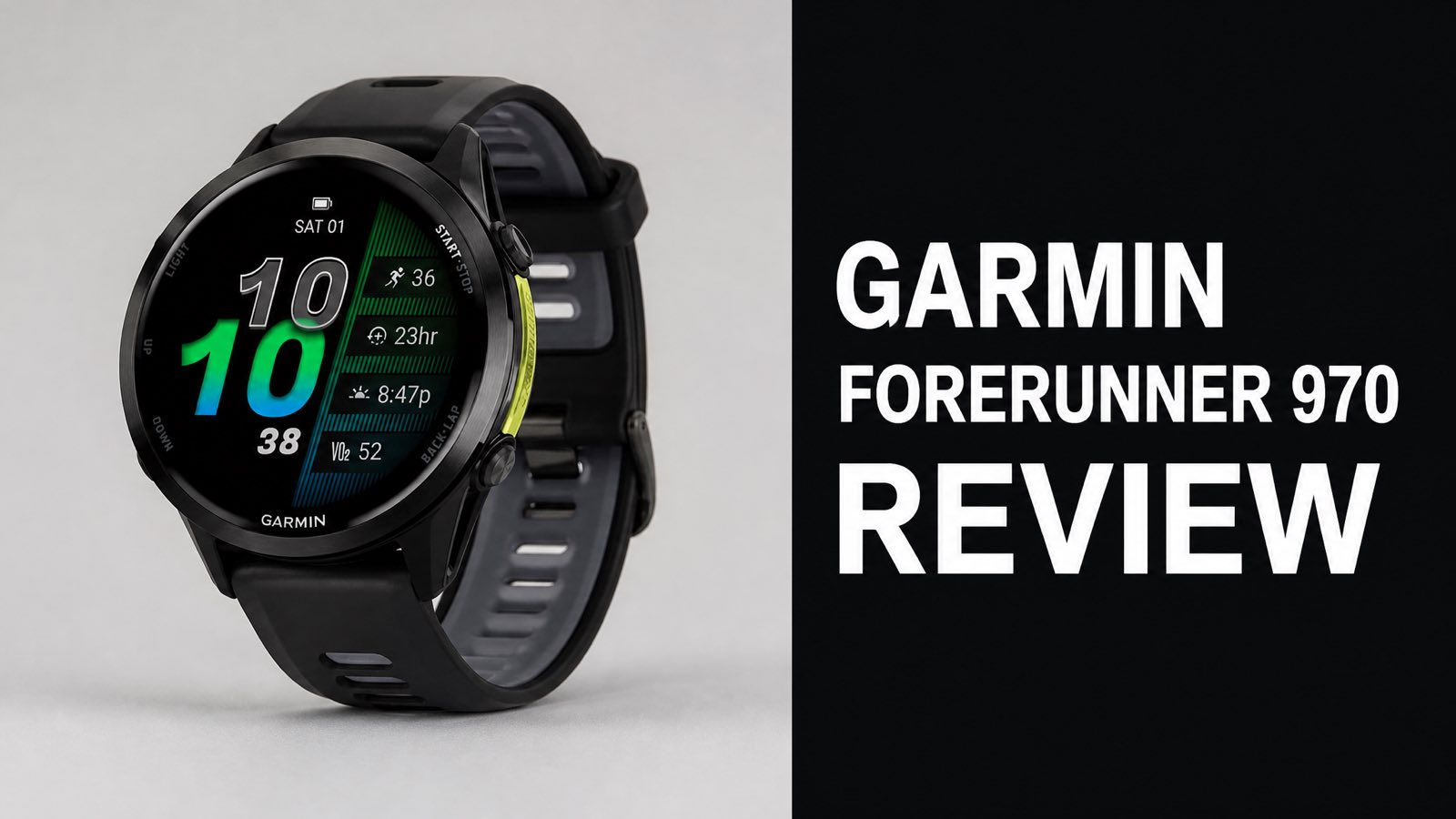
The Garmin Forerunner 970 is Garmin’s top running watch, launched in 2025 at $749.99. The 47 mm titanium and sapphire case holds an AMOLED screen, multi-band GPS, offline maps and an ECG sensor. Our team at Eat Proteins studied the independent lab and field tests so buyers can judge it fast.
Reviewers call it the most complete running watch Garmin has built. Accuracy scores run high, and the offline maps rival the Fenix line. Testers also praise the bright display and light body. Battery life drops against the older 965, though. Real-world use lasts four to nine days. The price jumps $150 over the 965. Garmin also added an ECG sensor.
So who should pay for it? The answer depends on how much you value maps, ECG and a bright display over raw battery life. Below, you’ll find specs, battery tests, rival watches, drawbacks and a clear verdict. Every point comes from independent testers, not from marketing copy. Read on.
What Is the Garmin Forerunner 970?
The Garmin Forerunner 970 is the flagship model of Garmin’s Forerunner running watch line. Garmin launched the watch at $749.99 in 2025. The 47 mm case uses a titanium bezel and a sapphire lens. The watch weighs about 56 grams (2 ounces). The watch tops the Forerunner range, above the 965 and the 570 models. Reviewers rank it as the best Forerunner yet.
Here’s the thing: the 970 targets serious runners. A touchscreen AMOLED display shows maps, widgets and notifications. Garmin pairs that screen with its Elevate Gen 5 heart rate sensor, which adds ECG and skin temperature readings.
Key Specs:
| Spec | Detail |
|---|---|
| Case size | 47 mm |
| Weight | 56 g (2 oz) |
| Display | AMOLED touchscreen |
| Storage | 32 GB |
| Water rating | 5 ATM (50 meters or 164 feet) |
Who Is the Garmin Forerunner 970 For?
The Garmin Forerunner 970 suits runners who train with structure and want mapping on the wrist. Triathletes and trail runners fit the profile too. Casual joggers gain little over cheaper Garmin models. The core training tools overlap heavily with the Forerunner 570, which also costs less than the 970. Testers agree the target buyer trains most weeks.
Does that mean beginners should skip it? Not always. BetterTrail’s tester found Garmin’s data easy to read. Still, the price asks for a real commitment to regular training.
What Features Does the Garmin Forerunner 970 Have?
The Garmin Forerunner 970 combines training analytics, offline maps and health sensors in one watch. Garmin adds a built-in LED flashlight, Garmin Pay contactless payments and 32 GB of storage. Offline music works with Spotify and Deezer. Body Battery, HRV tracking and daily suggested workouts fill out the software suite. The package feels very complete.
Main Features:
- Multi-band SatIQ GPS
- Full-color offline topographic maps
- ECG and skin temperature sensing
- Built-in LED flashlight
- Offline Spotify and Deezer music
- Garmin Pay contactless payments
To be clear, the data goes deep. Runner’s World calls the feature set dense and built for deep training optimization. Advanced metrics such as running economy suit data-minded athletes more than casual users. Is that overkill? For casual users, yes.
What Sensors and GPS Does the Garmin Forerunner 970 Use?
The Garmin Forerunner 970 uses the new Elevate Gen 5 optical sensor and all-systems multi-band GPS. Garmin builds the GPS on a new chipset compared with the Forerunner 965. Testers found heart rate readings very consistent. Track quality under dense forest canopy stayed very good in multi-band mode with SatIQ. Both upgrades target runners who train hard.
Why does that matter? Dense tree cover is a classic stress test for GPS watches. Clean tracks keep pace and distance honest on trail runs.
How Do Maps and Navigation Work on the Garmin Forerunner 970?
The Garmin Forerunner 970 stores full-color topographic maps and guides runners turn by turn. The watch supports GPX routes, round-trip route generation and off-course alerts. The touchscreen pans and zooms with ease. BetterTrail says navigation felt nearly identical to the Garmin Fenix 8 Pro in daily use. Maps stay on the wrist, with no phone needed.
The good news? The watch replaced a phone for most hikes and runs in that review. For complex off-trail routes, the tester still preferred a phone app.
How Good Is the Garmin Forerunner 970 Battery Life?
The Garmin Forerunner 970 lasts up to 15 days in smartwatch mode and 26 hours in GPS-only mode, per Garmin. Real-world results run lower. Testers report four to nine days of daily use with several GPS workouts. The bright AMOLED screen is the main drain, along with mapping and the flashlight. Heavy use of mapping and the flashlight cuts those ratings.
Battery Ratings:
| Mode | Rated Life |
|---|---|
| Smartwatch | Up to 15 days |
| GPS only | Up to 26 hours |
| All systems, multi-band | Up to 21 hours |
| GPS plus music | 12 to 14 hours |
Here is the kicker: the 965 lasted longer in smartwatch mode, with 23 days rated. Garmin traded endurance for a brighter screen. Lowering brightness to one third extends use, according to Mountaineer Journey.
How Long Does the Garmin Forerunner 970 Battery Last in Real Use?
Real-world use lands between four and nine days per charge. iRunFar charged the watch every eight to nine days. BetterTrail saw eight to nine days with four to five GPS workouts a week. TrackBetter and The Run Testers got only four to five days with the screen always on at full brightness. Brightness settings decide the result more than hardware does.
So why the gap? Screen settings explain most of it. An always-on display at full brightness cuts life to about four days. Standard settings stretch the watch past a week.
By comparison, ultra watches go much further. The Coros Vertix 2S reaches over 100 hours of GPS. The Suunto Vertical 2 reaches 65 hours. Does that hurt the 970? Only on ultra distances.
Does the Garmin Forerunner 970 Track Accurately?
Yes. The Garmin Forerunner 970 delivers consistent GPS and heart rate data in testing. Mountaineer Journey scored accuracy 9 out of 10. BetterTrail called the data accurate and consistent. iRunFar named it Garmin’s most complete GPS running watch. The verdict followed four months of daily use. Together, those verdicts make accuracy a clear strength.
Does it cover every metric? Not quite. Running economy and step speed loss metrics need the $169 Garmin HRM 600 chest strap. Without the strap, those readings stay locked.
How Does the Garmin Forerunner 970 ECG Feature Work?
The ECG feature works as a manual snapshot tool for Afib detection. The Elevate Gen 5 sensor is medically certified for ECG. Runner’s World says the test can be a hassle to enable. The feature does not offer continuous heart monitoring. The cheaper Forerunner 570 has no ECG sensor at all. Garmin pitches it as a health extra for runners who want insight.
In plain English: ECG adds peace of mind, not constant surveillance. Skin temperature and HRV tracking add trend data for recovery.
Garmin Forerunner 970 vs 570 vs 965: Which Is Better?
The Garmin Forerunner 970 beats the Forerunner 570 on materials, maps, battery life and ECG. The 570 costs less and offers a smaller 42 mm case. The 570 sticks to breadcrumb navigation and skips ECG. Against the 965, the 970 adds a brighter screen but cuts smartwatch battery life from 23 days to 15 days. Both watches share Garmin’s core training software.
Garmin Watch Comparison:
| Watch | Launch Price | Key Difference |
|---|---|---|
| Forerunner 970 | $749.99 | Full maps, ECG, AMOLED |
| Forerunner 965 | $599.99 | 23-day smartwatch battery |
| Fenix 8 AMOLED | $1,099.99 | 10 ATM rating, expedition battery |
The reason is simple: the 970 sits between mid-range and expedition watches. The 570 lacks the premium materials. The Fenix line adds far more battery capacity at a much higher price.
How Does the Garmin Forerunner 970 Compare With Rival Brands?
The Garmin Forerunner 970 weighs far less than ultra-focused rival watches. iRunFar measured 57 grams (2 ounces). The Coros Vertix 2S weighs 87 grams (3.1 ounces) and the Suunto Vertical 2 weighs 74 grams (2.6 ounces). The Amazfit T-Rex 3 weighs 68 grams (2.4 ounces). BetterTrail found it comfortable for all-day wear. Lighter weight helps comfort too.
What’s more, rivals win on endurance. The Amazfit T-Rex 3 passes 40 hours of GPS. Garmin wins on software polish and display quality. Which matters more? Daily wearability tips the scale for many runners.
What Are the Downsides of the Garmin Forerunner 970?
The Garmin Forerunner 970 carries three clear downsides: high price, AMOLED battery drain and limited size options. BetterTrail notes the core training experience looks similar to the cheaper Forerunner 570. The 970 comes only in 47 mm. Water resistance stops at 5 ATM, below the Fenix line at 10 ATM. Reviewers still rate the overall package very highly.
Main Drawbacks:
- Launch price of $749.99
- AMOLED screen drains battery faster than MIP designs
- Only one 47 mm case size
- 5 ATM water rating
- Chest strap needed for some running metrics
Pay attention to this: reviewers rarely call these flaws dealbreakers. They read as trade-offs for a brighter, more modern screen. Even the ECG tool, a manual snapshot, comes as a bonus rather than a headline feature.
Is the Garmin Forerunner 970 Worth the Price?
Yes. The Garmin Forerunner 970 is worth $749.99 for runners who use maps and advanced metrics. Mountaineer Journey says the premium demands real use of those features. The watch costs $150 more than the 965 and about $350 less than the AMOLED Fenix 8. Buyers who skip maps pay for features they never touch. Mapping and ECG are the key reasons to pay more.
Bottom line: casual runners can save money. The Forerunner 570 covers most core training tools for less. Should you pay up anyway? Only if mapping and ECG matter to you.
Where Can You Buy the Garmin Forerunner 970?
The Garmin Forerunner 970 sells through Garmin’s online store and major retailers such as REI and Walmart. Listings sit near the $749.99 launch price. Sales appear on older models first, and the Forerunner 965 now drops in price regularly. Compare listings before ordering to confirm the exact model and bundle. Check that the seller lists the new model.
Does the Garmin Forerunner 970 Need a Chest Strap?
No. The Garmin Forerunner 970 works without a chest strap for standard tracking. The Garmin HRM 600 unlocks running economy and step speed loss metrics. The strap costs about $169 (£150). Buyers who want the full metric suite must budget for it from day one. Skip it only if standard tracking is enough. The watch still tracks runs, sleep and heart rate.
Total Cost of Ownership:
| Item | Price |
|---|---|
| Forerunner 970 | $749.99 |
| Garmin HRM 600 chest strap | $169 |
| Watch plus strap | $918.99 |
Here’s why that matters: the full kit climbs above $900. Our experts at Eat Proteins suggest pricing the whole setup before you commit. Is the strap optional? Technically, yes.
Should You Try Eat Proteins?
Yes. Eat Proteins turns long, noisy product tests into short answers you can use. Our team at Eat Proteins reads independent reviews and checks the numbers for you. The Garmin Forerunner 970 shows why: a $750 watch deserves a closer look than a launch headline. Don’t buy blind. Read the facts first. Eat Proteins lays out the facts in a few minutes.
What Will You Get From Eat Proteins?
Eat Proteins gives you plain-language reviews of supplements, wearables and fitness gear. Every review follows the same buyer path. You see what the product is, what it costs, what testers dislike and where to buy it. Skip the guesswork, compare the facts and read the next Eat Proteins review today, before you spend. Every review ends with a clear verdict.