
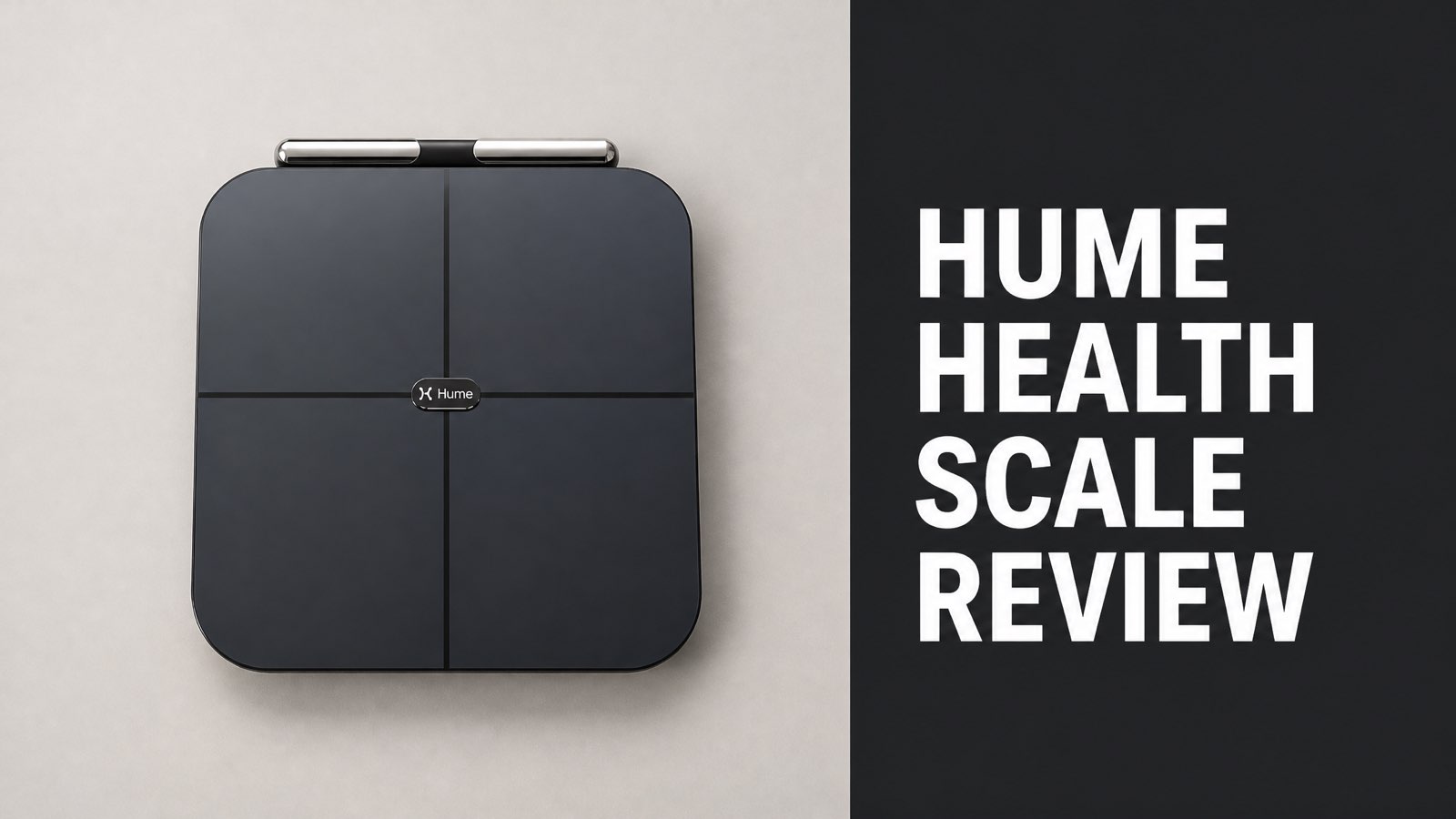
The Hume Health scale is the Body Pod, a smart body composition scale from Hume Health. It pairs a glass platform with a hand grip and a phone app. One short scan reports weight, body fat, muscle, water and bone mass in seconds. Buyers weigh it against cheaper models in the current market.
The Body Pod reads the whole body through foot and hand electrodes. Reviewers confirm accurate weight and rich trend data. Body fat claims lack independent proof. Support delays and app syncing draw complaints. Prices range from about $183 to $299.95, so the cost deserves a close look before checkout. Our team at Eat Proteins weighs those trade-offs.
Our Hume Health scale review covers how it works, what it tracks, safety limits, costs and rival scales. Read on to learn who gains the most from the handle design. You will also see who saves money by choosing a simpler scale instead, and why that choice matters for your own budget.
What Is the Hume Health Scale?
The Hume Health scale is the Body Pod, a smart body composition scale with a built-in hand grip. Hume Health sells it with a companion app. In seconds, it reads weight, body fat, muscle, body water and bone mass. In fact, it aims well above a basic bathroom scale, and it competes with clinic-style analyzers. Its weight limit is 400 pounds (181 kg) in all.
The Body Pod uses eight frequency sensors and a medical-grade chip. Four weight sensors sit under a tempered glass platform. A retractable handle holds the upper-body electrodes. Our team at Eat Proteins sees this setup as the main reason buyers pick it. Who is it for? Data-minded buyers, mostly.
Key Specs:
| Spec | Detail |
|---|---|
| Sensors | 8 frequency sensors, 4 weight sensors |
| Weight range | 6.6 to 400 lbs (3 to 181.4 kg) |
| Connectivity | Bluetooth only |
| Battery | Up to 1 year per charge |
| User profiles | Up to 24 |
Hume also sells a newer Body Pod 2.0 at $249. Is the old model gone? No, it’s still sold. The update adds 3D body scanning, a digital twin and a heart rate sensor. To be clear, the original model still ships and still gets reviewed.
Who Makes the Hume Health Scale?
Hume Health is a wellness hardware brand that also makes the Hume Band fitness tracker. The company runs one app for both devices. Wareable tested the band first and liked it enough to list it among its best fitness trackers. The scale followed as a natural second product for the same ecosystem. Both devices share one HealthOS platform and one login.
The scale and band share one dashboard. Weight trends sit beside sleep, activity and recovery data. What’s more, Hume sells an optional Hume Plus plan at $9.99 per month for extra insights.
How Does the Hume Health Scale Work?
The Body Pod sends a weak electrical current through the body to estimate composition. The method is called bioelectrical impedance analysis, or BIA. Fat resists the current more than muscle or water does. The scale turns that resistance into fat, muscle and water estimates. Age, height and sex refine each final number. Eight sensors read the signal.
Most budget scales only use electrodes under the feet. The Body Pod adds electrodes in the handle. Why does that matter? The current travels through arms, torso and legs, so the readout covers the whole body.
PCMag notes the handle lets the scale split fat and muscle by arm, leg and torso. The breakdown looks similar to a DEXA report. Here’s the catch: the numbers are still estimates.
How Do You Use the Hume Health Scale?
Setup takes only a few minutes with the Hume Health app. The scale pairs over Bluetooth. Users enter age, height and sex once. After that, each weigh-in takes only seconds, which Wareable calls the quickest of any wellness device it has tried. The routine below keeps readings consistent from day to day. Setup rarely needs a manual or a long video tutorial.
The weigh-in itself is simple. Wareable also advises the same time each morning, before food or a phone check. Does timing matter that much? Yes, it does. In plain English: consistent timing keeps the trend line clean.
Steps:
- Place the scale on a hard, flat surface.
- Open the Hume Health app on a nearby phone.
- Step on the glass platform with bare feet.
- Lift the handle to waist level with straight arms.
- Stand still until the scan finishes and syncs.
What Does the Hume Health Scale Measure?
The Body Pod measures weight plus a long list of body composition numbers. Hume lists 45 metrics in total. Core readings include body fat, muscle mass, body water, bone mass, visceral fat and metabolic age. A heart rate reading also appears on the display, so the first glance already tells a lot. Each reading syncs to the app within seconds of the scan.
Main Metrics:
- Body fat mass and percentage
- Muscle mass and skeletal muscle mass
- Visceral and subcutaneous fat
- Body water and protein mass
- Bone mass and metabolic age
- Basal metabolic rate and heart rate
Every metric gets a trend graph in the app. Trend graphs help users see change over weeks instead of one weigh-in. The good news? The weight itself reads accurately in Wareable’s tests.
Does the Hume Health Scale Track 45 Metrics?
Yes. Hume lists 45 metrics, but many are sub-breakdowns of a smaller core set. Segmental fat and muscle for each limb count as separate entries. PCMag counted 17 distinct metrics in its 2024 test of the first Body Pod. The true number depends on how a reviewer counts. Wareable lists the same figure for the newer model, and the 2.0 reuses the same count.
So what does that mean for you? Treat the 45 figure as a ceiling, not a promise of 45 unrelated insights. The core numbers are the ones that drive decisions.
Is the Hume Health Scale Accurate?
Yes. Weight readings match expectations, and PCMag found the data accurate overall. Body composition numbers carry more doubt, because every BIA scale estimates fat and muscle rather than measuring them directly. Even so, the handle design gives the Body Pod an edge over foot-only models that skip the upper body. Wareable agreed on weight, not on fat.
Hydration, meals and workouts all shift BIA results. Same-time weigh-ins reduce that noise. Wareable trusted the weight but could not confirm body fat figures without a clinical scan.
Factors That Skew Readings:
- Recent meals or large drinks
- Hard workouts before stepping on
- Dehydration or heavy sweating
- Varying time of day
Does the Hume Health Scale Match DEXA Scans?
No. Independent testers have not confirmed a DEXA match. Hume Health claims a 98% correlation for fat-free mass and body fat percentage. The company says an independent clinical team validated it. Wareable could not verify the claim without booking a DEXA scan of its own just to compare. DEXA is the gold standard, and few reviewers pay for a second scan.
Here’s the thing: correlation is not the same as identical numbers. A scale can track the direction of change well and still be off by a few points. Look at trends, not single readings. Is one bad scan a crisis? No. It’s noise.
What Do Hume Health Scale Reviews Say?
Reviews land in the middle to positive range. PCMag gave the Body Pod 3.5 out of 5, rated Good. Hume Health holds a 3.6 TrustScore on Trustpilot across about 7,100 reviews. The score covers the whole brand, not only the scale, so read it as a general signal about the company. Scores vary by reviewer type, and the wide spread shows in the star counts.
Reviewers praise the data depth and the daily motivation. They criticize support delays and app syncing. Do the praise and the complaints cancel out? Not quite, since each group describes a different part of the experience.
What Do Users Like About the Hume Health Scale?
Users like the depth of data and the premium build. One Trustpilot reviewer calls it a convenient at-home alternative to InBody or DEXA visits. Another reports losing over 40 pounds (18 kg) while pairing the scale with the band. Daily motivation comes up often in positive reviews. Long battery life earns repeat praise, with one charge lasting up to a year.
Wareable adds that the tempered glass and handle feel like gym gear. The battery also lasts long. A single charge is rated for up to a year.
Pros:
- Detailed body composition breakdown
- Handle sensors for whole-body readings
- Fast scans of a few seconds
- Up to 24 user profiles
- Battery rated for up to a year
What Are the Common Complaints About the Hume Health Scale?
The top complaints involve app syncing, occasional scan errors and slow customer support. Wareable hit error messages on some mornings and had to restart the scan. Trustpilot reviewers report emails going unanswered for weeks during returns. Data accuracy doubts also appear in the negative reviews. Price complaints follow close behind in the negatives.
The app must be open on a nearby phone. Otherwise the scale shows only weight and heart rate. The bad news? PCMag also flags no Wi-Fi, no onboard storage and a high price.
Cons:
- No Wi-Fi and no onboard memory
- Full data needs the app open
- Occasional scan errors
- Slow support responses reported
- No safe mode for pacemakers or pregnancy
Hume Health Scale vs Withings, Etekcity and Wyze: Which Is Better?
The Body Pod wins on metric depth, while rivals win on price or convenience. PCMag names the Etekcity HR Smart Fitness Scale at $79.99 its Editors’ Choice for most buyers. The Withings Body Scan at $399.95 adds Wi-Fi, ECG and a safe mode that the Body Pod lacks. Each rival fits a different type of buyer, from budget shoppers to premium health trackers.
Wyze offers the Scale Ultra BodyScan, rated 4.0 Excellent by PCMag. Renpho’s MorphoScan Nova also earns 4.0. By comparison, the Body Pod sits in the upper-middle of this field.
Scale Comparison:
| Scale | Price | PCMag Rating |
|---|---|---|
| Hume Body Pod | $229 to $299.95 | 3.5 Good |
| Etekcity HR Smart Fitness Scale | $79.99 | 4.5 Outstanding |
| Wyze Scale Ultra BodyScan | $139.98 | 4.0 Excellent |
| Renpho MorphoScan Nova | $219.99 | 4.0 Excellent |
| Withings Body Scan | $399.95 | Not rated here |
Is a Cheaper Smart Scale Enough?
Yes. For most people, a cheaper scale covers the basics well. Etekcity tracks the key daily metrics most buyers care about for a small fraction of the cost. Those who want limb-by-limb fat and muscle data need a handle model instead. Here, the Body Pod earns its premium. Budget scales also tend to offer a weight-only safe mode for special medical cases.
Think of it this way: the Body Pod buys depth, not necessarily better answers. Do you need that depth? Only some buyers do. Choose it only if segmental data will change what you do.
Is the Hume Health Scale Safe?
Yes. The Body Pod is safe for most healthy adults. BIA sends a very small current that users cannot feel, and many body composition scales use the same method. Still, specific groups need to check with a doctor first. The design leaves them fewer options than rival scales do. Wareable raised no safety concerns during weeks of daily testing at home.
PCMag points out one design gap. Users cannot turn off BIA for a weight-only reading. Cheaper scales often offer that mode. Pay attention to this if a medical device is involved. Does the current hurt? Users can’t feel it.
Who Should Avoid the Hume Health Scale?
People with pacemakers or other implanted devices need to skip the Body Pod unless a doctor approves it. The same applies during pregnancy. PCMag confirms the scale has no safe mode for either case. Users cannot turn the electrical current off for a weight-only reading. Anyone unsure about an implant needs a doctor’s answer first, before stepping on.
Heavy users also need to note the weight range. Wareable lists 6.6 to 400 pounds (3 to 181.4 kg). PCMag’s older test listed up to 440 pounds (200 kg). Check the current spec before buying.
How Much Does the Hume Health Scale Cost?
The original Body Pod starts around $183 and has listed as high as $299.95. Wareable cites a low of $183.04. PCMag recorded an MSRP of $299.95 with a $229 sale price. Body Pod 2.0 lists at $249. Prices move often, so check the official site before ordering. Optional extras like a warranty and a subscription can lift the final total each year for owners.
Extras add cost. A 10-year warranty costs $46 at checkout or $70 later. The optional Hume Plus plan runs $9.99 per month. At the same time, the core features work without any subscription.
Price Snapshot:
| Item | Cost |
|---|---|
| Body Pod (from) | $183.04 |
| Body Pod (PCMag sale price) | $229 |
| Body Pod 2.0 | $249 |
| 10-year warranty at checkout | $46 |
| Hume Plus subscription | $9.99 per month |
Is the Hume Health Scale Worth the Price?
Yes. For data-focused buyers, the scale is worth the money because segmental data is rare at this price. Athletes and body recomposition trackers fit that group. Casual weight watchers get little extra from the premium, and a cheaper scale serves them just as well. Wareable rates it better value than Withings for advanced metrics, even at its price.
Wareable calls it better value than Withings for advanced metrics. PCMag calls it expensive for its missing basics. Both views are fair. Is it a bargain? The answer depends on the goal. Match the price to what you’ll track.
Where Can You Buy the Hume Health Scale?
The safest source is the official Hume Health website. Hume sells the Body Pod there with free shipping and a free app. Reviewer buy links on Wareable and PCMag also point to the brand store. Buying direct secures the full 1-year warranty and the 10-year add-on. Third-party sellers vary in price and warranty terms, so verify each listing before paying.
Buy direct to get the full 1-year warranty and the 10-year add-on. Third-party sellers vary. Trustpilot lists lookalike domains with far lower scores, so confirm the web address first.
Should You Trust Eat Proteins on the Hume Health Scale?
Yes. Eat Proteins reviews products by reading real tests and real owner feedback. Our experts compare brand claims against reviewer experience, then flag the gaps. The verdict on this scale is a balanced one, built on PCMag, Wareable and thousands of Trustpilot reviews. Our coaches also check price history, support quality and long-term reliability.
Nobody needs to guess here. Does the scale deliver? For the right buyer, yes. If you want deep body composition data and can live with a Bluetooth-only scale, the Body Pod fits. If you want simple weight tracking, save the money.
What Is the Eat Proteins Verdict on the Hume Health Scale?
Eat Proteins rates the Body Pod a strong pick for data-minded buyers. The handle sensors and trend graphs deliver real insight into fat and muscle change over time. Support delays and app syncing keep the scale from a top mark. The price also deters most casual shoppers. Our team at Eat Proteins calls that a fair trade for the right buyer, with open eyes.
Ready to track your progress? Pair the scale with steady protein intake and weekly trend checks. Don’t wait on a perfect reading. Start your baseline this week, and let Eat Proteins guide the next step.