
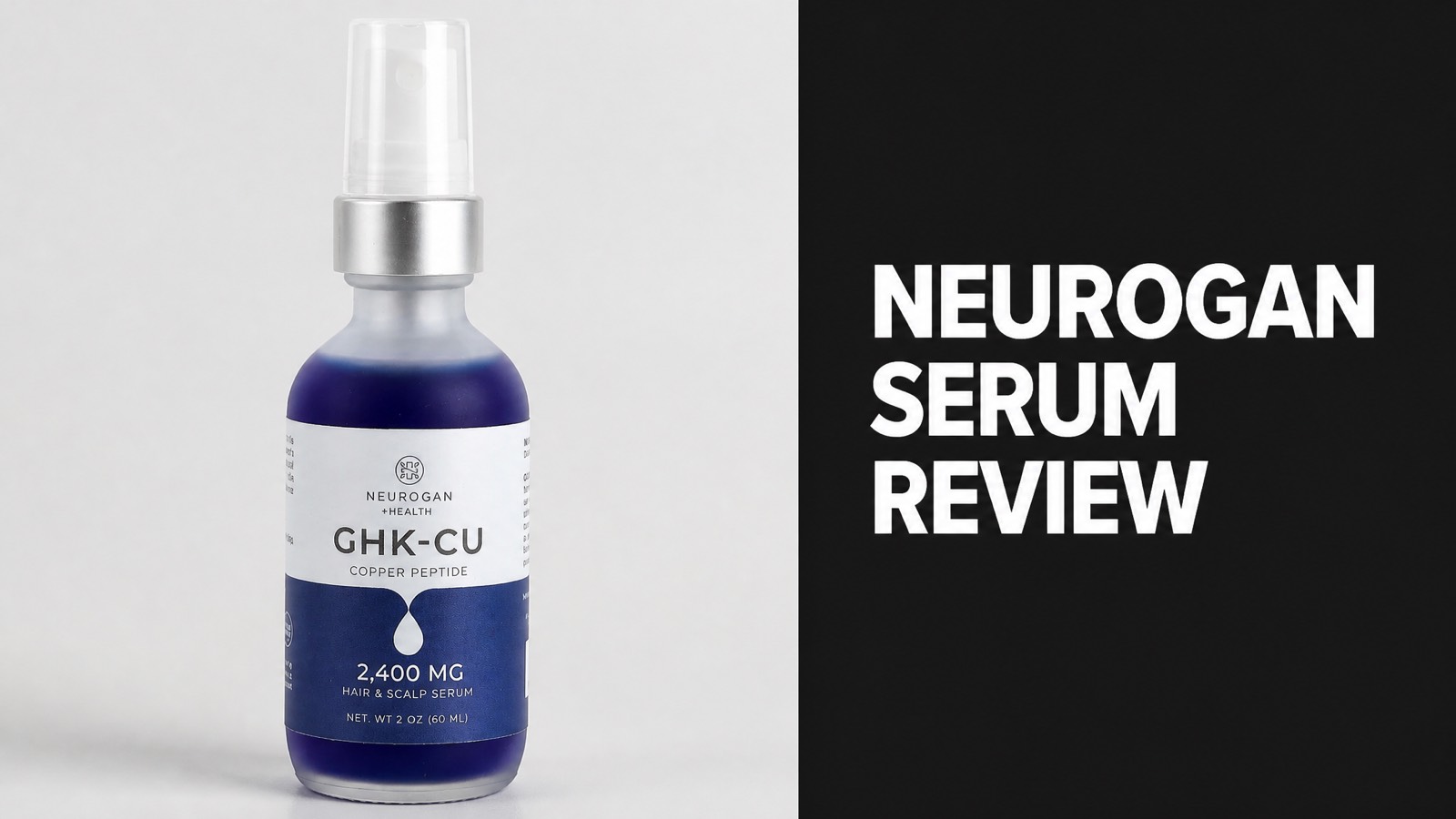
The Neurogan Health Copper Peptide Hair & Scalp Serum is a 2 oz (60 mL) cosmetic spray. The formula pairs 2,400 mg of GHK-Cu copper peptide with distilled water. The brand sells the serum for daily scalp use by men and women who want fuller-looking hair and a calmer, more comfortable scalp.
This review checks the label, the research and the public feedback. The formula has only two ingredients. The brand points to 8 to 12 weeks of daily use. No clinical trial proves regrowth. Amazon shows 4.1 stars from 378 ratings. Complaints center on shipping and delivery, not on the formula. Customer support earns frequent praise from many reviewers.
Here is the big picture. A simple formula and a fair $55 price make the serum a low-risk trial for most buyers. Read on to learn how to use it, what the evidence actually covers, who should skip it, how it compares with the Pro version and where to buy the bottle online today.
What Is the Neurogan Health Copper Peptide Hair & Scalp Serum?
The Neurogan Health Copper Peptide Hair & Scalp Serum is a leave-on cosmetic scalp spray built around GHK-Cu copper peptide. Each 2 oz (60 mL) glass bottle holds 2,400 mg of the active at a 4% concentration. The water-based formula sprays on as a fine mist and absorbs in minutes. The brand labels the product a cosmetic and not a drug. Pale blue liquid.
Neurogan Health is a San Diego brand that sells supplements and skincare. Its team partnered with researchers at Aalborg University in Denmark. In fact, the brand says it makes products in-house at a cGMP-certified facility with HPLC testing.
Our team at Eat Proteins tracks serums like this one closely. Why? Peptide hair care is a crowded category with loud claims. Our review separates the label facts from the marketing.
Quick Facts:
| Spec | Detail |
|---|---|
| Size | 2 oz (60 mL) |
| Active | GHK-Cu (copper tripeptide-1) |
| Strength | 2,400 mg (4%) |
| Format | Fine-mist spray in a glass bottle |
| Type | Cosmetic, not a drug |
Who Is the Serum For?
The serum targets people who notice thinning and want fuller-looking hair. The brand also names people with a dry or uncomfortable scalp as a fit. Anyone who prefers a short, two-ingredient, fragrance-free formula matches the profile. The Amazon listing positions the product for both men and women, on wet or dry hair, with daily use. Results vary by user.
To be clear, the product is not a treatment for a diagnosed hair-loss condition. Sudden or patchy hair loss calls for a doctor or dermatologist. The brand states this plainly on its own product page.
What Ingredients Are in the Serum?
The serum contains only two ingredients: medical-grade distilled water and GHK-Cu. The full label runs two lines, so checking it takes seconds. The brand lists no fragrance, no parabens and no artificial ingredients. The blue color comes from the copper peptide itself, not from an added dye. Simple labels build trust, and this one is quick to verify.
Most hair serums carry far more. A Neurogan press release puts the market average at 20 to 30 ingredients. Does a short list prove quality? No. The short list only makes the label easy to read and the formula easy to trace.
What the Label Leaves Out:
- Fragrance
- Parabens
- Artificial ingredients
- Unnecessary fillers
What Does GHK-Cu Do?
GHK-Cu is a copper tripeptide made of glycine, histidine and lysine holding a copper ion. The body produces the compound naturally, and Neurogan says levels decline with age. The copper ion gives the serum its blue color. Most published research on GHK-Cu focuses on skin and not on hair, and the brand says so openly. Hair data remains limited so far.
Think of it this way: the ingredient is a skincare staple moving into hair care. Neurogan also uses GHK-Cu in its face creams. The hair evidence is thinner than the skin evidence.
How Do You Use the Serum?
Daily use is the core of the routine: spray the serum on the scalp, then massage it in. The brand lists morning and evening use. Apply the serum first and let it absorb before any styling products. The fine mist reaches the scalp directly. The formula works on wet or dry hair without a greasy finish. Consistency matters most here, so pick a fixed time.
Steps:
- Spray a few pumps directly onto the scalp.
- Massage the serum gently to spread it evenly.
- Wait a few minutes for the serum to absorb.
- Style the hair as usual after absorption.
- Repeat the routine in the evening.
Color matters here. Copper peptides may tint very light, blonde, gray or chemically treated hair. Test a small section first. In plain English: a blue serum can leave a mark on pale strands.
Medicated products need care. If you already use minoxidil or another prescription product, ask your clinician how to combine them. The brand does not claim that stacking products gives better results.
How Long Do Results Take?
Results take time, and the brand points to 8 to 12 weeks of daily use. The early weeks focus on building the habit. Some users first notice a more comfortable scalp. Visible changes in hair appearance are unlikely that early, per the product page. Results vary from person to person, so pace matters more than speed. Patience is part of the daily routine.
The brand suggests a photo routine. Take a daylight photo of the part or crown on day one, then repeat it every four weeks. Gradual change is hard to see in a mirror. Photos remove the guesswork.
Does the Serum Actually Work?
No. The serum has no clinical proof of hair regrowth behind it. The brand sells the product as a cosmetic that may help condition the scalp and support fuller-looking hair. Customer photos show individual experiences only. Our experts at Eat Proteins call the serum promising but unproven, and the brand itself agrees. Proof of regrowth remains missing today.
Here’s the thing: the brand admits this itself. The product page states that published GHK-Cu research is mostly about skin. The page adds that the research is not clinical evidence for the finished hair serum.
Customer photos tell another story. Verified buyers share before-and-after shots from week 0 onward. But the brand labels them individual experiences, not a controlled study. Lighting and angle differ between photos, so they stay anecdotes.
What the Evidence Covers:
- GHK-Cu has broad research history in skin
- A 2026 study tested a 2% GHK-Cu serum on eyebrow hair over 12 weeks
- No trial has tested this 4% scalp serum
What Does the Research Say?
A small 2026 study found that a 2% GHK-Cu serum may support the look of eyebrow hair over 12 weeks. The study did not test the scalp. The study did not test the 4% concentration in this serum either. The result offers a useful hint and not a verdict. Larger human trials on scalp hair are still missing. Scalp trials with this exact formula remain absent.
AHK-Cu, a close relative, has more direct hair research. Lab studies on isolated human follicles and dermal papilla cells showed growth effects. But AHK-Cu is not in this bottle. The GHK-Cu serum cannot borrow those results.
What Do Neurogan Hair Serum Reviews Say?
Public reviews lean positive, with some friction around shipping. The Amazon listing shows a 4.1 out of 5 rating from 378 ratings. Trustpilot reviewers describe the brand as high quality with responsive support. Sample sizes stay small, so no single source settles the question, and brand-run channels lean glossy. Treat all of them as mere anecdotes.
Review Snapshot:
| Source | Signal |
|---|---|
| Amazon | 4.1 out of 5 from 378 ratings |
| Trustpilot | 24 brand reviews, mostly positive |
| Vitacost | Buyer praises the easy spray and no scent |
| Neurogan site | Verified customer photos from week 0 |
What Do Positive Reviews Say?
Happy buyers praise the easy spray, the missing scent and the quality feel. A Vitacost reviewer calls it a good-quality brand and likes the effects. A Trustpilot reviewer says nothing beat the Pro serum after minoxidil and other treatments. Customer service also earns frequent praise across the brand’s reviews. Several buyers mention repeat orders as well.
In fact, support gets as much love as the serum. Reviewers say the team replies fast and owns its errors. Reviews on a brand’s own channels lean glossy, so read them with care.
What Are the Common Complaints?
Complaints center on delivery and order fulfillment and not on the formula itself. Trustpilot reviewers mention delays, missing items and shipping mishaps. Support usually steps in to fix the problems. One reviewer reports an order that never arrived, likely lost in transit, but still plans to repurchase. Formula complaints are rare in the sources we found.
The bad news? Amazon’s 4.1 average means not every buyer is thrilled. Brand materials note that results vary and that visible change takes weeks. Buyers wanting fast regrowth risk disappointment.
How Does It Compare With Other Neurogan Serums?
Neurogan sells three copper peptide hair serums, and this GHK-Cu version is the entry option. The AHK-Cu + GHK-Cu Hair Serum Pro carries 4,800 mg of total copper peptides at 8%. The pure AHK-Cu serum also holds 4,800 mg at 8%. Every bottle is 2 oz (60 mL), so the difference lies in strength and peptide type. Strength is the main difference between them.
Serum Comparison:
| Serum | Strength | Ingredients |
|---|---|---|
| GHK-Cu Serum | 2,400 mg (4%) | Distilled water, GHK-Cu |
| AHK-Cu + GHK-Cu Pro | 4,800 mg total (8%) | Distilled water, GHK-Cu HCl, AHK-Cu |
| AHK-Cu Serum | 4,800 mg (8%) | Distilled water, AHK-Cu |
The Pro launched in November 2025 as a 1:1 blend of 2,400 mg GHK-Cu and 2,400 mg AHK-Cu. But the brand admits no controlled trial shows the blend beats either peptide alone. More peptide does not mean proven results.
Is the Pro Serum Worth the Upgrade?
No. The Pro serum lacks evidence that it beats the 4% GHK-Cu serum. Neurogan states that no controlled human trial shows a synergistic effect or an optimal ratio for hair growth. Higher strength raises the dose and not the proof. The Pro blend stays a theory, and the brand says as much on its own product page. Buyers get more peptide, not more proof.
To put it simply: new buyers start with the 2,400 mg bottle. Anyone wanting the dual formula pays for a theory. The pure AHK-Cu serum costs $229, or $183 on subscription, at 4,800 mg.
Is the Serum Safe?
Yes. The serum carries a low-risk profile on paper, thanks to a two-ingredient label. The brand lists no fragrance, parabens or fillers. The label directs use on the scalp only and away from the eyes. No safety trial specific to this bottle is public, so caution still applies, especially for first-time users of copper peptides. Patch testing adds a layer.
The brand lists no documented side effects, only a clear instruction. Stop using the serum if irritation occurs. Is staining the main downside? Mostly, yes. Blue tint on pale or treated hair is the practical risk.
Safety Notes:
- Use on the scalp only
- Avoid the eyes
- Stop use if irritation occurs
- Test a small hair section for color tint
- Ask a clinician before combining with prescription products
Who Should Avoid the Serum?
People with a diagnosed or sudden hair-loss condition need a doctor first, not a cosmetic serum. The brand says the product is not a treatment for medical hair loss. Sudden or patchy loss calls for a dermatologist. Prescription users check with their clinician before layering anything on top of their routine. Medical guidance comes before any cosmetic spray.
Light-haired and chemically treated users carry the color risk. The copper peptide may tint blonde, gray or very light strands. A test spray on a hidden section settles the question. And remember: the serum is a cosmetic, not an FDA-approved hair-loss treatment.
How Much Does the Serum Cost?
The serum lists at $55 for a 2 oz (60 mL) bottle on the Neurogan Health site. Subscribers pay $44. Free U.S. shipping applies to orders of $70 and up. The brand adds a 30-day money-back guarantee for buyers who are unhappy for any reason. Neurogan runs sales now and then, so the price can shift. Check the live price before ordering the bottle today.
Price Breakdown:
| Option | Detail |
|---|---|
| One-time purchase | $55 |
| Subscription | $44 |
| Free U.S. shipping | Orders of $70 and up |
| Guarantee | 30-day money back |
Do the math. A one-time bottle works out to about $0.92 per mL, or $27.50 per ounce. Subscribing drops the rate to roughly $0.73 per mL. So the discount saves 20%.
Is the Serum Worth the Price?
Yes. The serum is fairly priced for a low-risk cosmetic trial, thanks to the guarantee. At $55 it sits far below the $229 AHK-Cu serum. The simple label keeps the cost honest. Buyers pay for a short formula, not for filler. The $44 subscription price trims the cost further. Value depends on how you judge slow results over several months of regular use.
But here is the catch. The guarantee lasts 30 days, while visible changes take 8 to 12 weeks. The refund window closes before results can show. Does that matter? Yes. Judge the serum on scalp feel early and hair look later.
Where Can You Buy the Serum?
Buyers can order the serum from three places: the Neurogan Health site, Amazon and Vitacost. The brand site offers the subscription discount. Amazon ranks the product #14,541 in Beauty & Personal Care. Vitacost carries the 2 oz (60 mL) bottle. All three sellers ship across the United States, with brand shipping rules listed on site. Choose one seller.
Stick to the brand site and known retailers. Peptide products attract lookalikes. Retailer return terms may differ from the brand’s 30-day guarantee, so check the policy before checkout.
Why Should You Try Eat Proteins?
Eat Proteins cuts through supplement and skincare hype with plain-language product reviews. Our coaches read the label, the research and the reviews so you don’t have to. And the Eat Proteins approach never hides the gaps. Ready for the next honest breakdown? Keep reading with us and skip the guesswork on every purchase. Every review stays honest and clear.
What Is Our Verdict on the Serum?
Our team at Eat Proteins rates the serum a fair, low-risk cosmetic trial. The formula is simple, the price is moderate and the brand is open about its limits. Proof of regrowth is absent. Expect modest, gradual changes at best, and judge the result against your own day-one photos after 8 to 12 weeks. Skip the hype and track your own photos every week.
Bottom line: try it only if you commit to 8 to 12 weeks of daily use. Take day-one photos. Skip it for sudden hair loss, and see a doctor instead. Want more honest reviews? Join the Eat Proteins list below.