
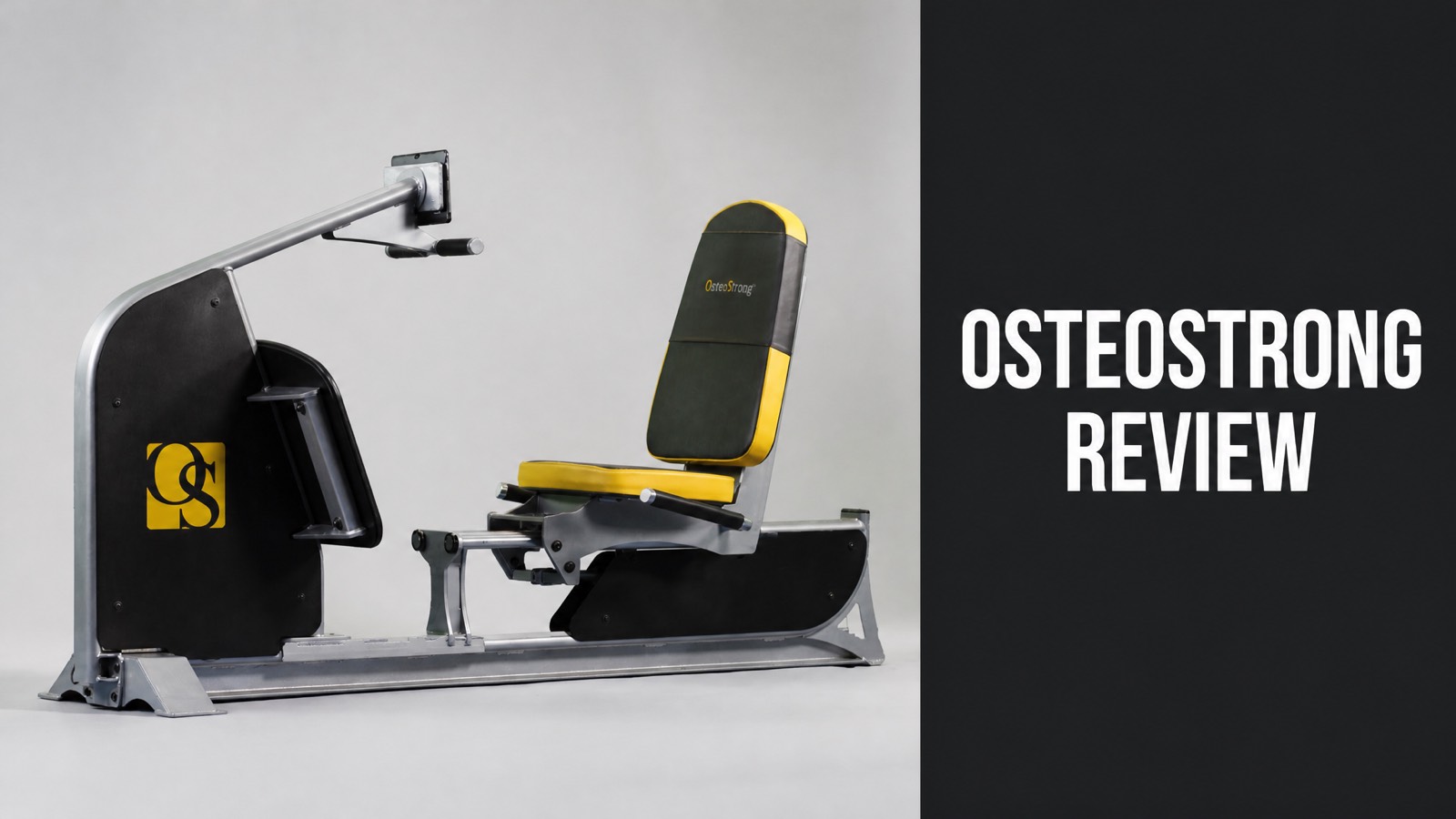
OsteoStrong is a franchised bone-health center that sells weekly 10 to 20 minute sessions on four force-measuring machines. Members push against fixed equipment at maximum effort each visit. Memberships run $149 to $259 per month across the United States, Europe, Asia and Australia.
Research does not yet prove that OsteoStrong raises bone density. A 2025 scoping review found inconsistent effects across nine studies. Members praise the short sessions and coaching. Critics cite price and thin evidence. Safety data is limited, and one physical therapist says strength training works as well for bone loading. See a doctor before joining.
The big picture is simple: OsteoStrong offers convenience, but the proof lags behind the price. This review covers how sessions work, what members say, what memberships cost and what to do first. Every claim below comes from named sources. Our team at Eat Proteins reviews every product this way.
What Is OsteoStrong?
OsteoStrong is a franchised membership center that sells short weekly sessions on four force-measuring machines. Centers operate across the United States, Canada, Europe, Asia and Australia. The company says it is not a gym, diet, supplement, pharmaceutical or medical treatment. Its focus is the skeleton, and each session centers on bone loading and force.
The company calls its method osteogenic loading. That term means stimulating bone growth through brief, high-force effort. Is OsteoStrong a medical therapy? No. The brand says so itself.
OsteoStrong at a Glance:
| Feature | Detail |
|---|---|
| Session length | 10-20 minutes |
| Frequency | Weekly |
| Equipment | Four proprietary machines plus a Vibe Plate |
| Monthly price | $149-$259 |
Who Should Use OsteoStrong?
OsteoStrong targets adults worried about bone loss, especially postmenopausal women and people with osteopenia. Women’s Health says people with chronic pain also benefit most. The company recommends sessions for all ages. Postmenopausal women over 50 face a higher fracture risk, so that group is a strong candidate. Bone mass declines from the early 40s.
Peak bone mass arrives in the early 20s. Decline starts by the early 40s. So, who gains the most? Our team at Eat Proteins points to midlife adults who pair sessions with strength training.
How Does OsteoStrong Work?
OsteoStrong works by asking members to push or pull against fixed machines at maximum effort for one short hold. Each machine measures the force produced. Screens show results in pounds and in multiples of body weight. Trainers coach every attempt and push members toward a target. The goal is a single all-out effort instead of many reps. Effort drives it.
The target is 4.2 multiples of body weight, a threshold the company ties to bone growth. For a 70-kilogram (154-pound) member, that equals 294 kilograms (648 pounds). Sounds extreme, right? Women’s Health notes the motions are tiny, with barely a full rep on each machine.
What Happens in a Session?
A session runs 15 to 20 minutes and follows a fixed circuit of warm-up, four machines and optional recovery tools. A trainer guides stretches on a Vibe Plate first. The machines then cover upper body, lower body, core and posture. Members finish with more stretching and balance work on the plate. Most leave with no sore spots. The whole visit stays brief.
Recovery extras vary by center. Women’s Health lists Normatec compression boots, red light therapy and a PEMF mat. Pay attention to this: one Mayo Clinic Connect member pays $159 instead of $149 for a modality after each session.
Session Steps:
- Warm up on the Vibe Plate with guided stretches.
- Push or pull on the upper body machine.
- Work the lower body machine at maximum effort.
- Finish the core and posture machines.
- Stretch and balance on the plate before recovery tools.
What Are the Benefits of OsteoStrong?
OsteoStrong claims stronger bones, better balance, improved posture and less pain from short weekly sessions. Women’s Health adds agility to the list. Machine screens give instant force feedback, which supports the measurable-results pitch. Claims are not proof. Research quality decides whether the promises hold. Marketing leans on those outcomes heavily.
Here’s why feedback matters. Members see a force number on every attempt. Does a rising number mean denser bone? No. Force output measures strength, while a DXA scan measures bone density.
Does OsteoStrong Increase Bone Density?
No. Research does not yet prove that OsteoStrong increases bone density compared with a control group. A 2025 scoping review in Osteoporosis International found no randomized trials against a control. Effects on bone mineral density were inconsistent across included studies. Safety data was thin, and most studies were small. Conflicts of interest add doubt.
The review screened 1,388 studies and included nine. Five of those were abstracts or unpublished. Seven were observational. Why does that matter? Observational work can’t separate OsteoStrong from medication or lifestyle.
In fact, a February 2025 Greek study reported gains. OsteoStrong funded it. Dr. Lora Giangregorio of the University of Waterloo, as summarized by Melio Guide, found no between-group density analysis. Control participants also self-selected.
Evidence Snapshot:
| Source | Finding |
|---|---|
| 2025 scoping review, Osteoporosis International | Nine studies, inconsistent bone density effects |
| 2025 Greek study, funded by OsteoStrong | No between-group bone density analysis |
| Women’s Health four-session trial | No soreness, pain relief unconfirmed |
Does OsteoStrong Help Pain and Balance?
No. Evidence does not yet confirm pain relief or balance gains beyond member reports. Women’s Health’s tester felt no soreness after four sessions. She was not convinced her lower back pain improved in a month. Maria Hadjidemetriou, 50, calls the program a game changer for her strength and balance. Pain was not a measured outcome in the 2025 scoping review.
Members report real changes. Hadjidemetriou can now jump 30 times and use stairs with less pain. Does that prove the machines caused it? No. She also trains three or four times a week.
What Do OsteoStrong Reviews Say?
OsteoStrong reviews split between enthusiastic members and skeptical experts. Members praise short sessions, friendly staff and measurable strength numbers. Skeptics cite cost and thin research. Yelp reviewers at the Brea center mention improved bone density numbers. A Mayo Clinic Connect member saw no change after a full year. Both camps sound convincing.
The catch? Personal stories can’t isolate OsteoStrong from medication, diet or other exercise. So, treat reviews as signals, not proof. The good news? Patterns across many reviews still tell you something.
What Do Members Praise?
Members praise the short sessions, personal coaching and the added recovery tools. Yelp highlights for the Brea center mention a personable owner who offers guidance throughout the health journey. Two Yelp reviews say bone density numbers improved dramatically. A Central Florida member says sessions help both physically and mentally. The tone runs upbeat.
Dr. Jennifer Glassman, 56, a functional medicine physician, joined after an osteopenia diagnosis in 2021. After one year, she reports no further bone loss. After two years, she reports improved bone density. Is that proof? No. The report is one personal account.
What Members Praise:
- Short weekly sessions
- Hands-on trainer coaching
- Instant force feedback on machine screens
- Recovery tools after each visit
- A friendly, supportive owner
What Are the Common Complaints?
Complaints center on price, long commitments and results that never showed up. One Mayo Clinic Connect member did a full year and saw no change. That member suggested lifting weights with a personal trainer instead. At over $200 per month, the comparison feels fair. Another critic questions the evidence behind the whole model. Cost dominates the criticism.
Here’s the part most people miss. The company recommends 18 months of weekly sessions for bone density gains. Why does that matter? Costs stack up. At $149 monthly, 18 months totals $2,682. At $259, it totals $4,662.
How Safe Is OsteoStrong?
OsteoStrong’s safety remains unproven because published safety data is limited. The 2025 scoping review found only two trials that reported fractures, falls or adverse events. Women’s Health’s tester reported no soreness or pain after four sessions. Still, a small personal report is not a safety study. Safety questions deserve attention before any purchase.
Melio Guide’s physical therapist also cites a lawsuit from a client who suffered a compression fracture. The details of that case sit outside this review. To be clear, our team at Eat Proteins treats it as a reason for caution, not a verdict.
Who Should Avoid OsteoStrong?
Adults with diagnosed osteoporosis, a fracture history or spine pain need a doctor’s approval before attempting maximal-effort pushes. Maximal effort loads the skeleton hard. The research gap on safety makes medical clearance a must. Healthy adults who already strength train face lower stakes, but a check-in still helps. Medical advice should come first.
Medication matters too. The two largest studies enrolled people on anti-resorptive drugs. So what does that mean for you? Tell your doctor about any osteoporosis medication before joining. Medication changes bone density by itself.
Ask Your Doctor First If You Have:
- Diagnosed osteoporosis
- A recent fracture
- Spine or lower back pain
- Current osteoporosis medication
OsteoStrong vs Strength Training: Which Is Better?
Strength training works as well as OsteoStrong for bone loading in the view of one orthopedic physical therapist. Gabby Griffin, DPT, says varied resistance work gives bone the best mix of forces. She is not affiliated with OsteoStrong. Women’s Health notes that not all experts see OsteoStrong as more effective. She favors consistent progressive training.
OsteoStrong needs one short visit a week. Strength training needs several sets and reps. Which wins on convenience? OsteoStrong. Which wins on evidence? Strength training has broader expert backing in these sources.
OsteoStrong vs Strength Training:
| Factor | OsteoStrong | Strength Training |
|---|---|---|
| Weekly time | 10-20 minutes | Several sets and reps |
| Monthly cost | $149-$259 | Varies by gym or trainer |
| Research base | Small, inconsistent studies | Backed by Griffin |
| Equipment | Four proprietary machines | Weights, machines or body weight |
Can Jumping Exercises Replace OsteoStrong?
Yes. Jumping exercises can deliver a similar bone-loading impulse in the view of one physical therapist. Gabby Griffin says 25 jumping jacks give almost the same impulse. A little plyometric bouncing gives bones good load. That costs nothing and needs no membership. Griffin is not affiliated with the company. Impact exercise suits healthy adults best.
Pay attention to this: jumping is high-impact. Members with osteoporosis or a fracture history need a doctor’s input first. Hadjidemetriou, for example, could not jump before joining OsteoStrong. So, who benefits? Healthy adults, mostly.
How Much Does OsteoStrong Cost?
OsteoStrong memberships cost between $149 and $259 per month, plus single-session drop-in rates at some centers. Women’s Health reports those prices across centers in the United States, Europe, Asia and Australia. Health insurance does not typically cover sessions. Medical savings accounts sometimes apply. Prices depend on the center and the extras you add.
Prices vary by location and add-ons. A Central Florida member pays $149 base and $159 with a recovery modality. Another Mayo Clinic Connect member cites over $200 monthly. In plain English: budget $150 to $260 a month.
Estimated Membership Cost:
| Plan Length | At $149 | At $259 |
|---|---|---|
| 6 months | $894 | $1,554 |
| 12 months | $1,788 | $3,108 |
| 18 months | $2,682 | $4,662 |
Is OsteoStrong Worth the Price?
No. OsteoStrong is hard to justify on price while its evidence stays inconsistent. A full 18-month plan runs $2,682 to $4,662. The 2025 scoping review found inconsistent bone density effects across trials. One Mayo Clinic Connect member who paid for a full year saw no change. Strength training costs far less at many gyms. Costs add up quickly over time.
The exception? Some members value coached, low-impact sessions and recovery tools. Women’s Health says people with chronic pain or osteopenia benefit most. Bottom line: pair sessions with strength training, and confirm results with a DXA scan after six months.
Should You Try Eat Proteins?
Yes. Eat Proteins cuts through the hype so you pay for results, not promises. Our team reads the studies, the reviews and the price tags. You get a plain verdict on OsteoStrong and on what to do next. Don’t sign a long plan without that verdict in hand. Your bones, your budget and your time deserve a straight answer. Our experts check every claim first.
Bottom line: the next move is yours. Book a DXA scan first. Then compare the monthly cost with a trainer. Our experts at Eat Proteins back the plan you can actually stick with.
What Should You Do Before Joining OsteoStrong?
Smart buyers get a baseline DXA scan, clear the plan with a doctor and test a single session first. Women’s Health recommends a DXA scan or blood tests after six months to confirm changes. A baseline makes that comparison meaningful. Ask the center for its published results, its cancellation terms and its pricing tiers. Confirm everything in writing.
Then compare options. Ask what you’d pay a trainer per month. Does the gap justify the machines? Only if coached, low-impact sessions matter to you. The Brea center page advertises a free session, so test one before you commit.