
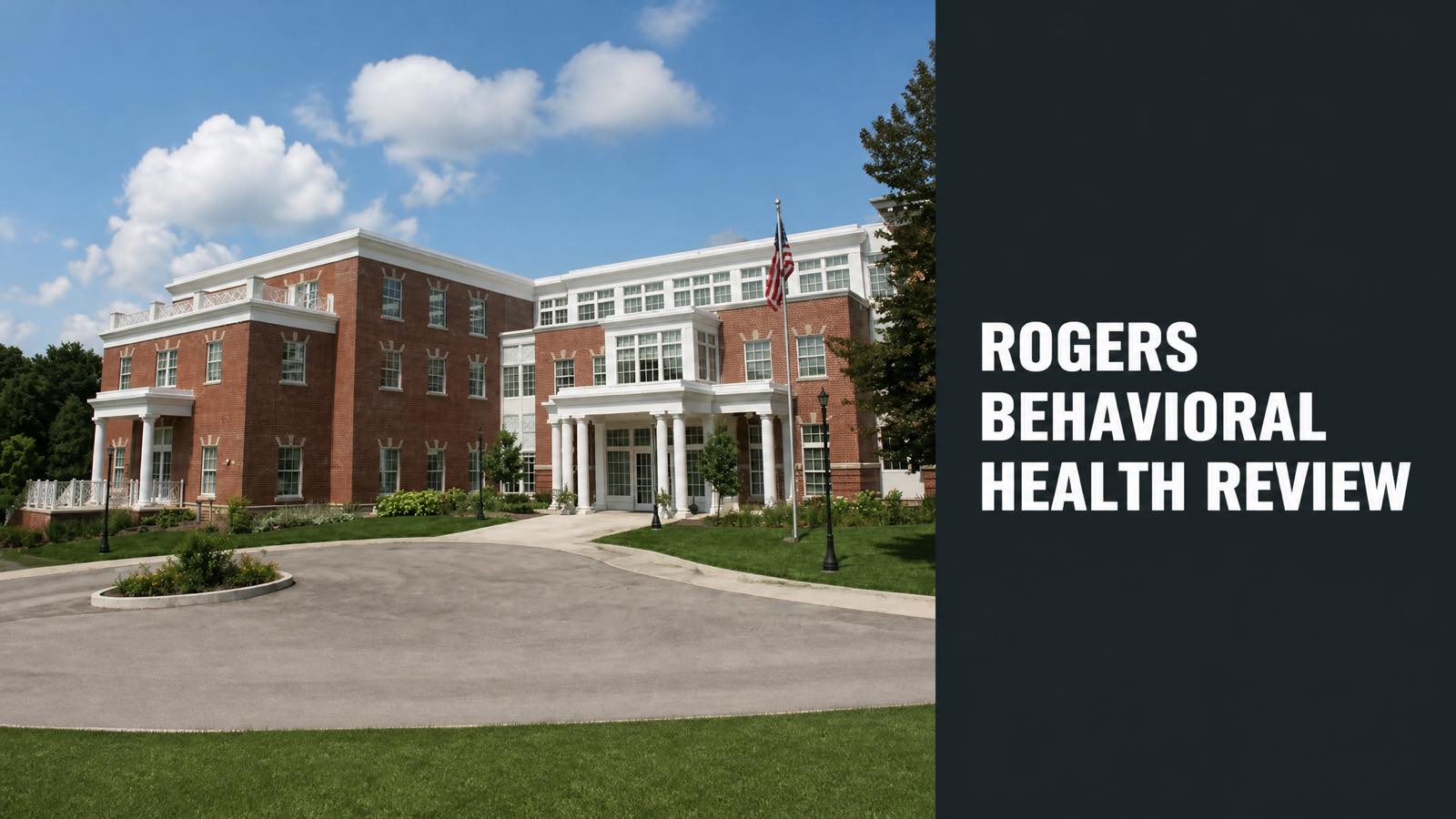
Rogers Behavioral Health is a not-for-profit mental health and addiction provider founded in 1907. It treats children, teens, and adults at about 20 locations. A major campus sits in Oconomowoc, Wisconsin. This review covers what patients report, what insurance covers, and what care costs.
Rogers treats eating disorders, OCD, anxiety, depression, and trauma. Care moves from hospital to residential to outpatient. Patients praise therapy depth and discharge planning. They criticize staffing, thin inpatient programming, and unclear waitlists. Insurance works for many patients, but pricing stays unpublished, so verify coverage first.
The big picture is mixed but credible. Rogers is a legitimate nonprofit with uneven patient feedback by program and year. Read on to learn who it suits, what insurance covers, how admission works, and which questions to ask before any stay begins, and what to expect from a first call.
What Is Rogers Behavioral Health?
Rogers Behavioral Health is a not-for-profit provider of mental health and addiction treatment founded in 1907. The system treats children, teens, and adults. Its care covers eating disorders, OCD, anxiety, depression, trauma, and substance use. Rogers runs about 20 locations across several states. Reviews here cover care, access, and cost. Read on.
A major campus sits in Oconomowoc, Wisconsin. Regional sites operate in California, Florida, Georgia, Illinois, Minnesota, Pennsylvania, Tennessee, and Washington. Wisconsin alone holds three inpatient hospitals, 14 residential programs, and nine outpatient centers, according to Rogers.
Rogers at a Glance:
| Detail | Fact |
|---|---|
| Founded | 1907 |
| Status | Not-for-profit |
| Locations | About 20 |
| Ages served | Children, teens, adults |
| Home state | Wisconsin |
To be clear, Rogers is a care system, not a supplement or a gadget. Our team at Eat Proteins reviews it the way a skeptical patient or parent would. Does that change the rules? Slightly. Evidence comes from public records and patient accounts, not lab tests.
Who Does Rogers Treat?
Rogers treats children, teens, and adults across several mental health and addiction conditions. Its own materials list depression and mood disorders, eating disorders, addiction, OCD and anxiety disorders, trauma, and PTSD. Separate programs exist for children, teens, and adults. Each age group gets its own care team. Eligibility varies by site. Ask first.
The eating disorder program accepts anorexia, bulimia, binge eating disorder, and ARFID. Reviewers on ED Treatment Review say it welcomes all genders. A separate trauma residential program also exists. Some patients move from the eating disorder track into trauma care.
How Does Rogers Behavioral Health Work?
Rogers works as a stepped system of care that moves patients between hospital, residential, and outpatient settings. A patient starts at the level that matches symptom severity. Staff then step care up or down as needs change. Reviewers say many people move back up to inpatient during treatment. Each level has its own team and rules. Ask about each one.
Admission begins with an assessment. Reviewers say Rogers staff drive patients to residential care when they move straight from inpatient. Inpatient also has a discharge planner. That planner works to line up outside providers after discharge.
Levels of Care:
- Inpatient hospital care
- Residential treatment
- Partial hospitalization (PHP)
- Intensive outpatient (IOP)
- Outpatient care
Here’s the thing: step-down isn’t always automatic. One reviewer says Rogers pushes partial hospitalization unless insurance won’t cover it. Another says admissions set up outpatient care even for an out-of-town patient. Why does that matter? Continuity keeps one team involved.
What Levels of Care Does Rogers Offer?
Rogers offers inpatient, residential, partial hospitalization, intensive outpatient, and outpatient care. Recovery.com counts five levels of care across the system. Not every site offers every level. Availability depends on the condition, the age group, and the location. Reviewers describe moving between levels during one course of treatment. Ask each site.
Rogers announced two new residential centers on its Oconomowoc campus. They serve young adults and adults with eating disorders, OCD, anxiety, and depression. The expansion adds residential capacity. Reviewers expect it to ease some access problems.
The adult eating disorder inpatient unit now occupies the old general adult unit, one reviewer says. Long-time patients notice such changes. Reviewers also mention a level system on inpatient that arrived in recent years.
What Conditions Does Rogers Treat?
Rogers treats eating disorders, OCD, anxiety, depression, trauma, PTSD, and addiction. Programs exist for children, teens, and adults. Each condition has its own track and care team. Rogers describes its approach as evidence-based. Reviews of individual programs show how that plays out day to day. Admission rules differ by program. Ask which track fits.
Eating disorder care covers anorexia, bulimia, binge eating disorder, and ARFID. OCD and anxiety care covers panic disorder, social anxiety, generalized anxiety, and PTSD. Mood disorder and addiction care run as separate programs.
Conditions Treated:
| Condition | Program Notes |
|---|---|
| Eating disorders | Anorexia, bulimia, binge eating, ARFID |
| OCD and anxiety | OCD, panic, social and generalized anxiety |
| Trauma and PTSD | Separate trauma residential program |
| Depression and mood | Care for adults, teens, and children |
| Addiction | Integrated with co-occurring care |
Co-occurring conditions get attention too. Does Rogers treat them together? In many cases, yes. A 2021 statement from Rogers leadership described integrated treatment of addiction and co-occurring disorders across inpatient, residential, and outpatient options.
Does Rogers Treat OCD and Anxiety?
Yes. Rogers offers specialized OCD and anxiety programs for children, teens, and adults. Recovery.com lists treatment for OCD, OC-spectrum disorders, generalized anxiety, panic disorder, social anxiety, and PTSD. Separate listings exist for adult and youth tracks at Oconomowoc, Wisconsin. Youth care spans children and teens. Adults use a separate track.
One caution comes from reviewers. A forum poster asked whether older adults who aren’t young adults can still reach OCD residential care for primary OCD. The answer wasn’t clear. Eligibility changes, so confirm current rules with Rogers admissions.
What Do Rogers Behavioral Health Reviews Say?
Reviews of Rogers are mixed, with praise for therapy depth and complaints about staffing and access. Detox.net shows a 4.0 rating from 57 reviews for the Herrington Recovery Center. Patients on ED Treatment Review describe both strong care and frustrating gaps in the same stay. Scores differ by program, site, and year. Recent reviews matter most here.
Detox.net scores the Herrington Recovery Center 4.0 overall. Treatment effectiveness also scores 4.0, and meals and nutrition score 4.2. One patient calls a 2018 stay first-class treatment. Another site, Yelp, shows a split of wonderful and negative stories.
Review Themes:
| Theme | What Reviewers Say |
|---|---|
| Therapy | More skills education than a prior program |
| Discharge | Planners arrange outside providers |
| Food | Close to typical hospital food |
| Staffing | Reports of understaffing |
| Admissions | Waitlist shared only after assessment |
Bottom line: patient reviews vary by program and year. Why? Rogers runs dozens of programs. A stay in 2018 differs from one in 2025. Read recent reviews for the exact program before you decide.
What Do Patients Praise?
Patients praise the skills-based therapy, discharge planning, and access for people on state insurance. One reviewer says Rogers offers more therapy and skills education than a previous program. Another says staff helped set up care before leaving the area. Praise comes mostly from patients who completed a full course of care. Staff care earns mentions.
In fact, art therapy earns a nod from one inpatient reviewer as actually helpful. Others call Rogers an important resource for people on state insurance. Many patients carried Medicare or Medicaid, one reviewer says.
What Are the Common Complaints?
Patients complain about understaffing, thin inpatient programming, hospital-style food, and admissions decisions. One inpatient reviewer says groups were mostly recreational, nutrition, CBT, and art therapy once or twice weekly. The reviewer wanted more. Complaints center on the inpatient and residential experience. Staffing recurs often in reviews.
The bad news? Another reviewer says Rogers has denied admission or discharged patients often lately. Others report tube feeding when intake falls short, at any body size. These are individual accounts. They aren’t audited data.
Here’s why that matters: our research source skews toward eating disorder patients. That’s the honest limit. Does it hide problems elsewhere? Possibly. Reviews for other Rogers programs were thinner in our data.
Does Rogers Behavioral Health Accept Insurance?
Yes. Rogers accepts insurance, and patients report coverage through private plans and state programs. Rogers also lists an insurance pricing calculator and a good faith estimate page on its site. Coverage depends on the plan, the program, and the location. Verification with admissions comes first. Plans differ widely. Call admissions before any stay begins.
One patient says insurance covers Rogers only for eating disorder treatment. Another lives in Wisconsin and says the plan covers only Rogers. Why verify first? Plans differ widely, and one denied claim changes the whole stay.
Coverage Notes:
- Medicare and Medicaid reported for eating disorder care
- Private plan coverage varies by program
- Single-case agreements listed by ED Treatment Review
- Financial aid through the Rogers foundation
Does Rogers Take Medicare and Medicaid?
Yes. Rogers takes Medicare and Medicaid for eating disorder care, based on patient reports. ED Treatment Review tags the center as accepting both. One patient with Wisconsin Medicaid went through inpatient, partial hospitalization, and intensive outpatient care in December 2023. Other reports span 2023 to 2025. Always confirm current rules directly.
Another reviewer heard that Rogers dropped government insurance. The Medicaid patient above disproved that rumor. This is important: rules change over time. Confirm current status with admissions before you plan around it.
How Much Does Rogers Behavioral Health Cost?
Rogers does not publish flat prices, and cost depends on the level of care and the insurance plan. Inpatient, residential, and outpatient stays bill differently. The Rogers site links an insurance pricing calculator and a good faith estimate page. Our research found no verified dollar figures. Costs differ by plan. Ask for an estimate before any admission.
Steps to Estimate Your Cost:
- Call Rogers admissions to request a full assessment.
- Share your insurance details for verification.
- Use the Rogers insurance pricing calculator.
- Request a good faith estimate in writing.
- Ask the foundation about financial assistance.
So why no number here? Our experts at Eat Proteins refuse to guess. Treatment bills vary by stay length and coverage. A made-up average would mislead families.
Does Rogers Offer Financial Aid?
Yes. The Rogers Behavioral Health Foundation provides financial assistance to clients who need help covering the cost of care. Recovery.com confirms this program. ED Treatment Review also tags Rogers as offering financial aid. Aid amounts and rules aren’t public, so ask admissions directly. Ask early in the process. Terms differ by case and program.
Rogers also appears under single-case agreements on that review site. Such agreements can cover out-of-network care in some cases. And it gets better: asking costs nothing. Ask admissions whether one fits your plan.
Is Rogers Behavioral Health Legit?
Yes. Rogers is a legitimate, long-established not-for-profit provider founded in 1907. Its foundation holds 501(c)(3) status. Newsweek and Statista ranked its Wisconsin sites first and second among state addiction treatment centers in 2021. Patient reviews remain mixed, as covered above. Ask for current accreditation details. Verify other claims too.
The Newsweek list ranked West Allis No. 1 and Oconomowoc No. 2 in Wisconsin. Rankings weighed service quality, reputation, and accreditation. Does that cover every program? No. The recognition covers addiction treatment only.
Trust Signals:
| Signal | Detail |
|---|---|
| Founded | 1907 |
| Tax status | Not-for-profit, 501(c)(3) foundation |
| Newsweek 2021 | West Allis No. 1, Oconomowoc No. 2 in Wisconsin |
| Detox.net rating | 4.0 from 57 reviews |
What Type of Facility Is Rogers?
Rogers operates as a hybrid of psychiatric hospitals, residential programs, and outpatient clinics. The system runs three inpatient behavioral health hospitals in Wisconsin. Residential programs sit in separate houses and centers. Outpatient centers serve patients who live nearby. Each setting follows its own rules and routines. Ask which setting applies.
Rogers inpatient is a voluntary program, one reviewer says. Patients with active safety concerns or medical instability can’t just sign themselves out. In plain English: leaving isn’t always instant. Ask admissions how leaving works at each level.
Who Should Avoid Rogers Behavioral Health?
Rogers does not suit patients who need immediate admission or a guaranteed bed. Reviewers say admissions won’t share waitlist length before a full assessment. Others report denied admissions and early discharges. Rogers delivers clinical care in a hospital-style setting, and it isn’t a resort. Expect structure and plan ahead. Call early for the options.
Short answer: families wanting a luxury setting face a mismatch. Reviewers describe hospital-style food and clinical routines. What’s more, strict rules apply on belongings. One patient asked whether ear piercings block admission to adult eating disorder inpatient.
Ask Before Admission:
- Waitlist length for the exact program
- Rules on belongings and restrictions
- Insurance verification and single-case agreements
- Discharge planning and step-down options
- Current eligibility by age and condition
Patients with strict dietary or medical restrictions need to ask early. One reviewer worried that Rogers wouldn’t honor all their restrictions. Does that rule Rogers out? No. It means asking admissions before the stay.
How Long Is the Rogers Waitlist?
Rogers does not publish waitlist lengths, and admissions share timing only after a full assessment. Reviewers find this frustrating. Several ask for current wait times for adult inpatient and residential care. No verified figure exists in public sources, so none appears here. Waits likely differ by program. Call early and ask about the exact program.
The new Oconomowoc residential centers aim to expand access. Timing still varies by program and age group. So what’s the move? Call early and ask about the specific program.
Why Trust Eat Proteins for Rogers Reviews?
Eat Proteins builds reviews from public records, patient accounts, and plain verification. Our team at Eat Proteins separates marketing claims from patient reports. We flag gaps instead of filling them. You deserve a review that admits what it can’t confirm, and this one does that. Every claim traces to a public source. Compare it with other reviews.
Our experts found a legitimate nonprofit with mixed patient feedback. That’s the honest picture. Is one review enough to choose a program? Never. Compare several recent accounts first.
What Is the Next Step?
The next step is a call to Rogers admissions for a full assessment. Bring your insurance card and a list of questions. Waiting rarely helps. If safety is at risk right now, call or text 988 or contact emergency services first. Eat Proteins researched Rogers so you can ask sharper questions. Use this review as your checklist. Take it one step at a time.
The good news? You don’t have to decide alone. Eat Proteins keeps a growing library of reviews to compare. Read them, ask questions, and choose with confidence.