
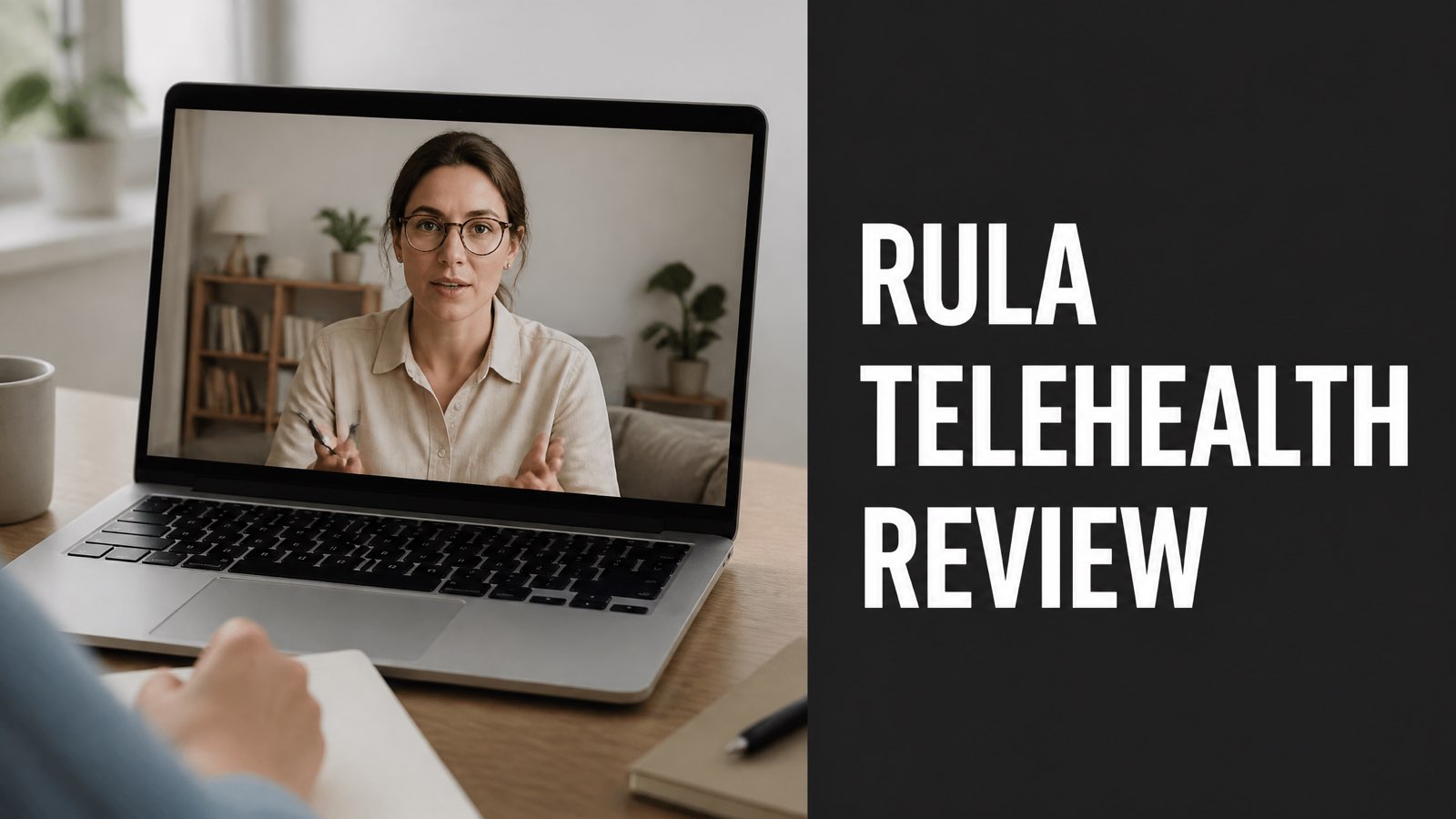
Rula Telehealth is an online mental health platform that matches patients with licensed therapists and psychiatrists in all 50 states. The company, formerly called Path Mental Health, runs sessions over secure video and accepts many insurance plans. Patients choose their own provider.
Our review covers how Rula works, which services it offers, and what real users say. Patients praise easy booking, fast openings, and strong therapists. Complaints center on billing gaps and login glitches. Insured patients pay about $15 per session. Self-pay rates start at $150. Rula also offers psychiatry and family therapy. Therapy starts at age 5.
The pattern is clear: Rula rewards patients with in-network coverage and punishes surprise bills. Read on to learn what each service costs, who should look elsewhere, and how to check your own price before you book. Expect honest numbers, cited sources, and a clear verdict on fit.
What Is Rula Telehealth?
Rula Telehealth is an online mental health platform that links patients with licensed therapists and psychiatrists in all 50 states. The company launched in 2019 as Path Mental Health. Its network lists more than 21,000 licensed providers across 80 clinical specialties. Patients meet their clinicians over secure video, not in an office. Care is remote.
Rula works as a provider group, not a bare directory. In fact, the company oversees its clinicians directly and runs one shared records system. Outcome questionnaires are completed at every appointment. Why does that matter? Therapists can track progress from one session to the next.
Is Rula the Same as Path Mental Health?
Yes. Rula is the same company as Path Mental Health, which rebranded under the new name in 2024. The rebrand arrived alongside a wider service lineup. Psychiatry and medication management joined the menu. Everyday Health and Choosing Therapy both call Rula formerly known as Path, so the two names point to one business. Only the brand name changed in 2024.
The founders are Josh Bruno, Gabriel Diop, and Greg Moore. They started the company after personal losses tied to gaps in mental healthcare. To be clear, the core therapy service stayed intact after the name change.
How Does Rula Work?
Rula works as a telehealth platform where patients complete a short intake, review matched providers, and book sessions over Zoom. Most appointments are virtual. Patients receive a secure video link one to two days before each session. Many providers show openings as soon as the next day, so waiting lists stay short. Booking takes only a few minutes online.
Sessions usually last 60 minutes, though patient or provider can adjust that length. Here’s the thing: the platform also asks for brief check-ins between sessions. One reviewer rated her symptoms weekly in about a minute. Why bother? The therapist gets a quick read on progress.
How Do You Find a Therapist on Rula?
Patients find a therapist by entering basic details, after which Rula builds a list of in-network providers in their state. Users then filter by specialty, language, background, or treatment approach. Each profile includes a biography to read before booking. Patients pick their own provider from that list. Patients can also switch to a new provider later.
Everyday Health’s reviewer chose a social worker from the list and booked the following week. Rula also lets patients switch providers if the first match fails. So what does sign-up involve? The steps below show the flow.
How to Start:
- Click Get Started and enter your birthday, state, and insurance details.
- Pick the type of therapy you want.
- Review the matched provider list and read the biographies.
- Book a session and add a card for any out-of-pocket costs.
- Join the Zoom link sent before your appointment.
What Services Does Rula Offer?
Rula offers individual therapy, couples counseling, family therapy, psychiatry, and medication management through its provider network. Therapy is open to anyone above age 5. Psychiatry is open to patients aged 13 and older. Rula lists care for more than 90 conditions. Anxiety, depression, trauma, ADHD, OCD, and bipolar disorder all appear. Scope is wide.
Rula is outpatient care by video. Pay attention to this: that matters in an emergency. If you face a crisis, call or text 988 instead of waiting for an appointment.
Key Services:
- Individual therapy in 60-minute video sessions
- Couples and family counseling
- Psychiatry and medication management for ages 13 and up
- Care for more than 90 conditions
- In-person visits in select areas
Does Rula Offer Psychiatry?
Yes. Rula expanded psychiatry to all 50 states, with medication management and evaluations for patients aged 13 and older. The first intake runs 60 minutes, and follow-ups run 30 minutes. Psychiatric providers follow the same matching model as therapists. Patients browse the list and choose a clinician themselves. The model keeps booking simple and familiar.
State rules govern controlled substances. Stimulants like Adderall and benzodiazepines like Xanax face tighter limits. Check your state’s guidelines before you book. Does Rula guarantee a prescription? No. A provider decides if medication fits.
Does Rula Provide Family Therapy?
Yes. Rula offers family therapy, a service that many online therapy platforms leave out. Self-pay sessions cost $165 each, and several insurance plans cover them too. Family sessions run on a shared Zoom link. Relatives can join from different locations and devices, which helps when schedules clash across households. Each person can log in from home.
Everyday Health’s reviewer booked three family sessions alongside individual therapy. Her 15-year-old attended all three. The format felt like group therapy, with each person checking in first. What’s more, she used a separate therapist for each service.
What Do Rula Reviews Say?
Rula reviews lean positive on provider quality and booking ease, with billing as the main source of complaints. Trustpilot shows 4.5 out of 5 stars across more than 5,000 reviews. Choosing Therapy gave Rula 3.5 out of 5. Most negative feedback targets the platform itself. Individual therapists draw far fewer complaints. Reviewers call it well built.
Rating Snapshot:
| Source | Score | Detail |
|---|---|---|
| Trustpilot | 4.5 out of 5 | 5,316 reviews, 82% five-star |
| Choosing Therapy | 3.5 out of 5 | Cost and privacy scored 5 out of 5 |
| Better Business Bureau | 148 complaints | Logged over three years |
Trustpilot also shows that Rula replied to 99% of negative reviews. But the company holds a paid Trustpilot subscription. In plain English: weigh that score alongside other sources. Don’t rely on one number.
What Are the Positive Experiences With Rula?
Patients most often praise easy booking, fast appointment availability, and the quality of individual therapists. Recent Trustpilot reviewers describe simple scheduling, transparent pricing, and biographies that made choosing easy. One user said insurance covered most of each session. Another has stayed in therapy for over a year. Praise stays steady.
Rula’s own data adds weight. Specifically, the company reports that 76% of patients show meaningful improvement within 8 sessions. Rula also claims 97% match satisfaction. Should you take those numbers at face value? Not fully. They come from Rula, so treat them as company claims.
What Are the Common Complaints About Rula?
The most common complaints center on billing surprises, gaps between insurance estimates and final charges, and login glitches. The Better Business Bureau logged 148 complaints over three years. Many involved final charges that differed from the first estimate. Rula says insurers set final copays after claims process. Estimates and bills often differ.
Everyday Health’s reviewer confirmed the missed-appointment rule. The site requires a card on file and an agreement to an automatic $99 charge for no-shows. Patients need to read the cancellation policy before booking. The bad news? Few people do.
Common Complaints:
- Final charges that differ from the first estimate
- A $99 charge for missed appointments
- Login and scheduling glitches
- Payment timing complaints from some users
Does Rula Accept Insurance?
Yes. Rula is in-network with most major insurers, such as Optum, Cigna, Aetna, Anthem, UnitedHealthcare, and many Blue Cross plans. Its homepage claims in-network status with more than 170 plans nationwide. Older pages cite 120 or 100 plans. The exact count varies by source and date, so confirm your own plan first. Providers set their own plan lists, though.
Acceptance depends on the individual provider. Everyday Health lists this as a con. Why does it matter? A plan can work with one therapist and fail with another. So filter providers by insurance before booking. Rula also verifies coverage and promises a cost estimate before sessions begin.
Plans Named by Rula or Reviewers:
- Aetna
- Cigna
- Optum
- UnitedHealthcare
- Anthem
- Blue Cross plans
- Kaiser
What Does a Session Cost With Insurance?
Insured patients pay an average of $15 per session, though the real amount follows each plan’s copay and deductible. Choosing Therapy notes that copays typically run from $0 to $50. The $15 average comes from Rula’s own website. Individual costs vary from plan to plan and from provider to provider. Plans with high deductibles cost patients more per visit.
Here’s the catch: carriers can update deductible amounts after a claim processes. A final balance can then exceed the first estimate. Can Rula override that? No. The insurer sets the final amount. HSA and FSA funds do work for out-of-pocket costs.
How Much Does Rula Cost Without Insurance?
Rula charges $150 for an individual therapy session and $165 for couples or family therapy when patients self-pay. Psychiatry costs $225 for the initial 60-minute visit and $175 for 30-minute follow-ups. Rula bills after each session. Rula offers no free consultation, subscription, or sliding scale. Payment arrives after every visit, not in advance.
Self-Pay Rates:
| Service | Length | Price |
|---|---|---|
| Individual therapy | 60 minutes | $150 |
| Couples or family therapy | 60 minutes | $165 |
| Psychiatry intake | 60 minutes | $225 |
| Psychiatry follow-up | 30 minutes | $175 |
Everyday Health says Rula’s self-pay prices run higher than other online platforms. Its reviewer paid $150 per individual session and $160 for a family session. Rates also vary by state and plan. For example, check your own state’s price before you commit.
Is Rula Worth the Price?
Yes. For insured patients, Rula is worth the price at an average of $15 per session. Self-pay patients face a steeper bill. Choosing Therapy scored online therapy cost 5 out of 5. Everyday Health flagged self-pay rates as higher than rivals. Insurance status decides the value for each patient. Plans with low copays make Rula an easy choice for most patients.
Without insurance, the math changes. Four weekly sessions at $150 cost $600. So what’s the move? Check your plan first, then compare other platforms. On Trustpilot, Grow Therapy scores 4.6, Talkspace 4.4, and BetterHelp 3.8.
Is Rula Legit?
Yes. Rula is a legitimate provider group that employs licensed clinicians and bills insurers directly. The company ran for years under its Path name. Choosing Therapy scored its privacy and HIPAA practices 5 out of 5 and its reliability 4 out of 5. Rula reports more than 5 million completed sessions. Reviewers describe real sessions with real therapists.
Legit doesn’t mean flawless. The complaints center on billing and logins, not on fake therapists. Is that a dealbreaker? For most patients, no. But check the fee rules and your insurance estimate first.
Who Should Look Elsewhere?
Some patients fit poorly with Rula, such as people in crisis, out-of-network patients, and anyone wanting a free trial. The platform provides outpatient care by video. Rula does not replace emergency help. Call or text 988 in a crisis, and don’t wait for a scheduled session. Anyone needing urgent or in-person care needs a different option right away.
Choosing Therapy scored the interface 2 out of 5 and extra features 1 out of 5. So don’t expect a toolbox of self-help extras. Rula focuses on matching and live sessions. Here is what that means for the groups below.
Poor Fits:
- People in a mental health crisis
- Patients whose insurer is not in-network
- Anyone who wants a free consultation or subscription pricing
- Patients seeking stimulants where state rules limit prescribing
Why Should You Trust Eat Proteins?
Our team at Eat Proteins reviews each service using public sources, independent testers, and verified user feedback. We compare pricing, insurance details, and complaint patterns side by side. Our experts flag company claims as claims. The approach keeps this Rula review grounded in what reviewers actually report. We read the fine print so you can skip it.
We also name the weak spots. Billing surprises and self-pay prices matter, so they appear in plain view. The good news? You get the full picture before you spend a dollar.
Should You Try Rula?
Yes. If your insurance is in-network, Rula delivers fast matching, wide provider choice, and low per-session costs. Self-pay patients compare rates first. Our coaches at Eat Proteins say therapist fit beats every other factor. Plan to switch if the first match feels wrong, since Rula lets patients change providers. Rula offers an instant cost estimate.
Don’t wait on a hunch. Run your plan through Rula’s instant cost estimate first. The estimate takes minutes. Then book the first open slot and judge your therapist in session one. Ready to find your fit? Start today.