
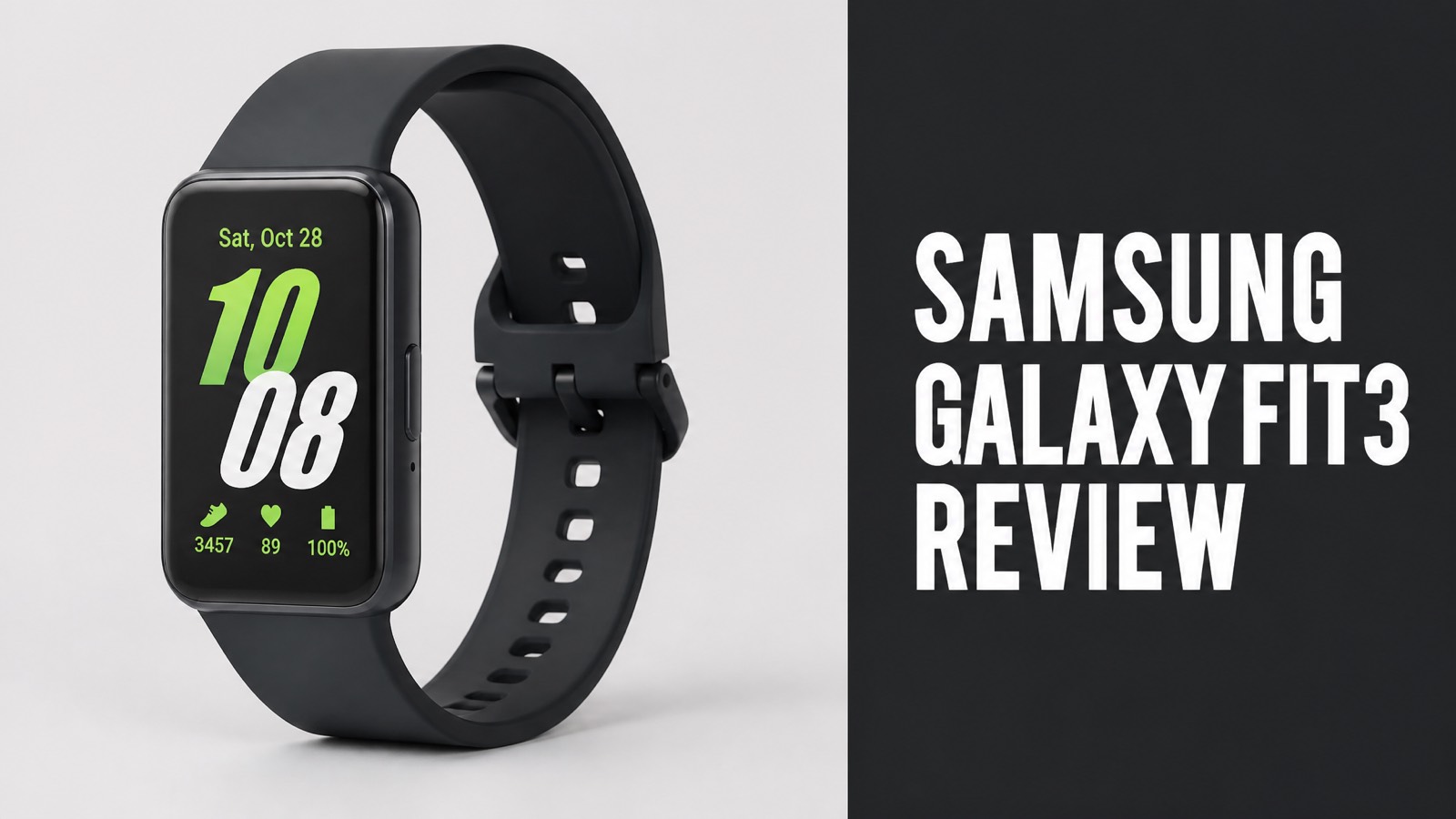
The Samsung Galaxy Fit3 is a budget fitness tracker with a 1.6-inch AMOLED screen. It tracks over 100 workouts, heart rate, sleep, stress, and blood oxygen. Samsung built it as the successor to the Galaxy Fit2. The tracker pairs with Android phones, and Samsung phones give the smoothest setup.
The Fit3 is accurate for steps and heart rate in most tests. The battery runs about 7.5 days with the always-on display off. The sleep data shows small gaps on some nights, which can understate your total rest. There is no built-in GPS, and the charging cable is proprietary. Prices range from $60 to $149 across retailers, so smart deals matter a lot.
Reviewers split on the Samsung-first setup, yet most praise the value at $70 or less. Next, you will see how the Fit3 compares with the Fitbit Inspire 3 and the Amazfit Band 7. Read on to learn whether this tracker fits your phone, your goals, and your budget before you spend a dollar.
What Is the Samsung Galaxy Fit3?
Samsung Galaxy Fit3 is a budget fitness tracker with a 1.6-inch (40.6 mm) AMOLED touch screen. Samsung launched it as the successor to the Galaxy Fit2. The new screen is 45% wider than before. In fact, far more data fits on your wrist at once. The curved 2.5D glass and aluminum frame give the tracker a clean, premium look at a very low price today.
The case is slim, light, and rectangular. The case measures 1.69 by 1.13 by 0.39 inches (43 by 29 by 10 mm). The weight is 0.65 ounces (18 grams). The aluminum body comes in dark gray, pink, or silver.
Who Is the Samsung Galaxy Fit3 For?
Samsung Galaxy Fit3 suits Android users who want simple health tracking at a low price. Walkers, gym-goers, and casual runners get the most value. Heavy data fans and triathletes will want a full smartwatch with built-in GPS and deeper training metrics instead. Our experts at Eat Proteins call it a strong first tracker for building a daily movement habit.
Here’s the thing: iPhone owners are out. The tracker pairs only with Android 10 or later phones that have 1.5 GB of memory. Does a Samsung phone matter? Yes, because snoring detection and camera control work only with one.
How Does the Samsung Galaxy Fit3 Work?
Samsung Galaxy Fit3 reads your body through five built-in sensors. An optical heart rate sensor, an accelerometer, a gyroscope, a barometer, and a light sensor feed the tracker. The tracker uses them to detect steps, workouts, sleep, stress, and blood oxygen around the clock. A companion app charts every metric over time, so you can spot your trends.
The software is a simplified FreeRTOS, not Wear OS. Why does that matter? Simpler software keeps the battery going. The look mirrors Samsung’s newer watches, but there is no app store. To be clear, you also get no tap-to-pay. The trade-off keeps the price and the power draw low.
Does the Samsung Galaxy Fit3 Need a Samsung Phone?
No. The Samsung Galaxy Fit3 works with any recent Android phone, though Samsung phones make setup far smoother. One reviewer paired it with a Pixel 9 Pro Fold. Expect extra permission prompts on those phones. Samsung itself pitches the tracker as a Samsung-first product. Samsung phones also unlock snoring detection and camera control from your wrist.
Setup needs the Galaxy Wearable and Samsung Health apps. On non-Samsung phones, a reviewer reported three apps and a Samsung account. Is the process painful? For some buyers, yes. Our team at Eat Proteins suggests budgeting ten minutes.
Setup Steps:
- Install the Galaxy Wearable app on your Android phone
- Pair the tracker through Bluetooth and accept the permissions
- Install Samsung Health and sign in with a Samsung account
- Pick your tiles, watch face, and emergency SOS contacts
What Features Does the Samsung Galaxy Fit3 Have?
Samsung Galaxy Fit3 tracks more than 100 workout types plus heart rate, blood oxygen, stress, and sleep. The tracker also adds heart rate variability, fall detection, and a route tracker over the Fit2. Water resistance is 5ATM and IP68, which means swim-ready protection up to 164 feet (50 meters). Customizable tiles reorder your key health screens.
Notifications show on the screen, and you can control music and your phone camera from your wrist. The tracker also offers an optional always-on display and cycle tracking. But don’t expect a speaker, a microphone, or an ECG.
Key Features:
- 1.6-inch AMOLED touch screen
- 100+ workout modes with automatic detection
- Heart rate, SpO2, stress, and sleep tracking
- Fall detection and emergency SOS button
- 5ATM and IP68 water resistance
- Barometer for elevation data
Does the Samsung Galaxy Fit3 Have GPS?
No. The Samsung Galaxy Fit3 has no built-in GPS and relies on your phone for route data. Without your phone, runs still log heart rate, cadence, pace, distance, and steps. The tracker simply cannot draw your route on a map, so carry your handset on every outdoor workout. Reviewers still call the phone-assisted tracking good enough for casual outdoor use.
Testers found the phone-free numbers close. GearLab saw distance run about 5% short on average. The real-time pace jumped around, though. The average pace still matched the baseline. Bottom line: fine for casual runners.
Is the Samsung Galaxy Fit3 Accurate?
Yes. The Samsung Galaxy Fit3 delivers accurate step counts and heart rate readings for its price. GearLab counted a half-mile (0.8 km) walk of over 1,200 steps and saw the tracker miss by one step. PCMag found daily step totals within a couple of hundred of an Apple Watch Ultra 2. Basic daily data is solid. The Fit3 also records cadence and elevation.
Auto-detection is the weak spot. PCMag saw no automatic walk recordings in ten days of testing. GearLab saw runs picked up after a delay of several minutes. So, start workouts by hand. The tap takes two seconds.
Accuracy Test Results:
| Test | Result | Tester |
|---|---|---|
| Steps on a half-mile walk | Off by 1 step in 1,200 | GearLab |
| Daily steps vs Apple Watch Ultra 2 | Within a few hundred steps | PCMag |
| Running distance without GPS | About 5% short | GearLab |
| Overall score | 58 out of 100, ranked 8 of 14 | GearLab |
Is Samsung Galaxy Fit3 Heart Rate Tracking Reliable?
Yes. The Samsung Galaxy Fit3 tracks heart rate within a few beats of reference devices during steady exercise. On a 30-minute run, PCMag saw gaps of three to seven beats per minute against an Apple Watch Ultra 2. GearLab matched the numbers to a chest strap. Sprint spikes registered quickly with little lag. The Inspire 3 handled those spikes less well.
Intervals are harder. During a high-intensity workout, readings drifted by five to ten beats per minute. Does that ruin the data? No. The data stays useful, because the tracker still showed the correct heart rate zone at each moment.
Is Samsung Galaxy Fit3 Sleep Tracking Accurate?
No. The Samsung Galaxy Fit3 lacks full precision on sleep tracking, though most nights look reasonable. PCMag found gaps of roughly 30 minutes in the sleep stage chart. Those gaps made the tracker underestimate total sleep time. Samsung wearables share this quirk. Samsung’s Watch 7, Watch Ultra, and Galaxy Ring showed similar gaps in the same tests.
When no gap appeared, sleep totals matched the Apple Watch Ultra 2 closely. The tracker also scores your sleep and logs blood oxygen. And with a Samsung phone nearby, it tracks snoring. The good news? Trends still show up clearly. Does that make the data useless? Not at all. Treat it as a trend, not a lab result.
How Long Does the Samsung Galaxy Fit3 Battery Last?
Samsung Galaxy Fit3 lasts about 7.5 days with the always-on display off in PCMag testing. Samsung claims 13 days, but real use falls short. A 208 mAh battery powers the tracker. Another reviewer reported around 10 days of moderate use, which sits between the two figures. Battery life depends on how you use the screen, sensors, and notification settings.
With the always-on display switched on, PCMag measured over 4.5 days. The Fitbit Inspire 3 lasted three days under the same conditions. Why the gap? The Fit3 screen is larger, yet the power draw stays low. Still, it beats any Galaxy Watch.
Battery Life Tests:
| Condition | Fit3 | Inspire 3 |
|---|---|---|
| Always-on display on | Over 4.5 days | 3 days |
| Always-on display off | 7.5 days | 8 days |
| Full recharge time | 71 minutes | Not tested |
How Fast Does the Samsung Galaxy Fit3 Charge?
Samsung Galaxy Fit3 recharges from zero to 100% in about 71 minutes. A magnetic proprietary cable snaps onto the back of the case. The box includes the cable but no power adapter. Any standard USB charger you already own will do the job fine. Charging overnight or during a morning shower keeps the tracker topped up for the whole week ahead of you now.
The cable is the sore point. The plug is proprietary, so a lost cable means a special order. Reviewers called it easy to misplace. Our experts at Eat Proteins suggest keeping it in one fixed spot near your bed.
What Do Samsung Galaxy Fit3 Reviews Say?
Samsung Galaxy Fit3 reviews praise the value, the screen, and the battery, while criticizing the phone-first setup. PCMag gave it an Editors’ Choice award for affordable Android trackers. GearLab gave a Best Buy award. Alex Reviews Tech scored it 3.5 out of 5. Verdicts split on the ecosystem, since Android owners outside Samsung face a slower setup.
The pattern is clear. Experts like the price and the accuracy. They dislike the missing GPS and the cable. So what do owners say? A hiker who paid just £23 said they were very happy with it.
What Do Users Like About the Samsung Galaxy Fit3?
Users like the bright AMOLED display, the slim design, and the long battery life. The screen stays readable in rain and bright sun. The case feels more premium than rivals at the same price. In fact, one owner said it felt better made than a previous smartwatch. Heart rate, steps, and sleep all land close to pricier devices, which owners value highly.
Look, workout variety earns praise too. The tracker offers niche modes like archery, pilates, and hula hooping. And here is the best part: you can start any mode from the wrist.
What Owners Like:
- Sharp 1.6-inch AMOLED display
- Slim, light aluminum case
- Battery life of 7 to 10 days
- Accurate steps and heart rate
- Low price for the feature set
What Are the Common Complaints About the Samsung Galaxy Fit3?
Common complaints focus on the missing GPS, the proprietary charger, and the slow setup. Reviewers also dislike the lack of Samsung Pay and voice control. Dismissing alarms is awkward too, because you must drag the button sideways instead of tapping it. Several testers also found the proprietary cable easy to lose, with no charger included in the box at all.
Syncing with Strava is another snag. A hiker found that only walks and runs upload on their own. Yoga and strength sessions need a manual upload. Is that a dealbreaker? For most buyers, no.
Common Complaints:
- No built-in GPS
- Proprietary charging cable and no adapter in the box
- Multi-app setup on non-Samsung phones
- No tap-to-pay or voice assistant
- Auto-detection misses walks
Samsung Galaxy Fit3 vs Fitbit Inspire 3?
Samsung Galaxy Fit3 beats the Fitbit Inspire 3 on screen size, price, and heart rate accuracy. PCMag crowned the Fit3 over the $99.95 Inspire 3 for Android users. The Fit3 display is 1.6 inches (40.6 mm). The Inspire 3 screen is only 0.76 inches (19.3 mm). The Fit3 also wins on workout metrics, with more precise numbers than the Fitbit tracker does.
The Inspire 3 fights back in three areas. The Inspire works with iPhones, tracks overnight skin temperature, and its battery lasts eight days with the display off. By comparison, the Fit3 offers on-demand blood oxygen readings, which the Inspire 3 skips.
Fit3 vs Inspire 3:
| Feature | Galaxy Fit3 | Inspire 3 |
|---|---|---|
| Screen size | 1.6 inches | 0.76 inches |
| Price (PCMag) | $69.99 | $99.95 |
| iPhone support | No | Yes |
| On-demand blood oxygen | Yes | No |
| Skin temperature | No | Yes |
Samsung Galaxy Fit3 vs Amazfit Band 7?
Samsung Galaxy Fit3 targets Android users, while the Amazfit Band 7 wins on iPhone compatibility and price. GearLab lists the Amazfit Band 7 at $50 and the Fit3 at $60. Both earned a Best Buy award, one for Android and one for budget iPhone owners. The Fit3 adds a larger 1.6-inch AMOLED screen, a barometer, and tight Samsung Health integration today.
So which one fits you? Pick the Fit3 if you own an Android phone and want a bigger screen. Pick the Amazfit if you carry an iPhone. The choice is simple.
How Much Does the Samsung Galaxy Fit3 Cost?
Samsung Galaxy Fit3 costs between $60 and $149 depending on the retailer and the sale. PCMag lists $69.99, and GearLab lists $60. Another reviewer saw a full price of $149 and advised waiting for a deal under $120. Prices shift often, so check before you buy. Shop around, because retailers regularly discount the tracker well below its launch price.
Outside the US, deals appear too. A UK shopper found it at £49 plus a £20 Samsung discount. Short answer: the street price isn’t close to the launch price. Is that a trick? No, it’s normal for tech.
Reported Prices:
| Source | Price |
|---|---|
| PCMag | $69.99 |
| GearLab | $60 list |
| bttr.reviews | $149 RRP, under $120 on sale |
| UK retailer deal | £49 before discounts |
Is the Samsung Galaxy Fit3 Worth the Price?
Yes. The Samsung Galaxy Fit3 is worth buying for Android users at $70 or less. The tracker costs a fraction of the $199.99 Galaxy Watch FE. Heart rate, steps, and sleep data stay accurate. At the $149 launch price, the case weakens. The tracker handles the basics well, so most budget buyers get everything they need. Our team at Eat Proteins agrees.
Skip it if you’ve got an iPhone, need GPS, or want contactless payments. Do you run without your phone? Then look at Garmin instead. The Vivoactive 5 costs $270 and won GearLab’s Editors’ Choice award.
Should You Try Eat Proteins?
Eat Proteins turns your tracker data into real results with expert nutrition guidance. Your Galaxy Fit3 shows steps, sleep, and heart rate. Our coaches at Eat Proteins show you how to fuel the effort behind those numbers. Join our community today and make every tracked workout count toward a stronger, healthier you. Your goals deserve real support.
Stop guessing. Pair your new tracker with protein advice built for your goals. Better recovery shows up in your sleep score first.
How Does Eat Proteins Support Your Fitness Goals?
Eat Proteins gives you clear, tested guidance on protein products and fitness gear. Our team reviews each product, from trackers to supplements. You get plain answers before you spend a dollar. Honest testing, expert commentary, and clear verdicts help you pick products that fit your life and your budget. Every review follows the same careful process.
Ready to level up? Browse more Eat Proteins reviews today. The right gear and the right fuel work best together. Start now, and let your tracker prove the progress.