
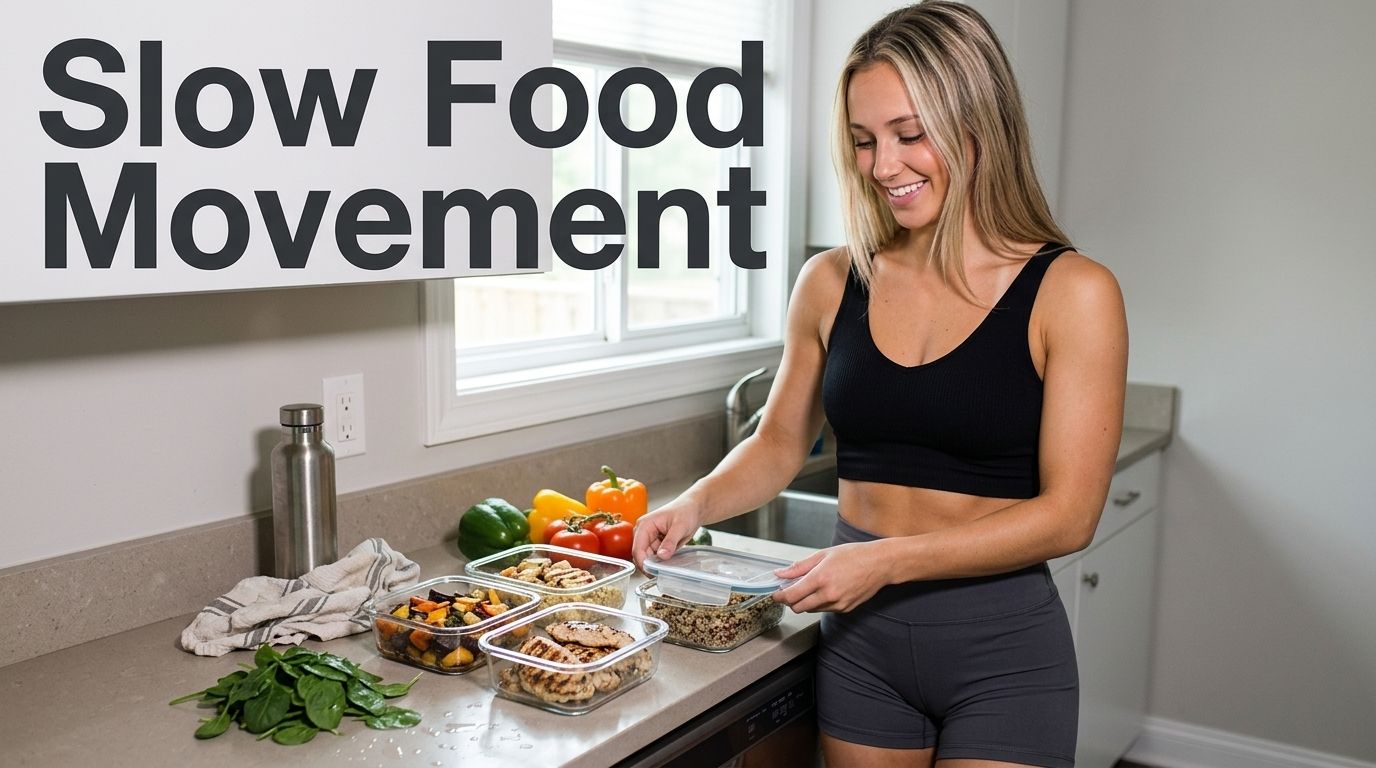
The slow food movement is a global grassroots campaign that advocates for food that is good, clean, and fair. Carlo Petrini founded it in Italy in 1986 in direct protest against fast food culture. The movement now operates in more than 160 countries with 100,000-plus members worldwide.
Slow food rests on three principles: good (flavorful and high quality), clean (no harm to health or environment), and fair (affordable with living wages for workers). It preserves local food traditions, protects endangered ingredients through the Ark of Taste, and connects consumers with producers through 1,500 local convivia groups worldwide.
This guide covers what the slow food movement is, how it works, and how anyone can apply its principles to their daily diet. Whether the goal is better nutrition, lower environmental impact, or simply more pleasure from food, slow food delivers a practical framework for eating with intention.
What Is the Slow Food Movement?
The slow food movement is a global grassroots campaign that advocates for food that is good, clean, and fair, founded in Italy in 1986 by journalist Carlo Petrini in direct opposition to fast food culture. The movement fights to preserve local food traditions and culinary practices that industrial agriculture and globalization threaten. Today it operates in 160-plus countries with over 100,000 members organized in 1,500 local groups called convivia.
Here’s the thing: slow food stands in firm opposition to the homogenization of taste. Global fast food chains standardize flavors and eliminate regional variety. The movement treats this cultural flattening as a direct threat to biological diversity and community identity.
The founders chose a snail as their logo to represent their values. The snail moves deliberately, carries its home everywhere, and takes time to reach its destination. Food deserves the same: time, attention, and respect.
How Did the Slow Food Movement Start?
The slow food movement traces its origin to March 1986, when the planned opening of a McDonald’s near Rome’s Spanish Steps sparked widespread national protest led by Carlo Petrini, a journalist from Bra in Piedmont, Italy. Petrini saw the restaurant as a cultural threat to Italian food traditions and the farmer-consumer relationship. His response was unconventional: rather than carry protest signs, he and his friends brought bowls of penne pasta to hand out at the demonstration.
Their slogan was direct: ‘We don’t want fast food. We want slow food.’ This act of culinary defiance attracted attention across Europe. It transformed a local protest into the seed of an international movement that nobody expected to survive, let alone thrive.
In 1989, representatives from 15 countries gathered at the Opera Comique in Paris. They signed the Slow Food Manifesto ‘For the Defense of and the Right to Pleasure.’ This signing formalized Slow Food as an international organization with a founding document, a clear philosophy, and a global mandate to protect food culture.
What Are the Three Core Principles of Slow Food?
The slow food philosophy rests on three non-negotiable principles: food must be good (flavorful and high quality), clean (produced without harm to health, animals, or the environment), and fair (affordable with living wages for all producers and workers). These principles were codified in the 2006 Slow Food Manifesto for Quality, which added social justice to the original pleasure-first platform. Each principle applies to the entire supply chain, from seed to table.
Good means the food delivers genuine sensory pleasure. Quality is prioritized over quantity, and flavor over shelf life. To be clear, slow food treats taste as a right, not a privilege reserved for affluent consumers with time and money to spend.
Clean means production causes no damage to human health, animal welfare, or ecological systems. Fair means all people in the food chain, from farmer to consumer, are treated equitably and compensated adequately. Both principles require accounting for the true social and environmental cost of food, not just the retail price on the label.
How Does Slow Food Work as a Global Organization?
Slow Food International operates as a not-for-profit grassroots foundation active in 160-plus countries, using a decentralized structure of local convivia supported by national associations and coordinated by the Slow Food Foundation as the global legal entity. The Foundation oversees international advocacy, flagship events, and producer support programs. Local convivia handle community education, producer relationships, and on-the-ground campaigns in their regions.
The flagship event is the Salone del Gusto (Hall of Taste), held biennially in Turin since 1996. The fair showcases small-scale, high-quality food producers from around the world to hundreds of thousands of visitors. And here’s the best part: the Terra Madre conference runs concurrently, drawing 5,000-plus farmers and food producers to share sustainable methods and advocate for policy change.
In 2022, the 8th International Slow Food Congress changed the legal structure from a membership-based organization to a foundation. This opened participation to individuals, public institutions, and private entities. After 33 years as president, Carlo Petrini stepped down and was succeeded by Edward Mukiibi, an agronomist from Uganda.
What Is the Ark of Taste?
The Ark of Taste is Slow Food’s global catalogue of food products and traditions that face extinction due to industrial agriculture, globalization, and the disappearance of traditional food knowledge from communities around the world. Over 6,100 food products have been documented and listed as at risk. Each entry represents a piece of biological and cultural heritage that cannot be recovered once it’s gone.
Alongside the Ark of Taste, Slow Food’s sentinel projects (known in French as les sentinelles) provide direct financial and technical support to small producers keeping endangered foods alive, including heritage protein sources such as traditional cattle and pig breeds, artisanal cured meats, and heritage legumes.
The Ark includes regional cheeses, heritage grain varieties, traditional livestock breeds, ancestral recipes, and artisanal preservation techniques specific to particular geographic communities. Losing an Ark entry means losing the farming knowledge, flavor profiles, and ecological relationships that sustained that food for generations. It’s not just about taste. It’s about survival of agricultural diversity.
Example Ark of Taste nominations by country:
| Country | Nominated Product |
| Australia | Kangaroo Island Ligurian bee honey |
| Australia | Queensland-native bunya nut |
| Australia | Tasmanian leatherwood honey |
| Australia | Victorian bull-boar sausage |
What Is the Salone del Gusto?
The Salone del Gusto is Slow Food’s biennial international food fair held in Turin, Italy, since 1996, widely regarded as one of the world’s most important platforms for artisanal and sustainably produced food from every continent. Hundreds of thousands of visitors attend each edition to taste, buy, and engage directly with small-scale food producers they would never otherwise encounter. The fair transforms Turin into a global hub for slow food culture every two years.
And this is where it gets interesting: the Terra Madre conference runs concurrently. Over 5,000 farmers, food producers, cooks, and academics gather to discuss sustainable practices, food policy, and the practical challenges facing small producers in industrial markets. Terra Madre is where the movement’s intellectual and political work gets done, side by side with the sensory celebration of the Salone.
The Belgian Chefs’ Alliance
One of the most recognized European expressions of the slow food philosophy is L’Alliance Slow Food des Chefs-Belgique, the Slow Food Chefs’ Alliance Belgium. The alliance was officially launched on June 4, 2016 at Place d’Armes in Namur during the 12th Edition of the Belgian Organic Week.
When 23 chefs se sont lancés dans l’aventure (23 chefs joined the initiative), they committed to a strict cahier des charges (sourcing charter) with propres critères spécifiques (specific sourcing criteria) for every ingredient on their menus. Chefs added the names of their producers directly to their menus, giving visibility to the farmers, breeders, fishermen, butchers, bakers, and artisans behind each dish.
L’alliance des chefs slow food de Belgique received direct recognition from Slow Food International through multiple press releases. La Libre Belgique, one of Belgium’s most widely read national newspapers, covered the alliance extensively in its food journalism. Belgian consumer and ecology organization ecoconso.be endorsed the alliance as part of the broader fight against malbouffe (junk food culture). The alliance also incorporated les sentinelles products into restaurant menus, creating a viable market for producers of endangered Belgian food traditions.
What Are the Health Benefits of Slow Food Eating?
Slow food eating centers on whole, minimally processed, and locally sourced foods that are nutritionally superior to industrially processed alternatives consumed in standard Western diets across developed nations today. Research consistently links ultra-processed food consumption to higher rates of obesity, cardiovascular disease, and type 2 diabetes. Shifting toward slow food principles reduces exposure to the additives, emulsifiers, and refined ingredients that drive these outcomes at the population level.
Seasonal produce is harvested at peak ripeness, maximizing retention of vitamins, antioxidants, and phytonutrients. Does that matter? Absolutely. Industrial produce is often harvested early and ripened artificially during transport, which degrades nutritional content measurably before the food reaches the consumer’s plate.
Preparing and eating food slowly supports both digestive health and mental well-being. Mindful eating reduces cortisol levels and improves meal satisfaction in controlled studies. The social dimension of slow food, sharing meals and appreciating food as culture, adds a psychological benefit layer that fast eating alone cannot replicate.
Does Slow Food Improve Nutritional Intake?
Yes. Seasonal vegetables contain significantly higher concentrations of vitamins C and E compared to out-of-season equivalents grown under artificial conditions and transported over long supply chains before reaching consumers. A tomato picked ripe in summer contains up to 40% more lycopene than one harvested early and chemically ripened during refrigerated transport. These differences compound across months of eating. And they add up fast.
Access to heritage grains, heirloom vegetables, and traditional protein sources diversifies the nutrient profile of the diet. Industrial food systems have narrowed global diets to a small number of high-yield monocultures, reducing dietary micronutrient variety dramatically. Slow food eating restores nutritional breadth by engaging the full range of what regional agriculture produces.
Traditional preparation methods like fermentation and slow cooking enhance the bioavailability of iron, zinc, and B vitamins. Fermentation breaks down anti-nutrients like phytic acid that block mineral absorption in grains and legumes. Slow cooking at lower temperatures preserves heat-sensitive vitamins that high-temperature industrial processing destroys.
Can Slow Food Help with Weight Loss?
Yes. Slow food principles support healthy weight management by reducing intake of ultra-processed foods, increasing dietary fiber from whole plant sources, and promoting mindful eating habits that give satiety hormones time to signal fullness before overconsumption occurs. The gut produces satiety hormones like GLP-1 and peptide YY within 15-20 minutes of eating. Eating quickly bypasses this signal window entirely. And consuming more food than needed becomes the automatic result.
Whole foods eaten in slow food diets deliver higher satiety per calorie than ultra-processed equivalents. Higher fiber content from vegetables, legumes, and whole grains slows digestion and extends fullness well past the meal. Ready to speed things up? Get a proven weight loss plan built around these exact principles.
The slow food approach also reduces reliance on highly palatable ultra-processed snacks engineered to override normal hunger signals. Removing these products from the diet reduces total caloric intake without the need for deliberate calorie counting. Weight changes observed in slow food adherents reflect this shift in food environment rather than strict dietary restriction.
How Do You Embrace the Slow Food Movement?
Embracing slow food starts with practical, accessible choices: shopping at farmers markets, choosing seasonal produce, cooking from scratch, and reducing ultra-processed foods in the daily diet without requiring a complete lifestyle overhaul from day one. The movement explicitly rejects perfectionism. Partial adoption delivers real benefits, and each change made consistently compounds over time into a fundamentally different relationship with food.
Joining a local convivium connects participants with like-minded food communities. The US alone has 170-plus local Slow Food chapters. These groups organize farm visits, tastings, cooking workshops, and advocacy events that make slow food principles social and tangible, not abstract and prescriptive.
The slow food ethos includes eating with others, taking time over meals, and treating food as cultural experience. Sharing meals, discussing food origins, and appreciating preparation are core to the movement’s philosophy. The social act of eating is inseparable from the food itself in slow food thinking.
What Does Eating Seasonally Actually Mean?
Eating seasonally means consuming fruits and vegetables harvested at their natural growing peak in a specific geographic region during each season of the year, prioritizing what the local land grows best and when it grows best. A seasonal diet in northern Europe looks different from one in subtropical Australia or the American Midwest. But the principle transfers: eat what grows around you, when it grows best. That’s it.
Seasonal produce examples by season (temperate climate):
- Spring: asparagus, peas, spinach, strawberries, radishes
- Summer: tomatoes, courgette (zucchini), peppers, stone fruits, corn
- Autumn: squash, apples, root vegetables, Brussels sprouts, pears
- Winter: celeriac, kale, leeks, stored legumes, citrus fruits
Eating seasonally also dramatically reduces the carbon footprint of food. Refrigerated long-haul transport of out-of-season produce generates significant greenhouse gas emissions per kilogram (2.2 pounds) delivered. Buying local and seasonal eliminates this transport leg and its environmental cost entirely.
How Do You Support Local Food Producers?
Supporting local food producers means buying directly from farmers markets, joining a CSA (Community Supported Agriculture) scheme, or shopping at independent food businesses rather than industrial supermarket chains that route the majority of revenue away from local communities. Each direct purchase removes an industrial intermediary from the supply chain. This increases the income share that reaches the farmer directly.
Every dollar spent at a local food business recirculates in the local economy at a rate 2-3 times higher than spending at chain retailers. Local money pays local wages, funds local suppliers, and supports local services. Chain retail spending routes the majority of revenue to distant corporate headquarters, bypassing the community where the purchase was made.
Slow Food’s global network includes 6,000-plus food producers. Connecting with them directly, through convivium events, farm visits, or online producer directories, creates relationships that support fair pricing and long-term viability for small-scale farming. These relationships are the economic backbone of the movement.
What Does Research Say About Slow Food and Sustainability?
Slow Food is positioned by contemporary researchers as a form of alternative food consumption that integrates relational, sensory, temporal, sustainable, cultural, and political dimensions under the unifying principles of good, clean, and fair food. Academic interest spans food science, sociology, environmental studies, and economics. The research base has grown substantially as food system sustainability has become a central global policy concern.
Qualitative research on Slow Food’s influence in Northern Cyprus documented how the movement shapes sustainable regional gastronomy. Semi-structured interviews with chefs, restaurant owners, food producers, and municipal actors revealed improved relationships across the regional food system. These improved relationships drove more sustainable purchasing decisions from all parties involved.
Biodiversity research supports the Ark of Taste model directly. Studies show heritage agriculture practices maintained through Slow Food networks protect soil microbiomes, reduce reliance on synthetic inputs, and maintain long-term crop yield stability. The Ark’s 6,100-plus listed products represent measurable ecological value, not just cultural nostalgia.
Is the Slow Food Approach Backed by Evidence?
Yes. Heritage agriculture practices associated with Slow Food principles are documented to protect soil microbiomes, reduce chemical inputs, and maintain long-term crop yields more effectively than industrial monoculture methods applied at comparable scale. These benefits compound over decades. Regenerative fields show measurable soil health improvements within 5-7 years of transition. The evidence supports the movement’s core environmental claims at the farm level.
Research on sustainable gastronomy from Italy, Australia, and Northern Cyprus documents reduced food waste, stronger producer-consumer relationships, and higher food quality satisfaction among slow food participants compared to conventional food consumers. These findings span cultural and geographic contexts, which suggests the effects are not locally specific.
Researchers describe Slow Food as a driver of agroecological transitions. Agroecology uses ecological principles to design farming systems that are productive, resilient, and regenerative rather than extractive. Slow Food’s advocacy for heritage seeds, traditional livestock breeds, and local food systems directly supports agroecological practice at the community level worldwide.
What Are the Criticisms of the Slow Food Movement?
Slow Food critics argue that the movement is structurally elitist, placing the time and financial burden of sourcing artisanal food on households least able to afford either the cost or the preparation time required under current working conditions. Without changing working hours or income levels, slow food preparation becomes an additional unpaid burden. These are substantive critiques, not peripheral objections, and the movement has grappled with them openly since the late 1980s.
Artisanal and locally produced foods typically cost more than industrially produced equivalents. The price difference reflects genuine production costs: lower yields, more labor, and smaller distribution networks. These higher prices make consistent slow food purchasing difficult on a constrained household budget.
Carlo Petrini recognized these barriers firsthand. After visiting Venezuela in 1989, he adjusted the movement’s philosophy to explicitly address food justice and fair access. The 2006 addition of ‘good, clean, and fair food for all’ to the Slow Food platform was a direct response to the elitism critique, extending the mandate from gastronomy to social equity.
Is Slow Food Only for the Wealthy?
No. Slow food is not inherently limited to affluent consumers, though economic barriers are real and the movement now explicitly acknowledges them as a central challenge to its mission of universal access to good, clean, and fair food for everyone. Critics point out that terms like ‘taste,’ ‘knowledge,’ and ‘discernment’ can function as class markers. The organization has responded with access initiatives and a revised mission that centers food justice.
Farmers markets, community gardens, and CSA schemes offer pathways to fresh seasonal food at lower cost than premium retailers. Many CSA schemes offer income-tiered pricing or work-share arrangements where members offset subscription costs with farm labor hours. Community gardens provide free or very low-cost access to seasonal produce in urban areas where fresh food access is structurally limited.
Slow Food’s current mission asserts that everyone has the right to good, clean, and fair food. The organization funds education programs, advocacy campaigns, and producer support networks in lower-income and food-insecure communities globally. Access remains a work in progress, but it’s now a stated organizational priority with real resources behind it.
Want Your Free Slow Food Eating Guide from Eat Proteins?
You have the science. You have the principles. Now you need the plan that fits your actual life and budget. Our nutritionists at Eat Proteins have built a free slow food eating guide with seasonal shopping lists, traditional cooking methods, and local sourcing strategies that work wherever you live.
The guide covers every season: what to buy, how to cook it, and how to find producers near you. Small, consistent shifts change the way you eat and how you feel over time. Sign up below and start where you are, not where you think you should be.
The Science of Slow Eating
The movement’s name carries a second meaning beyond opposing fast food: slowing down the act of eating itself. A systematic review published in Frontiers in Nutrition (Zhu et al., 2021) found consistent associations between fast eating and higher BMI across multiple studies, with fast eaters showing significantly elevated obesity and metabolic syndrome risk.
The hormonal mechanism explains why. Eating quickly prevents adequate release of peptide YY and GLP-1, two satiety hormones that signal fullness to the brain. Research published in the Journal of Clinical Endocrinology and Metabolism found that slower eating increased both hormone concentrations, reducing hunger at the same caloric intake. For protein specifically, thorough chewing activates digestive enzymes and improves amino acid absorption, reducing digestive stress on the gut.