
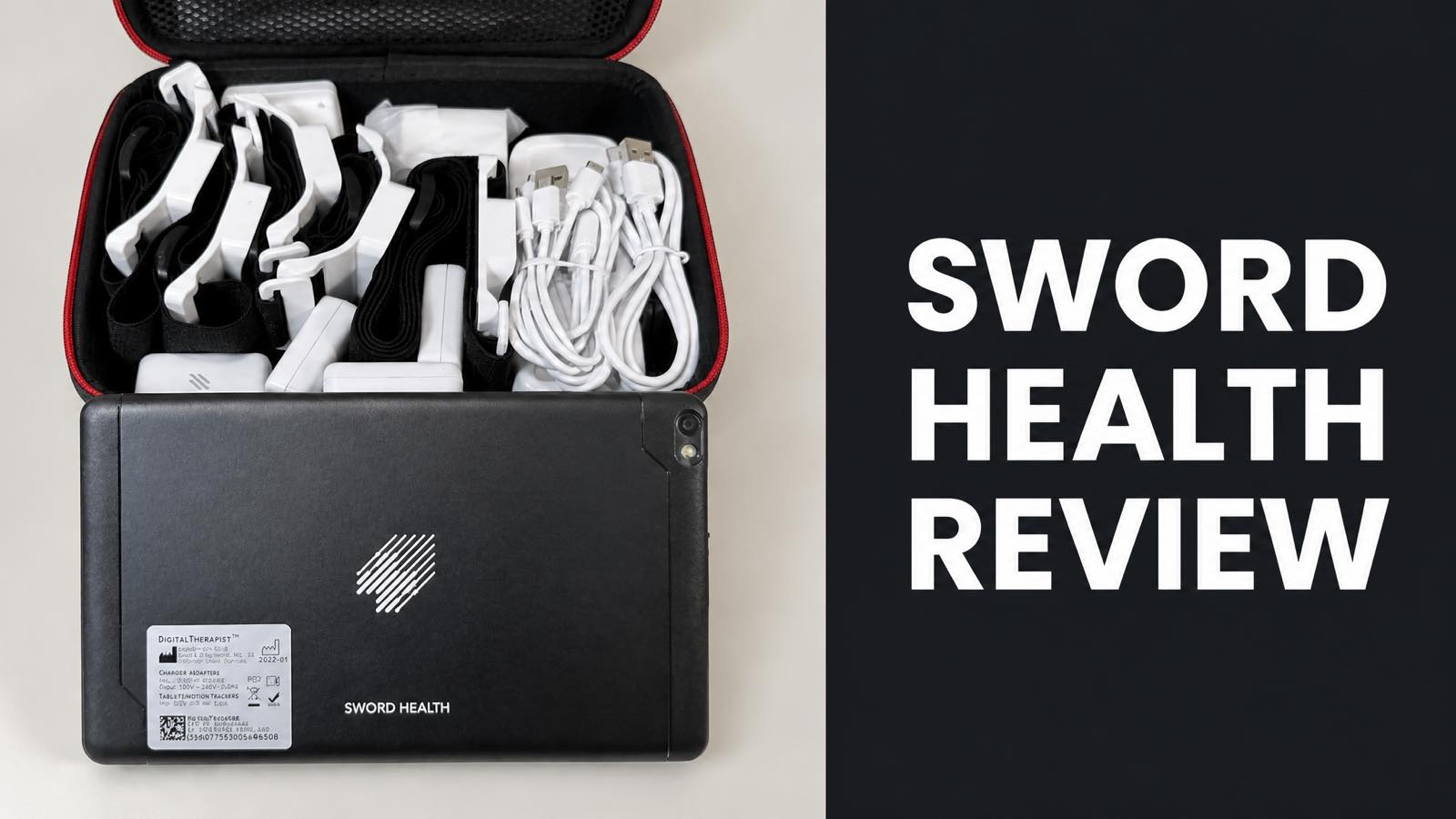
Sword Health is a digital health company that delivers physical therapy for muscle and joint pain at home. Founded in 2015, it serves over 1,300 employers and health plans. Members follow a custom exercise plan with a tablet, motion sensors, and a licensed therapist. The service needs no clinic visits.
Our team at Eat Proteins reviewed how the program works and what it treats. Research on its results is mixed, because one trial found no edge over in-person care. Members praise the convenience and real-time feedback. Complaints focus on sensors, call volume, and billing. Coverage comes only through employers and health plans. Pricing stays hidden.
The big picture is simple. Sword Health suits people with common aches who can exercise lightly and have coverage. Read on to learn how it works, what reviewers say, what it costs, and who should skip it before you decide. You will also see how it compares with rival Hinge Health.
What Is Sword Health?
Sword Health is a digital health company that delivers virtual physical therapy for musculoskeletal pain. The company started in Portugal in 2015. Its program pairs members with licensed physical therapists and guided exercise at home. Today it serves over 1,300 employers and health plans across three continents. Its current headquarters sit in New York.
To be clear, Sword Health isn’t a gym app. It’s a clinical service built around a physical therapist. The company also runs Bloom for pelvic health, Mind for mental health, and Predict for surgical risk assessment. Which one matters here? The core musculoskeletal program.
Sword Health Programs:
- Core musculoskeletal program for joint and muscle pain
- Bloom for pelvic health
- Mind for mental health
- Predict for surgical risk assessment
Is Sword Health a Large Company?
Yes. Sword Health is a large, well-funded company with a valuation near $4 billion. The company raised $40 million in 2025. Total funding now stands at $380 million. In January 2026 the company bought Kaia Health for about $285 million. The deal expanded the company’s reach into Germany. Indeed lists its staff at 501 to 1,000 employees. The team is midsized.
Here’s the part most people miss: scale reaches beyond employers. In June 2026, Sword Health partnered with the Portugal NHS. Reports say the platform becomes available to over 10 million people there. Does size prove quality? Not by itself, but it signals staying power.
How Does Sword Health Work?
Sword Health works by pairing a licensed physical therapist with guided exercise sessions done at home. A member completes an initial video assessment first. The therapist then builds a custom plan. Members follow it on a tablet and check in by chat, phone, email, or video. The whole process starts from home. Each session takes place in the member’s home.
Here’s why that matters: the tablet gives real-time form correction. Sessions happen on the member’s own schedule. Members should expect at least two contacts per week with the therapy team, though frequency varies. Sound like a lot? For some members, it is.
How It Works:
- Complete an initial video assessment with a licensed physical therapist.
- Receive the tablet and wearable sensors at home.
- Follow the custom exercise plan on the tablet.
- Check in with the therapy team by chat, phone, email, or video.
What Equipment Does Sword Health Use?
Sword Health uses a tablet and wearable motion sensors to track each exercise. The sensors are roughly the size of an AirPods case. They contain accelerometers, gyroscopes, and magnetometers. The tablet reads that data and shows corrections to the member as each movement happens. Sensors attach to the body during each session. Each sensor sits on the body.
In fact, the newer Thrive program takes a different route. Thrive delivers one-on-one AI-guided care with computer-vision technology. A doctor of physical therapy oversees the plan. Does setup change? Yes. Setup differs by program, so members ask which version their plan offers.
What Conditions Does Sword Health Treat?
Sword Health treats common musculoskeletal conditions such as back, shoulder, knee, and neck pain. The program also covers hip, elbow, ankle, and wrist pain. Members need to handle about 20 minutes of light-to-moderate exercise. The program fits people with everyday aches, not complex medical cases. Therapists adjust the plan as pain changes. Plans vary.
Commonly Treated Areas:
- Back pain
- Shoulder pain
- Knee pain
- Neck pain
- Hip pain
- Elbow, ankle, and wrist pain
Who Should Avoid Sword Health?
People with limited health, active cancer treatment, or warning symptoms need medical clearance before starting Sword Health. Members whose health prevents light exercise are excluded. So are people with symptoms of a serious underlying condition. A primary care provider gives the final word. Each case differs. Screening comes before any exercise plan.
The bad news? Persistent-symptom conditions fall outside the design. Fibromyalgia and chronic migraine are examples. The program targets mechanical pain that responds to exercise. Does your condition match? If not, your doctor can point to better options.
Does Sword Health Actually Work?
Yes. Sword Health reduced pain in observational studies of chronic low back pain and elbow conditions. Those studies are not randomized trials. The results come from members who chose the program. The sample limits how far the findings apply to everyone else, so treat them as encouraging. Evidence quality varies by condition. Sample sizes were not given.
Now, watch this: a randomized trial of 82 people with chronic shoulder pain found no significant differences. Sword Health matched in-person therapy on function, pain, and medication use. Is that bad? Not really. Matching a clinic from your living room is the whole pitch.
Evidence Summary:
| Study | Finding |
|---|---|
| Randomized trial, 82 people with chronic shoulder pain | No significant difference from in-person therapy |
| Observational studies, chronic low back pain | Reported pain reductions |
| Observational studies, elbow conditions | Reported pain reductions |
| Milliman review, December 2025 | Savings method consistent with common digital health approaches |
Is Sword Health Better Than In-Person Therapy?
No. Sword Health performed about the same as in-person therapy in a randomized trial. The trial covered 82 participants with chronic shoulder pain. Function, pain, and medication use showed no significant differences. The advantage is access and convenience, not stronger clinical results. Neither option wins on outcomes alone. Convenience separates them.
Short answer: choose by lifestyle. A clinic gives hands-on treatment. Sword Health gives flexible scheduling at home. In December 2025, Milliman reviewed the company’s savings method. Sword Health commissioned that report, so weigh it with care.
What Do Sword Health Reviews Say?
Sword Health reviews are largely positive, with a 4.7 out of 5 rating across app store listings. The score comes from roughly 51,000 reviews. Members cite at-home convenience, personalized plans, and real-time feedback. Complaints exist too, and Lin Health, a rival program, calls them a small fraction. Reviewers write about both wins and frustrations.
Here’s the thing: the themes repeat across sources. Praise centers on convenience and guidance. Criticism centers on equipment and service. Does one side win? Praise leads in volume. The complaints still deserve a close look.
Review Themes:
| Theme | Verdict |
|---|---|
| At-home convenience | Positive |
| Personalized plans | Positive |
| Real-time feedback | Positive |
| Sensor accuracy and connectivity | Negative |
| Onboarding calls and notifications | Negative |
| Billing confusion | Negative |
What Do Users Like About Sword Health?
Users like the convenience, the personalized plans, and the instant form feedback. Exercising at home saves travel time. Each plan comes from the member’s own therapist. The tablet corrects movement in real time, so nobody guesses at technique during a session. Many reviewers describe the app as easy to follow. Reviewers call the routine easy to follow.
On the business side, customers agree. FeaturedCustomers lists a 4.8 out of 5 score from 627 reference ratings. A labor fund consultant called the service unmatched in virtual care. Bias check? Vendors supply these reference customers, so read the praise with that in mind.
What Do Users Complain About?
Complaints center on sensor accuracy, connectivity, and heavy contact during onboarding. Some members report too many calls and notifications early on. Others struggle to reach or switch their therapist. Billing confusion also appears. Some members saw charges after returning the equipment. Reviewers raise these points often enough to notice. Themes repeat.
The truth is, these complaints are real. Lin Health calls them a small fraction of reviews but gives no count. Does that settle it? No. Members protect themselves by keeping proof of shipment when they return the equipment.
How Does Sword Health Compare to Hinge Health?
Sword Health and Hinge Health both rate 4.8 out of 5 on FeaturedCustomers. Hinge Health holds 1,383 ratings. Sword Health holds 627. Both sell virtual musculoskeletal care to employers. The scores match, so the difference lies in volume of proof rather than quality. Both appear in the virtual care platform category. Hinge Health is the closest comparison.
Rating Comparison:
| Metric | Sword Health | Hinge Health |
|---|---|---|
| FeaturedCustomers rating | 4.8 out of 5 | 4.8 out of 5 |
| Number of ratings | 627 | 1,383 |
| Customer references | 16 | 36 |
Which Option Has More Proof?
Hinge Health holds more ratings and more customer references on FeaturedCustomers. Its 36 references include 16 testimonials and 19 case studies. Sword Health lists 12 testimonials and 4 case studies. Counts alone don’t pick a winner, because the average score is identical. Hinge Health also lists one customer video. More references give buyers more detail.
And here’s the catch: employer choice decides this. Most members get whichever program their plan covers. Can you pick freely? Usually not. So compare coverage first, then features, and ask your benefits team which program applies.
How Much Does Sword Health Cost?
Sword Health typically costs members nothing out of pocket when an employer or health plan offers it. The company doesn’t publish a dollar price. Coverage, dependent eligibility, and employee exclusions vary by plan. Members confirm eligibility with their benefits team before assuming coverage. Dollar figures appear only in employer contracts. Plans differ.
Cost Facts:
- No out-of-pocket cost for most covered members
- No published dollar price
- Coverage varies by employer or health plan
- No individual purchase option
Can You Buy Sword Health Yourself?
No. Sword Health isn’t available for individual purchase through any public sign-up page. Access comes only through an employer or health plan. Members enroll after their organization signs a contract. People without coverage need another option, and a benefits portal is the first place to look. Check your benefits portal for an enrollment link. Ask HR.
Here’s how billing works behind the scenes. Employers use outcome-based billing and pay the full fee only when a member’s health measurably improves. Does that protect them? Partly. Independent validation of this model is limited, so treat it as a claim.
Is Sword Health Legit?
Yes. Sword Health is a legitimate, established company with real clinicians and large customers. The company began in 2015 and serves over 1,300 employers and health plans. Licensed physical therapists support each member’s program. Anthem and AT&T appear among its reference customers. Customer references and case studies back those claims. Trust is earned.
Trust Signals:
- Founded in 2015
- Over 1,300 employers and health plans served
- $380 million in total funding
- Portugal NHS partnership announced in June 2026
- 4.7 out of 5 across roughly 51,000 app reviews
Is Sword Health Safe?
Yes. Sword Health screens members before enrollment to match exercise to their health. People who can’t do light exercise are excluded. So are people with warning symptoms. Published side-effect data is limited, so members with doubts speak with their doctor first. Screening happens before the first session. Screening happens early and avoids poor fits.
Pay attention to this: employee reviews tell a different story. Glassdoor shows a 2.8 out of 5 work-life balance score from 253 reviews. Indeed shows 3.0 overall. Does that affect patients? Not directly, but it’s context worth knowing.
Why Should You Try Eat Proteins?
Eat Proteins gives you straight answers before you spend time or money. Our team at Eat Proteins checks the claims, the research, and the complaints for you. Sword Health has real strengths and real gaps. You deserve to know both. Don’t guess when the facts are one click away. Reviews like this one save hours of research. Our readers get facts, not hype.
What Should You Do Next?
If your plan covers it, you can start Sword Health at no cost and test it for yourself. Our experts at Eat Proteins say confirm coverage first, then ask about equipment returns. Missing the facts costs more than one call to your benefits team. Act this week while your enrollment window is open. Waiting only delays the decision. Clarity beats guesswork.
Bottom line: Sword Health is a solid pick for everyday aches with coverage. Want more honest reviews like this one? Subscribe below and get the next Eat Proteins review first.