
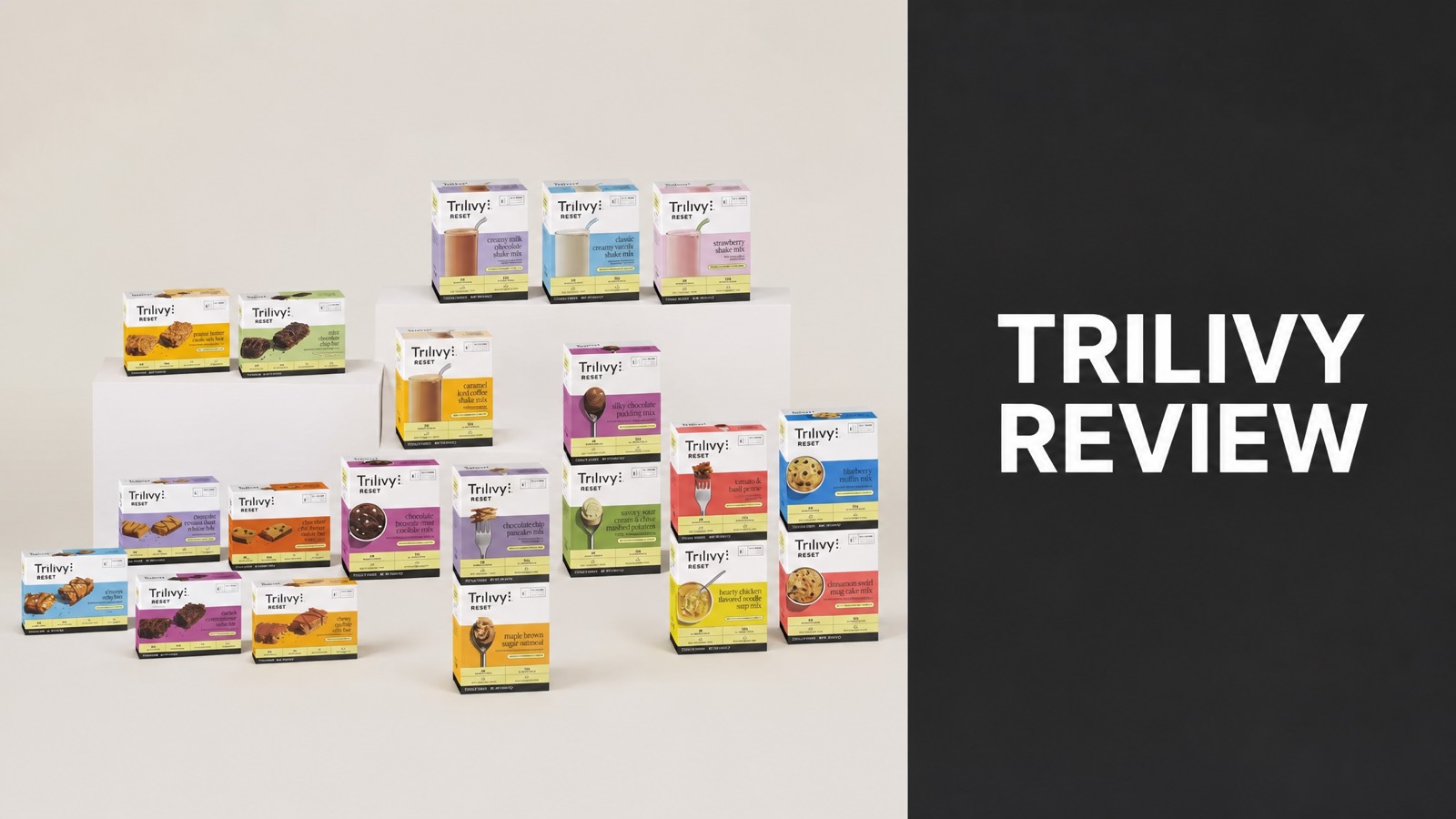
Trilivy is a metabolic health program from Medifast that sells packaged fuelings and one-on-one coaching. The brand frames it as a science-backed, three-phase system. Dietitians describe it differently: a rebrand of the Optavia weight loss plan with new names and the same core structure.
Our team reviewed the program step by step. Trilivy runs on Reset, Refine and Renew phases. Each fueling carries about 100-110 calories. The clinical study behind the claims compares very low calorie diets with a far higher calorie control. Coaches are mostly former clients who also sell the product to them. Pricing appears only in the cart total.
The real question is whether Trilivy delivers lasting results or only a short-term scale drop. Read on to see how the program works, what reviewers report, the safety risks, the cost and who should avoid it. Then decide whether Trilivy deserves your money. Facts matter more than slogans here.
What Is Trilivy?
Trilivy is a commercial metabolic health program from Medifast that pairs packaged meals called fuelings with one-on-one coaching. The brand pitches a three-phase system to reverse metabolic dysfunction. In plain English, it’s a structured diet. The plan uses pre-portioned food, a personal coach and plenty of wellness language. The brand sells hope too.
Dietitian Abby Langer notes the marketing leans on vague terms like resetting metabolism and improving metabolic flexibility. Why does that matter? Those phrases sound clinical, but they describe a calorie-controlled eating plan.
Trilivy’s own site claims more than 90% of Americans are metabolically unhealthy. That figure comes from company marketing. Our team at Eat Proteins found no independent source attached to it.
Is Trilivy Just Optavia Rebranded?
Yes. Trilivy is a rebrand of the Optavia program, which grew out of Medifast. Dietitian Abby Langer calls it the same three-step structure with new names. Reddit threads put it bluntly: Optavia is now Trilivy. The plans, fuelings and coaching model all carry over. So do the lean and green meals, now under a new label. Only the logo and slogans moved.
Medifast’s own employer page now describes the company as home to Trilivy. The parent company ties the two names together. Here’s the thing: the label changed faster than the program did.
Optavia vs Trilivy:
| Feature | Optavia | Trilivy |
|---|---|---|
| Step one | 5 & 1 plan | Reset (5 fuelings, 1 lean and green meal) |
| Step two | Transition phase | Refine (2 fuelings, 2 lean and green+ meals) |
| Step three | Maintenance | Renew (mostly whole foods) |
| Fueling add-on | None | MetaVantage technology |
How Does Trilivy Work?
Trilivy works by replacing most daily meals with pre-portioned fuelings, then adding one lean and green meal cooked at home. A coach guides the client through three phases. Each fueling runs 100-110 calories. Fuelings per day depend on the phase. They also depend on the calorie needs Trilivy assigns to each person. The routine stays simple and repetitive.
Trilivy offers the same plans Optavia had, including 5 & 1 and 4 & 2. A 5 & 1 plan means five fuelings and one lean and green meal. Simple enough? On paper, yes. The calorie math is steep, though.
The first step delivers 800-1000 calories a day (3,350-4,180 kilojoules). Clients stay there until they reach goal weight. Langer calls that long stretch a red flag. Very low calorie plans suit short, physician-monitored use.
What Are the Three Phases of Trilivy?
Trilivy runs in three phases called Reset, Refine and Renew. Reset uses five fuelings and one lean and green meal. Refine cuts fuelings to two and adds a second, less restrictive lean and green+ meal. Renew shifts to mostly whole foods and focuses on long-term behavior change. Each phase has its own calorie logic and its own rules. Simple on paper.
Refine resembles Optavia’s old transition phase, which raised calories from about 900 to 1,200 over three weeks. Trilivy no longer publishes a fixed length or calorie target. Intake is individualized to Total Energy Expenditure.
Renew is the maintenance step. Calorie budgets stay individual. To put it simply, Trilivy expects clients to stay on Renew forever.
The Three Trilivy Phases:
| Phase | Meals | Calories |
|---|---|---|
| Reset | 5 fuelings, 1 lean and green | 800-1000 a day |
| Refine | 2 fuelings, 2 lean and green+ | Individualized |
| Renew | Mostly whole foods | Individualized |
What Are Trilivy Fuelings?
Trilivy fuelings are small packaged foods that anchor the Reset and Refine phases. Each one delivers roughly 100-110 calories. The brand adds MetaVantage technology to every fueling, a blend of postbiotics, chromium and choline. Langer calls the fuelings tiny, expensive and unpalatable. Ouch. That’s a harsh verdict from a registered dietitian. Fair point.
The company claims MetaVantage supports metabolism and insulin function. Langer finds no actual research on the product to back that up. Many weight loss supplements use the same ingredients, and the evidence for them is unremarkable at best.
Five fuelings a day adds up to only around 500 calories. Is that enough food? Not on its own, which is why the lean and green meal fills the gap.
MetaVantage technology includes:
- Postbiotics
- Chromium
- Choline
Are Trilivy Fuelings Ultra-Processed?
Yes. Trilivy fuelings are ultra-processed foods, no matter how the brand frames them. Langer puts it plainly: no matter which way you slice it. The packaged, shelf-stable format sits at the center of both Reset and Refine. Most of a client’s food falls in that category early on, and that shapes the entire program experience. Convenience comes at a cost.
That matters for habits. Eating prepackaged food doesn’t teach self-management. Why not? Clients never practice shopping, cooking or portioning, so the skills arrive late, if at all.
Does Trilivy Work?
Yes. Trilivy produces short-term weight loss, mainly because daily calories drop sharply. Langer agrees clients will lose weight and metabolic markers will probably improve. The catch is durability. The loss tends to fade once people tire of the food and the rules. Bottom line: it works, but only briefly for most people, per dietitians. Results fade fast.
The brand cites a 14% visceral fat reduction at 16 weeks on the Reset 5 & 1 plan. The brand also cites 98% lean mass retention. And it claims coaching delivers 10x more weight loss and 17x more fat loss than going alone.
Those figures come from one 16-week trial in Obesity Science and Practice. Does a single trial settle the question? No. The comparison group matters, and that’s where the design falls apart.
Is the Trilivy Clinical Study Reliable?
No. The trial Trilivy cites compares very low calorie diets against a control group eating far more food. The trial ran 16 weeks with 198 people, 80% women, average BMI 34. Langer ran the USDA calculator and got about 2,068 calories a day for the control group. That’s no fair fight, and it skews every headline number it quotes. Context changes everything.
Trilivy reuses the same paper Optavia used for years. Langer finds no research on the new MetaVantage blend. In plain English: the rebrand changed the name, but the evidence stayed exactly where it was.
Study Groups and Daily Calories:
| Group | Daily calories |
|---|---|
| Optavia fuelings plus coaching | 800-1000 |
| Medifast diet | 1100-1300 |
| Self-directed control (Langer estimate) | About 2,068 |
What Do Trilivy Reviews Say?
Trilivy reviews split sharply between fans of the structure and critics of the cost, hunger and sustainability. The brand is new, so much feedback carries over from Optavia. The loudest praise comes from clients and coaches. The loudest warnings come from dietitians and watchdog pages. Both sides deserve a fair hearing before anyone signs up. Let’s dig in.
U.S. News and World Report gave Optavia 2.8 stars out of 5. Reviews on Reddit and Trustpilot are also low, per Langer. Common themes are cost, hunger, heavy reliance on ultra-processed fuelings and unsustainability.
What Do Positive Trilivy Reviews Say?
Positive Trilivy reviews praise feeling full and losing food noise between meals. One Facebook reviewer enjoyed the new fuelings and felt more satiated, with no food noise between meals. And that’s a fair point. Structured meals remove daily food decisions for some people. The plan feels easy to follow, and that appeal is real. Simplicity drives the praise.
The brand’s own site promises returning energy, a shrinking waist and new habits. Those are marketing claims, not independent results. Pay attention to this: the happiest posts often come from people selling or promoting the program.
What Are the Common Trilivy Complaints?
Common Trilivy complaints center on price, hunger, taste and a weak track record for long-term results. A BBB profile for Trilivy LLC includes a reviewer calling it one of the worst weight loss experiences ever. Those issues echo the old Optavia complaints, so the rebrand hasn’t quieted the critics at all. Reddit and Trustpilot threads repeat the pattern.
Langer adds a deeper concern. Coaches are mostly former clients with limited training, and they also sell the product. That conflict of interest sits behind many of the warnings.
Top Complaints:
- Tiny portions and ongoing hunger
- High cost of fuelings
- Unpalatable, shelf-stable food
- Heavy reliance on ultra-processed foods
- Hard to sustain long term
Is Trilivy an MLM?
Yes. Trilivy sells through a multi-level marketing model, with independent coaches who also sell the product to their clients. Langer confirms the structure. That setup builds a sales incentive into every piece of nutrition advice a client hears. To be clear, selling and coaching are the same job here, and that’s a clear conflict of interest. Not ideal.
What’s more, the site publishes official terms for a Client Referral Program. Referrals clearly sit inside the sales model. Reddit’s antiMLM community has already flagged the Optavia-to-Trilivy switch with plenty of skepticism.
Are Trilivy Coaches Qualified?
No. Trilivy coaches are mostly former clients with company training that falls short of accredited healthcare education. Langer reports that about 90% are former Optavia or Trilivy users. Training prepares them to deliver the program, not to provide individualized nutrition therapy to clients they also sell to. A wide gap between sales and clinical care.
Some coaches call themselves metabolic reset coaches. What does that mean? Nothing standardized. One coach link led Langer to an unvalidated metabolic scan that works as a marketing tool to capture contact details.
Coach Facts:
- About 90% are former Optavia or Trilivy users
- Training covers program delivery only
- No accredited healthcare license is required
- Coaches earn money selling the product
- Some use unvalidated metabolic scans to find leads
Is Trilivy Safe?
No. Trilivy carries real risks without physician oversight, mainly from its very low calorie first phase. Langer lists nutrient deficiencies, gallstones, low mood and poor sleep as possible problems of an extended Reset. That phase runs 800-1000 calories a day, which sits well below what most adults need each day to function well. That’s a serious gap.
In fact, Langer says every ex-Optavia client she has counseled reported negative physical and emotional effects. Is that a random sample? No. Still, the pattern is hard to ignore when the program stays the same.
Who Should Avoid Trilivy?
Anyone who can’t get physician monitoring should skip the Reset phase of Trilivy. Very low calorie diets are meant to be short term, for a specific purpose, and closely monitored by a physician. Trilivy is not built that way, so the safety net falls on the client. Gallstone-prone people and anyone needing a plan they can sustain should think twice.
People who want lasting habits fit poorly here too. Why? Prepackaged food and non-clinical coaching don’t build self-management. And here is the part most people miss: weight often returns once the packaged meals stop.
Who Should Skip Trilivy:
- People without a doctor monitoring a very low calorie diet
- People prone to gallstones or nutrient deficiencies
- People who need a plan they can sustain for years
- People uncomfortable with MLM-style coach sales
How Much Does Trilivy Cost?
Trilivy costs more than regular groceries because clients buy branded fuelings on top of their own lean and green meals. The main pages show no flat price. Totals appear in the cart after discounts, shipping and taxes. Langer calls the fuelings expensive, and the model gives clients every reason to keep reordering them every month. Budget accordingly.
Costs depend on the plan and the number of fuelings per day. A 5 & 1 plan needs more fuelings than a 4 & 2 plan. So what is the real bill? Check the cart total with your coach before committing.
Is Trilivy Worth the Price?
No. Trilivy charges premium prices for small, ultra-processed portions backed by a weak evidence base. Langer says it isn’t worth trying. She sees an expensive, restrictive diet that teaches few lasting skills. A rebrand doesn’t change that math, and the new name adds no new proof of results. The price stays high either way. Our team at Eat Proteins agrees.
Here’s why: even a successful run ends at Renew, which demands whole-food habits the fuelings never taught. What are you really paying for? Mostly convenience, coaching from non-clinicians and a short-term drop on the scale.
Is Eat Proteins Worth It?
Yes. Eat Proteins gives you plain-English reviews of products like Trilivy before you spend a single dollar. Our team digs into the research, the claims and the real complaints. You get the verdict without the sales pitch. Skip the guesswork, read first, then decide. One honest review can save you months of hunger and a good deal of real money. Simple.
Think of it this way: every Eat Proteins article follows one rule. Facts first, hype last.
What Should You Do Before Starting Trilivy?
Talk to a physician first, because very low calorie plans need medical oversight. Then compare the research behind any plan, not just the marketing. Our experts at Eat Proteins suggest a plan you can sustain. The plan should rest on whole foods and real habits for the long run. That’s the approach we trust. Start there, then compare your options carefully.
Ready to see how other programs stack up? Browse more Eat Proteins reviews and choose with the facts in hand.