
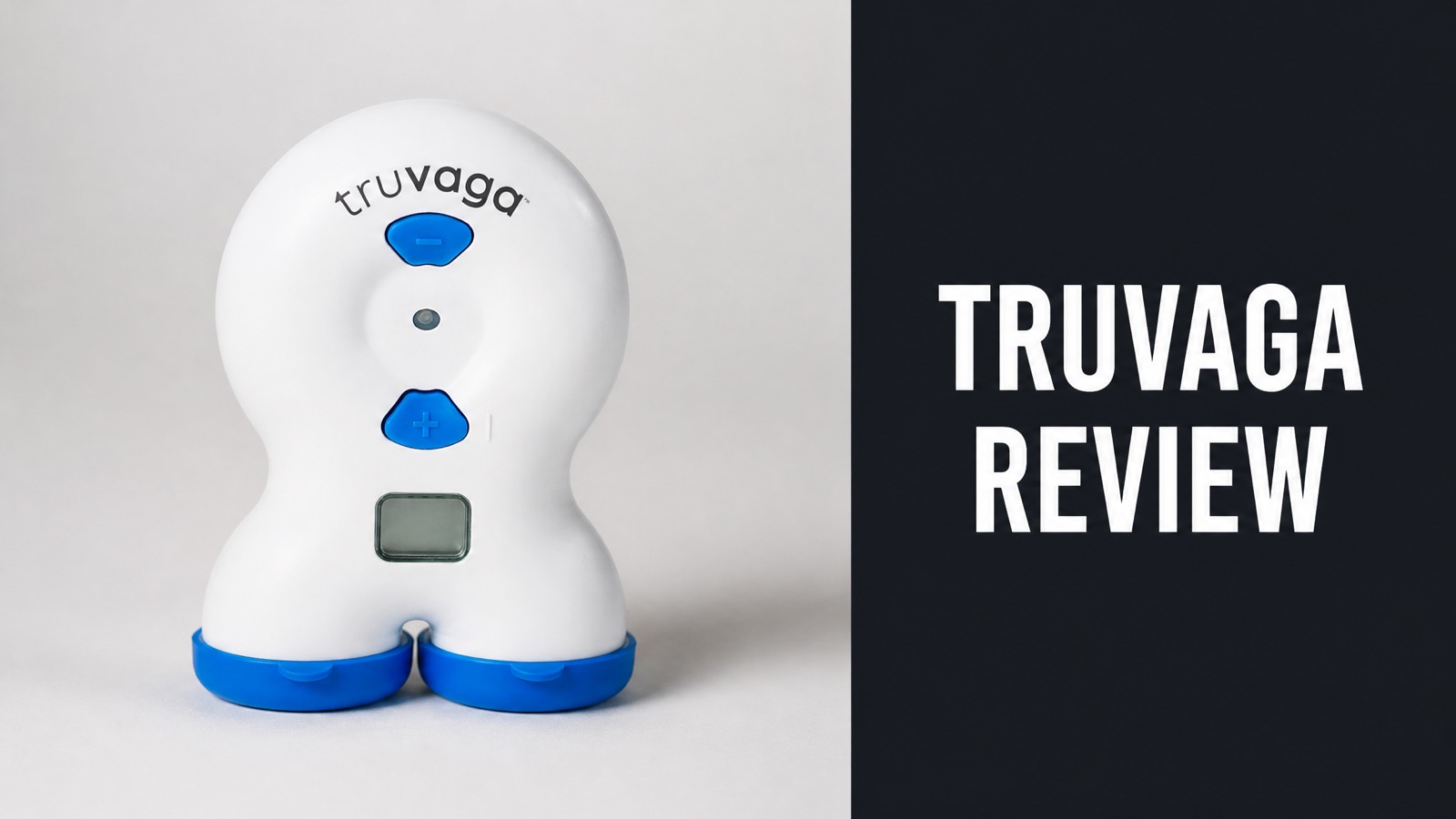
Truvaga is a handheld vagus nerve stimulator made by electroCore, a medical tech company in Rockaway, New Jersey. You hold it against the side of your neck for two minutes. It sends a gentle electrical signal to the vagus nerve. The brand sells two models, the Truvaga 350 and the Truvaga Plus.
The device targets the nerve that runs your rest and digest system. Sessions last two minutes, twice a day. Truvaga shares its core specs with gammaCore, a prescription device for cluster headaches. Users praise calmer evenings and better sleep. Complaints focus on the Plus app, short battery life, and gel refills. Prices run from $325 to $499 today.
The big picture is simple. Truvaga is a low-risk wellness tool, not a medical cure. The sections below cover how it works, what real users report, safety, rivals, and the full cost. Read on right now to see if this small neck device truly fits your stress, your sleep, and your budget.
What Is Truvaga?
Truvaga is a non-invasive vagus nerve stimulator that you hold against your neck for two-minute sessions. The brand is pronounced ‘tru-VAY-ga.’ Its parent company, electroCore, also makes gammaCore. Truvaga sells the device as a general wellness product. Its main promise is short: feel calmer, think clearer, and sleep better with a few minutes of daily use.
Where does the signal go? Straight to the vagus nerve. The vagus nerve is the longest cranial nerve in the body. It runs from the brainstem through the neck into the chest and gut. It helps control heart rate, digestion, breathing, and recovery from stress.
Truvaga reaches the nerve at the neck. Here’s why: the company says the nerve sits about 1.5 cm (0.6 inches) under the skin there. That’s the same spot where you’d check your pulse.
Key Facts:
- Maker: electroCore, Rockaway, New Jersey
- Type: handheld cervical vagus nerve stimulator
- Session length: 2 minutes, twice a day
- Models: Truvaga 350 and Truvaga Plus
- Status: general wellness product, no prescription needed
What Is the Difference Between Truvaga 350 and Truvaga Plus?
Truvaga 350 and Truvaga Plus differ mainly in lifespan, controls, and price. The Truvaga 350 is a self-contained unit with plus and minus buttons. It delivers 350 sessions and then stops working for good. The Truvaga Plus is rechargeable and runs through a free phone app. Innerbody reports that the Plus is guaranteed for 30,000 sessions or three years.
Which one lasts longer? The Plus, by far. The 350 covers about six months at two sessions a day. So the Plus gives you over 85 times more sessions for less than twice the price.
The kits differ too. The Truvaga 350 ships with four 50 ml (1.7 fl oz) tubes of Signagel. The Plus ships with one 50 ml bottle of Signaspray. Our team at Eat Proteins sees the 350 as a trial model and the Plus as the long-term pick.
How Does Truvaga Work?
Truvaga works by sending a mild electrical pulse through the skin of your neck to the vagus nerve. That pulse travels up to the brainstem. From there, it reaches brain areas that manage stress and mood. The goal is to shift your body out of fight or flight. In plain English, it nudges your calm rest and digest system to take over again, and quite fast.
Why does that matter? Stress keeps the sympathetic nervous system switched on. Your heart rate climbs and stress hormones rise. The vagus nerve acts like a brake on that response. Dr. Kara Wada, an immunologist, says the nerve helps regulate heart rate, breathing, digestion, and immune responses.
Implanted vagus nerve stimulators have existed since the late 1990s. Doctors use them for epilepsy and depression. Truvaga skips the surgery. It delivers the signal through the skin instead.
How Do You Use Truvaga?
Truvaga is used on the side of your neck, over your pulse, after you apply conductive gel or spray. It’s quick. Then you raise the intensity until you feel a strong but comfortable tingle. Many users also feel a slight pull at the lower lip. The session stops on its own after two minutes. Most users settle between intensity levels 4 and 7 on the scale.
Steps:
- Find your pulse on one side of your neck.
- Apply Signagel or Signaspray to the skin or electrodes.
- Place one electrode over the pulse with the other below it.
- Press plus, or start a session in the app, to raise the intensity.
- Hold the device still until the two-minute session ends.
Is placement tricky? At first, yes. Yahoo Health tester Kelsey Kunik, RD, needed some trial and error. She found her sweet spot at levels 7 to 8. Truvaga also offers free one-on-one training for new users.
Timing is flexible. The brand suggests one session in the morning and one before bed. Dr. Barry Rotman of Banner Peak Health does two minutes on each side of the neck, twice daily.
What Are Truvaga’s Features and Specs?
Truvaga delivers a 5,000 Hz waveform at a 25 Hz pulse frequency with a maximum output of 60 mA. Innerbody notes that 20 to 30 Hz is the standard range in successful tVNS studies. So 25 Hz sits right in the sweet spot. The 60 mA ceiling also stays below the 75 mA level that can disturb heart rhythm. Both models share these exact same core output specs.
Spec Comparison:
| Feature | Truvaga 350 | Truvaga Plus |
|---|---|---|
| Sessions | 350 total | 30,000 or 3 years |
| Controls | Buttons on device | Phone app required |
| Power | Built-in, not rechargeable | Rechargeable via USB-C |
| Conductor | Signagel tubes | Signaspray bottle |
| Session modes | One standard mode | Six goal-based modes |
The Plus app adds session goals. You can pick stress, mood, mental performance, physical performance, sleep, or other. Each mode uses a different pulse pattern. The app also tracks your history.
But the app has a catch. You must register with your name, email, and phone number before your first session. That setup takes about five minutes.
Is Truvaga the Same as gammaCore?
No. Truvaga is not the same product, but it shares near-identical technical specs with gammaCore. Both come from electroCore. gammaCore is FDA-cleared for migraine and cluster headache and needs a prescription. Truvaga is sold over the counter as a wellness device. The labels and legal claims differ. But the core electrical signal stays nearly the same.
Dr. Barry Rotman tested this himself. He ran oscilloscope tracings with his daughter, a biomedical engineering student. They confirmed Truvaga delivers the same stimulation protocol as gammaCore.
Why does that matter? gammaCore has years of clinical research behind it. Truvaga borrows that foundation at a fraction of the cost. Innerbody says gammaCore can cost several hundred dollars a month.
What Are the Benefits of Truvaga?
Truvaga is designed to lower stress, improve sleep quality, and sharpen mental clarity with daily use. These are the three goals the brand promotes. Research on vagus nerve stimulation also points to wider effects. Studies link it to better heart rate variability, lower inflammation, and fewer headaches. Results build over weeks of daily use, not minutes.
Claimed Benefits:
- Lower stress and anxious feelings
- Faster sleep onset and deeper rest
- Clearer focus and less brain fog
- Higher heart rate variability
- Fewer migraine days for some users
What about stress? A small 2025 study found that two weeks of tVNS lowered perceived stress and anxiety versus a sham device. Dr. Kara Wada says non-invasive stimulation can reduce physical markers of stress.
The brand’s own data looks strong. Truvaga cites a 30-day in-home test by The Benchmarking Company. In that test, 34 people used the device morning and night. Of them, 94% felt calmer and 74% reported better sleep.
Here’s the part most people miss: device makers fund many of these studies. So there’s a real risk of bias. Treat the numbers as promising, not proven.
Does Truvaga Help You Sleep Better?
Yes. Truvaga helps many users fall asleep faster and wind down more easily at night. In the brand’s 30-day test, 74% of users reported better sleep. Yahoo Health’s tester fell back asleep more often after early wake-ups. One Truvaga test user fell asleep within 10 to 15 minutes. These results come from steady daily use over several weeks, not one night.
Clinical research backs the idea. A 2022 trial of tVNS for primary insomnia saw 73% of patients improve after one month. A 2019 study found sleep gains in adults aged 55 and older after two weeks.
But there’s a catch. Those trials used two sessions of 20 to 30 minutes a day. Truvaga uses two-minute sessions. So results from home devices aren’t fully clear yet.
What Do Truvaga Reviews Say?
Truvaga reviews are mixed, with strong praise for sleep and calm but repeated complaints about the app and battery. The product page shows 4.5 stars from over 160 reviews. Trustpilot is harsher at 3.3 out of 5 from about 20 reviews. Innerbody gave Truvaga 4.0 out of 5 after two weeks of testing. Most praise centers on the short, simple daily sessions.
Expert reviewers lean positive. Innerbody rated effectiveness 9.4 out of 10 but gave cost only 6.7. Their team spent over 70 hours on research, testing, and talks with support.
Dr. Barry Rotman used Truvaga for eight months. He reported fewer migraines, better sleep, and a steadier mood. He didn’t feel instant effects, though. The gains came over weeks.
What Do Happy Users Like?
Happy users like the fast sessions, the calm feeling afterward, and steady sleep gains. One Trustpilot reviewer saw no change for a week. Then sleep and mood started to improve. Another user, aged 79, said friends noticed she seemed more relaxed. She also found it easier to recall words mid-conversation. Two minutes twice a day fits most routines easily.
Writer Jessie Quinn tested the Plus for Flow Space. She used sleep mode before bed. After one session, she felt a calm, post-yoga feeling.
Some users feel it right away. Others need a week or more. Truvaga itself says the device can take up to a week to work.
What Are the Common Complaints?
The most common complaints involve app connection problems, battery failure after one to two years, and ongoing gel costs. Several Android and Pixel owners couldn’t get the Plus app to work. One reviewer had to buy an iPhone just to run the device. Truvaga admits some Android models have compatibility issues. These problems hit only the Plus model.
Top Complaints:
- Plus app fails on some Android and Pixel phones
- Batteries die after about 1.5 to 2 years
- No replacement battery option
- Return shipping paid by the customer
- FSA claims denied for some buyers
Battery life is a real sore spot. One Truvaga 350 owner had 32 sessions left when the battery failed. The company pointed to a 1.5-year battery service life in the manual. They only offered a 15% discount on a new device.
Not every complaint is about hardware. One user with visceral hypersensitivity saw no benefit after six months of daily use.
How Does Truvaga Compare to Rivals?
Truvaga stands out for its short two-minute sessions and its clinical link to gammaCore. Most rivals need longer sessions. Nuropod clips to the ear for about 30 minutes. Pulsetto wraps around the neck for several minutes. Xen uses saline instead of special gel. Each device takes a different path to the same nerve. So the best pick depends on your routine.
Device Comparison:
| Device | Placement | Session | Price |
|---|---|---|---|
| Truvaga Plus | Neck, handheld | 2-4 minutes | $499 |
| Truvaga 350 | Neck, handheld | 2 minutes | $325 |
| Nuropod | Ear clip | About 30 minutes | $900 |
| Pulsetto | Neck band | Several minutes | $269 |
| Xen | Neck | Varies | $449 |
Which is cheapest to own? Pulsetto, in most cases. Innerbody puts its first-year cost near $350 with its gel plan. Xen runs $449 with store-bought saline as the only refill.
Is Truvaga Better Than Nuropod or Pulsetto?
No. Truvaga is not better in every way, but it wins on speed and signal pedigree. Two minutes is the shortest session in the group. Truvaga’s signal matches gammaCore’s cleared protocol. Nuropod needs no gel and has more ear-based studies. Pulsetto costs a lot less money up front, too. The right pick depends on your time, your comfort, and your budget.
Nuropod’s maker, Parasym, cites 60+ completed clinical studies. But Nuropod costs $900. And its sessions last about 30 minutes.
Pulsetto is the budget pick. It’s app-run like the Plus. Innerbody notes Xen reaches 100 Hz, which one study linked to stronger effects.
What Are the Side Effects of Truvaga?
Truvaga’s side effects are mild and usually stop once the session ends. The user manual lists tingling, muscle twitching, and small contractions as common. Some users get local pain in the face, head, or neck. That can include a toothache. Headache and skin irritation at the contact spot are also possible. Most people tolerate it well at their own level.
Is it safe overall? For most people, yes. Innerbody rated safety 7.7 out of 10. tVNS devices at 25 Hz are considered safe and well tolerated.
Comfort varies. Some people dislike the feeling of electrical stimulation. Jessie Quinn noted twitching and tingling but no pain.
Who Should Avoid Truvaga?
People with active implanted devices should avoid Truvaga, including anyone with a pacemaker, defibrillator, or hearing aid implant. The manual also warns against use with other stimulators like a TENS unit. Skip it if your neck has an open wound, rash, infection, swelling, or surgical scar. Don’t use it on wet skin or right after swimming or a shower.
Do Not Use If You:
- Have a pacemaker, defibrillator, or cochlear implant
- Are pregnant or breastfeeding
- Are younger than 12
- Had surgery to cut the vagus nerve in the neck
- Have a slow heart rate or arrhythmia
Innerbody adds asthma and abnormal autonomic function to the list. Dr. Kara Wada also flags a history of seizures. When in doubt, get your doctor’s OK first.
Is Truvaga FDA Approved?
No. Truvaga is not FDA approved or cleared, because it is sold as a general wellness product. That means it can’t claim to treat any disease. gammaCore, its prescription sibling, is FDA-cleared for migraine and cluster headache. Truvaga uses nearly the same specs. But it lacks the formal medical label and all of the extra oversight that comes with it.
Does that make it a scam? No. electroCore is an established medical device company. And Truvaga offers a 30-day money-back guarantee.
Still, keep expectations in check. The International Headache Society doesn’t recommend these devices for migraine or cluster headache. Research is still limited and mixed.
How Much Does Truvaga Cost?
Truvaga costs $325 for the Truvaga 350 and $499 for the Truvaga Plus. Both include free standard shipping and a 30-day money-back guarantee. The Plus offers financing from about $46 a month. You can also pay with HSA or FSA funds through Truemed. Health insurance doesn’t cover either of these two models. The 350 has sold for as low as $299 during sales.
First-Year Cost:
| Item | Truvaga 350 | Truvaga Plus |
|---|---|---|
| Device | $325 | $499 |
| Gel or spray 6-pack | $45 | $45 |
| Year one total | $370 | $544 |
Refills add up slowly. Truvaga sells Signagel and Signaspray at $45 per 6-pack. The brand calls that about a year’s supply. One 50 ml bottle of spray lasts around two months.
Want to save on refills? Innerbody found Signa Spray from other sellers for as little as $2.99 a year. It’s the same Parker Labs product.
Is Truvaga Worth the Price?
Yes. Truvaga is worth the price for people who want a quick, drug-free stress tool and plan to use it daily. The Plus makes the most sense long term. Its 30,000-session life beats buying a new 350 every six months. But the 350 is a cheaper way to test the idea. And the 30-day guarantee lowers your risk. Return it if it doesn’t help in a month or so.
Watch the FSA fine print. One buyer’s FSA claim was denied despite the Truemed checkout. Confirm you get a Letter of Medical Necessity before you pay.
Not sure yet? Try free methods first. Slow breathing, humming, and cold exposure also engage the vagus nerve. If those help a little, Truvaga may help more.
Should You Try Eat Proteins?
Yes. Eat Proteins gives you honest reviews and nutrition advice that help you manage stress, sleep better, and recover faster. A neck device is only one piece of the puzzle. What you eat shapes your nervous system too. Our team at Eat Proteins explains how protein, meal timing, and evening habits help. They support calm energy and much deeper sleep.
Don’t spend $500 on calm and ignore your plate. Pair smart gear with smarter meals. Then watch your energy and sleep improve. Start reading Eat Proteins today.
How Does Eat Proteins Support Stress and Sleep?
Eat Proteins supports stress and sleep with clear guides on protein, meal timing, and honest wellness gear reviews. Our experts connect what you eat with how you rest and recover. Here’s the kicker: protein foods supply tryptophan. Your body uses it to make melatonin. Small diet changes can show up fast in how well you sleep every single night of the week.
You’ve seen the full Truvaga breakdown. Now take the next step. Check back with Eat Proteins for new reviews, recipes, and recovery tips. Your calmest night starts with your next meal.