
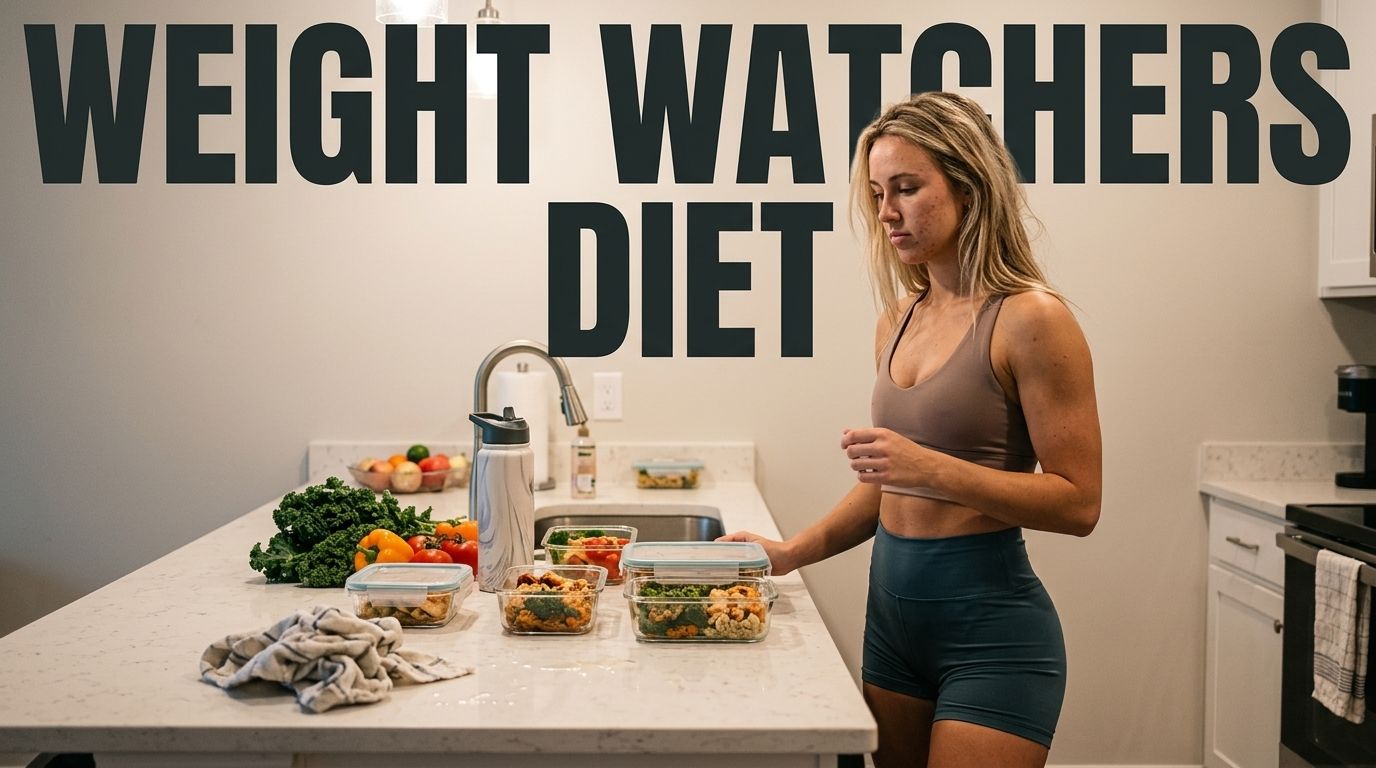
Weight Watchers is one of the longest-running commercial weight loss programs in the world. Founded in 1963 and now backed by more than 175 scientific publications, the program uses a Points system to simplify food choices without banning any food group. It’s designed for gradual, sustainable weight loss rather than rapid restriction.
The Points system assigns each food a numerical value based on nutrient and energy density. One point equals roughly 50 calories. ZeroPoint foods, including 350+ fruits, vegetables, and lean proteins, don’t require tracking at all. Clinical data shows members lose 0.5 to 1 kilogram (1 to 2 pounds) per week. Workshop members lose twice as much as those who go it alone.
This guide covers how the program works, what the research confirms, who benefits most, and where it falls short. Our nutritionists at Eat Proteins break down the mechanics so you can decide whether Weight Watchers fits your goals.
What Is the Weight Watchers Diet?
Weight Watchers is a commercial weight loss program that uses a Points system to simplify food choices and promote gradual, sustainable weight loss. The program, now branded as WW, assigns each food a point value based on nutrient density and caloric content. No foods are banned. It’s built on flexibility, not restriction.
Jean Nidetch founded the program in 1963 from her living room in Queens, New York. The original model combined the nutritional principles of the ‘Prudent Diet’ developed by Dr. Norman Jolliffe with weekly support group meetings. That combination of structured eating and community accountability remains the program’s foundation six decades later.
How Does the Points System Work?
The Points system converts complex nutritional data into a single number for every food, where one point equals approximately 50 calories. Foods with lower point values, like high-fiber carbohydrates, lean proteins, and legumes, can be consumed more freely. Foods with higher values require more careful portioning.
How Points Are Calculated:
| Factor | Effect on Points |
|---|---|
| Calories | Higher calories increase point value |
| Saturated fat | More saturated fat increases points |
| Sugar | Higher sugar content raises points |
| Protein | Higher protein lowers points |
| Fiber | Higher fiber lowers points |
After signing up, members answer questions about their current habits and fitness level. The app generates a personalized daily Points Budget. Members then spend those points however they choose throughout the day, tracking meals directly in the app.
What Are ZeroPoint Foods?
ZeroPoint foods are 350+ nutrient-dense foods selected by the Weight Watchers nutrition team that members can eat without weighing, measuring, or tracking. These foods form the foundation of healthy, balanced eating within the program. They’re rich in protein and fiber, which helps members stay full between meals.
ZeroPoint Food Categories:
- Most fruits and vegetables
- Skinless chicken and turkey breast
- Eggs
- Fish and shellfish
- Nonfat yogurt
- Legumes (beans, lentils, chickpeas)
- Popcorn (air-popped)
The ZeroPoint list frees up the daily Points Budget for foods that do carry values. Bread, wine, dessert, and other favorites stay on the table. The system works because ZeroPoint foods are naturally filling and nutritionally dense, so overconsumption is rare.
How Does Weight Watchers Help You Lose Weight?
Weight Watchers restricts energy intake to produce a weight loss rate of 0.5 to 1.0 kilograms (1 to 2 pounds) per week, which is the medically accepted standard for sustainable results. The program achieves this through portion awareness, nutrient-dense food prioritization, and behavioral change techniques. Here’s why that rate matters: faster loss typically means muscle breakdown, energy crashes, and rebound weight gain.
The program pairs food tracking with behavior change science. Members receive personalized activity goals, access to coaches trained in nutrition and behavioral science, and community support through workshops. Workshop members lose twice as much weight as members who manage the program independently.
What Rate of Weight Loss Can You Expect?
Weight Watchers members can expect to lose 0.5 to 1% of body fat per week, which translates to roughly 0.5 to 1 kilogram (1 to 2 pounds) for most people. This rate preserves muscle mass and reduces the risk of metabolic slowdown that accompanies rapid weight loss programs.
Members who pair the Core Program with GLP-1 weight-loss medications lose 11% more weight than those on the behavioral program alone. That data comes from a 2024 analysis of virtual clinic member outcomes at four weeks of membership. The medication pathway includes a dedicated Care Team of clinicians, fitness coaches, and registered dietitians.
Does the Program Include Exercise?
Yes. Weight Watchers builds personalized daily and weekly activity goals into each member’s plan based on their current fitness level. The app tracks activity alongside food intake, creating a complete picture of energy balance.
The exercise component reinforces the dietary changes rather than replacing them. Physical activity earns additional Points that members can spend on food. This creates a positive feedback loop where movement directly expands food flexibility. But the program never positions exercise as the primary weight loss tool.
What Are the Benefits of Weight Watchers?
Weight Watchers delivers a balanced, flexible approach where no foods are off-limits and members maintain full control over daily food choices within their Points Budget. The program accommodates vegetarian, vegan, kosher, halal, low-salt, and low-fat dietary preferences without modification.
Key Benefits:
- No foods are banned or restricted
- 350+ ZeroPoint foods reduce tracking burden
- Gradual weight loss preserves muscle mass
- Community support through workshops and coaching
- App-based tracking simplifies daily management
- Backed by 175+ scientific publications
The slow, steady weight loss model avoids the energy dips, mood swings, and muscle loss that come with restrictive diets. Building sustainable habits around food choices and portion awareness creates results that hold long after the initial weight loss phase ends.
Is Weight Watchers Flexible Enough for Any Diet?
Yes. Weight Watchers accommodates any dietary pattern because the Points system works with all food types rather than excluding specific categories. Vegetarian, vegan, kosher, halal, gluten-free, low-sodium, and low-fat approaches all fit within the framework without special modifications.
The ZeroPoint food list adjusts based on individual health conditions. Members with diabetes receive a modified list of 200+ ZeroPoint foods specifically selected to minimize blood sugar impact. This adaptability separates Weight Watchers from rigid meal-plan diets that break down when real life intervenes.
Does Weight Watchers Offer Coaching and Support?
Yes. Weight Watchers provides access to trained coaches through the app, in-person workshops at Studio locations, and virtual group sessions led by behavior change specialists. Coaches are trained in nutrition science and behavioral change methodology.
The support structure operates on multiple levels. In-app chat connects members with coaches for daily questions. Weekly workshops create community accountability. Members on GLP-1 medications get a dedicated Care Team of clinicians, fitness coaches, and registered dietitians. So what does that mean in practice? No member has to figure it out alone.
What Does Science Say About Weight Watchers?
Weight Watchers is backed by more than 175 peer-reviewed publications demonstrating efficacy for weight loss and long-term weight management. The program is the only commercial weight loss brand with 60 years of continuous scientific validation. And this is where it gets interesting: the evidence extends beyond weight to metabolic health markers.
The dietary composition resembles either a low-fat diet or a moderate-fat, low-carbohydrate diet depending on the variant used. Both approaches fall within established nutritional guidelines. The program’s emphasis on nutrient-dense foods over calorie restriction aligns with current metabolic research on sustainable weight management.
Is Weight Watchers Doctor-Recommended?
Yes. Weight Watchers is the number one doctor-recommended weight loss program based on a 2023 survey by Cerner Enviza of 500 physicians who recommend weight loss programs to patients. That endorsement reflects the program’s clinical evidence base and medically appropriate weight loss rate.
The clinical pathway now includes GLP-1 medication access for members who qualify. A 2024 internal analysis showed members on medications lose 11% more weight when combining them with the Core behavioral program versus medication alone. The program positions itself as a complete clinical solution rather than a standalone diet plan.
What Are the Downsides of Weight Watchers?
Weight Watchers carries a recurring monthly cost starting at $12 per month for the Core membership, with higher tiers for coaching, workshops, and medication access. The financial commitment separates it from free dietary approaches like simply eating more whole foods and vegetables.
Scientific evidence supporting commercial weight management programs, including Weight Watchers, remains limited by high attrition rates in studies. Many participants drop out before completion, which makes long-term efficacy data harder to interpret. The program works for those who stick with it, but retention is a genuine challenge.
Can the Points System Backfire?
Yes. The Points system can encourage some members to ‘game’ their budget by spending all daily points on nutrient-poor foods that fit the numbers but miss the nutritional goal. A day’s budget spent entirely on processed snacks technically stays within limits but defeats the health purpose.
The ZeroPoint food list partially addresses this risk. But the system still relies on individual judgment to balance point spending between nutritious and less nutritious options. Members without strong nutritional literacy may optimize for point math rather than actual health outcomes. Here’s the thing: points track quantity well, but quality remains the member’s responsibility.
Who Is Weight Watchers Best For?
Weight Watchers works best for adults who want a structured but flexible weight loss framework with community support and no food restrictions. The program particularly suits people who have tried rigid meal plans and failed because they couldn’t sustain the elimination approach long-term.
The coaching and workshop components add the most value for members who respond to accountability and social motivation. Workshop members lose twice as much weight as solo members. For self-directed individuals who prefer minimal interaction, the app-only tier provides the tracking tools without the community layer.
Does Weight Watchers Work for People With Diabetes?
Yes. Weight Watchers offers a diabetes-specific program with a modified ZeroPoint food list of 200+ items selected to minimize blood sugar impact. The foods on the diabetes list are less likely to cause glucose spikes while still providing balanced nutrition.
Weight loss itself improves glycemic control. The program’s gradual approach of 0.5 to 1 kilogram (1 to 2 pounds) per week avoids the metabolic stress that rapid weight loss diets can trigger in diabetic patients. The combination of portion control, nutrient-dense food prioritization, and physical activity alignment makes it a practical tool for diabetes management alongside medical treatment.
How Did Weight Watchers Start?
Jean Nidetch founded Weight Watchers in 1963 from her living room in Queens, New York, after years of frustration with fad diets that produced temporary results. Two years earlier, Nidetch had joined a 10-week weight loss program run by the New York City Board of Health. The program worked, but it lacked the peer support she needed to stay motivated.
Nidetch started inviting friends to weekly meetings in her home. They discussed goals, shared struggles, and held each other accountable. Those small gatherings grew into a global organization. The core insight was simple: dietary information alone doesn’t produce lasting change. Community support does.
How Has the Program Changed Over Time?
Weight Watchers has evolved through multiple iterations over six decades, shifting from a rigid meal plan to a flexible Points-based system driven by advances in nutritional science and behavioral psychology. The SmartPoints system replaced earlier calorie-counting models by weighting food values toward protein, fiber, and nutrient density.
Weight Watchers Evolution:
| Era | Key Change |
|---|---|
| 1963 | Founded by Jean Nidetch with weekly group meetings |
| 1990s | Points system introduced to simplify calorie tracking |
| 2010s | SmartPoints weighted toward nutrient density |
| 2018 | Rebranded to ‘WW’ with wellness focus beyond weight |
| 2024 | GLP-1 medication access added alongside behavioral program |
In 2018, Weight Watchers rebranded to ‘WW’ to reflect a broader focus on overall wellness beyond weight loss. The most recent addition is clinician-guided GLP-1 medication access for members who qualify medically. The program now positions itself as a complete health solution rather than a diet alone.
Want Your Free Healthy Eating Meal Plan?
You’ve seen the science behind structured eating. Now take the next step. The nutritionists at Eat Proteins built a free meal plan that prioritizes whole foods, lean proteins, and nutrient-dense meals without requiring a subscription or a Points calculator.
The plan gives you exact meals, specific portions, and a clear daily structure. No tracking apps needed. No monthly fees. Just real food that supports weight management, steady energy, and long-term health. Don’t put it off. Get your free plan and start eating with purpose today.