
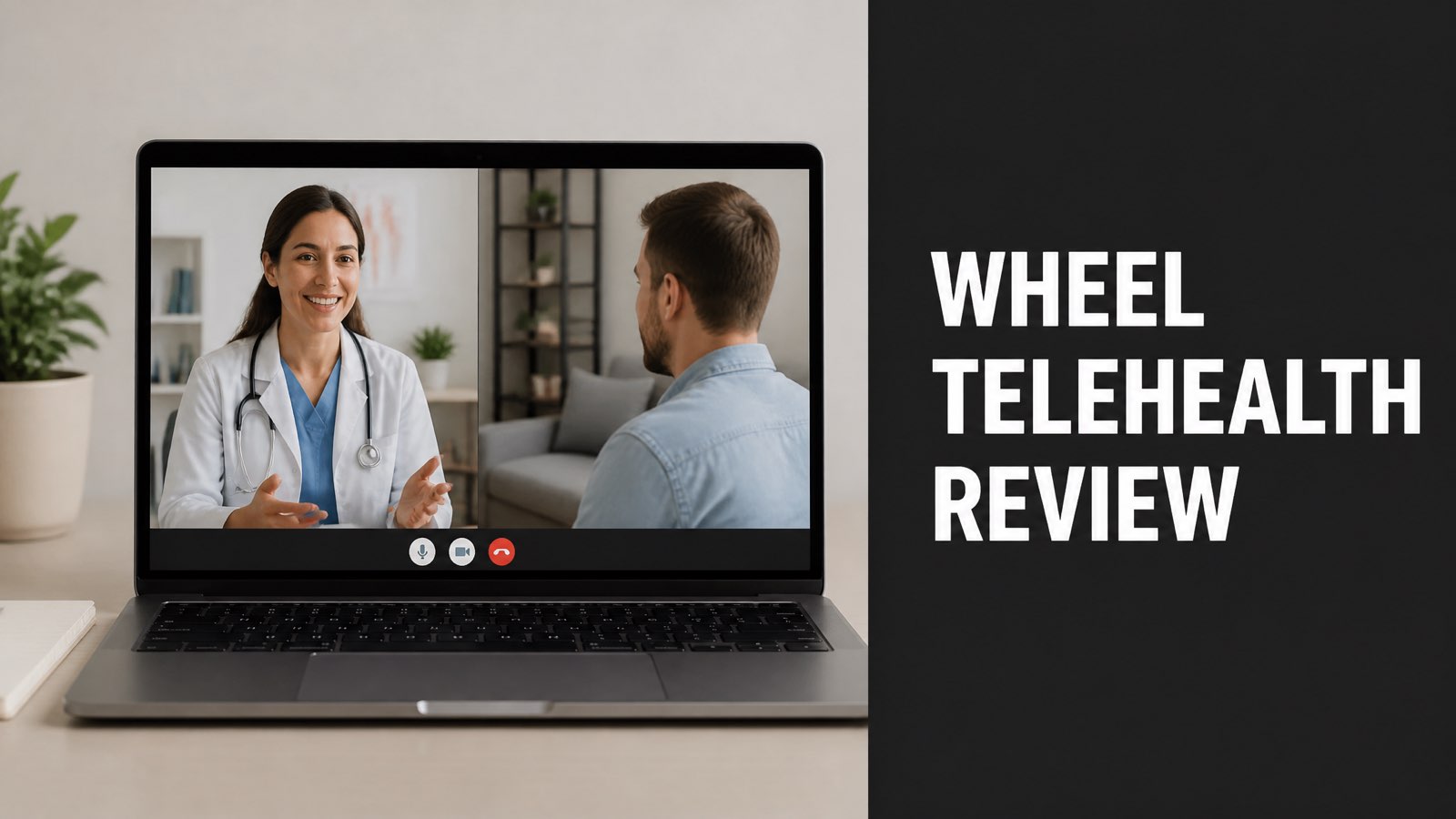
Wheel Telehealth is a virtual care company based in Austin, Texas. Founded in 2018, it sells white-label telehealth infrastructure to health plans, pharma firms and retailers. This review covers how it works, what it costs and who benefits. The company focuses on enterprise customers rather than individual patients.
Wheel runs a 50-state clinician network and reports over 9 million visits. Customer reviews barely exist. Pricing arrives only as a custom quote. A rival publishes fees openly. Layoffs hit staff in 2023, yet funding tops $216 million and partners include Amazon Pharmacy. Partner names also include Talkspace, Health Gorilla and Cost Plus Drugs. Prices stay unpublished.
The picture is mixed. Scale and breadth favor enterprise buyers. Opaque pricing and thin reviews favor caution. Read on to see the benefits, complaints, costs and a head-to-head comparison before you decide. Our team at Eat Proteins checks every claim against public sources. Each fact is sourced.
What Is Wheel Telehealth?
Wheel Telehealth is a business-to-business virtual care company based in Austin, Texas, founded in 2018. Digital health firms, health plans, pharma programs and retailers use it to run telehealth under their own brand. Patients rarely see the Wheel name, because the company works behind the scenes. The brand a patient sees belongs to the customer, not Wheel.
Our team at Eat Proteins checked the public record first. Wheel has raised more than $216 million. Its homepage reports over 9 million completed patient visits as of November 2026. Wheel sells to businesses. Can a patient sign up directly? No.
Wheel at a Glance:
| Detail | Fact |
|---|---|
| Founded | 2018 |
| Headquarters | Austin, Texas |
| Funding raised | $216M+ |
| Completed visits | 9M+ |
| Care programs | 70+ |
| Clinician coverage | 50 states, DC, Puerto Rico |
Who Uses Wheel Telehealth?
Enterprise buyers make up the core Wheel customer base. The company sells to digital health companies, pharma and life sciences firms, health plans, retailers and third-party administrators. Its marketing references Fortune 50 logos. In fact, individual patients cannot buy a Wheel plan themselves. Procurement teams make the buying decision. Scale matters.
Clinicians use Wheel too. Physicians, nurse practitioners, registered nurses, physician assistants and dietitians join its remote network. Does a newcomer qualify? Yes, prior telehealth experience is not required. Wheel supplies the training, tools and clinical protocols.
How Does Wheel Telehealth Work?
Wheel Telehealth works as white-label infrastructure that handles the clinical and operational work behind a customer’s brand. Customers keep their brand and their patient relationship. Wheel supplies the clinicians, software, prescribing workflow and reporting. Wheel says a launch takes as little as 45 days. The model favors speed over custom builds.
Speed is the pitch. Company officials told the American Hospital Association that Wheel launches telehealth in weeks instead of 15 months. Is that proven? Only by Wheel’s own statement, so our experts treat it as a vendor claim.
What Is Wheel Horizon?
Wheel Horizon is the platform that bundles care software, a clinician network and analytics. The software covers intake, scheduling, visit types, messaging and EMR workflows. Board-certified clinicians work through Wheel Medical Group. Integrated clinical operations and analytics complete the package for each customer. Customers see none of the plumbing.
Horizon Components:
- Care enablement software
- 50-state clinician network
- Integrated clinical operations
- Analytics and reporting
Here’s the thing about reporting. A rival’s comparison page says Wheel lists demographics, visit-funnel conversion, completed visits by state and no-shows. Revenue and lifetime value dashboards are absent from that list. Buyers confirm that with Wheel directly.
How Does Wheel Handle Prescriptions?
Wheel Telehealth connects prescribing to partner pharmacies instead of running its own pharmacy. Medication fulfillment runs through an Amazon Pharmacy integration. Prescription ordering, home delivery and lab orders appear as connected services. In 2024, Wheel also announced a tie-in with Cost Plus Drugs, which lists 2,300 medications. Setup varies.
Two more partners joined the same ecosystem. Talkspace adds mental health access. Health Gorilla shares diagnostic results across care teams. The good news? Buyers get several services through one vendor.
What Are the Benefits of Wheel Telehealth?
Wheel Telehealth offers scale, speed and program breadth to enterprise buyers. The clinician network covers all 50 states, DC and Puerto Rico. More than 70 care programs run on one platform. Reported volume tops 9 million visits. Large organizations get a vendor that can clear procurement review. Clinicians, software and analytics arrive as one package.
Main Benefits:
- 50-state clinician coverage
- 70+ clinical programs
- Launch in as little as 45 days
- Amazon Pharmacy fulfillment
- One contract for partner clinicians
Does Wheel Telehealth Scale Fast?
Yes. Wheel reports roughly 4,000 visits a day and more than 9 million visits in total. Volume at that level shows the infrastructure carries real load. Company officials also claim launches take weeks. Wheel itself supplies every one of those speed figures. Independent confirmation is not in the public record. The figures give buyers a sense of size.
Does volume prove quality? Not by itself. Commissioned research adds context. More than 70% of surveyed consumers said virtual care saved them time. About 60% said they would pay extra for it. To be clear, Wheel funded that research, so our team reads the numbers with care.
Does Wheel Offer GLP-1 Weight Management?
Yes. Wheel runs a weight management program that includes GLP-1 options. The program reports more than 250,000 GLP-1 visits. Registered dietitian nutritionists also work inside the clinician network. Dietitian involvement matters to readers who track nutrition and protein intake alongside any medication. Customers choose whether to offer it to patients.
Weight management is one of many programs. Is it the largest? Public sources do not say. Others cover urgent care, primary care, women’s health, men’s health, dermatology and pediatrics. Customers pick which programs to launch under their own brand.
What Do Wheel Telehealth Reviews Say?
Wheel Telehealth has almost no public customer reviews. A comparison dated November 10, 2026 found zero reviews on G2 and Trustpilot. Wheel’s Google Business Profile shows none, and a former Capterra listing returns a not-found page. The company sells to enterprises, so consumer review sites rarely apply to it. Review volume stays low for B2B vendors.
Public Review Profiles:
| Site | Rating | Reviews |
|---|---|---|
| G2 | None yet | 0 |
| Trustpilot | None yet | 0 |
| Glassdoor (employees) | 2.1/5 | 80 ratings |
| Indeed (employees) | 4.1/5 | 7 reviews |
Cuvo Health, a competitor, compiled those figures. Our experts note that the source has a stake in the comparison. The reason is simple: each number is checkable on the review site itself.
What Do Employees Say About Wheel?
Employee ratings paint a mixed picture of Wheel as a workplace. Glassdoor shows 2.1 out of 5 from 80 ratings. Indeed shows 4.1 out of 5 from only 7 reviews. Glassdoor reviewers describe unclear direction from leadership and decisions communicated late. The gap in sample size makes direct comparison unreliable here. Sample sizes differ widely between sites.
Workplace ratings measure employment, not product quality. Do they predict vendor performance? Not directly. Staff turnover can still affect service continuity, which is why buyers glance at them.
What Are the Common Complaints About Wheel?
Complaints center on pricing opacity, gated documentation and past layoffs. Wheel publishes no prices. Its API documentation sits behind a password, and credentials arrive only after Wheel approves the organization. The company also cut 56 employees, which was 28% of its workforce, in 2023. Each gap reflects limited public information about the company.
The bad news? Reporting gaps come up too. A rival’s review says revenue, retention and lifetime value dashboards are not listed. Both points are secondhand, so buyers verify them in a sales call. Are the gaps fatal? Not necessarily.
Wheel Telehealth vs Cuvo Health: Which Is Better?
Cuvo Health is the closest published alternative to Wheel Telehealth for consumer brands. Both sell white-label telehealth infrastructure backed by a 50-state clinician network. Wheel targets enterprise buyers and quotes prices deal by deal. Cuvo targets consumer brands and posts its fees on a public pricing page. Pricing marks the sharpest divide here.
Wheel vs Cuvo:
| Factor | Wheel | Cuvo |
|---|---|---|
| Target buyer | Enterprise | Consumer brands |
| Pricing | Custom quote | Published |
| Launch time | As little as 45 days | Under 30 days |
| Clinicians | 50 states, DC, Puerto Rico | 300+ providers, 50 states and territories |
| API access | Approval required | Public on higher plans |
By comparison, Cuvo supplied most of these details itself. Our team at Eat Proteins treats them as vendor claims until a customer confirms them.
How Do the Costs Compare?
Wheel publishes no pricing, while Cuvo lists its fees openly. Cuvo Launch costs $997 a month after a $9,800 setup. Cuvo Grow costs $2,500 a month after a $15,000 setup. Both plans add $25 per completed consult, with no revenue share. Wheel’s price stays unknown until a quote arrives. Cuvo’s data comes from its page. Buyers can model margin from them.
Wheel quotes after a sales cycle. Cuvo’s page frames that as a quarter-long procurement review. What’s more, Wheel has not confirmed that timeline, so the gap remains unproven. Is cheaper always better? Not for enterprise needs.
Is Wheel Telehealth Legit?
Yes. Wheel Telehealth is a real, well-funded company with a seven-year operating history. Founded in 2018, it has raised more than $216 million and reports over 9 million visits. Wheel Medical Group governs its clinician network. Named partners include Amazon Pharmacy, Talkspace and Cost Plus Drugs. No scam signals appear in the sources. Funding is real.
Legitimacy Signals:
- Founded in 2018 in Austin, Texas
- More than $216M raised
- Over 9M reported visits
- Licensed 50-state clinician network
- Named ecosystem partners
How Stable Is Wheel Telehealth?
Wheel Telehealth carries real workforce risk despite its funding. The company laid off 56 employees in 2023, which equals 28% of its staff. An earlier cut of 17% came less than a year before. Funding of $216 million cushions those moves. Still, two rounds of cuts in a short span signal turbulence. Funding helps, but headcount cuts still matter to buyers.
Our experts found no public reports of outages or regulatory action in the sources reviewed. Absence of evidence is not proof. Is Wheel stable? Funding says yes. In plain English: buyers still run their own due diligence.
How Much Does Wheel Telehealth Cost?
Wheel Telehealth does not publish prices for any plan or care program. Pricing arrives as a custom quote after a sales conversation. Deals are scoped one at a time, and implementation takes several weeks. No public per-visit fee exists as of November 2026. Short answer: buyers must ask. Wheel’s customers learn the cost only after they request a quote.
Known Pricing Facts:
- No public price list
- Quotes issued deal by deal
- Launch in as little as 45 days
- API credentials only after approval
Does any buyer skip the quote process? Not publicly. Here’s why: pricing depends on programs, volume and integrations, and Wheel scopes each deal separately.
Who Gets Value From Wheel Telehealth?
Enterprise buyers get the most value from Wheel Telehealth. Health plans, pharma programs, retailers and third-party administrators gain a configurable platform with 70-plus programs. Established digital health firms gain a vetted clinician network. Small consumer brands face a heavier sales process and an unpublished price. Fit depends on buyer size.
Clinicians gain value too. Wheel offers one schedule, one contract and one credentialing process across partner companies. Roles run part-time or full-time. Care is delivered by asynchronous messages and by video visits. Bottom line: it’s a platform built for scale, not for casual buyers.
Should You Try Eat Proteins?
Yes. Eat Proteins gives readers plain-language reviews of health products and services before they commit. Our team researches public sources, flags vendor claims and marks what stays unverified. The Wheel Telehealth review above follows that method. Every verdict rests on facts a reader can check on their own. Reviews like this one save research time.
What Does Eat Proteins Offer Readers?
Eat Proteins offers independent reviews built on public evidence. Our coaches and experts compare vendors side by side and name the gaps. Each review lists what is verified, what is claimed and what is missing. Readers save hours of research and see the caveats up front. Subscribers get new reviews as soon as they publish. Expect plain language and no hype.
Don’t buy blind. Join the Eat Proteins list and get the next review first.