
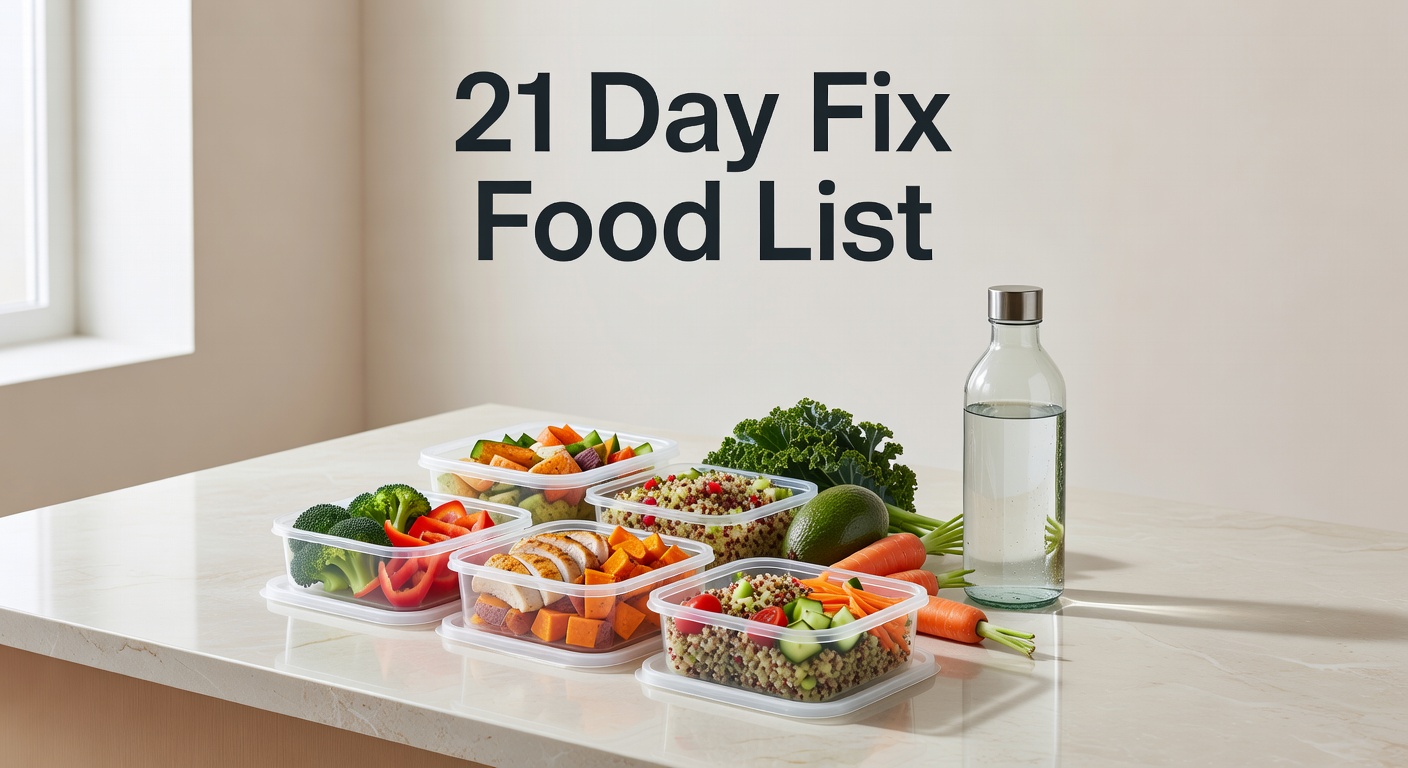
The 21 Day Fix food list is a color-coded container system created by Beachbody that organizes every food into six categories by nutrient type and portion size. Each container color represents a different food group: green for vegetables, purple for fruit, red for protein, yellow for healthy carbs, blue for healthy fats, and orange for seeds and dressings. The program is now officially called Portion Fix but remains widely known by its original name.
The system works by assigning each person a daily container allowance based on their target calorie range. Plans range from Plan A at approximately 1,200 calories per day up to Plan F at 2,500 calories, with container counts adjusted for each bracket. Our nutritionists at Eat Proteins have broken down every container, every approved food, and the key rules that determine whether a food fits the plan.
This guide covers the complete food list by container, what to avoid, free foods, treat swaps, and a sample meal day. Whether starting a first round or returning after a break, this is the reference to keep on hand.
What Is the 21 Day Fix Food List?
The 21 Day Fix food list is a portion-controlled eating framework developed by Beachbody that categorizes foods into color-coded containers, each representing a specific nutrient group and a precise serving size. The program was launched in 2013 and updated in 2019 under the name Ultimate Portion Fix, then simplified further as Portion Fix. The core food list has been revised multiple times to expand options and improve nutritional clarity. Beachbody CEO Carl Daikeler reported losing 12 pounds in 21 days on the original program.
How Do the Color-Coded Containers Work?
Each container is sized to hold a specific serving amount for its designated food group, removing the need for calorie counting or weighing food on a scale. Green holds 1 cup for vegetables. Purple holds 1 cup for whole fruits. Red holds 3/4 cup for proteins. Yellow holds 1/2 cup for healthy carbohydrates. Blue holds 1/3 cup for healthy fats. Orange holds 2 tablespoons for seeds and dressings. Teaspoons measure oils and nut butters at literally one teaspoon per serving.
Foods on each container list are ranked by nutritional value. Items higher on the list deliver more micronutrients per serving. For most containers, the rule is to fill the container until the lid closes. Foods listed with specific measurements — such as ’10 asparagus spears’ — follow that count rather than filling by volume.
How Many Containers Do You Get Per Day?
Daily container allowances are determined by a calorie target calculated from body weight and activity level, then assigned to one of six container plans ranging from Plan A (approximately 1,200 calories) to Plan F (approximately 2,500 calories). Plan A allows 3 green, 2 purple, 4 red, 2 yellow, 1 blue, 1 orange, and 2 teaspoons per day. Each plan adds containers as calorie targets increase. Plan D at approximately 2,100 calories allows 6 green, 4 purple, 6 red, 4 yellow, 1 blue, 1 orange, and 6 teaspoons daily.
21 Day Fix Daily Container Allowances by Plan:
| Container | Plan A (~1,200 cal) | Plan B (~1,500 cal) | Plan C (~1,800 cal) | Plan D (~2,100 cal) |
|---|---|---|---|---|
| Green (vegetables) | 3 | 4 | 5 | 6 |
| Purple (fruit) | 2 | 3 | 3 | 4 |
| Red (protein) | 4 | 4 | 5 | 6 |
| Yellow (carbs) | 2 | 3 | 4 | 4 |
| Blue (healthy fats) | 1 | 1 | 1 | 1 |
| Orange (seeds/dressings) | 1 | 1 | 1 | 1 |
| Teaspoons (oils/nut butters) | 2 | 4 | 5 | 6 |
What Foods Are in the Green and Purple Containers?
The green and purple containers cover all non-starchy vegetables and whole fruits respectively, with each container providing roughly 30 to 100 calories per serving and emphasizing nutrient density over caloric volume. Green container foods average 40 calories per cup. Purple container foods average 75 calories per cup. Both containers are among the most filling per calorie in the plan, making them the foundation of satiety across all container plans. Only whole fruits count toward the purple container — fruit juices do not qualify.
Which Vegetables Are on the 21 Day Fix Green Container List?
The green container holds 1 cup of non-starchy vegetables, with the highest-ranked options including leafy greens like lettuce, collard greens, and spinach, followed by cruciferous vegetables like broccoli and Brussels sprouts. Other approved green container foods include tomatoes, asparagus, onions, zucchini, snow peas, butternut squash, and bell peppers. Homemade salsa counts as a green at a half-cup serving. Vegetable broth counts as 2 cups per green container. Surprisingly, corn and regular sweet peas count as yellow containers, not green.
Green Container Examples (1 cup each):
- Lettuce, spinach, collard greens, kale — leafy greens (highest nutritional rank)
- Broccoli, Brussels sprouts, cauliflower — cruciferous vegetables
- Tomatoes, bell peppers, asparagus, zucchini — low-starch produce
- Onions, snow peas, mushrooms, celery, cucumber — versatile staples
- Butternut squash, spaghetti squash — winter squash varieties
- Homemade salsa (1/2 cup) / Vegetable broth (2 cups) — liquid and condiment options
Which Fruits Are on the 21 Day Fix Purple Container List?
The purple container holds 1 cup of whole fruit, with berries, melon, and stone fruits ranking highest on the nutritional priority list inside the program’s official guide. Approved purple container foods include apples, bananas, grapes, mango, strawberries, blueberries, cantaloupe, pineapple, and kiwi. Pumpkin puree counts as a purple container at 2/3 cup. Unsweetened applesauce counts at 3/4 cup. Dried fruits like raisins, dates, apricots, and figs also count as purple in smaller measured amounts listed in the official guide.
What Foods Are in the Red Container?
The red container holds 3/4 cup of protein foods and delivers an average of 145 calories, 21 grams of protein, and 6 grams of fat per serving — making it the primary driver of satiety and muscle maintenance on the plan. Red container foods range from 100 to 200 calories per serving depending on the protein source. Lean animal proteins, eggs, dairy proteins, and plant-based proteins all qualify. The program prioritizes protein to support both fat loss and lean mass preservation during the 21-day workout cycle.
What Proteins Can You Eat on the 21 Day Fix?
The red container covers lean meats, poultry, seafood, eggs, Greek yogurt, cottage cheese, and plant proteins including tofu, tempeh, and legumes for those following a vegan or vegetarian variation of the plan. Chicken breast, turkey, duck, fish, pork tenderloin, and lean beef all qualify. Shellfish and game meats also count. Whole eggs and egg whites are included. Greek yogurt and cottage cheese are dairy options. Ricotta cheese qualifies at the red container portion size.
Red Container Protein Options (3/4 cup each):
- Lean animal proteins: chicken breast, turkey, lean beef, pork tenderloin, fish, shellfish
- Eggs: whole eggs and egg whites (counts as 3/4 cup volume)
- Dairy proteins: Greek yogurt, cottage cheese, ricotta cheese
- Plant proteins (vegan list): tofu, tempeh, veggie burgers, beans, lentils
- Protein powder: approved varieties count as red per measured serving
What Foods Are in the Yellow, Blue, and Orange Containers?
The yellow, blue, and orange containers cover healthy carbohydrates, healthy fats, and seeds or dressings respectively, completing the macronutrient balance required for energy, hormonal health, and nutrient absorption. Yellow container foods average 115 calories per serving with 15 to 30 grams of carbohydrates. Blue container foods include calorie-dense healthy fats at 1/3 cup. Orange holds just 2 tablespoons for high-calorie seeds and dressings. The teaspoon category covers oils and nut butters at one teaspoon per serving, averaging 35 calories and 4 grams of fat.
What Carbs Are Allowed on the 21 Day Fix?
The yellow container holds 1/2 cup of complex carbohydrates, specifically whole grains and starchy vegetables that provide sustained energy without the blood sugar spikes associated with refined carbs. Approved yellow foods include sweet potatoes, brown rice, whole grain pasta, quinoa, oatmeal, beans, lentils, whole grain bread, corn, sweet peas, and barley. Note that 1/4 cup of whole grain flour equals one yellow container when baking from scratch. Low-fat milk (8 oz) counts as 1 yellow plus 1/2 teaspoon.
What Healthy Fats Can You Eat on the 21 Day Fix?
The blue container holds 1/3 cup of healthy fats including avocado, nuts, cheese, and coconut milk, foods that support hormone production, joint health, and fat-soluble vitamin absorption. The orange container at 2 tablespoons covers pumpkin seeds, sunflower seeds, flaxseeds, and Fix-approved dressings. The teaspoon category includes extra-virgin olive oil, coconut oil, nut butters like almond and peanut butter, butter, and mayonnaise. Unsweetened almond milk (8 oz) counts as 1 teaspoon rather than a blue container.
Yellow, Blue, Orange, and Teaspoon Examples:
| Container | Size | Example Foods | Avg Calories |
|---|---|---|---|
| Yellow | 1/2 cup | Sweet potato, brown rice, oatmeal, quinoa, whole grain bread | 115 |
| Blue | 1/3 cup | Avocado, mixed nuts, cheese, coconut milk | ~120 |
| Orange | 2 tbsp | Pumpkin seeds, sunflower seeds, Fix-approved dressings | ~80 |
| Teaspoon | 1 tsp | Olive oil, coconut oil, peanut butter, almond butter, butter | 35 |
What Foods Should You Avoid on the 21 Day Fix?
The 21 Day Fix strongly discourages added sugar, processed foods, refined carbohydrates, fried foods, and most alcoholic beverages, based on research showing these foods directly contribute to weight gain and undermine calorie-controlled efforts. A review of 68 studies found that people who consumed added sugar and sugar-sweetened beverages were significantly more likely to be overweight compared to those with low sugar intake. A separate study of over 4,000 people found that eating fast food more than three times per week increased obesity risk by 33%.
In practice, the 21 Day Fix does not create an absolute banned food list. The program instructs followers to eat only from the approved container lists. Sweetened milks were removed from newer editions of the plan. Processed snack foods, white bread, white rice, regular pasta, candy, soda, packaged desserts, fast food, and most condiments with added sugar fall outside the approved list.
Foods to Avoid on the 21 Day Fix:
- Added sugar and sugar-sweetened beverages (soda, juice, sweetened coffee drinks)
- Processed and packaged snack foods (crackers, chips beyond the treat swap allowance)
- Refined carbohydrates (white bread, white rice, regular pasta)
- Fried foods (French fries, fried chicken, doughnuts)
- Fast food beyond occasional tracked servings
- Sweetened dairy (flavored yogurt, sweetened milk)
- Alcohol (beyond the three weekly treat swaps)
Are Treats Allowed on the 21 Day Fix?
Yes. The 21 Day Fix allows three treat swaps per week, where a specific container is replaced with an approved indulgence from a designated treat list rather than eliminating all enjoyment foods for 21 days. Dark chocolate (a 1.5-inch square), dried fruits, small portions of potato chips or tortilla chips (6 chips per yellow container), and mini pretzels all qualify. Wine (5 oz / 148 mL = 1 yellow), light beer (12 oz / 355 mL = 1 yellow), and regular beer (12 oz / 355 mL = 1.5 yellow) are treat swap options as well.
What Are Free Foods on the 21 Day Fix?
Free foods on the 21 Day Fix are ingredients that do not count toward any container and can be consumed freely throughout the day, primarily covering flavor-adding herbs, spices, condiments, and low-calorie liquids. The free food list includes fresh lemon and lime juice, all vinegars (apple cider, white wine, red wine), mustard, fresh and dried herbs, spices (excluding salt), garlic, ginger, hot sauce (Tabasco or Mexican-style with no added sugar), and pure flavor extracts. Coffee and tea are also free foods.
Free Foods List:
- Lemon and lime juice (not lemonade)
- All vinegars: apple cider, white wine, red wine
- Mustard (any variety without added sugar)
- Fresh and dried herbs: parsley, cilantro, basil, rosemary, thyme
- Spices (all except salt): cumin, paprika, turmeric, chili powder
- Garlic, ginger, green onion, chili varieties
- Hot sauce (Tabasco or Mexican-style only — no sugar)
- Pure flavor extracts: vanilla, peppermint, almond, coconut
- Coffee and tea (unsweetened)
Does the 21 Day Fix Food List Actually Work for Weight Loss?
The 21 Day Fix food approach is grounded in well-established weight loss research: it eliminates added sugars and processed foods, emphasizes high-protein and high-fiber intake, and controls portion sizes — three of the most consistently supported dietary strategies in clinical studies. Research shows that cutting out added sugar and processed foods produces significant reductions in body fat. High-protein diets preserve lean muscle during caloric restriction. High-fiber vegetables and whole grains increase satiety and reduce total calorie intake without willpower-dependent restriction.
What Does a Sample 21 Day Fix Meal Day Look Like?
A standard Plan A day distributes containers across 3 meals and 2 to 3 snacks, covering all food groups without exceeding the calorie target through portion tracking alone rather than calorie counting. Breakfast might include oatmeal (1 yellow), 2 eggs (1 red), and sauteed spinach (1 green) with a teaspoon of peanut butter. A midday snack covers Greek yogurt (1 red) and half a banana (1 purple). Dinner uses chicken breast (1 red), broccoli (1 green), and 10 olives (1 orange) cooked in olive oil (1 teaspoon).
Sample 21 Day Fix Day (Plan A):
| Meal | Food | Containers Used |
|---|---|---|
| Breakfast | Oatmeal, 2 eggs, sauteed spinach, peanut butter | 1Y + 1R + 1G + 1 tsp |
| Snack 1 | Frozen blueberries (thawed) | 1P |
| Lunch | Whole wheat bread, deli turkey, mayo, sliced tomatoes | 1Y + 1R + 1 tsp + 1G |
| Snack 2 | Greek yogurt, half banana | 1R + 1P |
| Dinner | Chicken breast, broccoli, olives, olive oil | 1R + 1G + 1O + 1 tsp |
| Snack 3 | 20 pistachios, sugar snap peas | 1B + 1G |
Want Your Free 21 Day Fix Meal Plan from Eat Proteins?
Our coaches at Eat Proteins have built a free 21 Day Fix meal plan that maps every container across all six bracket sizes for a full week. The plan includes a printable grocery list, container counts for every meal, and a simple prep guide that makes the first week straightforward instead of overwhelming. No guesswork, no calculator — just a clear plan ready to follow from day one.
The 21 Day Fix food list is the foundation, but a complete meal plan is what turns the food list into consistent daily action. Tap the link below to download the free plan, save it to your phone, or print it for the fridge. Starting strong on day one sets the tone for the full 21 days — and the right food plan makes starting strong significantly easier.