
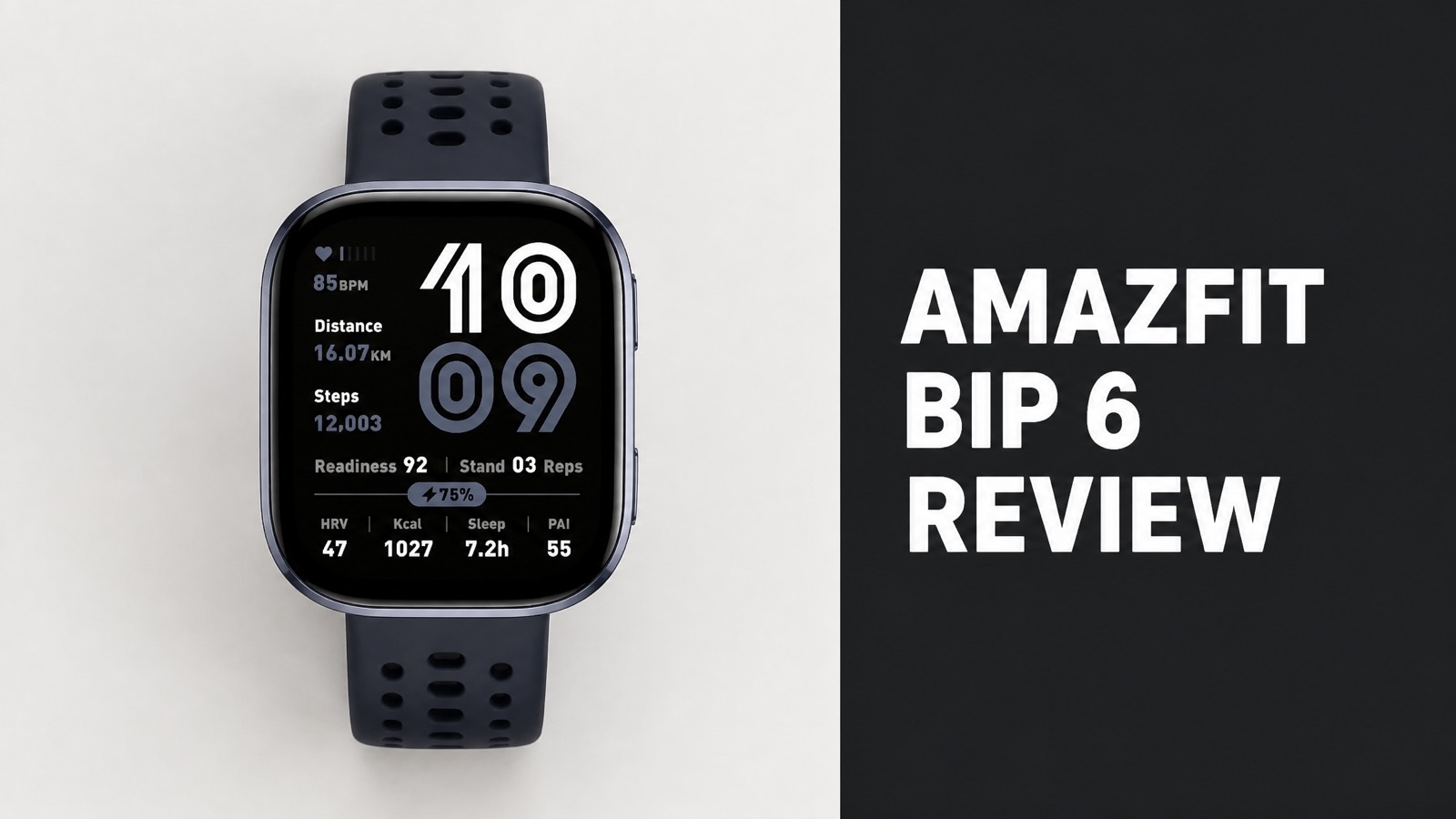
The Amazfit Bip 6 is a budget smartwatch from Zepp Health that sells for $79.99. The watch packs an AMOLED screen, built-in GPS, offline maps, and a battery rated for 14 days. Amazfit released it in 2025 as the successor to the Bip 5. Reviewers praise its value. Early reviews were warm.
Our review covers how the watch works, which features matter, and where it falls short. Battery tests land between 8 and 13 days. Heart rate holds up for casual use. Sleep data wobbles. Rivals like the Active 2 and Redmi Watch 5 offer different trade-offs. The price sits far below flagship watches. Pricing, battery, and accuracy each get a clear verdict.
The big picture is simple. The Bip 6 delivers more value than its price suggests, as long as expectations stay realistic. Read on to learn who benefits most, who needs a different watch, and whether $80 is a fair deal for your own fitness goals and budget. Expect plain, honest answers.
What Is the Amazfit Bip 6?
The Amazfit Bip 6 is a budget smartwatch from Zepp Health. Amazfit brings an AMOLED screen, GPS, and a 14-day battery claim to a $79.99 price tag in the United States. The watch runs Zepp OS and works with both Android and iPhone. Most buyers can pair it within minutes and start tracking steps, sleep, and workouts. Setup is quick and takes minutes.
Amazfit built the Bip line as its value play. The Bip 6 replaces the Bip 5 and swaps the old TFT screen for AMOLED. In fact, it adds an aluminum frame and an extra physical button too. The price dropped from $89 to $79.
Our team at Eat Proteins tracks wearables because fitness data guides nutrition choices. Does a $79 watch deliver useful data? Mostly, yes. Casual users get plenty, while serious athletes hit limits quickly.
Who Is the Amazfit Bip 6 For?
The Amazfit Bip 6 suits first-time smartwatch buyers and casual fitness trackers who want features without a big bill. CNET calls it ideal for newcomers and for iPhone users curious about smartwatches. Android Authority agrees that the watch is not built for fitness enthusiasts. Casual goals fit it best. Walkers and beginners gain the most from it.
Think of it this way: the Bip 6 is a starter watch with extras. Walkers, casual runners, and sleep-curious buyers get the most value. But structured interval athletes outgrow its sensors fast.
How Does the Amazfit Bip 6 Work?
The Amazfit Bip 6 reads heart rate, blood oxygen, and sleep data with the BioTracker 6.0 sensor. The optical sensor sits on the back of the watch. The watch syncs those readings to the Zepp app over Bluetooth. The app then turns raw numbers into scores for sleep, readiness, stress, and daily activity. Trends over days matter more than single readings.
Here’s why that matters. The sensor measures around the clock with no special mode. One Tap Measuring also collects heart rate, SpO2, stress, and breathing rate in a single read. Those readings cover most daily checks.
Setup Steps:
- Charge the watch with its magnetic puck and your own USB-C cable.
- Install the Zepp app on your phone.
- Pair the watch over Bluetooth and update the firmware.
- Pick a watch face and assign the two physical buttons.
- Turn on continuous heart rate and sleep tracking.
Setup takes some patience. CNET needed to fine-tune the watch face, screen settings, and button actions. Why the friction? Zepp packs many options into menus. Once configured, daily use runs smoothly.
Does the Amazfit Bip 6 Work With iPhone?
Yes. The Amazfit Bip 6 works with both iPhone and Android through the Zepp app. Notifications, Bluetooth calling, and health sync run on both platforms. Quick replies to messages work on Android only. iPhone owners therefore get no built-in reply option for texts, unless they use a third-party app workaround. Calls and alerts still work well on iOS.
The bad news? Bluetooth range is short on iPhone. CNET lost the connection when the phone sat one room away. Does Find My Phone still help? Barely. Health data still syncs to Apple Health.
What Features Does the Amazfit Bip 6 Have?
The Amazfit Bip 6 packs GPS, offline maps, Bluetooth calling, and over 140 sport modes into an $80 watch. Health tools include continuous heart rate, SpO2, stress, sleep stages, breathing rate, and cycle tracking. Water resistance is rated at 5 ATM, or 50 meters (164 feet). Few budget rivals match that list. The Zepp app unlocks most of these tools.
GPS covers five satellite systems: GPS, GLONASS, BeiDou, Galileo, and QZSS. But there is no dual-frequency support. Wareable saw distance underreported against a dual-frequency watch. What’s more, free offline maps are rare under $100.
Strength mode counts sets and reps, and it tries to guess the exercise. Does the guess work? Rarely. Jacob Desforges saw chin-ups labeled as pull-ups and no attempt at push-ups.
Key Specs:
| Feature | Detail |
|---|---|
| Display | 1.97-inch AMOLED (390×450 pixels) |
| Peak brightness | 2,000 nits |
| Battery | 340 mAh |
| Water resistance | 5 ATM (50 m / 164 ft) |
| Sport modes | 140+ |
| Price | $79.99 |
How Good Is the Display?
The Bip 6 display delivers vivid AMOLED color and deep blacks at a budget price. The 1.97-inch panel runs 390 by 450 pixels. Peak brightness reaches 2,000 nits. Android Authority found the screen easy to read on sunny spring days outdoors. LCD and TFT screens look dimmer at this price, so the upgrade stands out right away. The screen is the biggest upgrade.
To be clear, reviewers disagree on sunlight. CNET failed to read the screen in direct sun. Android Authority had no such problem. Always-on mode also drains the battery fast, per Wareable.
What Are the Benefits of the Amazfit Bip 6?
The Amazfit Bip 6 offers premium-style features, long battery life, and solid tracking at a quarter of flagship prices. Wareable calls it one of the best budget smartwatches available. Android Authority found no single deal-breaker. The value case drives nearly every positive review. Casual users get the most out of it. Beginners and walkers benefit most.
In plain English, you get the main smartwatch jobs for $80. Is it perfect? No, but notifications arrive reliably. Android Authority paired it with a OnePlus 13 and saw no delays. Strength tracking, cycle tracking, and Strava sync round out the package.
Does the Amazfit Bip 6 Last Two Weeks?
No. The Amazfit Bip 6 rarely hits the claimed 14 days, but it still lasts one to two weeks. Reviewers measured 8 days with heavy GPS use. Light use projected to about 13 days. Always-on display cut life to under a week. Battery saver mode is rated at 26 days, though it disables most continuous monitoring. Expect to charge it roughly once a week with GPS.
Battery Test Results:
| Usage | Result | Source |
|---|---|---|
| Light daily use | 13.2 days projected | Jacob Desforges |
| GPS workouts and heart rate | 8 days | CNET |
| Always-on display | Under 7 days | Wareable |
| Battery saver mode | 26 days claimed | Amazfit |
Charging is slow. CNET measured about two hours from empty to full. Amazfit leaves the USB-C cable out of the box. The catch? Buyers must supply their own cable and brick. Wareable logged a 6% drop per 30-minute GPS session.
How Accurate Is the Amazfit Bip 6 Tracking?
Accuracy is mixed. The Amazfit Bip 6 tracks resting heart rate well but produces inconsistent sleep readings. Jacob Desforges found heart rate within 2 BPM of manual checks. CNET matched a Polar chest strap. Android Authority logged 3 hours 50 minutes of sleep against 6 hours 9 minutes on an Apple Watch Ultra 2. Wrist sensors at this price have limits.
The Quantified Scientist tested four units against reference devices. Indoor cycling heart rate looked strong. Sleep stage tracking didn’t. So what’s the verdict? Casual tracking works, but clinical use doesn’t. Wareable notes the health features are not medical grade.
Fit matters, too. One owner in a Facebook group found readings improved after moving the watch to the inside of the wrist. And Amazfit advises a snug fit to keep contact with the skin.
What Do Amazfit Bip 6 Reviews Say?
Amazfit Bip 6 reviews are broadly positive, with praise for value and battery and criticism of software and sensor accuracy. CNET, Wareable, and Android Authority all recommend it for casual users. Owners in Amazfit groups echo that view. Complaints cluster around the app, the voice assistant, and sleep data. Most buyers rate the value above the polish.
Owners and reviewers praise the screen, the price, the battery, and the notification reliability. One owner calls it budget friendly with good performance. Another loves the accurate step count and custom watch faces. Jacob Desforges counted steps manually and saw exact matches.
Pros:
- Bright AMOLED screen at $79.99
- Battery life of one to two weeks
- Offline maps and built-in GPS
- Reliable notifications
- Accurate step counting in manual tests
What Are the Common Complaints?
Complaints center on the Zepp Flow voice assistant, the cluttered app, short Bluetooth range, and uneven sleep tracking. CNET says Flow makes Siri look like a mind reader. Android Authority found the AI button on notifications useless. One owner calls heart rate and sleep tracking horrible. Software polish is the weak spot. Owners raise these issues often.
Cons:
- Voice assistant is slow and inaccurate
- Zepp app feels busy and unclear
- Single case size looks bulky on small wrists
- No NFC payments or music storage
- Sleep and heart rate data can be wrong
Hardware gripes are fewer. The single case size looks bulky on small wrists. And the Zepp app overwhelms new users with scores it never explains. Does that sink the watch? Not at this price, but the polish gap is obvious.
How Does the Amazfit Bip 6 Compare to Rivals?
The Amazfit Bip 6 competes with the Redmi Watch 5, the CMF Watch 3 Pro, and the Amazfit Active 2. Wareable lists the Redmi Watch 5 at $89 and the Active 2 at $99. Xiaomi, Honor, and Huawei fill out the rest of the budget field. The Fitbit Inspire 3 also overlaps on price and basic features. Each rival trades features against price in a different way.
Budget Watch Comparison:
| Watch | Price | Edge |
|---|---|---|
| Amazfit Bip 6 | $79 | Offline maps, battery life |
| Redmi Watch 5 | $89 | Budget alternative |
| Amazfit Active 2 | $99 | More smartwatch features |
| Fitbit Inspire 3 | $99 | Deeper sleep analysis |
The Bip 6 stands out on offline maps and battery life. Rivals win in other spots, and that’s fair. Which matters more? The answer depends on whether a buyer wants features or polish. Wareable named the CMF Watch 3 Pro a standout performer in its own testing.
Is the Amazfit Bip 6 Better Than the Active 2?
No. The Amazfit Active 2 offers more smartwatch features for $99, so it beats the Bip 6 on raw capability. Wareable places the Active 2 just above the Bip 6 in Amazfit’s range. The $20 gap buys extra features. The Bip 6 still wins on price for first-time buyers who want the basics. Budget buyers who skip extras lose little by choosing the cheaper model.
Here’s the Fitbit angle. The Inspire 3 lasts about 10 days and needs a phone for GPS. The Bip 6 has built-in GPS and a bigger AMOLED screen. But Fitbit leads on sleep depth and Google Health ties.
Is the Amazfit Bip 6 Safe and Legit?
Yes. Amazfit is a real brand under Zepp Health, and Amazfit, Amazon, and Best Buy all sell the Bip 6. Major outlets including CNET, Wareable, and Android Authority tested the watch. The reviews our team read raise no safety concerns. The health features are wellness tools, not medical devices. Real symptoms need a doctor. Amazfit sells wearables worldwide.
Wareable states that the health features are not medical grade or regulator approved. So blood oxygen and stress scores are trend tools. A doctor handles any real symptoms. In short, the watch is legit, but it is not a diagnostic device.
Who Should Skip the Amazfit Bip 6?
Serious athletes and feature-heavy users are better served by a pricier watch. The Bip 6 lacks NFC for contactless payments and has no music storage. Third-party apps aren’t supported. Optical sensors also lag during hard intervals. Structured training needs a chest strap or a dedicated sports watch. Small-wrist buyers also find the case bulky and large.
Skip If:
- You train with structured intervals
- You want contactless payments
- You need offline music for phone-free runs
- You rely on third-party apps like Spotify
- You have a small wrist and want a compact case
Bottom line: skip it for precision training. Skip it for phone-free music runs. Is that you? If not, everyone else can read on.
How Much Does the Amazfit Bip 6 Cost?
The Amazfit Bip 6 costs $79.99 in the United States, which is $10 less than the Bip 5 at launch. Wareable lists $79 and CNET lists $80, so the price is consistent across reviews. Extra costs include a USB-C cable. The optional Zepp Aura subscription adds deeper sleep analysis for buyers who want it. Retail discounts appear often, so check prices first.
Where to Buy:
- Amazfit website
- Amazon
- Best Buy
- Target
- Walmart
The Zepp Aura add-on is optional. The add-on brings advanced sleep analysis and AI coaching. And most buyers never need it. The base watch works without any subscription.
Is the Amazfit Bip 6 Worth the Price?
Yes. The Amazfit Bip 6 is worth $79.99 for casual users who want GPS, AMOLED, and week-long battery life. Android Authority notes four Bip 6 watches cost the same as one Pixel Watch 3. Lifestack praises its display-to-price ratio under $100. Value fades only when training demands rise. Buyers who expect flagship polish will feel the gaps very quickly.
Bottom line: the flaws are real. Sleep data wobbles, and the app overwhelms. Do those flaws cancel the value? For most casual buyers, no. At $80, the trade-offs are easy to accept.
Should You Trust Eat Proteins on the Amazfit Bip 6?
Eat Proteins tests the tools behind your nutrition goals, and the Amazfit Bip 6 earns a spot on your shortlist. You get GPS, offline maps, and a week of battery for $79.99. Our experts back it for casual tracking. A cheap, capable tracker beats an expensive one you never wear. Our team checks every claim against real reviews before it backs anything.
Is the Amazfit Bip 6 Right for Your Goals?
Yes. The Amazfit Bip 6 fits casual fitness goals, daily activity habits, and basic sleep tracking. You track steps, workouts, and recovery trends without a big spend. Pair the data with smart eating habits. Our coaches at Eat Proteins say consistency beats perfect numbers. Grab the watch and start tracking today. Small habits add up fast, week after week.