
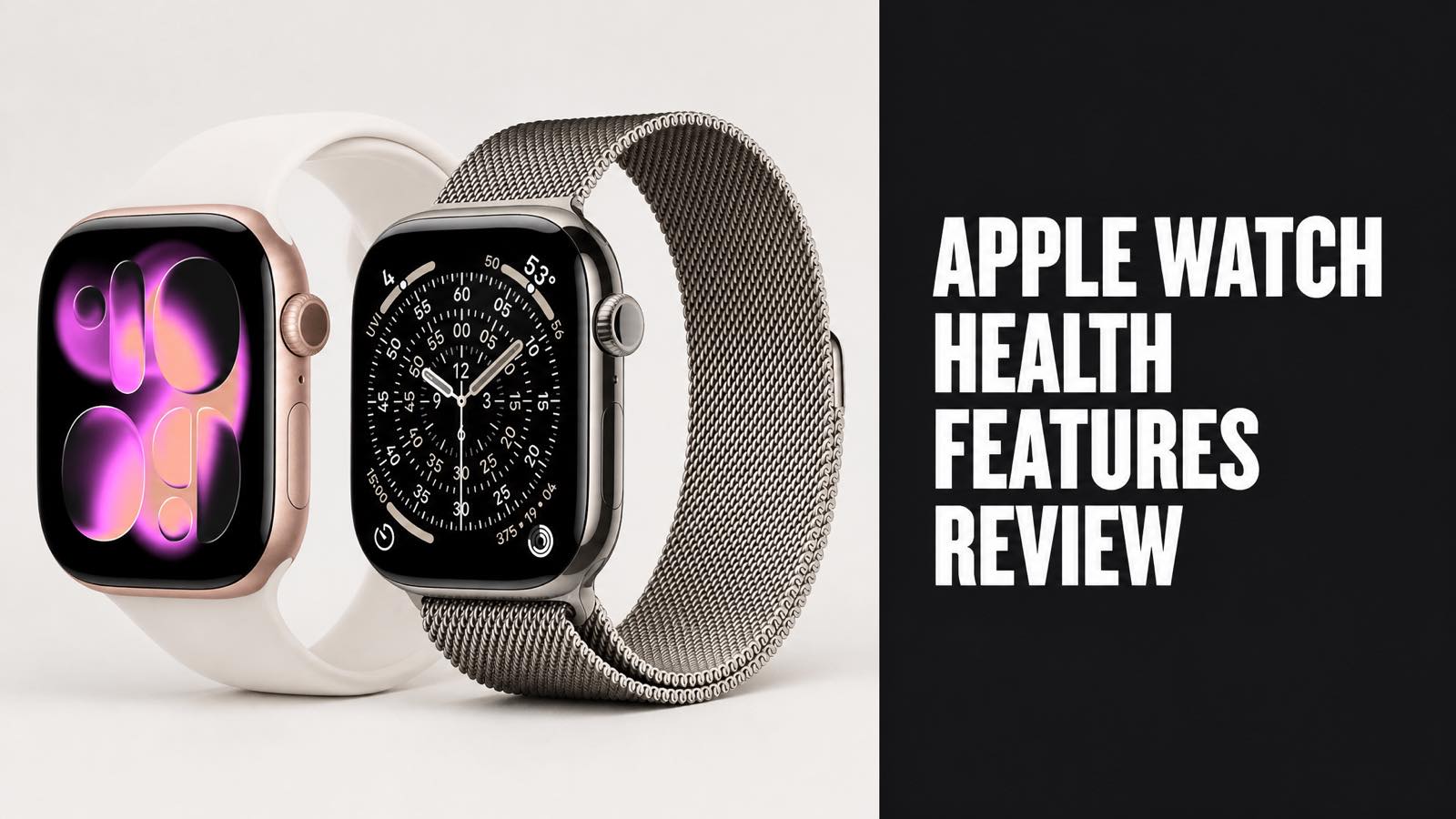
Apple Watch health features are sensors and software that track heart rate, sleep, rhythm, and blood pressure signals. Apple builds them into recent models, and Series 12 adds a new Health Sensing System. This review covers what each tool does, who it helps, and where it falls short.
Heart rate sensing is the base layer, and Apple says Series 12 leads all wearables for accuracy. Sleep Score grades duration, bedtime, and interruptions. Hypertension notifications flag signs of chronic high blood pressure. ECG, sleep apnea alerts, and Fall Detection add a safety net. Prices start at $399, and a few real gaps remain for most buyers.
The big picture is simple. Apple Watch turns raw body data into plain guidance, but it stays a screening aid and not a doctor. Our team at Eat Proteins checked every claim against expert reviews. Read on to learn how each feature works, who gains most, and whether the cost fits your health goals.
What Are Apple Watch Health Features?
Apple Watch health features are sensor-driven tools that track the heart, sleep, and body signals from the wrist. The set covers heart rate, ECG, blood oxygen, Sleep Score, cycle tracking, and Fall Detection. Apple groups the data inside the Vitals app on the watch and the Health app on the iPhone . Most checks run on their own, so wearers rarely start one.
Here’s the thing: the range is wide. Wareable calls the suite formidable. ECG for AFib assessment, sleep apnea alerts, and Fall Detection work silently as a safety net. Our team at Eat Proteins counts that quiet design as the main draw. Is the data safe? Apple calls the Health app a central and secure location.
Models and Health Highlights:
| Model | Health Highlight |
|---|---|
| Series 9 and 10 | Hypertension notifications and Sleep Score via software update |
| Series 11 | Hypertension notifications, Sleep Score, and a tougher display |
| Series 12 | Health Sensing System and a 0-10 readiness score |
Which Apple Watch Models Have Health Features?
Recent Apple Watch models share a core health toolkit, and newer models add more on top. The Series 11 brought hypertension notifications and Sleep Score, and both reach the Series 9 and Series 10. Series 12 went on sale September 18 with a new sensor system and a readiness score. Check the exact model before buying, since features differ from year to year.
And case size matters too. Series 11 comes in 42mm (1.65 inches) and 46mm (1.81 inches), and the slim body stays under 10mm (0.39 inches). Wareable found the 46mm model comfortable for 24/7 wear. The comfort suits overnight tracking.
How Do Apple Watch Health Features Work?
Apple Watch health features work by reading light and electrical signals from the wrist and turning them into scores. An optical heart sensor tracks blood flow with green LEDs. Software then converts the data into heart rate, sleep, and blood pressure signals. The iPhone stores the results in the Health app. The watch shows quick summaries on the wrist too.
The good news? Series 12 rebuilds the process. Its Health Sensing System adds new optical and electrical heart sensors and the S11 chip. The watch now measures heart rate every five seconds all day. Why does that matter? Continuous data makes Activity rings more accurate.
Series 12 Sensing Upgrades:
- Heart rate measured every five seconds
- HRV measured up to 24 times more often
- Recovery HRV and overall HRV views
- Daytime vitals view beside overnight vitals
- Step counting rebuilt with machine learning
How Accurate Is the Heart Rate Sensing?
Apple says Series 12 offers the most accurate heart rate sensing in a wearable. The company ran a study with over 1,000 diverse participants and compared the watch against leading wearables. Apple Watch showed the highest accuracy across devices. The result comes from Apple’s own study. Treat it as a company claim. Outside labs have yet to confirm it.
In fact, independent testing points the same way. Wareable rated Series 11 heart rate and GPS accuracy as excellent. The watch lacks dual-frequency GPS. Does that hurt? Not necessarily, because Wareable says dual-band does not automatically mean better tracking.
How Does the Sleep Score Work?
Apple’s Sleep Score grades each night out of 100 using three inputs. Total duration counts for 50 points. Bedtime consistency counts for 30 points. Interruptions count for 20 points. The method skips sleep stage analysis, which Wareable calls limited in accuracy on consumer wearables. The score leans on data the wrist tracks reliably. Simple wins here.
The trade-off? Simplicity. The Disconnekt reviewer saw Apple scores above 90 on most nights. Her Oura Ring 4 averaged 82 over a year, and Oura also weighs latency, restfulness, REM, and deep sleep. So Apple’s score reads kinder.
What Are the Benefits of Apple Watch Health Features?
The main benefits are early warnings, daily guidance, and one place for all health data. The watch flags high blood pressure signs, sleep apnea, and AFib. Scores guide training and rest. The Health app stores every metric. Each benefit runs in the background with little effort from the wearer. None needs a separate device. Setup takes only a few minutes.
Our experts at Eat Proteins like how little setup the system needs. Wear the watch, and the data flows. Is that a big deal? For busy people, yes. Short answer: the best feature is the one that runs unseen.
Main Benefits:
- Passive hypertension notifications
- Sleep apnea alerts
- ECG app for AFib assessment
- Fall Detection
- Readiness score on Series 12
- Cycle tracking and wrist temperature
Does Apple Watch Detect High Blood Pressure?
Yes. Apple Watch flags consistent signs of chronic high blood pressure using the optical heart sensor. The feature analyzes blood vessel responses in the background. Hypertension notifications arrived with the Series 11 and also reach the Series 9 and Series 10. Wareable calls it a set and forget tool that works quietly. No manual test is ever needed.
Now here is the thing: Apple isn’t the first brand to attempt blood pressure tracking. The edge is reach. Why does that count? Apple’s ecosystem puts the feature on millions of wrists. More wearers means more early flags. Wareable says it has the potential to be a genuinely life-saving tool for millions of users.
Does Apple Watch Track Sleep Apnea?
Yes. Apple Watch sends sleep apnea notifications based on overnight data from the wrist. Wareable lists the alerts beside ECG, blood oxygen monitoring, and Fall Detection as part of a silent safety net. The Vitals app adds overnight heart rate, respiratory rate, wrist temperature, and sleep duration for a fuller picture. Wearers need no extra gear.
But blood oxygen comes with a catch. Does every unit show it? No. Apple’s support page flags some US units bought on or after January 18, 2024. Those units do not show blood oxygen in the Vitals app. The affected part numbers end in LW/A or LS/A. Check the box label first.
What Are the Limits of Apple Watch Health Features?
The limits center on battery life, absent readiness scoring on Series 11, and simplified sleep analysis. Series 11 still lasts about a day. The Disconnekt notes it lacks a daily readiness score. The Sleep Score skips deeper metrics. Wareable adds that dual-frequency GPS is absent on the Series 11, even as cheaper rivals adopt it. Each gap is small but real.
The bad news? Battery is the daily pain point. Is a day enough? Only just. Series 11 gained six more hours than Series 10 but still lasts only a day. Series 12 keeps up to 24 hours of everyday life. Outdoor workout battery rises 25 percent, to up to 10 hours.
Known Limits:
- Battery life near one day
- No dual-frequency GPS on Series 11
- No daily readiness score on Series 11
- Simpler Sleep Score than Oura
- Blood oxygen missing on some US units
- Titanium models cost more
Who Needs More Than Apple Watch Health Features?
Anyone who needs a medical diagnosis needs a doctor, not a smartwatch alone. Hypertension and sleep apnea notifications flag patterns. They don’t confirm a condition. To be clear, the watch is a screening aid. The device also pairs with an iPhone, so the phone choice comes first. Android users need a different watch. Book a visit after any alert today.
Users who want blunt coaching face a mismatch. Wareable says Garmin and Whoop speak more bluntly about poor recovery, while Apple takes a softer approach. And Series 10 owners gain little from the Series 11. Is an upgrade worth it? Not really, says The Disconnekt.
How Does Apple Watch Compare With Garmin and Whoop?
Apple Watch wins on iPhone integration, while Garmin and Whoop lead on depth and blunt coaching. Wareable says Garmin and Huawei devices offer incredible battery life and deep fitness tracking. Those rivals are superb trackers but not true smartwatches in the same vein as Apple’s. The gap shows up in daily phone tasks. Pick by phone first, then by budget.
Apple Watch vs Garmin vs Whoop:
| Brand | Scoring Style | Standout Strength |
|---|---|---|
| Apple Watch | Duration, bedtime, interruptions | iPhone integration |
| Garmin | Direct recovery and sleep verdicts | Battery life and fitness depth |
| Whoop | Direct recovery and sleep verdicts | Blunt recovery feedback |
Is Apple Watch Better Than Garmin for Health Tracking?
No. Apple Watch is not better on every metric, but it fits iPhone users best. The Garmin Venu 4 and Venu X1 offer longer battery life and deep fitness tracking. Apple wins on phone integration, such as Sleep Mode mirroring and directions pinged to the wrist. Those small touches are hard for rivals to copy. Garmin fans know that well, yet accept the trade.
The right pick depends on the buyer. Does an iPhone user lose much by skipping Garmin? Mostly battery days. Does a hard-training athlete gain from Garmin? Possibly. Bottom line: match the watch to the phone and the training style.
How Much Does an Apple Watch Cost?
The Apple Watch Series 11 starts at $399 in the US and £369 in the UK. The UK price is a slight cut from the Series 10 launch price of £399. Aluminum models cost less than titanium, and The Disconnekt calls the gold titanium version incredibly expensive. Budget buyers lean toward the lighter aluminum case. Retailer sales can often lower the final price.
Apple Watch Price Snapshot:
| Item | Price |
|---|---|
| Series 11 (US start) | $399 |
| Series 11 (UK start) | £369 |
| Series 10 (UK launch) | £399 |
| Health app lab panel, 50+ biomarkers | $119 |
Is Apple Watch Worth the Price?
Yes. Apple Watch pays off for iPhone owners who want passive health monitoring every day. The Disconnekt calls the Series 11 a no-brainer for first-time buyers and upgraders from the Series 8 or earlier. Series 10 owners can skip the jump. The gains over last year’s model are small, and the review says so plainly. Value rises with every day of wear.
Wareable agrees that Series 8 owners and older gain the most. Here’s why: the cumulative improvements add up, from tougher glass to new health alerts. Series 12 adds Ceramic Shield 2, which is 60 percent tougher than Ion-X. And the $119 lab panel runs at about 2,000 Quest Diagnostics sites in the US.
Why Should You Trust Eat Proteins Before You Buy?
Eat Proteins breaks down health products using the questions real buyers search for. Our team reads manufacturer claims, expert reviews, and user feedback before writing a word. You get the facts, the flaws, and the price in one place. No hype, no filler. Just a clear verdict that fits a skeptical buyer. Trust grows from clear sourcing and honest scoring.
What Should You Do Next?
Pick your model, check the price, and decide if the health alerts fit your life. Don’t wait for a scare to start tracking. The Eat Proteins library covers more wearables, supplements, and wellness tools. Browse it now and buy with confidence. The right choice is waiting, and every day without data is a day lost. Act today. Your data starts counting at once.