
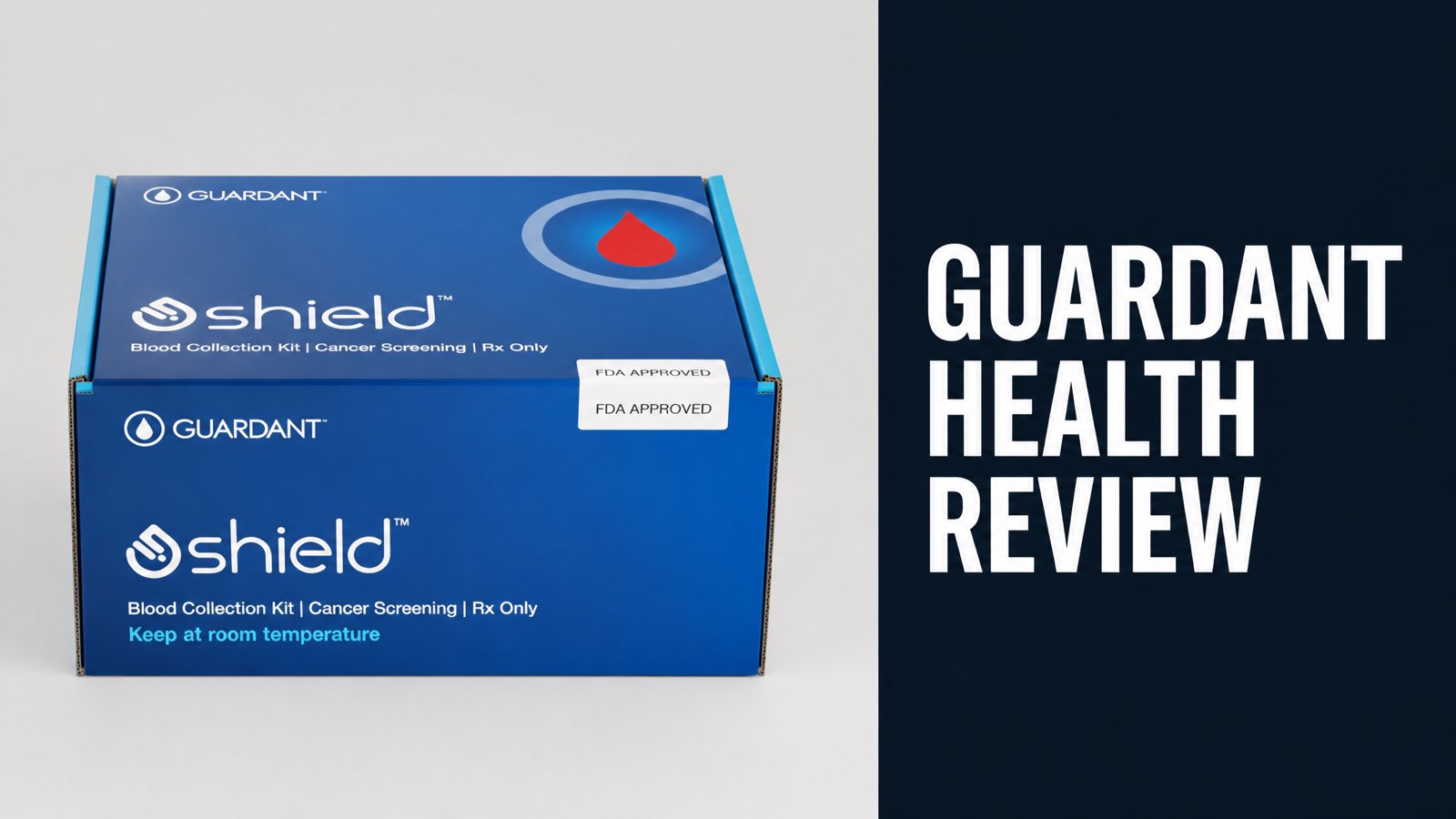
Guardant Health is a precision oncology company in Palo Alto, California, that builds blood tests for cancer. Founded in 2012, it launched Guardant360 in 2014. Its Shield test became the first FDA-approved blood test for primary colorectal cancer screening in July 2024. Nasdaq lists the company under the ticker GH.
In a study of more than 20,000 adults, Shield detected 83% of colorectal cancers with 90% specificity for advanced neoplasia. Yet the test misses most precancerous lesions. A doctor must prescribe it, and Medicare covers it. The list price is $1,495. Reviews of the company split between convenience praise and expert caution about prevention power.
Blood tests lower the barrier to screening, but they do not replace colonoscopy. Our Guardant Health review covers accuracy, limits, cost, coverage and eligibility. Readers learn whether Shield fits a personal screening plan and what to ask a doctor. Each section answers a question patients ask before ordering.
What Is Guardant Health?
Guardant Health is a precision oncology company that builds blood tests for cancer. The company launched in 2012 and introduced its Guardant360 test in 2014. Its Shield test now screens average-risk adults for colorectal cancer. Our team at Eat Proteins reviewed the company’s data, the FDA label and independent studies. Nasdaq lists it under the ticker GH.
Guardant reports more than 1 million blood tests performed. Why does that matter? Experience with cell-free DNA analysis underpins the Shield platform. The company also reports over 100,000 completed Shield tests.
Guardant Health Key Facts:
- Founded in 2012
- Guardant360 launched in 2014
- Shield FDA approved in July 2024
- Headquartered in Palo Alto, California
- More than 1 million blood tests performed
What Is the Shield Blood Test?
The Shield test is a blood-based screening test for colorectal cancer. It targets adults 45 and older at average risk. A clinician draws blood during a routine visit. Guardant Health analyzes the sample in its own laboratory. The FDA approved it as a primary screening option in July 2024, a first for any blood test. Results arrive after laboratory analysis.
Shield isn’t a stool test or a scope. Does that matter? Absolutely. Here’s the thing: it needs no bowel prep, no diet change and no sedation. And patients skip the extra time away from work that a procedure demands.
How Does Shield Work?
Shield looks for tumor signals in a small blood sample. Tumors shed DNA into the bloodstream, known as circulating tumor DNA. The lab reads alterations in that cell-free DNA. Guardant describes a multimodal approach that combines genomics, epigenomics and proteomics to flag colorectal cancer signals. Patients need no stool sample, bowel prep or diet change.
The result is qualitative. In other words, the lab reports a signal detected or not detected. Is a positive result a diagnosis? No. A positive result requires a follow-up colonoscopy.
Shield Process:
- A doctor prescribes the test.
- A clinician draws blood at a healthcare visit.
- The sample travels to the Guardant Health laboratory.
- The lab reports a signal detected or not detected.
- A positive result leads to a follow-up colonoscopy.
What Does Shield Detect?
Shield detects colorectal cancer signals in cell-free DNA from blood. The test targets alterations tied to colorectal cancer. The test fits average-risk adults aged 45 and older. People with a personal or family history of the disease fall outside its intended use. A doctor confirms eligibility before ordering. A positive signal calls for colonoscopy.
Detection strength rises with cancer stage. Does stage matter that much? Yes. The label lists high detection for Stages II, III and IV. Early disease is harder to catch, as the next section shows.
Does Guardant Shield Work?
Yes. Shield detects 83% of colorectal cancers in average-risk adults. The ECLIPSE study enrolled more than 20,000 people at over 200 sites in 37 states. Results appeared in The New England Journal of Medicine on March 14, 2024. Specificity for advanced neoplasia reached 90%. The FDA approval rested on these results and a favorable panel vote in May 2024.
Existing non-invasive tests range from 74% to 92% sensitivity for colorectal cancer. So Shield sits inside that range. Does that make it the best option? Not quite. Shield lands in the middle of the pack.
Shield Performance Data:
| Metric | Result |
|---|---|
| Colorectal cancer sensitivity | 83% |
| Specificity for advanced neoplasia | 90% |
| Stage I cancer detection | 55%-65% |
| Precancerous lesions missed | 87% |
| Real-world completion rate | Over 90% |
How Accurate Is Shield?
Shield is accurate for cancer but weaker for precancer. Sensitivity reaches 83% for colorectal cancer. Specificity for advanced neoplasia is 90%. Those figures come from the registrational ECLIPSE trial. The FDA reviewed the same data before approval, and the results match the range of current non-invasive screening tests. Stage changes the picture.
False results happen in both directions. What does that look like? A false negative means colonoscopy finds a tumor Shield missed. A false positive means Shield signals cancer and colonoscopy finds none. The product label lists both outcomes.
What Does Shield Miss?
Shield misses most precancerous lesions. The product label states the test does not detect 87% of them. One out of 10 patients with a negative result may have a precancer that a screening colonoscopy would catch. The gap is the biggest limit of the test. Stage I cancers also slip through more often. Doctors weigh that risk against test convenience.
Why does this matter? Dr. Robert Schoen of UPMC notes that screening prevents cancer, not just detects it. A blood test mostly finds cancer that already exists. Stage I detection runs only 55%-65%. Bottom line: colonoscopy still protects best.
What Do Guardant Health Reviews Say?
Guardant Health reviews split between patient praise and expert caution. Patients like the convenience. Gastroenterology researchers question the long-term benefit. Several featured testimonials come from people compensated by Guardant Health, so independent studies carry more weight than marketing stories. Both camps cite real data from published studies.
Search results for Guardant Health reviews mostly show employee ratings on Glassdoor and Indeed. Do those help a patient? Not really. Patient feedback centers on the Shield blood test, so the sections below focus on Shield.
What Do Patients Like?
Patients like Shield because the test is fast and simple. A clinician draws blood during a regular visit. One featured patient says ten minutes gave peace of mind. Another calls it a screening option completed right at the doctor’s office. No prep, no sedation and no stool sample make the process easy. The whole process fits inside one office visit.
Adherence backs this up. In fact, Guardant reports that more than 90% of prescribed patients completed Shield in real-world use. Studies show only 28%-71% completion for other methods. The good news? Completion saves lives.
Dr. Reid Ness of Vanderbilt-Ingram Cancer Center makes a fair point. No screening strategy works if the patient will not accept it. The best test is the one that gets done.
What Are the Common Complaints?
The main complaint is that blood tests underperform colonoscopy at prevention. A model in Annals of Internal Medicine found blood tests cut colorectal cancer incidence by 42% and deaths by 56%. Colonoscopy and FIT cut incidence by over 70% and deaths by 75%. The gap drives most expert criticism. Experts also flag weak precancer detection and cost gaps.
The model assumed everyone completed every step. Does real life match? Rarely. The analysis also covered the Freenome test, not only Shield. Researchers add that the right choice depends on what a patient accepts and can afford.
Cost draws complaints as well. For example, Medicare Advantage plans may charge copays. Medicaid mostly does not cover the test. Pay attention to this: coverage varies by state, region and plan.
How Does Shield Compare to Other Screening Tests?
Shield trades some prevention power for convenience. Colonoscopy and FIT cut colorectal cancer incidence by over 70% in the Annals model. Multitarget stool DNA tests cut it by 68%. Blood tests cut it by 42%. Participation rates shape the real-world results, and each test carries different tradeoffs. Cost, comfort and accuracy all vary widely by test.
Costs differ widely. How wide is the gap? By comparison, a colonoscopy averages about $1,700 and a FIT about $50, per American Family Physician. Shield lists at $1,495 before insurance.
Screening Test Comparison:
| Test | Incidence Cut | Deaths Cut |
|---|---|---|
| Colonoscopy | Over 70% | 75%+ |
| FIT stool test | Over 70% | 75%+ |
| Multitarget stool DNA | 68% | 73% |
| Blood test (cf-bDNA) | 42% | 56% |
Is Shield as Effective as Colonoscopy?
No. Shield is not a replacement for colonoscopy. The label says so directly. Colonoscopy finds and removes precancerous lesions, while Shield finds mostly cancers. Any positive Shield result requires a follow-up colonoscopy to confirm the finding. Blood-based screening works as an alternative for patients who refuse other tests. Doctors weigh each option.
The American Cancer Society includes blood tests in its guidelines. But it recommends them only for people who decline or have not completed a visual or stool test. NCCN guidelines also list blood-based screening.
So why use Shield at all? An imperfect test that gets done beats a perfect test that gets skipped. More than one in three eligible Americans stay unscreened.
Is Guardant Shield Safe?
Yes. Shield is FDA approved as a primary colorectal cancer screening option. The approval came in July 2024 after an FDA advisory panel recommended it in May 2024. The test requires only a standard blood draw. The agency reviewed the ECLIPSE data before it approved the test. Guardant Health lists clear precautions and limitations on the product label.
Safety here means accuracy risks. What are they? False negatives give false reassurance. False positives trigger an unneeded colonoscopy. A negative result does not guarantee the absence of cancer, so patients keep screening on schedule.
Who Should Avoid Shield?
Shield is not for high-risk individuals or anyone under 45. The test targets adults aged 45 and older at average risk. People with certain medical or family histories need other screening methods. A doctor decides the right test for each patient. The label lists specific exclusions, shown below. High-risk patients need surveillance colonoscopy instead.
Shield Is Not Indicated For:
- Personal history of colorectal cancer, adenomas or related cancers
- A positive result on another colorectal screening within six months
- Inflammatory bowel disease, ulcerative colitis or Crohn’s disease
- Family history of colorectal cancer
- Certain hereditary syndromes
To be clear, Shield screens but does not diagnose. In plain English: diagnostic and surveillance colonoscopy remain the standard for high-risk patients.
How Much Does Shield Cost?
Shield carries a list price of $1,495. Guardant Health set that price when the test launched commercially in August 2024. Insurance changes what patients pay. The company reports $0 out-of-pocket cost for most insured patients, based on its own billing data. Actual costs vary by state, region and plan. Coverage keeps expanding as more insurers join in.
Medicare covers an FDA-approved blood test every three years. Is it free for everyone? No. Eligible Fee for Service patients pay $0. Medicare Advantage members may face copays or deductibles. CMS also covers the follow-up colonoscopy after a positive result.
Shield Coverage Overview:
| Payer | Coverage |
|---|---|
| Medicare Fee for Service | Covered, $0 out-of-pocket |
| Medicare Advantage | Covered, copays may apply |
| UnitedHealthcare | Covered |
| VA Community Care | Covered |
| Medicaid | Not covered except Florida and Kentucky |
| Medicare over age 85 | Not covered |
Is Shield Worth the Price?
Yes. Shield earns its price for people who would otherwise skip screening. A cost-effectiveness study found Shield stays cost-effective up to a unit cost of $3,241 at $100,000 per quality-adjusted life year. The $1,495 list price sits well below that line. The study modeled average-risk adults. Cheaper stool tests change the math for some patients.
The reason is simple: the math changes for people who would complete a colonoscopy or FIT. A FIT costs about $50 and cuts incidence more. For those patients, the cheaper test wins. Does price decide everything? No. Participation does.
Insurance matters too. Our experts at Eat Proteins advise checking coverage before the blood draw. Verification avoids surprise bills for patients outside Medicare, UnitedHealthcare and VA coverage.
Where Can You Get Shield?
Shield is available only through a doctor or healthcare professional. The test is not sold directly to consumers. Providers order it through Guardant Health or through Quest with test code 18441. The blood draw happens at a routine visit with no special prep. Guardant Health performs and bills the test directly. Patients ask about it at a regular checkup.
Patients start by asking a primary care provider. The Shield website offers a short questionnaire that checks eligibility. Now here is the thing: the questionnaire takes minutes, and a doctor makes the final call.
How to Get Shield:
- Check eligibility on the Shield website.
- Ask a doctor about blood-based screening.
- Confirm insurance coverage with the provider.
- Complete the blood draw at the visit.
- Schedule a colonoscopy if the result is positive.
Do You Need a Prescription?
Yes. Shield requires a prescription from a healthcare professional. A doctor confirms the patient is 45 or older and at average risk. Patients with a family history or prior polyps need other tests. The prescription step keeps the test with the people it was built for. The Shield website offers an eligibility questionnaire. Doctors then place the order.
Short answer: no doctor, no Shield. What’s more, colonoscopy, FIT and stool DNA tests remain valid choices for average-risk adults. Talk with a physician about all screening options first.
Why Should You Try Eat Proteins?
Eat Proteins turns dense health research into plain answers. Our team reads the studies, the labels and the fine print so readers don’t have to. The Shield test proves the point. The headline numbers look strong, and the limits hide in the details. You deserve both sides of every story. Our coaches turn that research into clear next steps for every reader.
What Does Eat Proteins Offer?
Eat Proteins reviews health products with the same rigor every time. Our experts compare marketing claims against published evidence and flag what is missing. Every review ends with a clear verdict. Don’t settle for a sales page when real data exists. Look for the evidence before you buy. Our coaches translate every finding into clear next steps for you.
Talk with a doctor first. Then use Eat Proteins to check the rest. Browse more reviews before your next health purchase, because the best decision starts with the full picture. Don’t wait.