
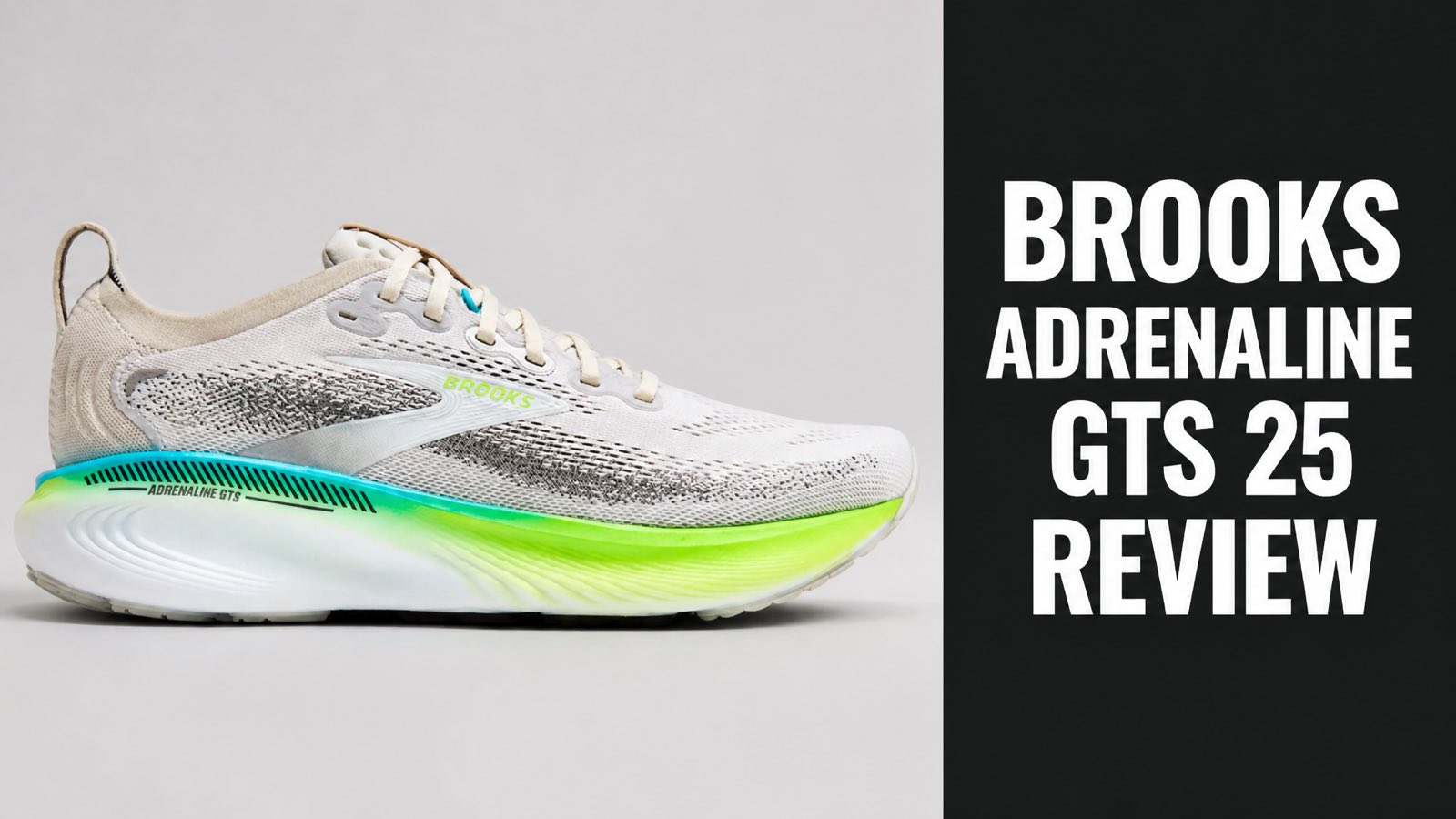
The Brooks Adrenaline GTS 25 is a stability daily trainer for runners who overpronate. Brooks released it in November 2025 at $155. It’s the 25th version of a line that started in 1999. GTS stands for Go-To Support, and the shoe aims at heel strikers, walkers, and runners with flat feet.
The big changes are a softer DNA Loft v3 foam and a lower 10 mm drop. The heel base also got wider, and wet grip improved. The upper is new as well. Lab tests show top-tier stability and a near indestructible outsole. But the shoe weighs 10.4 oz (295 g) and feels flat at speed. So does the 25th edition still earn its spot as the go-to stability shoe?
Here’s the big picture. The GTS 25 is the most comfortable and most honest Adrenaline yet. It’s built for easy miles, long runs, and long shifts on your feet. Below, you’ll learn how it works and how it fits. You’ll also see what reviewers say, how it compares, and what it costs today.
What Is the Brooks Adrenaline GTS 25?
The Brooks Adrenaline GTS 25 is a moderate stability daily trainer built for overpronators, heel strikers, and long easy miles. It went on sale in November 2025. RunRepeat gives it an 86 overall and a 95 for stability. Daily running scores 91. Racing? Only 39. In fact, the shoe ranks in the top 2% most popular running shoes in RunRepeat’s database.
The line has a long history. The Adrenaline launched in 1999. Running Shoes Guru notes that only the Asics Kayano has stayed in production for a similar stretch.
Who buys it? Runners, walkers, gym-goers, and nurses on 12-hour shifts. RunMoore says its store has fit roughly 725,000 people in some version of the shoe.
GTS 25 at a Glance:
- Moderate stability trainer with GuideRails support
- Nitrogen-infused DNA Loft v3 midsole
- 10 mm drop with a 37 mm (1.46 in) heel
- RoadTack rubber outsole
- Narrow, normal, wide, and extra-wide sizes
- List price of $155
What Changed From the GTS 24?
The GTS 25 gets a softer midsole, a lower 10 mm drop, a wider heel, and better wet grip. RunRepeat measured the foam at 34.5 AC, which is 27% softer than the GTS 24. To offset that softness, Brooks widened the heel base to 100.7 mm (3.96 in). Why does that matter? A soft foam on a narrow base wobbles. The wider base keeps every landing planted and safe.
The drop got more honest, too. The GTS 24 claimed 12 mm but measured 13.2 mm. The GTS 25 claims 10 mm and measures 10.2 mm.
Wet traction rose from 0.48 to 0.59 in RunRepeat’s test. The upper is new, with a double jacquard mesh made from 66.2% recycled materials.
How Does the Brooks Adrenaline GTS 25 Work?
The Brooks Adrenaline GTS 25 pairs GuideRails on both sides of the heel with a soft DNA Loft v3 midsole. The rails only kick in when your stride drifts inward. Marathon Sports compares them to bumpers on a bowling lane. Think of it this way: they stay quiet until fatigue pulls your knee inward. Then they nudge you back into line without a forced correction.
The foam does the cushioning work. Nitrogen gas is infused into an EVA-based foam. Brooks designed it to feel soft, light, and durable at the same time.
The shoe also has a stiff heel counter. RunRepeat rated it 4 out of 5, against a 2.9 average. A very mild rocker keeps the ride predictable rather than rolling.
How the Ride Comes Together:
- The wide heel base catches your landing.
- The DNA Loft v3 foam absorbs the impact.
- The GuideRails limit any inward roll of the knee.
- The mild rocker and 10 mm drop move you to toe-off.
Who Is the 10 mm Drop For?
The 10 mm drop suits heel strikers first, and it now works better for runners who land midfoot, too. RunRepeat measured 10.2 mm against an 8.4 mm lab average. That’s still high, but it’s far closer to the market than the old 13.2 mm. Running Shoes Guru says the lower drop smooths the move from heel strike to toe-off. Most daily runners will feel it.
Not everyone agrees. Marathon Sports says midfoot and forefoot strikers may still find 10 mm unnatural.
Heel strikers gain the most. The 138 SA heel shock absorption beats the 131 SA lab average. Long runs feel easier on the legs.
What Are the Key Specs of the Brooks Adrenaline GTS 25?
The Brooks Adrenaline GTS 25 weighs 10.6 oz (300 g) in men’s sizes, according to Brooks. The heel is 37 mm tall, and the forefoot sits at 27 mm. Lab numbers land close. RunRepeat weighed it at 10.4 oz (295 g). The heel measured 36.1 mm (1.42 in), and the forefoot measured 25.9 mm (1.02 in). Gaps this small are normal. The fit and feel stay true to the spec.
The women’s version is lighter. Brooks lists it at 9.4 to 9.5 oz (266 to 269 g). Both versions come in four widths.
Weight is the sore spot. The lab average sits at 9.2 oz (261 g). So the GTS 25 carries about 1.2 oz (34 g) more than a typical road shoe.
Brooks Claims vs Lab Results:
| Spec | Brooks Claim | RunRepeat Lab |
|---|---|---|
| Weight (men’s) | 10.6 oz (300 g) | 10.4 oz (295 g) |
| Heel stack | 37 mm (1.46 in) | 36.1 mm (1.42 in) |
| Forefoot stack | 27 mm (1.06 in) | 25.9 mm (1.02 in) |
| Drop | 10 mm | 10.2 mm |
| Outsole rubber | Not listed | 4.1 mm (0.16 in) |
How Does the Brooks Adrenaline GTS 25 Fit?
The Brooks Adrenaline GTS 25 fits true to size, with a medium width and an average toebox. RunRepeat counted 241 votes for true to size. Its gel cast measured 96.0 mm (3.78 in) at the widest point. The toebox came in at 72.8 mm (2.87 in). Zappos buyers agree, with 89% saying it felt true to size. Wide feet? Try the 2E. Most runners won’t need to size up.
The length changed a bit. RunMoore says older Adrenalines ran short, but this one runs slightly long.
The heel collar splits opinion. Running Shoes Guru compares the new knit collar to a turtleneck. The tester found it overpadded at first.
What Are the Benefits of the Brooks Adrenaline GTS 25?
The Brooks Adrenaline GTS 25 delivers gentle stability, softer cushioning, and an outsole that resists wear for hundreds of miles. RunRepeat praises its stability, comfort, and world-class outsole durability. The shoe also earned top picks for flat feet and plantar fasciitis. Is that rare? Yes. Few trainers score this well in both stability and comfort.
Comfort starts at step-in. Running Shoes Guru felt more plushness than expected from a Brooks shoe. Break-in time was short.
The shoe also works off the road. Honest Brand Reviews calls it comfortable for errands, walks, and recovery days. Nurses praise it for long shifts.
Main Benefits:
- Subtle GuideRails stability for overpronators
- Foam 27% softer than the GTS 24
- Above-average heel shock absorption
- Wet traction up from 0.48 to 0.59
- Four widths and a removable insole for orthotics
Does the Brooks Adrenaline GTS 25 Control Overpronation?
Yes. The Brooks Adrenaline GTS 25 controls overpronation with GuideRails that guide the stride instead of forcing it. Tyler at Mountaineer Journey has a flat left foot that rolls inward. He says the medial collapse he always feels was gone at once. The shoe also eased his IT band pain. Here’s the part most people miss: the rails stay quiet until form slips.
RunMorph calls it a guide, not a brace. The rails only step in past a certain threshold of knee collapse.
Mountaineer Journey scored support at 9 out of 10. Only the stiffer Hoka Gaviota 6 matched it in their testing.
Does the Brooks Adrenaline GTS 25 Last Long?
Yes. The Brooks Adrenaline GTS 25 shows some of the best outsole durability in its class. RunRepeat measured only 0.5 mm (0.02 in) of wear in its abrasion test, against a 1.1 mm average. The rubber is 4.1 mm (0.16 in) thick, while most shoes carry 3.1 mm. RunRepeat calls the long-term durability potentially legendary. That’s high praise for a daily trainer.
RunMorph expects 700 to 800 km (435 to 497 miles) of real use. That’s before the outsole reaches critical wear.
The upper holds up, too. RunRepeat scored toebox durability 3 out of 5 and heel padding 4 out of 5. Both beat the averages.
What Do Brooks Adrenaline GTS 25 Reviews Say?
Brooks Adrenaline GTS 25 reviews are mostly positive, with praise for support, comfort, and a soft step-in feel. Zappos shows 516 reviews, and 87% give five stars. Experts agree. RunMorph rates it 8.6 out of 10, and Mountaineer Journey gives it 8.5. But many Zappos reviews were incentivized. Does that matter? A little, so weigh expert lab data, too.
Loyal fans are happy. One buyer said they own 54 pairs of Adrenalines. Another switched back from the Ghost after trying the 25.
Testers also see the shoe as an evolution, not a reinvention. RunMoore says the update keeps fans happy without converting new runners.
What Do Runners Like?
Runners like the out-of-box comfort, the gentle support, and the secure fit. One reviewer said the shoe needed no break-in time and felt like clouds. A nurse praised the thicker sole and wider base for 12-hour shifts. Wide-footed buyers like the 2E and 4E options. A sailor even praised the grip on wet decks at a steep heel. Some call it the best version yet.
Long runs are the sweet spot. Marathon Sports says the shoe lets you log miles without thinking about form.
Running Shoes Guru logged over 50 miles (80 km). The tester found the ride smooth, controlled, and comfortable from heel strike to toe-off.
What Are the Common Complaints?
The most common complaints focus on weight, a dull ride at speed, and an overpadded heel collar. RunRepeat says the shoe needs to lose weight as soon as possible. Its energy return is only 52.1% at the heel, below the 58.7% average. Marathon Sports testers felt bulky on tempo runs and speed work. Here’s the kicker: the shoe is heavier than the GTS 24.
Heat is another issue. RunRepeat measured breathability at 66 BR, against a 75 BR average. Heavy sweaters will notice on summer runs.
Small gripes add up. The tongue isn’t gusseted. The shoe has no reflective details, and colorway choices feel limited to some buyers.
Common Complaints:
- Heavy at 10.4 oz (295 g)
- Low energy return for faster paces
- Below-average breathability
- Bulky, turtleneck-style heel collar
- No reflective details
How Does the Brooks Adrenaline GTS 25 Compare to Rivals?
The Brooks Adrenaline GTS 25 matches its top rivals on stability and beats most of them on durability and value. RunRepeat scores the Asics Gel-Kayano 33 at 86, a tie with the GTS 25. The Nike Structure 26 scores 85. Both rivals weigh almost the same as the Brooks. RunMorph sums it up well. The GTS 25 never wins by knockout, but it never loses either.
Lighter rivals exist. The Asics GT-2000 15 weighs 252 g (8.9 oz), according to RunMorph. It’s livelier but less protective on long runs.
RunRepeat also points lighter runners to the Hoka Arahi 8. For a livelier ride, it suggests the Saucony Tempus 2.
GTS 25 vs Top Stability Rivals:
| Shoe | Score | Lab Weight | Lab Drop | Price |
|---|---|---|---|---|
| Brooks Adrenaline GTS 25 | 86 | 10.4 oz (295 g) | 10.2 mm | $145 |
| Asics Gel-Kayano 33 | 86 | 10.5 oz (298 g) | 8.5 mm | $170 |
| Nike Structure 26 | 85 | 10.4 oz (296 g) | 10.1 mm | $145 |
| Asics GT-1000 15 | 83 | 9.8 oz (278 g) | 9.9 mm | $115 |
Is the GTS 25 Better Than the Gel-Kayano 33?
Yes. The GTS 25 is the better value, while the Gel-Kayano 33 offers a softer, more premium feel. Both scored 86 in RunRepeat’s lab. The Kayano costs $170, which is $25 more than RunRepeat’s $145 price for the Brooks. RunMorph rates the Kayano 7 out of 10 and says its value struggles against the Brooks. Want a softer, plusher ride? Pick the Kayano instead.
The Kayano runs a lower 8.5 mm drop. Midfoot strikers may prefer that geometry.
The Brooks wins on outsole wear. RunRepeat rated its outsole durability good, while the Kayano scored decent.
Who Should Avoid the Brooks Adrenaline GTS 25?
Neutral runners get no benefit from the GTS 25, since its GuideRails add support they don’t need. RunMorph says unnecessary stability does nothing for a neutral stride. Brooks makes the neutral Ghost line for those runners. Not sure how you land? Get a gait analysis at a running store before you buy. A quick test at the store saves you money and a poor fit.
Weight-conscious runners have better options. RunRepeat suggests the adidas Supernova Solution 2 or the Hoka Arahi 8 instead.
Very wide feet outside the four widths may struggle. Heavy sweaters in hot weather face the same issue.
Skip It If You:
- Have a neutral stride
- Want a light, bouncy shoe
- Run tempo or race-pace workouts often
- Prefer a low drop
- Run hot in summer heat
Is the Brooks Adrenaline GTS 25 Good for Speed Work?
No. The Brooks Adrenaline GTS 25 is a slow-pace workhorse and not a tool for intervals or races. RunRepeat scores it 56 for tempo and 39 for racing. RunMorph says to avoid it at paces faster than 4:45 per km (7:39 per mile). Its sweet spot runs from 5:15 to 6:30 per km. That’s 8:27 to 10:28 per mile. Its weight and low rebound cost you at faster paces.
Keep a lighter shoe for fast days. RunMorph suggests the Saucony Guide 19 at 275 g (9.7 oz) as a do-it-all option.
Marathons are fine for finishers. RunMorph says the heel cushioning and late-race stability help over 42 km (26.2 miles).
How Much Does the Brooks Adrenaline GTS 25 Cost?
The Brooks Adrenaline GTS 25 lists at $155, which is $15 more than the GTS 24 at launch. RunMoore says part of the increase is tariff related. RunRepeat lists a lower $145 price, against a $158 average for running shoes. Discounts arrived fast after launch. Running Shoes Guru found it on Amazon for $115 in November. That’s a 26% cut from the list price.
Other retailers cut prices, too. Zappos listed it at $124.95, and Running Warehouse listed $124.96.
Europe follows the same path. RunMorph lists a 160 euro launch price, with deals from around 122 euros.
Where to Buy and Recent Prices:
| Retailer | Price | Discount |
|---|---|---|
| Brooks list price | $155 | None |
| Amazon | $115.00 | 26% off |
| Zappos | $124.95 | 19% off |
| Running Warehouse | $124.96 | 19% off |
Is the Brooks Adrenaline GTS 25 Worth the Price?
Yes. The Brooks Adrenaline GTS 25 is worth the price for overpronators who log steady, easy miles each week. RunMorph estimates 700 to 800 km of use from one pair. At the lowest European price, that works out to about 0.15 to 0.17 euros per kilometer. Is that a good deal? Short answer: yes. Few stability trainers last that long or cost so little per mile.
Mountaineer Journey rated value 8.5 out of 10. The tester calls it one of the best walking shoes for overpronation.
Bottom line: buy it on sale for support and durability. Skip it if you want speed.
Why Should You Try Eat Proteins?
Eat Proteins helps you fuel the miles you’ll log in a stability shoe like the GTS 25. Good support protects your knees and arches. But your muscles still need protein to repair after every run. Our team at Eat Proteins shares simple guides for runners and active people. Why guess about recovery? Start with a plan that works. Your legs will thank you later.
Don’t let a great shoe do all the work. Pair your daily miles with smart nutrition and bounce back faster.
How Can Eat Proteins Help Your Running?
Eat Proteins gives runners clear advice on protein, recovery meals, and daily intake. Our experts explain protein sources, meal timing, and portion sizes in plain English. You’ll also find honest reviews of running shoes and supplements. Ready to train smarter? Explore Eat Proteins today and build habits that last. Every guide keeps things short and simple.
Your next run starts in the kitchen. Check out our latest guides and keep your body ready for every mile.