
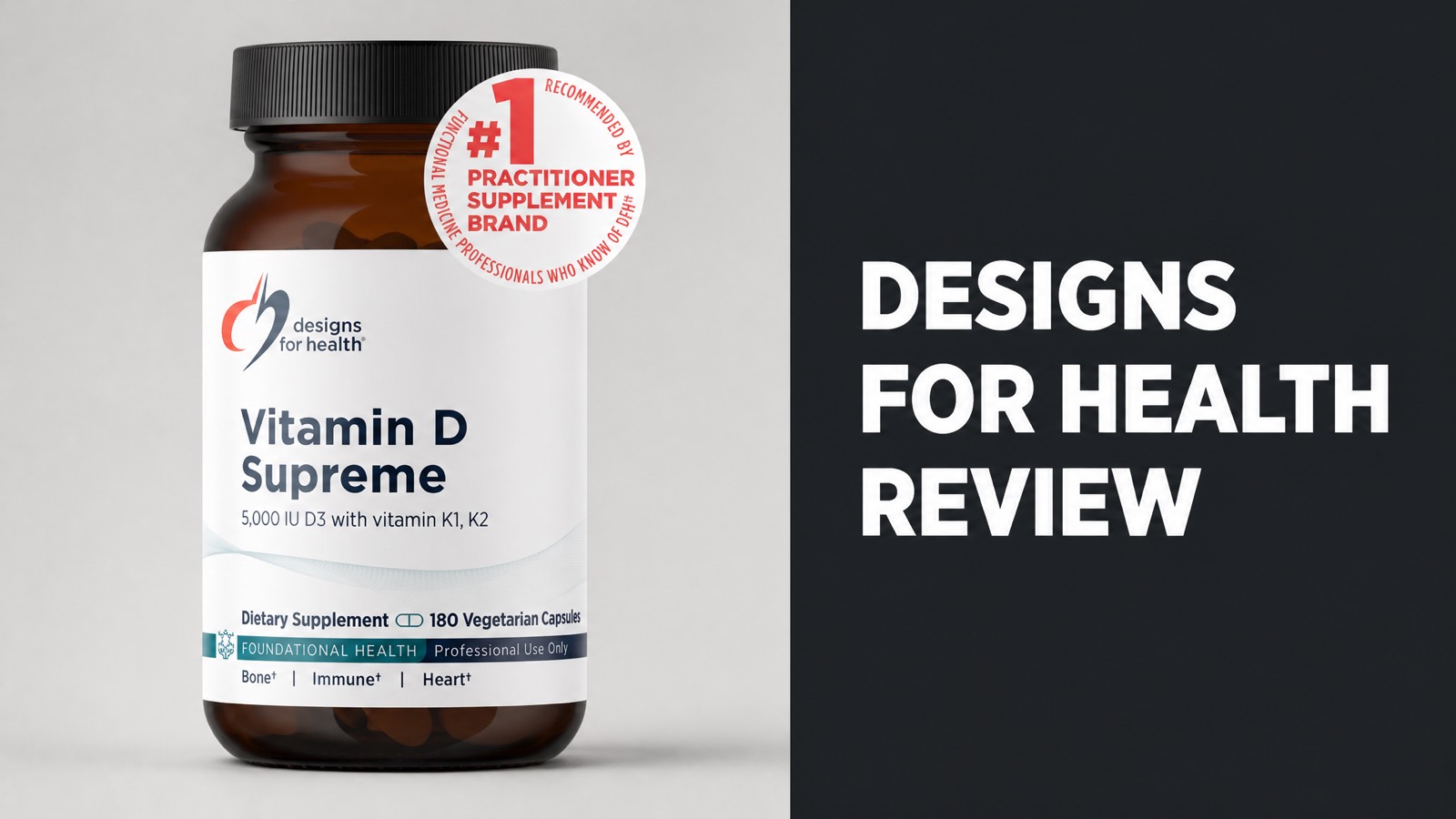
Designs for Health is a US supplement company founded in 1989. The family-owned brand sells practitioner-grade vitamins, probiotics, and targeted formulas for gut, hormone, and heart health. Functional medicine practitioners form its core audience, and shoppers can now order direct.
The brand works through a practitioner-first model with direct shopper access. Its signature ingredients and external lab testing set it apart from store brands. ConsumerLab approved 7 of 8 tested products. Reviews run positive, though price draws complaints. Safety depends on the specific product and dose. Buyers pay a premium for that level of rigor.
Designs for Health earns trust on quality, not on price. The brand suits buyers who want clinic-grade formulas and accept a premium. The sections below cover ingredients, reviews, safety, cost, and where to buy so readers can judge the value themselves. Skeptical buyers get straight answers here.
What Is Designs for Health?
Designs for Health is a family-owned supplement company founded in 1989. The brand sells professional-grade vitamins, minerals, probiotics, and targeted formulas. Its catalog covers gut health, hormones, heart health, and daily basics. Functional medicine practitioners form its core audience, and the company calls itself the top brand they recommend.
Here’s the thing: the company started small. The brand began in 1989 as an education company. Did it stay that way? No. Three decades of research-driven formulas turned it into a full supplement maker built on a ‘Science First’ motto.
Who Makes Designs for Health?
Designs for Health manufactures its products in Arlee, Montana and Henderson, Nevada. Both facilities follow FDA Good Manufacturing Practices. The company stays family-owned and makes everything in the United States. Retailers report that each finished batch faces contaminant, heavy metal, and microorganism testing, and potency checks confirm label claims.
Company Facts:
| Fact | Detail |
|---|---|
| Founded | 1989 |
| Ownership | Family-owned |
| Facilities | Arlee, Montana and Henderson, Nevada |
| Standards | FDA Good Manufacturing Practices |
In plain English: a family business runs the whole operation. The company kept its focus on practitioners instead of mass retail. The practitioner focus separates it from the supplement aisle at big-box stores.
How Does Designs for Health Work?
Designs for Health sells through a practitioner-first model with direct shopper access. Practitioners get a free Virtual Dispensary, Spotlight testing, eScripting, and rewards, plus a dedicated Functional Medicine Consultant. Everyday shoppers create a DFH account to order products, follow custom plans, and book functional testing at exclusive savings.
So what does that mean in practice? A practitioner recommends a formula through the Virtual Dispensary. Is that channel protected? The company says yes and works to prevent counterfeits and unauthorized sales, so buyers receive product straight from the source.
What Is in Designs for Health Supplements?
Designs for Health supplements cover vitamins, minerals, probiotics, collagen, and targeted herbal formulas. The catalog includes Vitamin D Supreme, Twice Daily Multi, Zinc Supreme, Magnesium Glycinate Complex, NAC, and Berberine Synergy. Most products ship as capsules, with powders and lozenges in the mix. Formulas center on bioavailable ingredient forms.
Free-from claims matter too. Retailers describe the line as gluten-free and soy-free, and most formulas skip artificial colors and sweeteners. Many are non-GMO and dairy-free. Each label confirms the details for that specific product.
Which Signature Ingredients Stand Out?
Designs for Health built its reputation on branded ingredients such as TruTG fish oil and DeltaGold tocotrienols. TruTG is a triglyceride fish oil that Supplement First calls more bioavailable than common ethyl ester oils. DeltaGold tocotrienols appear in every one of its vitamin E products. Both ingredients anchor the brand’s research-driven story.
Signature Ingredients:
- TruTG triglyceride fish oil
- DeltaGold tocotrienols in every vitamin E product
- Shelf-stable, dairy-free broad spectrum probiotics
- Anaerostipes caccae, a butyrate-producing probiotic strain
The newest star is the Anaerostipes Probiotic. NutraIngredients USA named it the 2026 Product of the Year for Microbiome Modulation. Shelf-stable probiotics resist heat. Does heat exposure ruin potency? No. The brand’s formulas hold up without refrigeration.
What Are the Benefits of Designs for Health?
Designs for Health delivers three main benefits: practitioner-grade formulas, external lab testing, and a wide targeted catalog. Buyers get doses built for clinical use instead of generic store-shelf amounts. The catalog spans gut, hormone, heart, and daily-basics needs. Retailers add that formulas follow clinical research instead of passing trends.
Bottom line: the benefits come from rigor, not novelty. Wellness Market calls the brand reputable among nutritionists, naturopaths, and functional medicine practitioners. ConsumerLab approved 7 of 8 tested products. Does approval guarantee results? No. Approval signals consistent quality.
Does Designs for Health Test Its Products?
Yes. Designs for Health tests every ingredient for purity, potency, and identity at external ISO-certified labs. The company also screens every ingredient for outside contaminants. Retailers add that each batch faces heavy metal and microorganism checks. Finished-product potency testing also confirms that label claims match what sits inside the bottle.
Quality Tests:
- Purity testing
- Potency testing
- Identity testing
- Contaminant screening
- Heavy metal testing
- Microorganism testing
To be clear, those are the brand’s own statements. Do they settle the question? No. Independent proof matters more. ConsumerLab tested 8 Designs for Health products and approved 7. None earned a Not Approved label, and 2 earned Top Pick status.
Do Designs for Health Products Work?
Yes. Designs for Health products deliver on quality, and many buyers report noticeable effects. Reviewers cite more energy, steadier wellbeing, and hair regrowth after daily use. Results vary by product and person because the brand sells a large, varied catalog. No single study covers every formula, and statements on supplements lack FDA evaluation.
Here’s the catch: efficacy depends on the formula. ConsumerLab put the extra ingredient in CoQnol 200 under review for its CoQ10 absorption claim. Does a branded ingredient prove better results? No. Product-level proof beats brand-level reputation.
What Do Designs for Health Reviews Say?
Designs for Health reviews skew strongly positive across retail and review sites. The Twice Daily Multi holds a 4.8 rating from 92 iHerb ratings. A Trustpilot reviewer reports ordering for about 10 years without dissatisfaction. Volume stays modest, though, because Trustpilot lists only 11 reviews for the company. Retail ratings carry most of the evidence.
iHerb Rating Breakdown (Twice Daily Multi):
| Stars | Ratings |
|---|---|
| 5 stars | 80 |
| 4 stars | 7 |
| 3 stars | 2 |
| 2 stars | 2 |
| 1 star | 1 |
Let me break that down. About 87 percent of iHerb ratings are five stars. Only 3 of 92 ratings are two stars or lower. Is that enough to judge the whole brand? No. The ratings cover one product.
What Do Customers Like?
Customers praise the quality, the formulas, and the practitioner backing. One iHerb reviewer calls the Twice Daily Multi the best multivitamin and notes a doctor recommendation. Another credits active methylated B vitamins in two small pills. A third calls the brand semi-professional and trustworthy. Quality ingredients and potency come up again and again.
Customer Praise:
- Active, methylated B vitamins
- Daily nutrients in two small pills
- Doctor and practitioner recommendations
- Accurate, quick shipping
- Excellent customer service
Service earns praise too. The Trustpilot reviewer calls customer service excellent and packing accurate and quick. Why does that matter? Supplement buyers reorder often, so reliability compounds. Ten years of loyalty tells the story.
What Are the Common Complaints?
The top complaint is price. One iHerb reviewer says the multivitamin is not cheap but still the best. Premium doses and testing push costs above store brands. A second gap is review volume. Trustpilot shows only 11 reviews, which is too few for a firm verdict on service or shipping. Some shoppers find that premium hard to justify for everyday basics.
The bad news? Some praise reads as promotional. One five-star iHerb review gushes about elegant packaging with no product detail. Vague praise like that adds little evidence. Specific reviews, such as the methylated B comment, carry far more weight.
How Does Designs for Health Compare to Thorne and Metagenics?
Designs for Health, Thorne, and Metagenics all target practitioners with clinical-grade formulas. Thorne and Metagenics sit beside Designs for Health on Trustpilot’s suggested-company panel. Thorne shows 92 reviews at a 1.6 score. Metagenics shows 30 reviews at 1.6. Designs for Health shows just 11 reviews on the same page. Counts vary widely across brands.
Now watch this: low scores don’t prove weak products. Trustpilot skews toward order and service complaints. A fairer yardstick is third-party lab testing. ConsumerLab approved 7 of 8 Designs for Health products it tested. Compare the exact product, dose, and test result across brands.
Is Designs for Health Better Than Store Brands?
Yes. Designs for Health beats typical store brands on testing, formulation, and ingredient transparency. Retailers highlight external ISO-certified lab checks and detailed sourcing information. Store brands rarely publish that depth of detail. The tradeoff is cost, since practitioner-grade doses carry a premium over drugstore and big-box multivitamins.
Think of it this way: a drugstore bottle optimizes price, while Designs for Health optimizes formulation. Wellness Market says buyers pay for research-backed formulas and quality control. Does everyone need that? No. Buyers with simple needs pay for features they won’t use.
Is Designs for Health Safe?
Yes. Designs for Health runs a credible quality program with GMP facilities and external lab testing. ConsumerLab tested 8 of its products and rejected none of them. Safety still depends on the specific product, the dose, and the user’s health. The company also fights counterfeits, and ConsumerLab lists the brand in its guide to avoiding fake supplements.
Check Before You Buy:
- Match the product to a specific health need
- Review the label for dose and allergens
- Confirm medication interactions with a clinician
- Order from the brand or authorized sellers
- Check lot and expiration dates on arrival
Here’s the part most people miss: supplements aren’t FDA evaluated. Does that make them unsafe? No. The gap means testing and sourcing carry the weight. Designs for Health shows both, and independent labs confirmed quality for 7 of 8 products.
Who Should Be Careful With Designs for Health?
Prescription drug users, pregnant women, and people with chronic conditions need clinician guidance before starting any Designs for Health product. Potent formulas carry real drug and condition interactions. ConsumerLab flags side effects and interactions for red yeast rice, which contains natural lovastatin. The same caution applies across the catalog.
Allergens need a check too. Retailers call the line gluten-free and soy-free, but formulas vary by product. In fact, ConsumerLab tests red yeast rice for citrinin, a kidney toxin. Label reading beats assumptions every time.
How Much Does Designs for Health Cost?
Designs for Health prices most products between $21.99 and $61.99 per bottle at Supplement First. Magnesium Glycinate Complex starts at $21.99. Zinc Supreme costs $24.49. Prenatal Pro and Red Yeast Rice both sit at $55.49. H-S-N Radiance Capsules reach $61.99. Such prices place the brand well above drugstore options and near other practitioner lines.
Sample Retail Prices:
| Product | Price |
|---|---|
| Magnesium Glycinate Complex | From $21.99 |
| Vitamin D Supreme | From $24.49 |
| Twice Daily Multi | From $36.49 |
| NAC | $49.99 |
| Berberine Synergy | $53.49 |
| Red Yeast Rice | $55.49 |
Prices change by retailer and bottle size. Does the label price tell the whole story? No. Cost per serving decides real value. Supplement First offers free U.S. shipping on orders over $39, which trims the effective cost of a larger order.
Is Designs for Health Worth the Price?
Yes. Designs for Health is worth the price for buyers who want tested, practitioner-grade formulas and strong doses. The brand charges more than store brands. In return, buyers get external lab testing, bioavailable ingredient forms, and ConsumerLab approval for 7 of 8 tested products. Buyers who only want generic basics pay for features they won’t use.
Here’s a quick test: does the formula solve a specific need? A methylated B complex fits a buyer who can’t convert standard B vitamins. A basic multivitamin doesn’t need premium pricing. When does premium pay off? When the product matches the problem.
Where Can You Buy Designs for Health?
Buyers can order Designs for Health from the brand’s official site and from authorized retailers. Supplement First, iHerb, and Wellness Market in Canada all carry parts of the line. Amazon lists many Designs for Health products too. The official site gives the clearest authenticity guarantee because the brand blocks counterfeits and unauthorized sales.
How to Order Safely:
- Create a DFH account on the official site.
- Ask a practitioner for a Virtual Dispensary link if one applies.
- Compare the official price with authorized retailers.
- Check the lot number and expiration date on arrival.
Counterfeits are a real online issue. ConsumerLab added Designs for Health to its counterfeit-avoidance guide in October 2023. The guide now covers 22 brands. The brand’s own site and authorized sellers are the safe sources.
Why Should You Try Eat Proteins?
Eat Proteins helps you pick supplements that fit your goals before you spend a dollar. Our team at Eat Proteins reads the labels, checks the testing, and compares the price per serving. You skip the guesswork. Every verdict comes with prices and proof. Missing out on that clarity costs real money, so start with our reviews today and shop with confidence.
How Does Eat Proteins Help You Choose?
Our experts at Eat Proteins break down every brand the same way: ingredients, testing, reviews, safety, and price. You get one clear verdict per product. Reread the Designs for Health breakdown, then browse our other supplement reviews. Your next smart purchase starts with one click. Our coaches compare the numbers so you don’t dig through lab reports.
Ready to stop second-guessing? Explore more Eat Proteins reviews now and buy with confidence.