
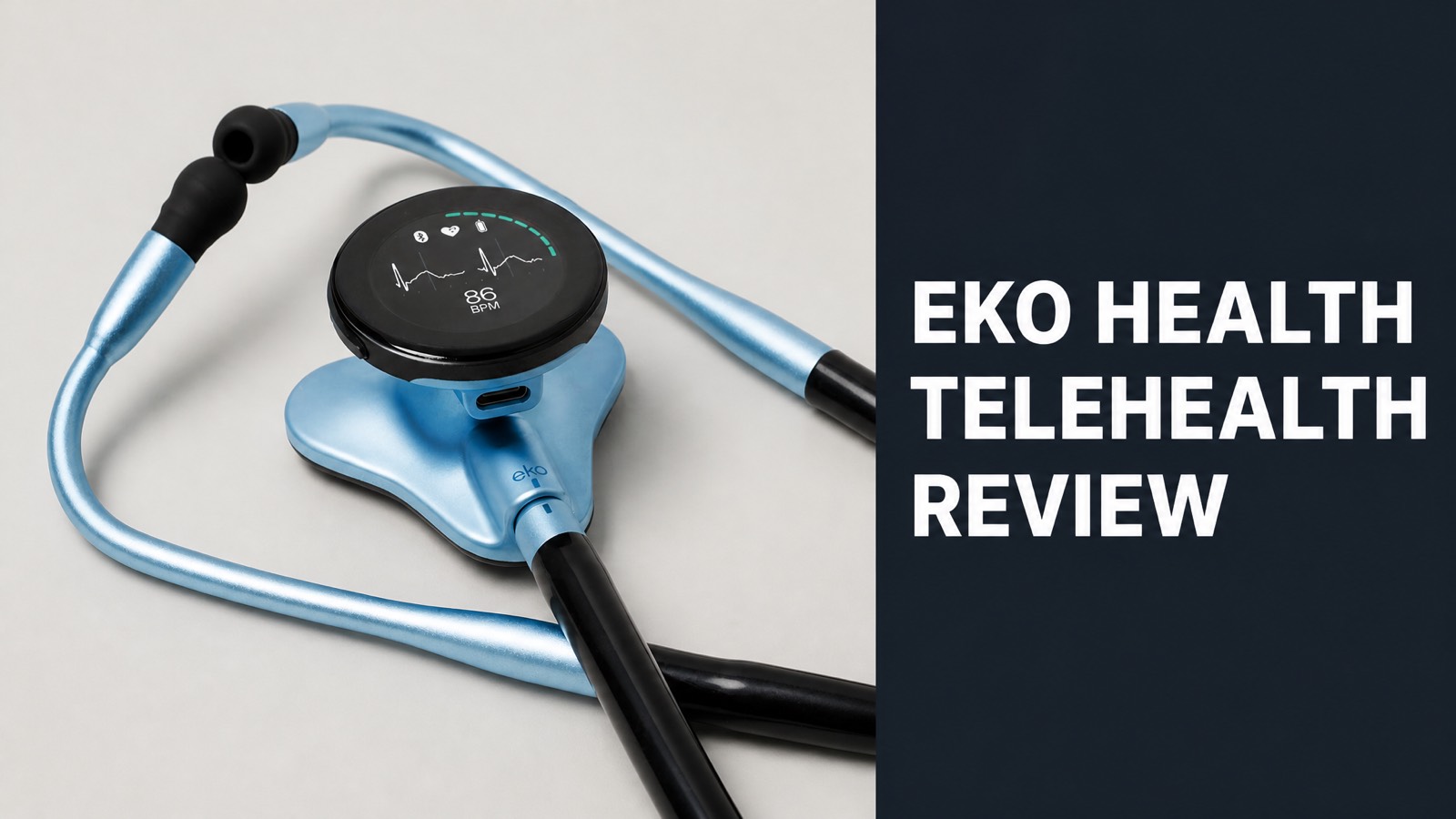
Eko Health telehealth is a software platform that streams live heart sounds, lung sounds, and ECG waveforms during virtual visits. Eko Health built it for clinicians and health systems that run virtual care. Providers use it to examine patients who sit miles away from the clinic today.
Our review covers how the platform works, what it includes, and who it fits. Reviewers rate Eko Health 4.4 out of 5 on REVIEWS.io. The company holds nine FDA clearances. Eko says the platform is HIPAA compliant and runs on web and mobile. Pricing is quote-based, so buyers must contact sales. Some users also report hardware failures after the warranty.
Eko Telehealth supports health systems with more than 800 hospitals in the US, per GlobalData. The big question is whether remote listening justifies the investment. Read on to see the features, the user complaints, the cost, and the final verdict for your own practice today.
What Is Eko Health Telehealth?
Eko Health telehealth is a platform that streams heart sounds, lung sounds, and ECG waveforms live during virtual visits. Eko Health pairs the software with its digital stethoscopes. Clinicians hear a remote patient in real time, as if both sat in one room. The platform runs alongside the video tools that care teams already use in their daily practice.
The product is called Eko Telehealth. In fact, Eko is an official partner of the American Telemedicine Association. Health systems with more than 800 US hospitals use the platform, according to a GlobalData report.
Here’s the thing: Eko doesn’t sell doctor visits. The company sells tools that clinicians use during their own visits. So who is that tool really for? Providers and health systems, not patients.
Who Is Eko Health Telehealth Built For?
Eko Telehealth is built for clinicians, nurses, and health systems that run virtual care programs. Eko lists inpatient, outpatient, specialty, community, and home care settings. Each of those settings needs a reliable way to listen to patients remotely. Eko built the platform to fill that gap in virtual exams. Remote teams gain a real physical exam tool.
Main Use Cases:
- Hospital-at-home providers
- Visiting nurses
- Rural and community care teams
- Virtual nursing programs
- Specialty consults
Eko’s own site stresses rural care. Why does that matter? Clinicians in small clinics can run a physical exam without a patient traveling. To be clear, a helper must place the stethoscope on the patient.
How Does Eko Health Telehealth Work?
Eko Health telehealth works by sending stethoscope audio and ECG data over a dedicated audio-visual channel. A helper places the Eko stethoscope on the patient. The remote clinician listens live through the Eko app or a web portal. Waveforms appear on screen while the audio plays in real time. Both streams stay in sync throughout the entire live visit.
How a Remote Exam Runs:
- A helper places the Eko stethoscope on the patient’s chest.
- The device captures heart and lung sounds plus ECG data.
- The software streams the data over an encrypted channel.
- The remote clinician listens and views waveforms live.
Eko says the dedicated channel keeps latency low. Does that matter? Absolutely, since lag makes live listening hard. The platform runs on Windows, Mac, iOS, and Android. Eko also launched a fully web-based version with single sign-on for enterprise teams.
Does Eko Health Telehealth Replace Video Visits?
No. Eko Telehealth complements existing video platforms instead of replacing them. Clinicians keep their usual video tool for the conversation. Eko adds the high-fidelity listening layer on top during the same live visit. Care teams keep their current workflow and simply add the stethoscope stream to it. Setup stays light for busy clinicians and nurses.
Eko offers two paths. Health systems deploy Eko’s own solution. Or they plug the audio into an existing telehealth platform. Why does that matter? Teams avoid swapping out software they already trust.
What Features Does Eko Health Telehealth Include?
Eko Health telehealth includes live audio streaming, ECG and phonocardiogram waveforms, and enterprise management tools. The audio is high-fidelity. Eko’s proprietary audio architecture drives the sound quality. Clinicians can hear subtle murmurs even from a distance. Waveforms on screen show what the ears pick up, so the exam uses both sight and sound.
Key Features:
- High-fidelity live audio
- Real-time ECG and PCG waveforms
- Onboarding and deployment help
- Dedicated VIP customer support
- Centralized management for large systems
- Scalability from a single site to a full system
And here’s the best part: the CORE 500 stethoscope adds three filters (heart, pulmonary, and wide) plus active noise cancellation. Noisy rooms matter less. Does that help in a busy clinic? Eko says yes.
Does Eko AI Detect Heart Disease?
Yes. Eko AI is FDA-cleared to detect murmurs, atrial fibrillation, and low ejection fraction. Eko holds nine FDA clearances in total. The company also cites more than 70 clinical publications that validate its technology and audio. Eko built its AI for heart and lung exams specifically. Providers still make every final diagnosis by themselves, not the AI.
Eko claims that providers who use its tools are 2x more likely to detect heart disease. Is that independent proof? No. Eko also says over 60% of heart diseases go undiagnosed. The bad news? Those figures come from Eko’s own marketing.
What Do Eko Health Reviews Say?
Eko Health reviews are mostly positive, with a 4.4 rating across 419 reviews on REVIEWS.io. About 87 percent of reviewers recommend Eko Health. Many of those reviews cover the CORE 500 stethoscope and accessories, not the telehealth software itself. Buyers should read the ratings with that gap in mind. Hardware feedback dominates public review pages today.
Review Snapshot:
| Source | Rating | Notes |
|---|---|---|
| REVIEWS.io | 4.4 out of 5 | 419 reviews, 87% recommend |
| Eko website | Provider testimonials | Curated by Eko |
| Sutter Health | Executive quote | Praises virtual patient experience |
| Guthrie | Nephrology chief | Praises auscultation sound quality |
Bottom line: no independent review site rates the telehealth software on its own. Our team at Eat Proteins treats the numbers above as a guide, not proof.
What Do Users Praise About Eko Health?
Users praise the sound quality, the app, and the noise cancellation. A nephrology chief at Guthrie said the quality of auscultation sounds impressed him. He said his virtual exams ran as efficiently as in-person visits. Sutter Health’s digital chief also praised the shift toward bringing care to the patient. Both comments describe the experience warmly.
An EMS provider praised the three filters on the CORE 500. A family physician said Eko confirms suspicious sounds in seconds. Is that independent? No. Eko publishes these testimonials on its own site.
What Do Users Complain About?
The most serious complaints involve hardware durability and customer support. One reviewer said the electronics in a CORE 500 failed after one year. The device stopped holding a charge. Because it has no acoustic backup, the stethoscope went silent. The reviewer also called the support experience unacceptable and unresponsive. That review is a warning.
Common Complaints:
- Battery or electronics failure after the warranty
- No acoustic backup when the battery dies
- Earpiece breakage and a $150 replacement
- Slow or missing support replies
This is important: these reports come from individual, unverified reviewers. Do they describe the software? No. They describe the stethoscope. Still, a dead one ends a remote exam.
Is Eko Health Telehealth Safe and Legit?
Yes. Eko Health is a legitimate company with nine FDA clearances and more than 70 clinical publications. Eko says it has sold more than 750,000 devices. TIME also named Eko among the world’s top HealthTech companies of 2026. Eko is an official partner of the American Telemedicine Association as well. Together these signals show an established vendor.
Legitimacy Signals:
| Signal | Detail |
|---|---|
| FDA clearances | Nine |
| Devices sold | More than 750,000 |
| Hospital reach | Systems with 800+ US hospitals |
| Industry recognition | TIME top HealthTech companies, 2026 |
| Clinical evidence | 70+ publications |
Short answer: the company is real and established. Is every number independent? No. Eko supplies most of them itself.
Is Eko Health Telehealth HIPAA Compliant?
Yes. Eko Telehealth is encrypted, HIPAA compliant, and SOC 2 compliant, according to Eko. The company lists these standards on its telehealth page. These claims are self-reported by Eko. Health systems should still request the compliance documents during procurement. Eko also says that the platform deploys through its own solution or an existing one.
How Much Does Eko Health Telehealth Cost?
Eko Health telehealth uses quote-based pricing that runs through the Eko sales team. Eko doesn’t publish a price for the platform. Eko lists no public figure on its pages. The telehealth page directs buyers to a contact sales form and a brochure download. Final cost depends on the size of the deployment, the device count, and the support tier you choose.
What Affects Your Quote:
| Factor | Why It Matters |
|---|---|
| Number of sites | Larger systems need more deployment help |
| Number of stethoscopes | Each device is a separate purchase |
| Integration needs | Existing video platforms add setup work |
| Support level | VIP support and onboarding are offered |
The stethoscopes themselves sell on the Eko website. Eko advertises bundle savings of up to $100 on the CORE 500. One reviewer said replacements left them out over $600. Eko also notes that stethoscopes may qualify for HSA or FSA reimbursement.
Is Eko Health Telehealth Worth the Price?
Yes. Eko Health telehealth is worth the cost for programs that run frequent remote exams. Virtual nursing, hospital-at-home, and rural care all depend on listening. Programs with rare remote visits get less value. Durability complaints add risk. Buyers should weigh the cost against how often clinicians need remote exams each week. Weigh that trade-off.
Here’s what that actually means: ask for a written warranty and a support service level before signing. Does the vendor replace failed devices fast? That answer decides the real value.
Where Can You Get Eko Health Telehealth?
Providers get Eko health telehealth by contacting the Eko sales team through the form on the telehealth page. Eko offers a demo request and a downloadable brochure. Health systems usually deploy it across many sites at once. Eko also offers onboarding and deployment assistance after the contract is signed. Larger systems get centralized management tools too.
Eko sells its stethoscopes directly through ekohealth.com. The store runs offers for new customers. Pay attention to this: the software and the hardware are separate purchases.
Can Individual Providers Buy It?
Yes. Individual providers can buy Eko stethoscopes directly from the Eko website. The telehealth software is pitched at health systems, so single clinicians should confirm availability with sales. Eko says it scales from a single site to large systems. The ekohealth.com store lists current bundles and HSA and FSA details. Sales can confirm software access.
Should You Try Eat Proteins?
Yes. Eat Proteins reviews supplements, devices, and telehealth services so you never have to guess. Eko Telehealth suits a hospital or virtual care team, but most readers need something simpler. Our experts at Eat Proteins do the digging before you spend a single dollar. You deserve clear answers, so start here.
What Does Eat Proteins Cover Next?
Eat Proteins covers the products people actually search for, from supplements to health devices. You’re one click away from the next honest review. Don’t miss it. Subscribe below and get every new review before everyone else does.