
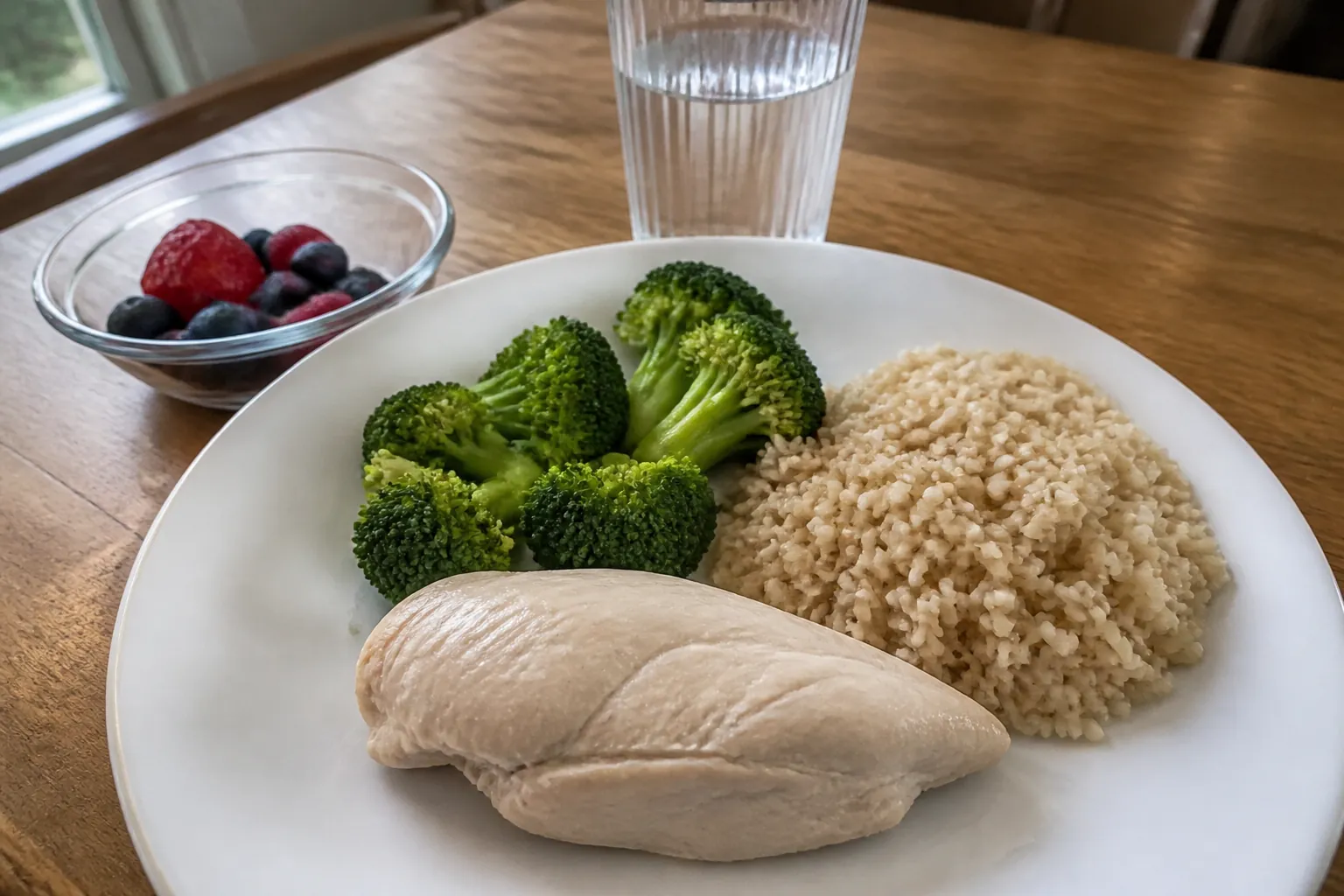
A gallbladder diet menu is a low-fat, high-fiber weekly eating plan of fruits, vegetables, whole grains and lean proteins. Regional Digestive Consultants allows 25 to 40 g of fat a day on its gallstone diet sheet. The 7-day menu has 3 meals plus snacks each day, with dinners reused as lunches. Good foods include fruits, vegetables, whole grains, beans, lean poultry, white fish and low-fat dairy.
Fried foods, fatty meats, full-fat dairy and rich desserts are left off the menu. After gallbladder surgery, clinics disagree on whether a low-fat diet is required. A food journal helps find personal triggers, one food at a time.
What Is a Gallbladder Diet Menu?
A gallbladder diet menu is a low-fat, high-fiber weekly eating plan of fruits, vegetables, whole grains and lean proteins. The gallbladder diet menu lists set breakfasts, lunches, dinners and snacks for each day.
Cleveland Clinic states there is no precise gallstones diet and no single food that improves gallbladder health. Cleveland Clinic dietitian Beth Czerwony says less saturated fat means the body needs to release less bile.
Who Should Follow a Gallbladder Diet Menu?
A gallbladder diet menu should be followed by people with gallstones that cause symptoms and people waiting for gallbladder surgery. People in the first weeks after gallbladder removal and people with gallbladder sludge, on medical advice, use the same menu.
Silent gallstones cause no symptoms and need no treatment. The National Health Service (NHS) says people waiting for gallstone surgery may be advised to eat a low-fat diet. Cleveland Clinic recommends a low-fat, high-fiber diet for gallstones and gallbladder sludge.
Angela M Madden’s 2024 review found that about 2% to 4% of people with silent gallstones develop symptoms each year. That review notes low-fat diets have traditionally been advised for gallstone symptoms, but calls the evidence uncertain. People with symptoms should talk to a doctor or registered dietitian before starting, since symptoms need a diagnosis first.
Can a Low-Fat Menu Dissolve Gallstones?
No, a low-fat menu cannot dissolve gallstones that are already in the gallbladder. Existing gallstones are not reabsorbed through diet changes, so they stay in place.
Angela M Madden’s University of Hertfordshire review found only one usable trial, with 69 adults, published in 1986. That trial found no significant effect of a low-cholesterol diet with ursodeoxycholic acid on gallstones. The review authors called the evidence scant. Prescription bile acid medicine is an option only when a doctor decides on it.
Mayo Clinic states there is no reliable evidence that a gallbladder flush helps prevent or treat gallstones. The lumps passed after an olive oil and juice flush are globs of oil, juice and other materials, not gallstones. Some people get nausea, vomiting, diarrhea and stomach pain during a gallbladder flush. Mayo Clinic states that diet changes usually cannot stop gallstones from coming back.
How Much Fat Is Allowed on a Gallbladder Diet Menu?
Fat allowed on gallbladder diet menus is 25 to 40 g a day on the Regional Digestive Consultants diet sheet. University of Wisconsin Health uses a 40 to 50 g fat diet sheet for gallbladder disease or trouble digesting fat.
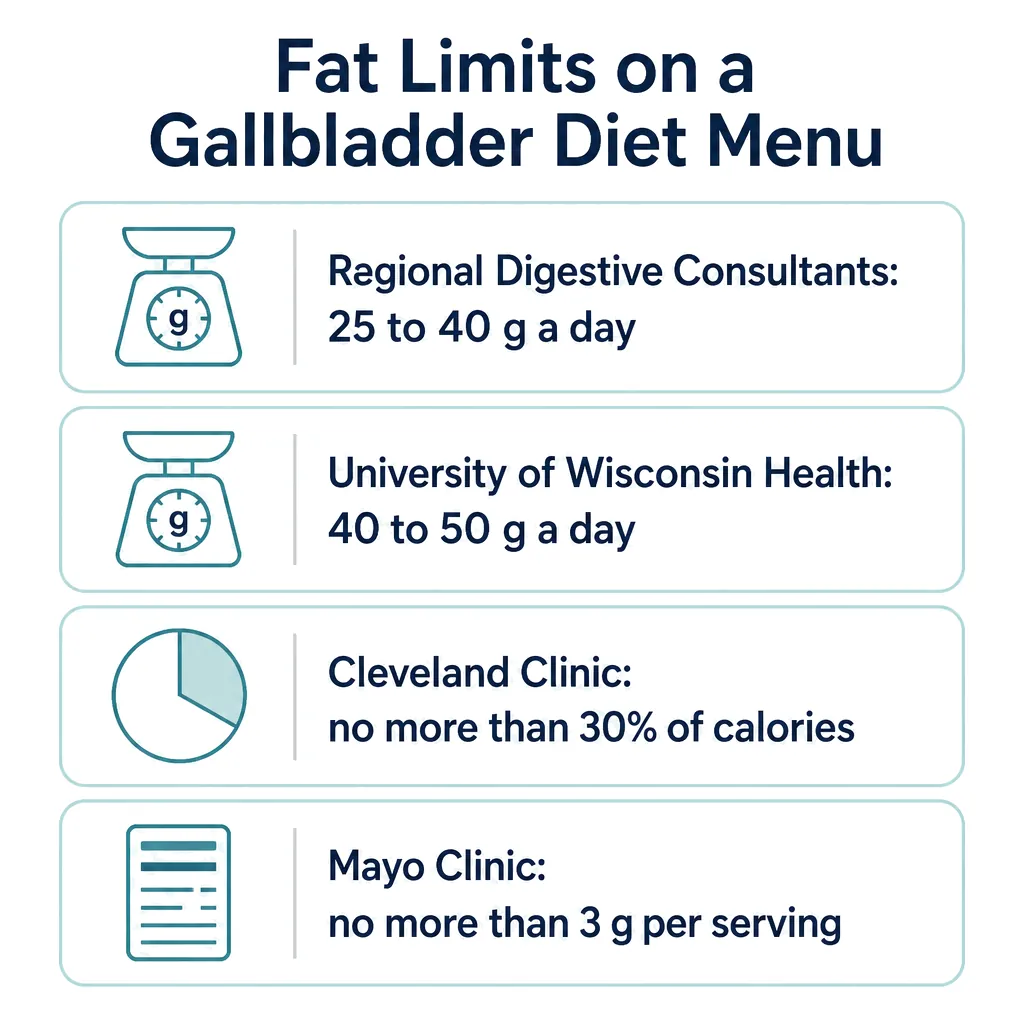
Cleveland Clinic advises that fat supply no more than 30% of daily calories, or about 60 g at 1,800 calories. Bangkok Hospital advises 20% to 35% of total calories from fat after gallbladder surgery. Regional Digestive Consultants limits added fat to 3 teaspoons a day and meat to 6 oz (170 g).
Mayo Clinic defines low-fat foods as those with no more than 3 g of fat per serving. Bangkok Hospital lists the same 3 g per serving limit for people with fat indigestion after gallbladder removal.
P Hildebrand’s 1998 study in Gastroenterology found that cholecystokinin release and gallbladder emptying require digestion of dietary fat. Fat limits vary by clinic and by symptoms. People should talk to a doctor or registered dietitian to set a personal fat limit.
Why Are Small, Frequent Meals Recommended?
Small, frequent meals are recommended because smaller amounts of fat are easier to digest than one large, fatty meal. Mayo Clinic notes that larger amounts of dietary fat can stay undigested and cause gas, bloating and diarrhea.
University of Wisconsin Health recommends 5 to 6 small meals a day instead of 3 large ones after gallbladder surgery. Gallbladder attacks often follow heavy meals and usually occur in the evening or at night. Each day of the 7-day menu has 3 meals plus snacks, so fat is spread across the day.
What Does a 7-Day Gallbladder Diet Menu Look Like?
A 7-day gallbladder diet menu looks like low-fat breakfasts, lunches, dinners and snacks, with dinners reused as lunches. Sample menus serve as examples only, since tolerance to garlic, caffeine and tomatoes differs between people.
| Day | Breakfast | Lunch | Dinner | Snacks |
|---|---|---|---|---|
| Day 1 | Greek yogurt with berries | Vegetable soup with barley | Chicken and broccoli stir-fry | Carrot and celery sticks with low-fat hummus |
| Day 2 | Oatmeal with blueberries and cinnamon | Leftover chicken and broccoli stir-fry | Grilled turkey burgers with roasted Brussels sprouts | Fruit with low-fat cottage cheese |
| Day 3 | Egg white omelet with spinach | Leftover turkey burger | Baked salmon with asparagus (if tolerated) | Air-popped popcorn without butter |
| Day 4 | Whole-wheat toast with jam | Quinoa salad with lemon dressing | White fish with baked sweet potato | Pretzels |
| Day 5 | Greek yogurt with berries | Lentil and carrot stew | Lemon-herb chicken breast with sautéed spinach with garlic | Nonfat frozen yogurt |
| Day 6 | Porridge with skim milk and banana | Brown rice and black bean bowl | Chicken and broccoli stir-fry | Carrot and celery sticks with low-fat hummus |
| Day 7 | Oatmeal with blueberries and cinnamon | Leftover chicken and broccoli stir-fry | Grilled turkey burgers with roasted Brussels sprouts | Fruit with low-fat cottage cheese |
The 7-day menu is a sample, so people should talk to a doctor or registered dietitian about portions and fat. Ten meals in the 7-day table have full recipes in the gallbladder diet recipes collection.
Dietitian-reviewed 7-day gallbladder menus include a breakfast, lunch, dinner and snack each day. Those menus are based on oats, egg whites, skinless poultry, white fish, beans and cooked vegetables. The day notes below mark which dinners are reused as lunches.
- Day 1: The chicken and broccoli stir-fry at dinner is reused as the Day 2 lunch.
- Day 2: One turkey burger from dinner is saved for the Day 3 lunch.
- Day 3: Baked salmon is listed only for people who tolerate oily fish.
- Day 4: White fish replaces meat at dinner, with pretzels as the snack.
- Day 5: The lunch is lentil and carrot stew, a high-fiber legume meal.
- Day 6: The stir-fry dinner repeats, and the leftovers become the Day 7 lunch.
- Day 7: Turkey burgers and fruit with cottage cheese repeat from Day 2.
What Is a Good Breakfast for Gallbladder Problems?
A good breakfast for gallbladder problems is nonfat Greek yogurt with berries or oatmeal with blueberries and cinnamon. An egg white omelet with spinach and whole-wheat toast with jam are other gallbladder-friendly breakfast choices.
Porridge made with skim milk and banana appears in another sample menu. Cleveland Clinic names Greek yogurt, whole-wheat toast, scrambled egg whites and smoothies as swaps for bacon and bagels.
What Is a Good Lunch on a Gallbladder Diet?
A good gallbladder diet lunch is vegetable soup with barley, lentil and carrot stew or quinoa salad with lemon dressing. A brown rice and black bean bowl and a jacket sweet potato with tuna in water are other good lunches.
Canned fish in water fits a low-fat diet, while fish canned in oil is on the avoid list. University of Wisconsin Health suggests 5 to 7 oz (140 to 200 g) of lean meat, poultry or fish daily. A 3 oz portion is about the size of a deck of cards.
What Is a Good Dinner for the Gallbladder?
A good gallbladder dinner is chicken and broccoli stir-fry, grilled turkey burgers or white fish with baked sweet potato. Lemon-herb chicken breast with steamed vegetables and baked salmon with asparagus, if tolerated, are other gallbladder menu dinners.
Fish oil helps the gallbladder empty, the National Institute of Diabetes and Digestive and Kidney Diseases says. Some hospitals limit oily fish such as salmon on low-fat diets, so salmon is marked if tolerated in the menu. Tolerance to oily fish differs from person to person.
Lean dinner proteins on the University of Wisconsin Health list include skinless poultry, white fish, shellfish, beans and eggs.
What Are Good Snacks on a Gallbladder Diet?
Good snacks on a gallbladder diet are air-popped popcorn without butter, fruit with low-fat cottage cheese and pretzels. Carrot and celery sticks with low-fat hummus and nonfat frozen yogurt are other gallbladder menu snacks.
Low-fat sweets on one gastroenterology practice’s list include sherbet made with skim milk, gelatin, angel food cake and graham crackers.
Nuts fit only as a small portion that counts toward the daily fat budget, since sources disagree on them. That practice counts 6 almonds or 20 small peanuts as one of 3 daily fat servings.
What Drinks Fit a Gallbladder Diet Menu?
Drinks that fit gallbladder diet menus are water, skim or 1% milk, clear broth and fruit juice in small amounts. MedlinePlus advises 8 to 10 glasses of water a day after laparoscopic gallbladder removal to ease bowel movements.
Caffeinated drinks such as coffee and tea fit if tolerated, but caffeine may worsen loose stools after surgery. Bangkok Hospital advises avoiding coffee and tea while diarrhea continues after gallbladder removal. Alcohol is best limited.
Low-fat drinks on the same practice’s list include cocoa made with skim milk, not drinks made with high-fat dairy.
What Foods Are Good for the Gallbladder?
Foods that are good for the gallbladder include fruits, vegetables, whole grains, beans, lean poultry, white fish and low-fat dairy. High-fiber foods such as beans, peas, oats and brown rice are recommended in larger amounts.
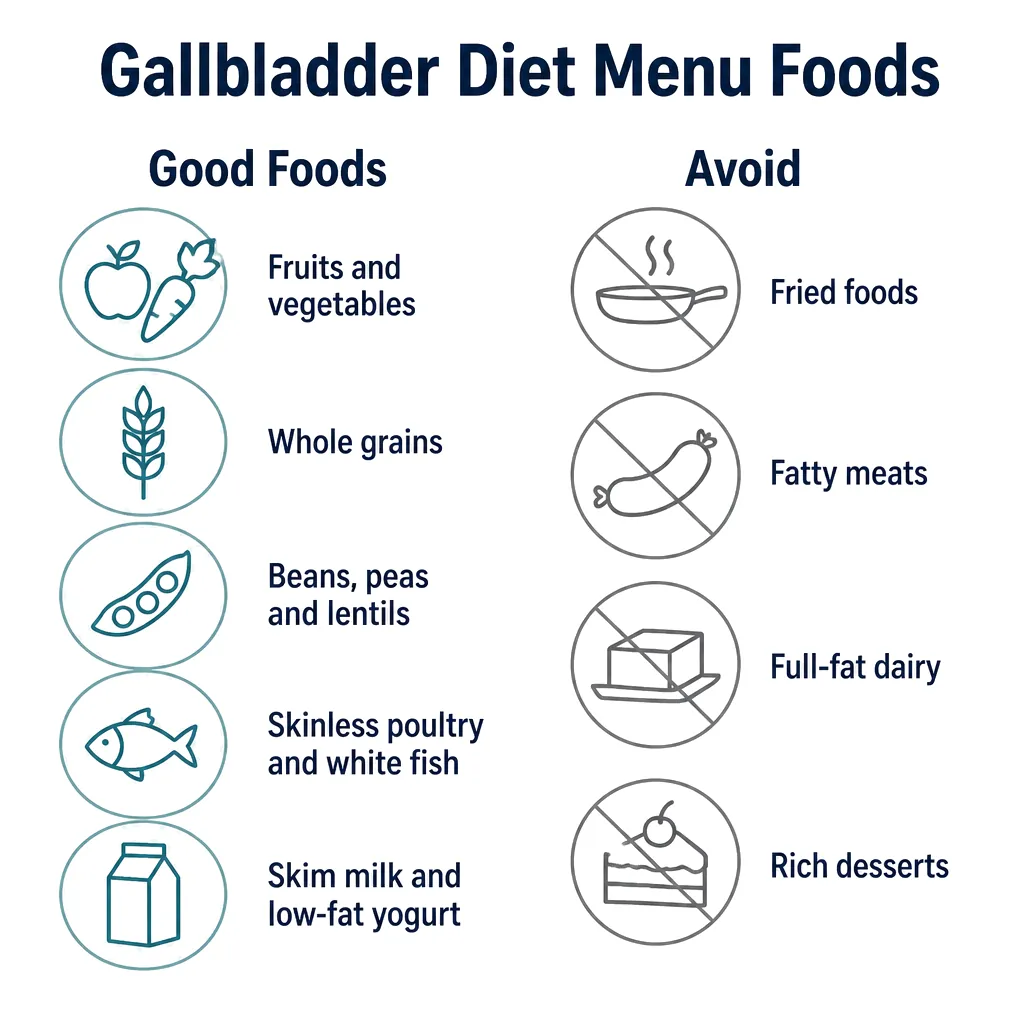
- Fruits and vegetables: High-fiber foods recommended in larger amounts on a gallbladder diet.
- Whole grains such as oats, brown rice and barley: Fiber-rich grains, along with whole wheat bread.
- Beans, peas and lentils: High-fiber legumes, found in the lentil stew and the black bean bowl.
- Skinless poultry and white fish: Lean proteins that are lower in saturated fat than red and processed meats.
- Skim milk and low-fat yogurt: Low-fat dairy that replaces full-fat dairy, with 1% milk, cottage cheese and low-fat cheeses as options.
- Small amounts of olive oil: Healthy fats such as olive oil, avocado and nuts fit a post-surgery diet in small amounts.
Cleveland Clinic gives 25 to 35 g of fiber a day as the usual target, raised slowly after gallbladder removal.
Are Spaghetti, Potatoes, and Eggs Okay for the Gallbladder?
It depends, spaghetti, potatoes and eggs are okay for the gallbladder when prepared without added fat. One digestive clinic limits whole eggs each week and allows egg whites as a swap.
Starches such as rice, macaroni and noodles are allowed without added fat, but fried potatoes are not. Potatoes with butter, cream or cheese are left out too.
Tomatoes, the base of most spaghetti sauces, are tolerated by some people with gallbladder problems and not by others. That clinic leaves out creamy sauces and meat sauces.
What Foods Should Be Avoided on a Gallbladder Diet Menu?
Foods that should be avoided on a gallbladder diet menu include fried foods, fatty meats, full-fat dairy and rich desserts. High-fat foods such as butter, lard, bacon and hot dogs are on the Cleveland Clinic limit list.
- Fried foods: Fried foods are on the Cleveland Clinic limit list.
- Fatty red meat and processed meats: Bacon, deli meats and hot dogs.
- Butter, lard and full-fat dairy: Full-fat dairy products and solid cooking fats.
- Creamy sauces and gravies: Creamy sauces and gravies are on the University of Wisconsin Health limit-or-avoid list.
- Pastries and rich desserts: Pastries and rich desserts are on the same limit-or-avoid list.
University of Wisconsin Health advises avoiding canned and frozen meals with over 15 g of fat per serving. Cleveland Clinic advises cutting back on sugary drinks, sugary condiments and foods made with white flour.
A longer guide lists 15 foods to avoid with gallbladder issues.
How Should the Menu Change After Gallbladder Surgery?
After gallbladder surgery, the menu should change toward lower fat for the first weeks, though not every clinic requires it. NHS Borders dietitians state that a low-fat diet is not required after gallbladder removal.
Bile flow without a gallbladder is direct, from the liver straight into the intestines. That direct flow can cause short-term stomach or bowel upset. Cleveland Clinic, Mayo Clinic and University of Wisconsin Health suggest lower fat for the first weeks. A Cleveland Clinic dietitian says more than half of patients have trouble digesting fat after gallbladder removal.
Mikhail Fisher’s 2008 study of 100 patients found 17% had troublesome new diarrhea after laparoscopic gallbladder removal. MedlinePlus notes that loose stools after eating may last 4 to 8 weeks after laparoscopic removal.
Cholecystectomy recovery takes about a week after laparoscopic surgery and 4 to 6 weeks after open surgery, Mayo Clinic states. People should talk to a doctor or registered dietitian after surgery, especially when diarrhea lasts more than three days.
What Can Be Eaten in the First Days After Gallbladder Surgery?
Foods eaten in the first days after gallbladder surgery are clear liquids and broth, gelatin, and plain toast and crackers. White rice and bananas follow as solid food returns, and MedlinePlus advises avoiding greasy or spicy foods for a while.
Mayo Clinic advises no high-fat, fried or greasy foods, fatty sauces or gravies for at least 1 week after surgery. Cleveland Clinic calls soft, bland, low-fiber foods the best way to rest the gut right after gallbladder surgery. Soft, bland foods like those in a 7-day bland diet menu suit this stage.
Foods to hold off at first are heavy meats, bread with seeds or nuts, and carbonated drinks.
J N Shah’s 2012 study of 294 patients found drinking within hours of laparoscopic gallbladder removal safe and well accepted. People should follow the surgeon’s discharge sheet and talk to a doctor or registered dietitian about foods not tolerated.
How Long Is a Low-Fat Diet Needed After Gallbladder Removal?
A low-fat diet is needed after gallbladder removal for a few weeks to a few months in most people. Bangkok Hospital recommends low-fat, high-fiber food particularly during the first 2 months after surgery.
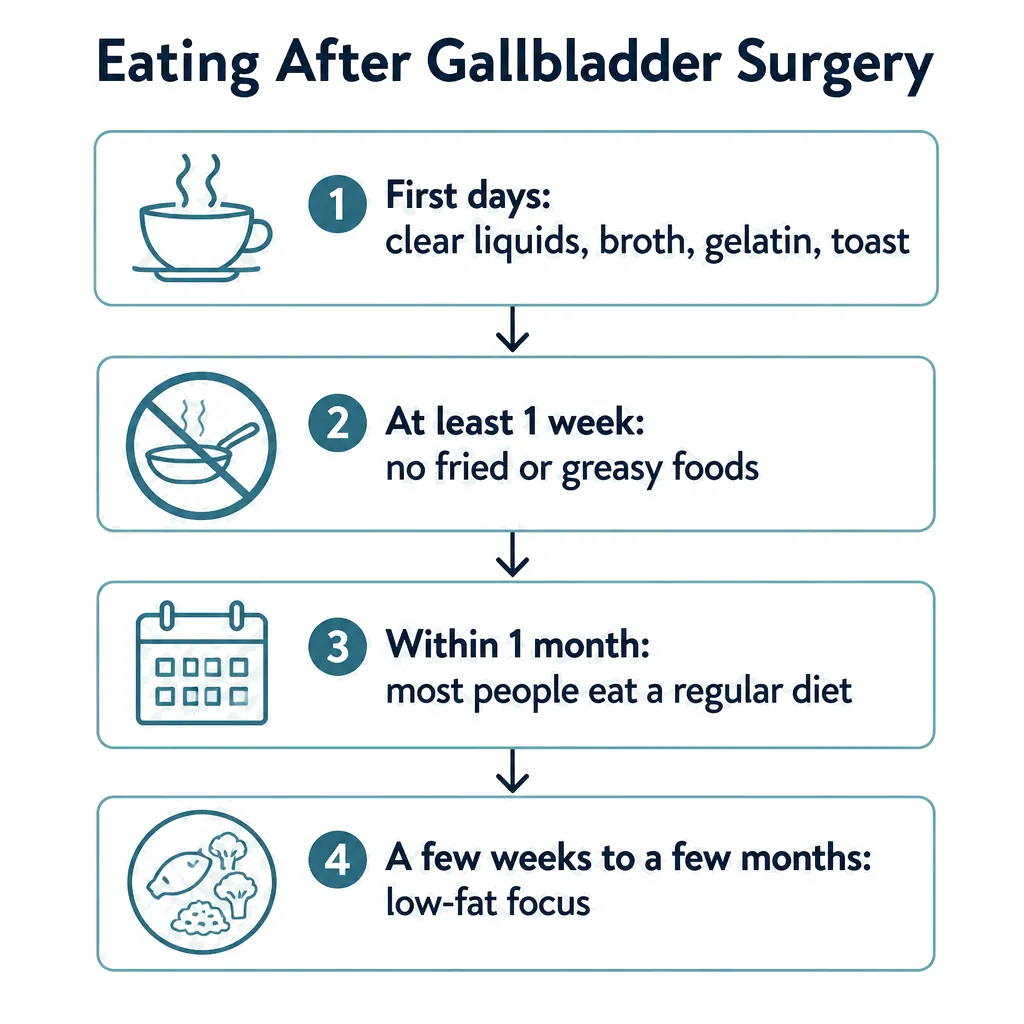
A Cleveland Clinic dietitian says most people can return to a regular diet within 1 month after surgery. Mayo Clinic notes that diarrhea after gallbladder removal usually lasts no more than a few weeks to a few months. University of Wisconsin Health advises keeping fat moderate long term, not extremely low, while avoiding high-fat meals.
Yolanda Ribas Blasco’s 2020 study of 83 patients found symptoms improved after gallbladder removal regardless of fat intake. A bowel habit change persisted at 6 months in 23% of those patients. Foods are added back one at a time. People should talk to a doctor or registered dietitian if diarrhea lasts more than three days or symptoms continue.
How Can the Menu Be Adjusted for Personal Triggers?
To get the menu adjusted for personal triggers, people keep a food journal and swap one food at a time. Cleveland Clinic recommends a food journal to see which foods trigger gallbladder symptoms.
A registered dietitian helps rework a diet around each person’s own triggers. Mayo Clinic lists caffeine, dairy products and very sweet foods as foods that can worsen diarrhea after gallbladder removal. People take the journal notes to a doctor or registered dietitian for review.
Fiber portions should rise gradually after gallbladder removal to avoid nausea and vomiting.
The Mediterranean diet and the Dietary Approaches to Stop Hypertension (DASH) diet suit gallbladder health, Cleveland Clinic says.
Can a Gallbladder Diet Menu Be Used for Weight Loss?
It depends, a gallbladder diet menu can be used for slow, steady weight loss but not for fast weight loss. Rapid weight loss makes the liver release extra cholesterol into bile and can keep the gallbladder from emptying properly.
National Institute of Diabetes and Digestive and Kidney Diseases suggests losing 5 to 10% of starting weight over 6 months. Mayo Clinic advises losing 1 or 2 pounds (about 0.5 to 1 kilogram) a week to limit gallstone risk. One digestive clinic advises losing no more than 3 lb (1.4 kg) a week.
K Johansson’s 2014 cohort compared a 500 kcal very-low-calorie diet with a 1,200 to 1,500 kcal diet. The very-low-calorie diet group had more gallstones needing hospital care. Weight cycling, losing and regaining weight repeatedly, may lead to gallstones.
The same institute suggests at least 150 minutes a week of moderate activity such as brisk walking. The medicine ursodiol can help prevent gallstones during rapid weight loss, a choice made by a doctor. People should talk to a doctor or registered dietitian before any calorie-restricted plan or weight-loss medicine.
When Should a Doctor Be Called During a Gallbladder Attack?
A doctor should be called in a gallbladder attack when pain lasts hours or comes with fever, jaundice or vomiting. Gallbladder attack warning signs include nausea, chills, tea-colored urine and light-colored stools.
Gallbladder attack warning signs mean people should call a doctor or seek emergency care. A gallbladder diet menu is not a treatment for a gallbladder attack. A bile duct that stays blocked for more than a few hours can lead to gallstone complications.
Jared R Gallaher’s 2022 review found that gallstones blocking the cystic duct cause 90% to 95% of acute cholecystitis cases.
Acute cholecystitis pain is usually persistent and spreads toward the right shoulder, the NHS notes. The NHS guidance on acute cholecystitis advises seeing a doctor soon if that pain lasts more than a few hours.
MedlinePlus advises calling a provider after surgery for a fever above 101°F (38.3°C), unrelieved pain or yellow skin. University of Wisconsin Health lists severe or persistent diarrhea and severe abdominal pain after surgery as reasons to call. People should talk to a doctor or registered dietitian about the menu once the attack is assessed.
Want Your Free Gallbladder Diet Meal Plan from Eat Proteins?
The free Eat Proteins meal plan turns this 7-day gallbladder diet menu into one simple page. You get breakfast, lunch, dinner and snack ideas made from low-fat, high-fiber foods.
Sign up below to get the plan by email and keep it handy for the week. Talk to your doctor or registered dietitian before changing your diet, especially after gallbladder surgery.