
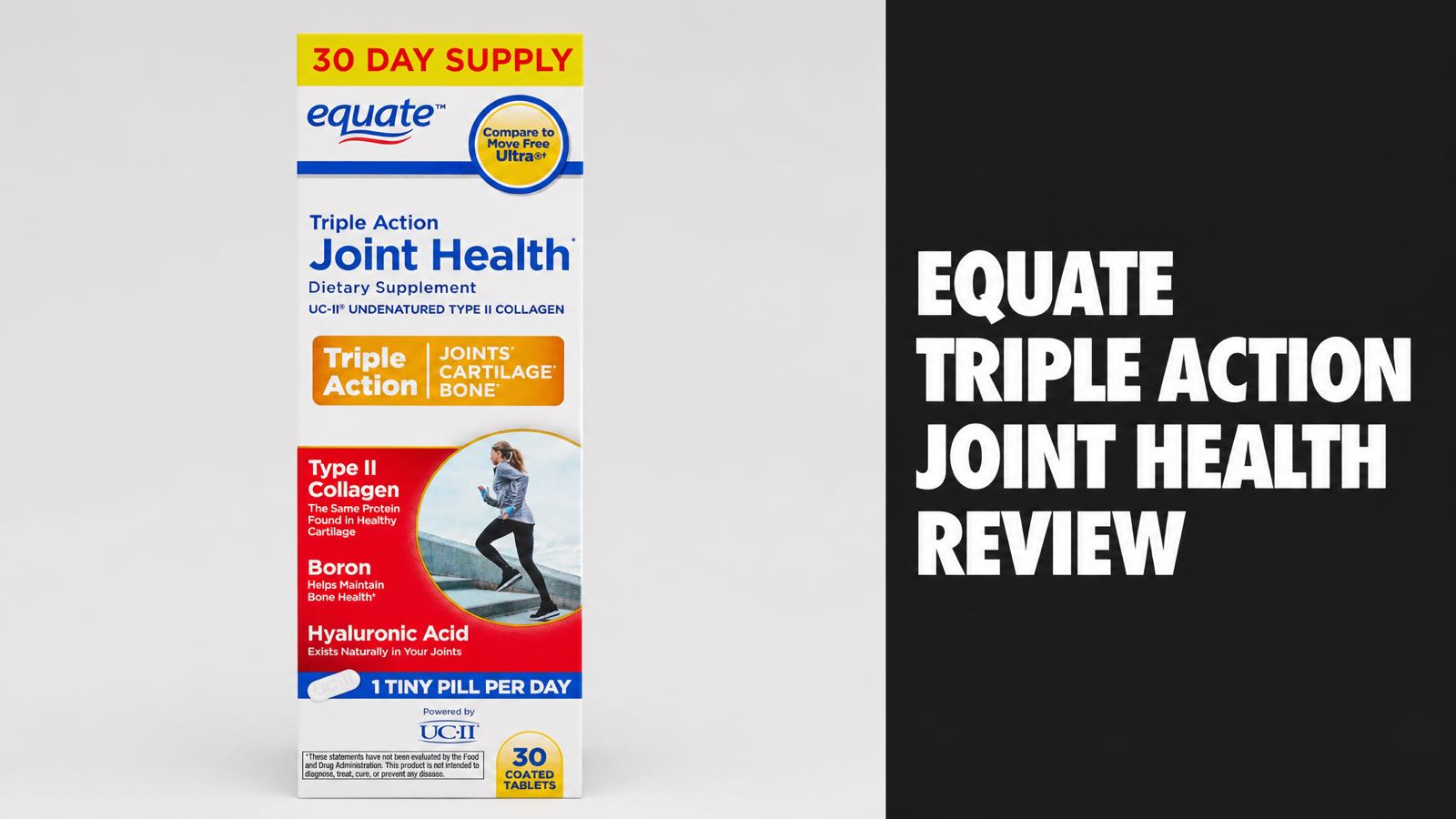
Equate Triple Action Joint Health is a once-daily joint supplement sold under Walmart’s store brand. Each coated tablet combines UC-II cartilage, boron glycinate, and hyaluronic acid. A bottle holds 30 tablets and starts near $14.88. Adults use it for stiff knees, achy hips, and everyday joint wear.
This review covers what the tablet contains and how its three ingredients work. Dosing is one tablet daily, with or without food. Reviewers praise stiffness relief and low cost, while a few report no change or a bad reaction. The formula matches Kirkland Signature on every headline number, and side effects stay mild for most users. Costs stay low too.
The big picture is simple. This is a low-risk, low-cost trial for adults who want joint support, not a proven cure. Read on to learn about ingredients, real customer feedback, price per tablet, safety limits, and a clear, simple rule for deciding whether to keep buying after one month.
What Is Equate Triple Action Joint Health?
Equate Triple Action Joint Health is a once-daily joint supplement sold as a store brand at Walmart. Each coated tablet combines three ingredients: UC-II cartilage, boron glycinate, and hyaluronic acid. A bottle holds 30 tablets, so one bottle covers a month. The tablet is aimed at adults who want daily joint support without a large pill count. It is cheap.
In fact, the formula copies a well-known brand layout. The bottle invites shoppers to compare it with Move Free Ultra. Our team at Eat Proteins sees this pattern often with store brands. The price drops, while the core ingredient list stays close.
Who Is It Made For?
The tablet targets adults with stiff knees, achy hips, or general joint wear. Reviewers on Walmart mention arthritis, bad knees, and hip pain. Athletes and active older adults also appear in the feedback. Nobody under 18 is the intended user, and the label offers no pediatric dose. The label gives no pediatric dose. Most feedback comes from older adults.
Who gets the most from it? Adults who want a low-cost daily habit. The product is a supplement, not a drug. It does not diagnose, treat, cure, or prevent any disease, and the FDA has not evaluated those claims.
What Ingredients Are In Equate Triple Action Joint Health?
Each tablet delivers three active ingredients in small, fixed amounts. The supplement facts list 40 mg of UC-II cartilage, 5 mg of boron glycinate, and 3.3 mg of hyaluronic acid. The serving size is one tablet. A full bottle contains 30 servings, which makes the dose simple to track. The label names no other actives. The mix is simple and easy to track.
Active Ingredients Per Tablet:
| Ingredient | Amount | Role |
|---|---|---|
| UC-II cartilage | 40 mg | Undenatured type II collagen source |
| Boron glycinate | 5 mg | Trace mineral for bone and joint support |
| Hyaluronic acid | 3.3 mg | Joint lubrication support |
Here’s the thing: the doses are modest. Glucosamine and chondroitin are absent. That sets this tablet apart from many joint formulas. Shoppers who expect those two classic ingredients will not find them here.
What Does UC-II Collagen Do?
UC-II is a patented form of undenatured type II collagen taken from chicken cartilage. The 40 mg dose matches the amount used in published human studies on knee comfort. The body treats the collagen differently from regular protein. Researchers believe it calms the immune response that wears down cartilage. Studies focus on knee comfort. Results vary.
Does that mean a guaranteed result? No. Studies were small and often funded by the ingredient maker. Our experts at Eat Proteins treat the evidence as promising but not final. Individual response varies a lot.
Which Other Ingredients Are In The Tablet?
The tablet uses several fillers, binders, and coating agents beyond the three actives. The list includes microcrystalline cellulose, croscarmellose sodium, magnesium stearate, silicon dioxide, and stearic acid. It also includes titanium dioxide as a colorant. These agents hold the tablet together and give it a smooth coat. Together they hold the tablet.
Inactive Ingredients Worth Noting:
- Titanium dioxide (colorant)
- Polyethylene glycol (humectant)
- Polysorbate 80 (emulsifier)
- Polyvinyl alcohol (binder)
- Magnesium silicate (anti-caking agent)
To be clear, none of these is unusual in a coated tablet. Still, titanium dioxide draws criticism from some ingredient trackers. If you avoid it, check the bottle yourself.
How Does Equate Triple Action Joint Health Work?
The formula works through three separate routes that target joint tissue. UC-II aims at the immune signals behind cartilage breakdown. Hyaluronic acid supports the fluid that cushions the joint. Boron supports bone and mineral balance. Each ingredient plays a different part, which explains the ‘triple action’ name. The parts fit together. No trial tests it.
Think of it this way: the tablet is a small team, not one star player. Does a team of small doses beat one big dose? Evidence is limited. The three-part design is a marketing frame. The real proof sits in the UC-II research.
How Should You Take Equate Triple Action Joint Health?
Adults take one tablet daily, with or without food. The label recommends daily use for best results. Consistency matters more than timing. Many reviewers take the tablet in the morning. One reviewer reports feeling better within two doses, though most users need weeks. The label sets no upper dose. Skipping days weakens any steady routine, so stay steady.
Daily Routine:
- Take one tablet with water each day.
- Keep the same time every day.
- Use the bottle for at least 30 days before judging results.
- Stop and call a doctor if a reaction appears.
What Are The Benefits Of Equate Triple Action Joint Health?
The tablet promises joint comfort, flexibility, and support for daily movement. Retail listings describe a blend designed to promote flexibility and comfort. The product page also stresses a one-tablet routine and a 30 day supply. Those claims are general wellness claims, not medical cures. Listings stress an easy routine. No page shows a measured outcome.
Claimed Benefits:
- Joint comfort during daily activity
- Better flexibility
- Cartilage support
- Simple one-tablet dosing
The bad news? Marketing language is vague. No claim comes with a number. That makes it hard to hold the product to a clear standard.
Does Equate Triple Action Joint Health Actually Reduce Joint Pain?
No. The product has no direct clinical trial proving pain relief on its own. Some of its ingredients have evidence behind them, especially UC-II at 40 mg. But no study tested this exact Equate tablet. Real-world results depend on the person and the cause of the pain. Researchers tested UC-II alone, not this tablet. Pain often has several causes in one body.
Short answer: it may help some people. Many reviewers report less stiffness. Others feel no difference at all. Our coaches at Eat Proteins suggest a 30 day trial, then an honest check on your own comfort.
What Do Equate Triple Action Joint Health Reviews Say?
Reviews lean strongly positive, with high ratings across major retailers. MyOTC shows 4.7 stars from 826 reviews. Walgreens shows a similar 4.7 for its own Triple Action tablet. Walmart reviewers post verified purchases. Those numbers beat most store-brand supplements in the aisle. Customers also leave notes on Walmart and MyOTC each month, so it is fine.
Now, watch this: high stars do not prove effect. Customers who feel better post more often. Does that skew the score? Probably a little. Independent scoring site SuppCo gives the product a low TrustScore of 3.1, mostly for missing testing data.
What Do Positive Reviews Say?
Happy buyers praise stiffness relief, low price, and long-term use. One Walmart reviewer says the tablets helped with stiffness for years. Another reports a hip pain drop from a 7 to a 1 on day one. A third says the product beats rivals at a lower cost. Most of these buyers have used the tablets for years and say they reorder often. Many call it effective.
Common Praise:
- Less joint stiffness
- Lower cost than name brands
- Easy single-tablet routine
- Long-term repeat buying
What Are The Common Complaints?
Critics report no change in pain, and a few mention unwanted reactions. One Walmart reviewer says they felt no difference. Another reports shortness of breath and more joint pain, and warns people taking rosuvastatin. These are single anecdotes, not proof. Still, they deserve attention before you buy. Each comment is a personal story, not a clinical test.
Here’s what no one tells you: a supplement that works for one person can fail for the next. And that’s normal. Joint pain has many causes, from wear to inflammation. One pill cannot fix every cause.
How Does Equate Triple Action Joint Health Compare To Kirkland Signature And Move Free Ultra?
Equate uses the same three-ingredient plan as Kirkland Signature and Move Free Ultra. Kirkland lists 40 mg of UC-II, 5 mg of boron, and 3.3 mg of hyaluronic acid, matching Equate. The bottle also tells shoppers to compare with Move Free Ultra. The main difference is price and bottle size. Shoppers see matching label numbers, so loyalty matters little.
Quick Comparison:
| Product | UC-II | Boron | Hyaluronic Acid |
|---|---|---|---|
| Equate Triple Action | 40 mg | 5 mg | 3.3 mg |
| Kirkland Signature Triple Action | 40 mg | 5 mg | 3.3 mg |
| H-E-B Triple Action | Similar formula | Similar formula | Similar formula |
Which Triple Action Option Costs Less Per Serving?
Equate costs about $0.50 per tablet at the listed starting price of $14.88. Kirkland sells a 110 count bottle, which usually lowers the per-tablet cost for Costco members. Prices change often. Check the current shelf price before you decide. Larger bottles help long-term users. Smaller ones suit first-time buyers. Check the shelf tag before you pay.
The bottom line: buy the bottle size you will finish. A larger bottle only saves money if you stay consistent. Equate suits a first trial, since the 30 count bottle limits upfront spending.
What Are The Side Effects Of Equate Triple Action Joint Health?
Most users tolerate the tablet well, with mild reactions in a small group. Possible effects include stomach upset, nausea, and allergic reactions. The label lists no specific safety warning. Still, every supplement carries some risk. A bad reaction means you stop and call a doctor. Serious reactions are rare. Stop at once if breathing trouble appears.
What about drug mixes? One Walmart reviewer reports a reaction while taking rosuvastatin. That is a single report, not a confirmed interaction. Even so, anyone on prescription medicine should ask a pharmacist first. Boron is also safe only within limits.
Who Should Avoid Equate Triple Action Joint Health?
Certain groups should check with a doctor before they start. That includes pregnant or nursing women, people on prescription drugs, and anyone with a chicken or egg allergy. UC-II comes from chicken cartilage, so poultry allergy matters. Children should not take it. Anyone with a condition should ask a pharmacist first. Safety beats savings, every time.
Check With A Doctor First If You:
- Are pregnant or nursing
- Take statins or other prescriptions
- Have a poultry allergy
- Have a diagnosed joint disease
How Much Does Equate Triple Action Joint Health Cost?
A 30 count bottle starts at about $14.88, which works out to roughly $0.50 per tablet. That makes the product a budget pick in the joint aisle. Walmart sets the price, and it can shift by store or by online seller. Third-party sellers sometimes charge much more. Shipping and sales can shift the total. Compare similar bottles and sellers before checkout.
So, is a $15 bottle a big bet? Not really. A month of trial costs less than most name brand joint products. The risk is low in money terms. The real cost is patience.
Is Equate Triple Action Joint Health Worth The Price?
Yes. For a trial, the tablet offers a fair deal given its label and its review scores. The formula matches costlier rivals on the headline numbers. High retailer ratings add confidence. The weak points are missing third-party testing proof and the lack of glucosamine or chondroitin. Reviews are strong and the entry cost is low. Trial risk stays small.
In plain English: it’s a decent low-risk test. It is not a miracle. If you see no change after 30 to 60 days, stop buying. Our team at Eat Proteins backs that rule for any supplement.
Is Eat Proteins Worth Trying Before You Buy Another Supplement?
Yes. Eat Proteins gives you plain answers on supplements before you spend money. Our experts read labels, compare doses, and flag weak claims. You get the facts without the hype. That saves you from wasted bottles and false hope. Our team reads the labels, weighs the evidence, and says what matters. No hype, no filler, only facts you can use today.
Don’t guess on your next purchase. Check the label, weigh the reviews, and talk to your doctor. Then come back to Eat Proteins for the next honest review. Your joints, and your wallet, will thank you.
What Should You Do Next?
Your next step is a simple 30 day test with a clear goal. Note your stiffness level before day one. Rate it again at day 30. If nothing changes, move on. Browse more Eat Proteins reviews to compare your options and choose with confidence. Our coaches suggest a simple note on paper. Writing it down keeps your result honest and your next choice easy.
Ready to decide? Start with the facts here. Then pick your next move. Eat Proteins is here for every step.