
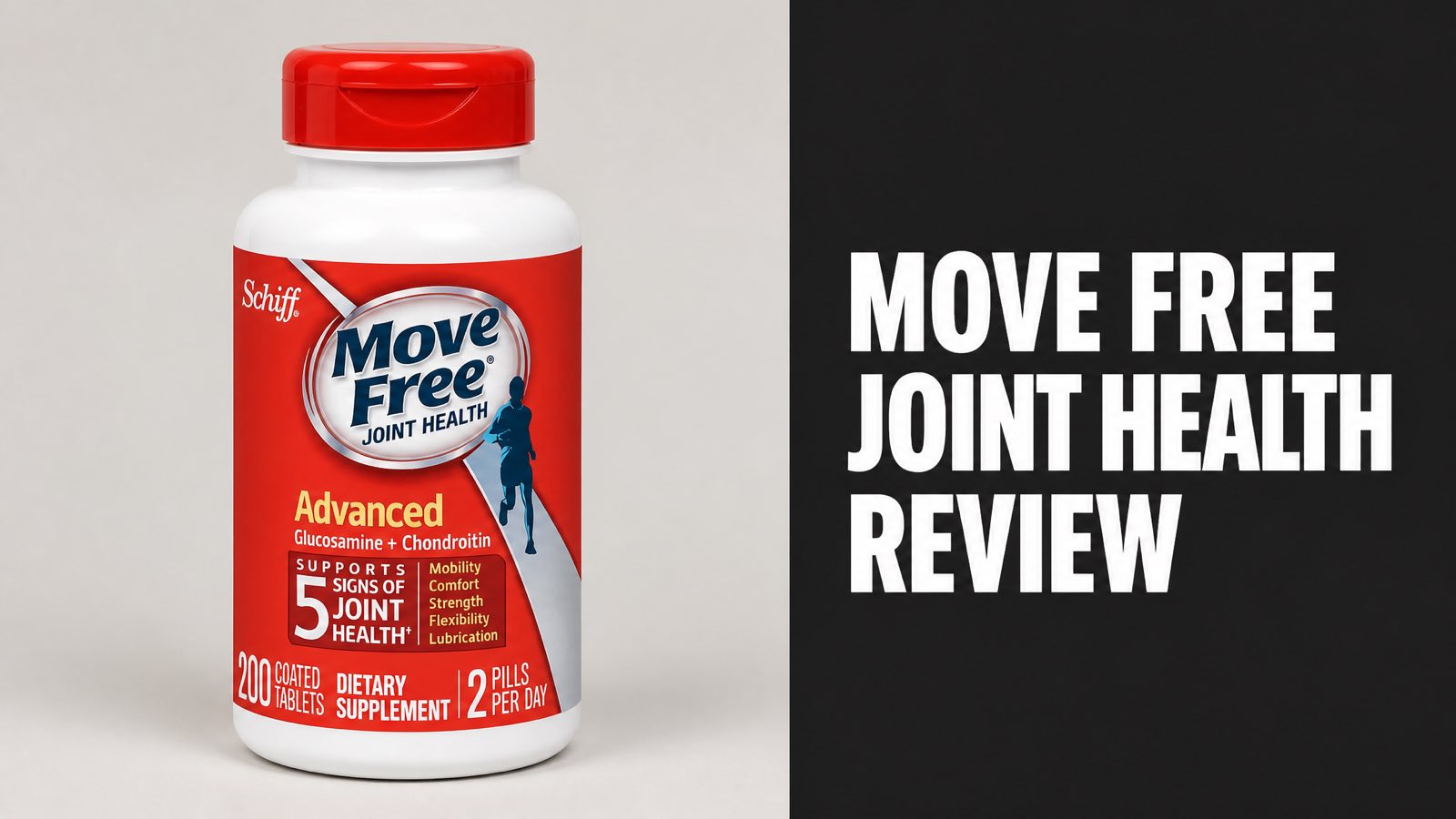
Move Free Joint Health is a line of glucosamine, chondroitin, and collagen supplements from Schiff Vitamins. Buyers take the coated tablets to ease stiff knees and hands. The range includes Advanced, Ultra, and Ultra Triple Action formulas, and each one uses a different ingredient mix.
Move Free is not one product, so the label decides what a buyer gets. The NIH-funded GAIT trial found no overall pain relief. A subgroup with moderate-to-severe pain responded far better. Reviews run positive at retailers and mixed on Drugs.com. Side effects stay mild for most users. Our review weighs the clinical evidence against real buyer feedback.
Results take 8 to 12 weeks, and a fair trial needs the full label dose. Warfarin users and people with shellfish allergies need extra care. Read on to see which formula fits, what it costs, and who gains the most from taking it. Our team at Eat Proteins gives the honest final verdict.
What Is Move Free Joint Health?
Move Free Joint Health is a family of joint supplements built on glucosamine, chondroitin, collagen, and hyaluronic acid. Schiff Vitamins makes the coated tablets. Shoppers take them daily to ease stiffness and support mobility in the knees, hands, and hips. The range spans several formulas, and each one targets a slightly different buyer. Labels differ.
Here’s the thing: Move Free isn’t one product. Each box carries a different ingredient stack. To be clear, the label on the box decides what a buyer actually gets.
An NCBI Bookshelf entry calls Move Free a proprietary line of multi-ingredient dietary supplements. Retailers sell it as a daily tablet. Our team at Eat Proteins reviews it as a supplement, not a medicine.
Which Move Free Product Line Fits You?
Move Free Advanced suits buyers who want the classic glucosamine and chondroitin stack. Ultra and Ultra Triple Action suit buyers who prefer type II collagen, boron, and hyaluronic acid in one small tablet. Each line targets a different kind of shopper. The right pick depends on the dose a buyer wants to test and the pill count a buyer will tolerate.
Advanced typically holds glucosamine HCl at 1,500 mg (1.5 g). Chondroitin ranges from 200 mg to 1,200 mg depending on the product. Some versions add hyaluronic acid and calcium fructoborate.
Ultra Triple Action reviewers describe a tiny coated tablet taken once a day. In fact, many prefer that to larger pills. But the doses used in major trials sit in the Advanced style formulas.
Move Free Lines at a Glance:
| Line | Core Ingredients | Daily Dose |
|---|---|---|
| Advanced | Glucosamine HCl, chondroitin, often hyaluronic acid and calcium fructoborate | 1 tablet twice daily or 2 tablets once daily with meals |
| Ultra | Type II collagen, boron, hyaluronic acid | 1 tablet daily |
| Ultra Triple Action | UC-II type II collagen, boron, hyaluronic acid | 1 tablet daily |
What Ingredients Are in Move Free Joint Health?
Move Free ingredients fall into two camps, the glucosamine and chondroitin camp and the type II collagen camp. Advanced formulas lean on glucosamine HCl and chondroitin sulfate. Ultra formulas swap those for collagen, boron, and hyaluronic acid. Many labels add one or two extras on top, so reading the supplement facts panel matters. Labels differ widely.
Glucosamine and chondroitin are building blocks of cartilage. Researchers have studied both for decades in osteoarthritis. Collagen has a smaller and younger body of evidence behind it.
Pay attention to this: the cheapest box may not match the studied doses. Some versions carry as little as 200 mg of chondroitin. Does that gap matter? Yes, because the best-known trial used 1,200 mg daily.
Key Ingredients Explained:
| Ingredient | Found In | Role |
|---|---|---|
| Glucosamine HCl | Advanced | Cartilage building block |
| Chondroitin sulfate | Advanced | Supports cartilage structure |
| Type II collagen (UC-II) | Ultra lines | Targets joint comfort through an immune pathway |
| Hyaluronic acid | Advanced (some) and Ultra | Component of joint fluid |
| Boron | Ultra lines | Mineral cited for bone and joint support |
Is Glucosamine HCl as Good as Glucosamine Sulfate?
No. Glucosamine HCl has weaker and more mixed evidence than the patented crystalline glucosamine sulfate used in European trials. Most Move Free products use HCl because the form is stable in tablets and cheaper to make. Sulfate supplies the sulfate group the body uses to build cartilage, and HCl lacks that group. Stability drives that choice in tablets.
The US GAIT trial used glucosamine HCl. Its results apply directly to Move Free users. Positive European trials by Reginster and Pavelka used sulfate instead.
A 2011 study found sulfate reaches higher joint fluid levels than HCl. Does that change pain relief? Nobody has proven it. Head-to-head trials remain limited.
How Does Move Free Joint Health Work?
Move Free supplies the raw materials the body uses to build and lubricate cartilage and joint fluid. Glucosamine and chondroitin feed the cartilage matrix. Hyaluronic acid adds a lubricating compound found in synovial fluid. Collagen formulas aim at joint comfort through a mechanism called oral tolerance. Results, when they come, build slowly. Slow gains.
Lab and animal data suggest glucosamine and chondroitin support cartilage components. Human evidence for rebuilding cartilage is weak and inconsistent. So what does that mean for you? Expect symptom relief at best, not repair.
Does Move Free Joint Health Actually Reduce Joint Pain?
Yes, for some people. Move Free helped a specific subgroup in major trials but not the average osteoarthritis patient. The NIH-funded GAIT trial enrolled 1,583 patients and found no significant pain reduction overall. The subgroup with moderate-to-severe knee pain responded far better. Mild aches fall outside that evidence. Responders see it by week 12.
In that subgroup, about 79% responded to glucosamine plus chondroitin. Placebo drew about 54%. Subgroup results are less reliable than primary outcomes, and researchers still debate them.
The 2020 Cochrane review found little to no benefit in high-quality trials. Guidelines split as a result. ACR and OARSI 2019 conditionally recommend against routine use, while EULAR conditionally recommends considering glucosamine sulfate.
What the Research Found:
| Source | Finding |
|---|---|
| GAIT trial (NEJM, 2006) | No significant pain relief overall; 79% vs 54% response in moderate-to-severe subgroup |
| LEGS trial (2010) | Small joint-space improvements, modest pain effect near the clinical threshold |
| Cochrane review (2020) | Little to no benefit in high-quality trials |
| ACR and OARSI (2019) | Conditionally recommend against routine use |
Does Move Free Joint Health Protect Cartilage?
No. Move Free has no strong human evidence for protecting or rebuilding cartilage. Radiographic data on structural change is weak and inconsistent. Marketing language about cartilage rests mostly on laboratory and animal findings. Buyers who want structural protection are paying for a promise that human trials have not confirmed. Human proof is missing.
The LEGS trial reported small gains in joint-space narrowing with glucosamine sulfate over two years. Do those gains apply to Move Free? Not directly, since they came from a different form than most tablets use. Bottom line: don’t buy it as cartilage insurance.
What Do Move Free Joint Health Reviews Say?
Customer reviews lean positive on retail sites and mixed on drug-focused review sites. Sam’s Club lists a 4.6 out of 5 average for Move Free Ultra Triple Action across 2,283 ratings. Drugs.com shows a 5.1 out of 10 average from 16 reviews. The gap reflects who writes the reviews and how they were recruited. Weigh both sources before judging the product.
Why the difference? Retail pages include many promotional reviews from product-testing programs. Drugs.com reviewers describe longer personal experiences. Here is the part most people miss: look at both before judging.
Sams Club Ratings (Ultra Triple Action, 75 ct):
| Stars | Share of Ratings | Count |
|---|---|---|
| 5 stars | 68% | 1,563 |
| 4 stars | 23% | 524 |
| 3 stars | 7% | 162 |
| 2 stars | 1% | 19 |
| 1 star | 1% | 15 |
What Do Customers Like About Move Free Joint Health?
Buyers praise the small coated tablets, the neutral taste, and the simple daily dose. Many say one tablet a day beats the larger glucosamine pills they used before. Several reviewers report easier stairs and less stiffness in the knees and hands. Others like the easy-open bottle and the rewards program Move Free runs. Easy swallowing ranks as top praise.
One Drugs.com reviewer, a 73-year-old runner, felt stiffness return after two weeks off the tablets. Did restarting help? The stiffness faded. Anecdotes like that are encouraging, though they aren’t proof.
What Are the Common Complaints About Move Free Joint Health?
Complaints center on weak results, a high price, and swelling reported by a few users. Drugs.com shows 44% of reviewers reporting a negative experience against 38% positive. Some saw zero relief after a full week. Others reported puffy faces, swollen eyelids, or swollen feet and legs after starting the tablets. Results vary a lot from person to person.
One reviewer called the price a little high. Another found the larger Advanced tablets harder to swallow. In plain English: results vary a lot from person to person.
What Are the Side Effects of Move Free Joint Health?
Move Free is usually well tolerated, with mild stomach upset as the most common side effect. Trials report nausea, heartburn, and diarrhea at low rates. Three risks deserve attention: blood sugar changes, bleeding with warfarin, and shellfish allergy. A few drug-site reviewers also report swelling, though trials do not confirm that link. Talk to a doctor.
Chondroitin resembles heparin in structure. Why does that matter? Warfarin users have seen higher INR readings, so close monitoring matters. Glucosamine can modestly raise fasting blood glucose, which matters for people with diabetes or prediabetes.
Reported Side Effects:
- Nausea, heartburn, or diarrhea
- Modest rise in fasting blood glucose
- Higher INR in warfarin users
- Swelling of the face, feet, or legs in a few user reports
Who Should Avoid Move Free Joint Health?
People on warfarin need a doctor’s approval before starting Move Free. Anyone with a severe shellfish allergy needs an allergist’s advice first, since most glucosamine comes from shellfish. Purification usually removes the allergen protein, but caution still applies. Patients on any anticoagulant plan for closer INR monitoring if they proceed. Ask first.
People with diabetes or prediabetes need to monitor blood sugar early on. Those with mild, occasional aches gain little from the evidence. The same goes for healthy people hoping to prevent arthritis, because no credible evidence supports prevention.
How Much Does Move Free Joint Health Cost?
Move Free pricing varies by product line, tablet count, and retailer. Sam’s Club, Walmart, and iHerb all carry it. Package sizes run from 30 tablets to 120 tablets. Check the current shelf price and the per-day cost before buying. Sales, bundles, and bulk sizes change the math from week to week. Per-day cost matters more than the sticker price on the box.
Walk through the math on a per-day basis. Ultra tablets cost one dose per day. Does a bigger box mean a better deal? Not always, since Advanced boxes need two tablets a day and empty faster.
Is Move Free Joint Health Worth the Price?
Maybe. Move Free is worth the price only for buyers with moderate-to-severe osteoarthritis who commit to a full trial. Reviewers split on value. One calls the price a little high but worth it. Another calls the price quite good compared with similar products. Buyers with mild aches get the weakest return on that money. Set a trial budget before buying.
A supplement that hasn’t helped by week 12 is wasted money. Why set an end date? Without one, a buyer keeps paying for nothing. Set a firm date before the first purchase.
How Do You Take Move Free Joint Health?
Move Free Advanced is taken as one tablet twice daily or two tablets once daily with meals. Ultra lines use one small tablet a day. Meals and a full glass of water ease stomach upset. Trial regimens used 1,500 mg (1.5 g) of glucosamine and 1,200 mg of chondroitin daily, split across the day. Splitting doses across meals keeps intake steady. Stay steady.
Weight matters too. Does body weight change joint load? Yes. Each pound (0.45 kg) lost cuts about 4 pounds (1.8 kg) of force across the knee with every step. The good news? Pairing the supplement with weight management stacks the odds.
How to Run a Fair Trial:
- Pick the formula that matches the studied doses.
- Take the full label dose with meals for 12 weeks.
- Track pain and stiffness weekly in a simple note.
- Stop the product if nothing improves by week 12.
How Long Does Move Free Joint Health Take to Work?
Move Free takes 8 to 12 weeks to show effects, when it works at all. Joint supplements do not act overnight. Some reviewers claim relief within days, but trial evidence points to a slower build. A genuine 12-week trial at the full label dose is the fair test of whether a given box works. Relief within days is rare in trials, so patience is part of the plan.
If no meaningful change shows by week 12, continuing is unlikely to help. Will month six fix it? Rarely. So set a calendar reminder.
Should You Try Eat Proteins for Joint Support?
Eat Proteins helps you pair any joint supplement with the protein and nutrition habits that protect muscles around joints. Supplements alone rarely fix joint pain. Strong muscles, steady weight, and smart nutrition carry more of the load. Stronger muscles take pressure off aching knees. Our experts at Eat Proteins break the science down in plain English.
Ready to move better? Start with a 12-week plan, track your pain, and build your meals around quality protein. Don’t wait for stiffness to decide for you. Join our list below for new reviews.
Why Trust Eat Proteins on Joint Support?
Our team at Eat Proteins reads the clinical trials and the customer reviews before writing a verdict. We rate evidence honestly, flag weak claims, and name the people who benefit most. Move Free earns a qualified yes for moderate-to-severe osteoarthritis and a pass for mild aches. Readers with mild aches can skip the purchase. Our verdict stays honest.