
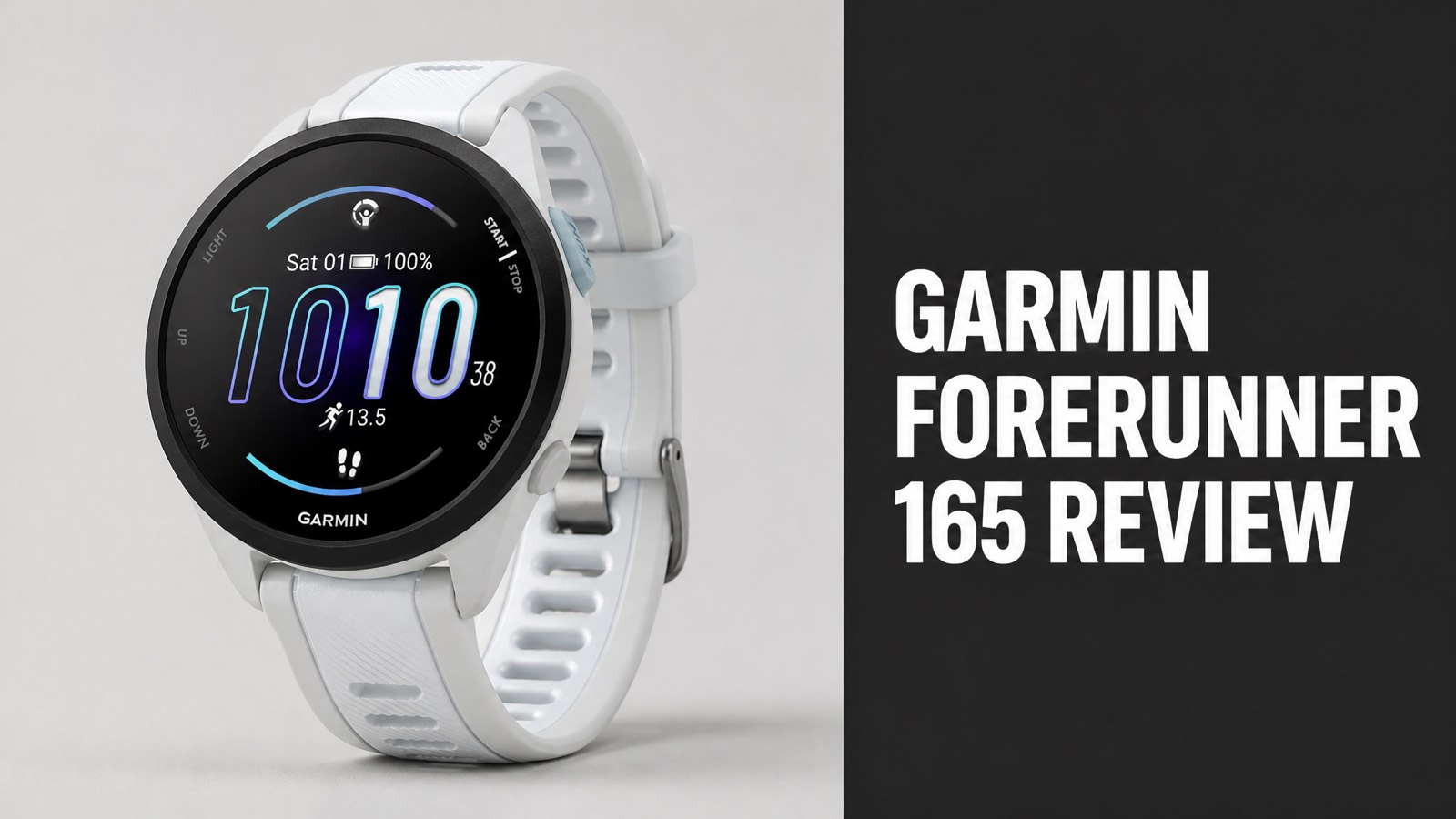
The Garmin Forerunner 165 is an entry-level GPS running watch with a 1.2-inch AMOLED touchscreen. Garmin sells it for $250 as the budget step into the Forerunner line. The watch tracks runs, sleep, and daily recovery. Beginners and intermediate runners are the target audience for this model.
Testers rate the watch highly. The GPS stays accurate on known loops. The heart rate sensor holds steady zones. Battery life runs average at 11 days in smartwatch mode. Reviewers flag missing multisport, maps, and Training Readiness. Value jumps at a $200 street price, so timing matters for budget buyers. Is it a fit for you? The details follow.
The big picture is simple. The Forerunner 165 gives most runners everything useful without flagship costs. The review covers accuracy, battery, rivals, risks, and price. Read on to decide with confidence. Learn which trade-offs matter to you and your training plan.
What Is the Garmin Forerunner 165?
The Garmin Forerunner 165 is an entry-level GPS running watch with a 1.2-inch (30 millimeter) AMOLED touchscreen. Garmin built the model as the budget doorway into the Forerunner line. The watch tracks runs, sleep, and daily recovery. Garmin lists it at $250, and a Music edition adds offline song storage for phone-free runs.
In fact, the 165 sits between the Forerunner 55 and the Forerunner 265, a middle spot in Garmin’s range. Runners get a bright screen and Garmin’s recovery tools. The multi-band GPS of pricier models stays out of reach. The trade keeps the price low.
The case comes in one 43-millimeter (1.7 inch) size. The watch weighs 39 grams (1.4 ounces) and uses a 20-millimeter silicone strap. Its resin build feels light on the wrist, and testers barely notice it during all-day wear.
Key Facts:
- 1.2-inch AMOLED touchscreen, 390 by 390 pixels
- 43-millimeter case, 39 grams (1.4 ounces)
- 11 days smartwatch battery, 19 hours with GPS
- Price of $250 in the US, £249 in the UK
Who Is the Garmin Forerunner 165 For?
The Forerunner 165 suits new and intermediate runners who want accurate tracking at a fair price. Run to the Finish now picks it as an entry-level running watch. Its guidance tools help beginners plan easy days and hard days without guesswork or a coach. Price, screen quality, and ease of use all point beginners toward this model.
Casual fitness fans benefit too. The watch logs sleep, stress, steps, and more than 25 activity types. So, who gets the most from it? Anyone moving from a basic tracker who wants clear data and a screen that reads well outdoors.
How Does the Garmin Forerunner 165 Work?
The Forerunner 165 tracks movement with GPS, a barometric altimeter, a compass, a gyroscope, and an accelerometer. Those sensors feed pace, distance, and elevation to the screen. A wrist optical sensor adds heart rate, breathing rate, and blood oxygen readings. Together, the sensors cover most daily and sport tracking needs.
Onboard Sensors:
- GPS satellite receiver
- Barometric altimeter
- Compass
- Gyroscope and accelerometer
- Elevate V4 optical heart rate sensor
Garmin Connect then turns the raw data into recovery scores. Body Battery rates daily energy from 1 to 100. HRV Status tracks overnight heartbeat variation. Here’s the kicker: one tester saw an HRV drop and realized the watch noticed an illness first.
Navigation uses a touchscreen plus five buttons. Runners can lock the screen mid-run and use buttons alone. The setup works with gloves in winter. The Garmin Connect app pairs smoothly, and Strava uploads happen automatically after each workout.
What Features Does the Garmin Forerunner 165 Have?
The Forerunner 165 packs more than 25 activity profiles, Garmin Pay, and daily suggested workouts. The watch adds Pacing Pro race plans, predicted race times, and Garmin Coach training plans. Users can edit any profile or build custom ones from scratch. Few budget watches offer that range, and the setup menus stay simple even for new users.
Smart features cover the basics. The watch shows text alerts, weather, a morning report, and phone music controls. Find My Phone works too. To be clear, the watch has no microphone. Wrist calls aren’t possible.
The standard edition stores no music. The Music edition adds offline song storage. Runners who hate carrying a phone pick that version. In the UK, the upgrade costs £50 more.
Does the Garmin Forerunner 165 Actually Work?
Yes. The Forerunner 165 delivers reliable tracking and recovery data for everyday runners. Testers at CleverHiker, Run Weekly, and BetterTrail all praise its core tracking. The watch trails premium models in advanced metrics, GPS band support, and battery life. Those gaps matter only to serious racers, so most buyers never feel them in daily use.
Does it demand training know-how? No. Suggested workouts start with base sessions, then adapt to the runner. Strava syncing needs no setup after pairing. Our team at Eat Proteins sees that ease as the biggest win for beginners.
Test Results Summary:
| Area | Verdict | Tester |
|---|---|---|
| GPS accuracy | Exceptional on known loops | CleverHiker |
| Heart rate | Solid for steady runs | Run Weekly |
| Display | Bright and readable in sun | Run Weekly |
| Battery | Middle of the road | CleverHiker |
Is the Garmin Forerunner 165 GPS Accurate?
Yes. The Forerunner 165 tracks distance within a few hundredths of a mile on a known loop. CleverHiker measured it slightly short or slightly long, never far off. The gap stays well under 100 meters (328 feet) on a typical loop. Wobble appeared only under very dense tree cover, and open roads stayed clean. Expect dependable splits on most routes.
The watch lacks multi-band GPS. On trails, Run to the Finish saw slightly different distance and elevation against a Forerunner 265. The difference was minor. Run Weekly also noted slow satellite lock in New York City.
Users pick the satellite mode. Options include off, GPS only, all systems, and UltraTrac. CleverHiker mostly runs GPS only or UltraTrac. The blend keeps accuracy high and protects battery life.
Is the Garmin Forerunner 165 Heart Rate Sensor Accurate?
Yes. The optical sensor holds heart rate zones consistently during steady-state runs. Run Weekly describes it as reasonably accurate for most activities. Heart rate zones stay steady, which helps runners who train by effort. The watch logs breathing rate, blood oxygen, and resting heart rate trends all day.
Fast intensity changes are the weak spot. Wrist sensors lag during intervals. Is that a deal breaker? Not really. Run Weekly suggests pairing a Polar H10 chest strap for interval sessions, which is normal advice for any wrist monitor.
Conditions matter too. Run to the Finish tested at 60 degrees Fahrenheit (16 degrees Celsius) on lighter skin, which favors accuracy. Sleep and heart data matched a Coros watch and an Oura Ring in Run Weekly’s tests.
How Long Does the Garmin Forerunner 165 Battery Last?
Garmin rates the Forerunner 165 for 11 days in smartwatch mode and 19 hours with GPS active. Always-on display mode drops that to about 4 days. The bright AMOLED screen drives the shorter life compared with older Garmin watches. Run to the Finish accepts that trade for the display, and daily charging habits adjust quickly after the first week.
Rivals last longer. In one side-by-side test, a Coros Pace 4 still held 38 percent charge when the Forerunner died. The Coros Apex 4 reaches 24 days in smartwatch mode. By comparison, the 165 feels average.
Battery saver mode and do-not-disturb stretch the charge. Run to the Finish notes the 165 lasts about 3 days less than the Forerunner 55. The life covers daily training. Ultras and multi-day trips need more.
What Do Garmin Forerunner 165 Reviews Say?
Reviews of the Forerunner 165 land mostly positive, with 4.5 out of 5 ratings from CleverHiker and BetterTrail. Experts praise the AMOLED screen, recovery tools, and clean interface. Criticism targets battery life, materials, and missing premium metrics. Those flaws rarely sink the verdict. Most testers still recommend the watch.
The pattern repeats across sources. Reviewers love the value and the polish. They accept the compromises because the watch costs far less than flagships. And the compromises are real, so read the pros and cons below before buying.
Reviewer Verdict:
| Pros | Cons |
|---|---|
| Bright AMOLED display | Below-average battery life |
| Accurate GPS tracking | Basic, scratch-prone materials |
| Polished recovery tools | No multisport or topo maps |
What Do Users Like About the Garmin Forerunner 165?
Testers love the bright AMOLED display and the polished Garmin Connect ecosystem. The combination feels premium. Run to the Finish says the screen alone justifies the extra $50 over the Forerunner 55. Run Weekly found it readable in midday sun without squinting. Colors look vivid, and text stays sharp at a glance during runs and workouts.
Comfort earns praise too. The buttons sit low on the case, and the 39-gram body vanishes on the wrist. Here’s the thing: the five-button layout works in rain and with gloves. BetterTrail rates the user experience 4.5 out of 5.
The recovery suite stands out for the price. Body Battery and HRV Status give daily guidance. Testers also like Garmin Pay, text alerts, and automatic Strava syncing.
What Are the Common Complaints About the Garmin Forerunner 165?
Complaints center on battery life, build materials, and missing features. BetterTrail scores quality and durability only 2.5 out of 5. The glass lens and fiber-reinforced polymer bezel scratch more easily than titanium or sapphire parts on pricier watches. Budget materials keep the price low but wear faster.
Feature gaps follow. The watch has no topographic maps, only breadcrumb navigation. The model offers no multisport mode, so triathletes can’t log several sports in one session. The Training Readiness score is also missing.
Size is the last gripe. The 43-millimeter case comes in one option only. The case suits small and medium wrists. Larger wrists may find it compact, and Run to the Finish prefers the bigger 265 strap.
How Does the Garmin Forerunner 165 Compare to Rivals?
The Forerunner 165 trades battery life for smart features against the Coros Pace 3. The Pace 3 lasts longer, costs slightly less, and offers fewer smartwatch extras. CleverHiker calls it a great entry-level watch, so the choice is close. Garmin wins on ecosystem and screen quality, and the smart tools add daily value for everyday wear beyond running.
The Forerunner 265 sits one tier up. The 265 adds multi-band GPS, Training Readiness, and a larger case. The price jump is steep, though. Run to the Finish still uses a 265 daily, but admits the 165 covers most beginner needs.
Rival Comparison:
| Watch | Best For | Trade-Off |
|---|---|---|
| Coros Pace 3 | Long battery life | Fewer smart features |
| Forerunner 265 | Extra GPS accuracy | Higher price |
| Apple Watch SE | iPhone users | Shorter battery, lighter training |
The Apple Watch SE suits iPhone users who want a smartwatch first. The Apple model offers richer apps. By comparison, battery life is shorter, and training depth is lighter than Garmin’s.
Is the Garmin Forerunner 165 Better Than the Forerunner 55?
Yes. The Forerunner 165 upgrades the Forerunner 55 with an AMOLED screen, a barometric altimeter, and better GPS. Run to the Finish now recommends the 165 as the entry-level pick over the older model. The brighter display is the headline change. Daily use feels noticeably more modern, and sunlight readability improves a lot.
The altimeter delivers real value. The sensor reports total ascent and descent, so a hilly 4-mile (6.4 kilometer) run reads differently from a flat one. Basic breadcrumb maps arrive too, though reviewers call them limited.
The upgrade costs about $50 more. The battery drops by roughly 3 days. Is that fair? Run to the Finish says the screen alone makes the trade worth it.
Who Should Avoid the Garmin Forerunner 165?
Triathletes, ultra runners, and backcountry hikers need a different watch than the Forerunner 165. The watch skips multisport profiles. Its 19-hour GPS limit ends long events early. Breadcrumb navigation can’t replace real topographic maps in remote terrain. Those gaps are structural, not fixable with settings.
Skip It If You Need:
- Multisport tracking for triathlons
- Topographic maps for backcountry routes
- More than 19 hours of GPS battery
- Multi-band GPS for dense cities
Runners who live in dense cities or deep canyons also look elsewhere. Single-band GPS wobbles under heavy cover and tall buildings. And the wrist sensor lags in interval sessions. So, who else skips it? Anyone who needs chest-strap precision from the watch alone.
Buyers who want premium materials look higher. The Forerunner 970 and Coros Apex 4 use titanium or sapphire crystal. The 165 uses glass and polymer. The choice keeps weight and price down.
Is the Garmin Forerunner 165 Legit?
Yes. The Forerunner 165 is a genuine Garmin product sold by Garmin, REI, and Amazon. Run to the Finish advises buying direct from Garmin for the warranty and return rights. REI offers an excellent return policy as the next best option. Both routes protect the buyer if the watch disappoints after a few weeks of real use.
Independent testers back the claims. CleverHiker states it accepts no manufacturer payments and drains each watch repeatedly in testing. Multiple outlets reached the same conclusion on GPS and display quality.
One caution applies. Wrist-based estimates such as VO2 Max and predicted race times run optimistic. Run to the Finish urges readers to treat them as rough benchmarks.
How Much Does the Garmin Forerunner 165 Cost?
The Garmin Forerunner 165 costs $250 in the United States and £249 in the United Kingdom. The Music edition costs £299 in the UK. Retail discounts appear regularly. BetterTrail says a $200 price makes the watch far more compelling than the $250 list price. Patient buyers often save, and sale events make a clear difference for budget shoppers.
Value depends on your priorities. Run Weekly calls £249 really good value for the features. BetterTrail notes the Coros Pace 4 offers nearly twice the battery at the same price. Smart features tip the balance toward Garmin.
Price By Version:
| Version | Price | Market |
|---|---|---|
| Standard | $250 | United States |
| Standard | £249 | United Kingdom |
| Music | £299 | United Kingdom |
Is the Garmin Forerunner 165 Worth the Price?
Yes. The Forerunner 165 offers strong value for runners who want smart features and a bright screen at a fair price. Run Weekly calls it really good value at £249. BetterTrail finds it far more attractive when discounted to $200 (about £160). Both views point to the same buying advice: watch for sales and compare retailers before checkout.
The bottom line? Match the watch to your needs. Casual and beginner runners get everything useful. Endurance athletes pay for features they’ll never use and miss the ones they need.
Where Can You Buy the Garmin Forerunner 165?
Buyers can purchase the Forerunner 165 from Garmin, REI, Amazon, and other major retailers. Garmin’s own store carries the full warranty and straightforward returns. Run to the Finish lists direct purchase as the first recommendation for that reason. Direct buyers also see every color and strap option, plus current promotions in one place.
REI is the next best choice. The retailer is known for an incredible return policy. Compare current prices across all three stores before checkout. Discounts to $200 appear periodically, and they change the value picture.
Is Eat Proteins Worth It?
Yes. Eat Proteins delivers honest, source-checked reviews before you spend a single cent on gear. Our team at Eat Proteins reads the tests, compares the claims, and flags every trade-off. You get the verdict without wading through ten tabs. Honest reviews save you money and time, and they keep you away from gear that overpromises on features.
You came to decide on a watch. Now you know the trade-offs. Don’t let the next discount slip by. Check today’s price and grab the Forerunner 165 while the deal lasts.
What Is the Eat Proteins Verdict on the Forerunner 165?
Our experts at Eat Proteins rate the Forerunner 165 a top pick for beginners and casual runners. The AMOLED screen, accurate GPS, and recovery tools beat most watches near this price. Bottom line: buy it at $200 or less, and skip the full $250 unless you need it today. Patience pays, and the sales do come.
Skip it only for triathlon, ultra distances, or backcountry navigation. Everyone else gets a polished, capable watch. Ready to upgrade your wrist? Start with the Forerunner 165.