
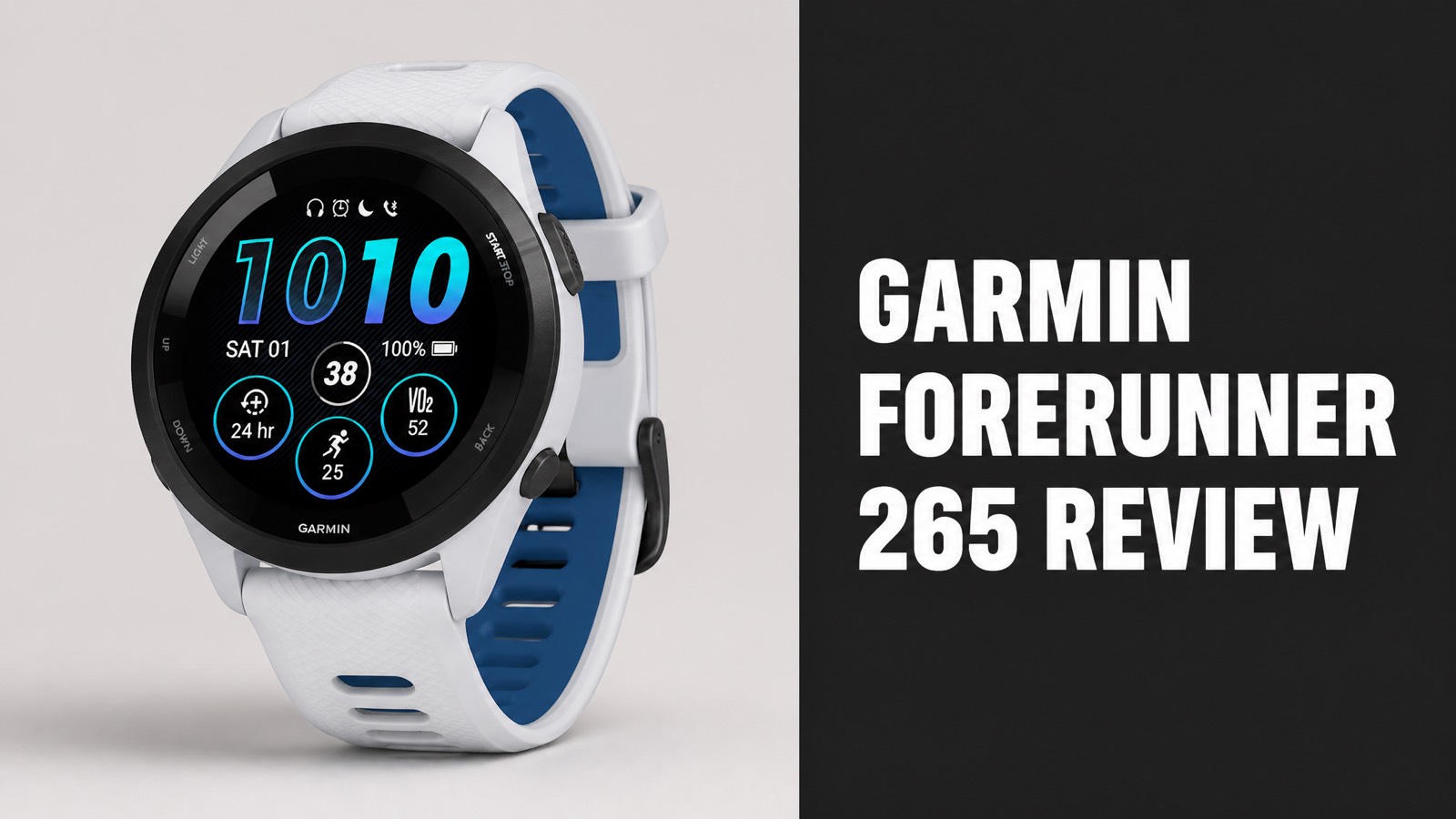
The Garmin Forerunner 265 is a mid-range GPS running watch that Garmin launched in March 2023. It pairs an AMOLED touchscreen with dual-frequency GPS and detailed recovery tracking. Runners use it to train, sleep better, and wear one watch all day. Testers rank it among the best Garmin watches for runners.
Reviewers praise its accuracy, interface, and daily coaching and recovery tools. The watch launched at 449 dollars, but street prices have dropped. Battery life reaches 13 days as a smartwatch and 20 hours in GPS mode. Rivals like the Coros Pace 4 last longer, yet Garmin’s analytics remain richer. Complaints cover the plastic build and missing maps.
Our experts at Eat Proteins reviewed the research so you don’t have to. Read on to learn the features, real battery life, rival matchups, and pricing. By the end, you’ll know whether this watch fits your goals and budget. Whether you run marathons or walk daily, the verdict matters.
What Is the Garmin Forerunner 265?
The Garmin Forerunner 265 is a mid-range GPS running watch with a bright AMOLED touchscreen. Garmin launched it in March 2023 as the successor to the Forerunner 255. The watch tracks runs, sleep, stress, and recovery in one place. Reviewers call it a benchmark for runners who want deep coaching data. Many runners pick it as their first serious Garmin watch.
Here’s the quick picture. The watch comes in a 46 mm size and a smaller 42 mm 265S version. The larger model weighs 47 grams (1.7 ounces). Our experts at Eat Proteins like that it’s light enough to wear all day.
Quick Specs:
| Spec | Detail |
|---|---|
| Launch date | March 2023 |
| Case size | 46 mm (1.8 inches) or 42 mm (1.7 inches) |
| Weight | 47 g (1.7 oz) or 39 g (1.4 oz) |
| Water rating | 5 ATM (50 meters or 164 feet) |
Who Is the Forerunner 265 Built For?
The Forerunner 265 fits runners who want serious training data without flagship pricing. Garage Gym Reviews named it best for runners among Garmin trackers. Marathon and 10K runners get the most from its coaching tools. Casual walkers get plenty of value too. Triathletes also like it as a cheaper, lighter Fenix alternative, with solid swim and bike modes.
Who should look elsewhere? Trail runners who depend on navigation. The watch offers breadcrumb routes but no topographic maps. Runningshoesguru also calls its compass temperamental. Those runners should look at the Forerunner 965 or a Fenix.
What Features Does the Garmin Forerunner 265 Have?
The Garmin Forerunner 265 packs dual-frequency GPS, an AMOLED screen, and Garmin’s full coaching suite into a light case. It also adds heart rate tracking, sleep scoring, and built-in music storage. Over 30 activity profiles cover running, cycling, swimming, triathlon, skiing, and Pilates. The result is a true multisport tool. Garmin Pay is onboard.
Look at the training side. Training Status reviews four weeks of load. Daily Suggested Workouts match sessions to recovery. Race Predictor estimates finish times from VO2 max. PacePro builds a pacing plan for race day, segment by segment.
Key Features:
- Dual-frequency L1/L5 GPS
- 1.3 inch AMOLED touchscreen
- Training Status and Daily Suggested Workouts
- Race Predictor and PacePro pacing plans
- Built-in music storage
- Morning Report with sleep and readiness data
How Good Is the AMOLED Display?
The 46 mm model uses a 1.3 inch (33 mm) AMOLED screen with 416 x 416 pixels. Gorilla Glass 3 covers the display. RunMorph reports peak brightness of 1,000 nits. Colors look rich, and the layout stays easy to read during hard efforts. Colors pop, menus respond fast, and the screen stays readable mid-run. It’s a clear upgrade over the Forerunner 255.
There’s one catch. Runningshoesguru found the screen harder to read in bright sun when the backlight is off. Why does that matter? Always-on mode and raised brightness settings fix most of it. The smaller 265S uses a 1.1 inch (28 mm) panel.
How Accurate Is the GPS?
The Forerunner 265 delivers fast, clean tracking thanks to dual-frequency L1/L5 GPS. RunMorph reports satellite lock in under 10 seconds in most conditions. Tracks stay tidy in dense forest and between tall buildings. Pace readings hold steady without the wild swings of entry-level watches. On track intervals, the first lap marker matches the true distance.
Business Insider calls Garmin’s GPS and wrist heart rate sensor among the most accurate on the market. Here’s the thing: optical heart rate isn’t perfect. RunMorph notes room for improvement at high intensity. A chest strap fixes that for interval work.
What Are the Benefits of the Garmin Forerunner 265?
The Forerunner 265 turns raw body data into clear daily guidance. Every morning, the Morning Report summarizes sleep, readiness, weather, and goals. Body Battery and stress monitoring show how much energy remains. Heart rate variability (HRV) flags early overtraining. Reviewers say the data actually helps them train. Each insight arrives in plain words.
Let me explain why that matters. Most trackers drown users in numbers. Garmin ranks the numbers and says what to do next. The Independent’s tester called it the one wearable she’d wear full time.
Main Benefits:
- Daily Morning Report with readiness insights
- Body Battery and stress monitoring
- HRV-based overtraining alerts
- Structured Garmin Coach plans
- Light case for all-day wear
Does the Forerunner 265 Actually Improve Training?
Yes. The Forerunner 265 gives runners objective load and recovery feedback that guesswork can’t match. Training Status shows whether fitness is building, holding, or slipping. Race Predictor updates as VO2 max changes. Garmin Coach adapts plans for 5K, 10K, half marathon, and marathon goals. Runners also get a clear signal about exactly when to rest.
There’s one gap. Runningshoesguru found the built-in plans thin and suggested importing third-party plans. Does that break the deal? Not really. Garmin Connect accepts outside workouts, so serious runners can load a favorite plan and still get live guidance.
What Do Garmin Forerunner 265 Reviews Say?
Reviews for the Forerunner 265 are strongly positive across expert and user sources. RunMorph scored it 8.5 out of 10. Business Insider named it the best all-around running watch for most active people. Garage Gym Reviews rated it among the best fitness watches it has tested. Few mid-range watches earn that level of consensus from many independent testers.
Praise clusters around accuracy, interface, and recovery insights. Complaints cluster around battery life, plastic build, and price. Let’s break both sides down.
Review Scores and Verdicts:
| Source | Verdict |
|---|---|
| RunMorph | 8.5 out of 10 |
| Business Insider | Best all-around running watch |
| Garage Gym Reviews | Best for runners |
| The Independent | Excellent training partner |
What Do Users Like About It?
Reviewers love the clean interface, accurate tracking, and useful recovery metrics. Business Insider found the default screens showed steps, sleep, recovery, and heart rate without tweaking. The Independent praised the Morning Report. RunMorph rated its interface 8.8 out of 10. Comfort scores high too, because the silicone band is soft and the case is slim.
What’s more, the watch looks like a normal smartwatch. Testers wore it to sleep and to work. Several said it’s the first running watch they’d keep on all day.
What Are the Common Complaints?
The most common complaints target the plastic build, price, and short GPS battery life versus rivals. Runningshoesguru said the watch looks cheap and scratches easily. Garage Gym Reviews listed the lack of wireless charging. Others dislike the proprietary charging cable. Casual buyers rarely notice these flaws day to day. Some call the compass unreliable.
Heart rate has limits too. The sensor can’t read through a tattoo. Is that a dealbreaker? Only for heavily inked wrists, and a chest strap solves it. A screen protector also helps with scratches.
How Does the Garmin Forerunner 265 Compare to Rivals?
The Forerunner 265 wins on coaching depth but loses on GPS battery life. The Coros Pace 4 lasts about 41 hours in GPS mode versus 20 hours for Garmin. Suunto and Polar rivals cost more. Garmin’s ecosystem remains the richest of the group. Both rivals use AMOLED screens and dual-frequency GPS. Garmin weighs 47 grams (1.7 ounces), Coros 32 grams (1.1 ounces).
Here’s what that means in plain English. Pick Garmin for analytics and polish. Pick Coros for endurance and value. The newer Forerunner 570 adds features at a higher price.
GPS Watch Comparison:
| Watch | GPS Battery | Weight | Price |
|---|---|---|---|
| Forerunner 265 | 20 h | 47 g (1.7 oz) | Around 299 euros |
| Coros Pace 4 | 41 h | 32 g (1.1 oz) | Around 270 euros |
| Suunto Race 2 | 40 h | 50 g (1.8 oz) | Around 499 euros |
| Forerunner 570 | 26 h | 47 g (1.7 oz) | Around 399 euros |
Forerunner 265 vs Forerunner 965: Which Is Better?
The Forerunner 965 adds maps, a titanium bezel, and longer battery life for about 150 dollars more. Garage Gym Reviews lists the 265 at 449 dollars and the 965 at 599 dollars. The 965 is also slightly larger. Both share the core coaching tools. The two share the same screen quality and core sensors. Most runners never need the extras, and the savings add up.
So which wins? It depends on the route. Trail runners and ultra athletes need the maps. Road runners and gym-goers rarely do. For them, the 265 delivers nearly the same training value.
How Long Does the Garmin Forerunner 265 Battery Last?
The Forerunner 265 lasts up to 13 days as a smartwatch and about 20 hours in standard GPS mode. RunMorph saw 8 to 9 days of real use with daily 60 to 90 minute runs. High-accuracy dual-frequency GPS cuts runtime to about 8 hours. That covers a half marathon. That’s strong for an AMOLED watch. Always-on mode shortens it, so expect less with the screen lit.
Charging is quick. Fifteen minutes adds roughly 15 percent. A full hour reaches 100 percent. The watch uses a proprietary cable, so pack it for trips.
Battery Life by Mode:
| Mode | Runtime |
|---|---|
| Smartwatch mode | Up to 13 days |
| Standard GPS | About 20 hours |
| Dual-frequency GPS | About 8 hours |
| Real-world daily use | 8 to 9 days |
Is the Battery Enough for a Marathon?
Yes. The Forerunner 265 easily covers a marathon in standard GPS mode. Even slow runners finishing in six hours use only a third of the 20-hour rating. Dual-frequency mode also covers most marathon times at 8 hours. Ultra distances are a different story. Most runners finish a marathon with plenty of charge left. Top up the night before to be safe, always.
Here’s the part most people miss. Ultra runners need UltraTrack mode, which logs one fix per minute. Accuracy dips on tight turns. Otherwise, the Coros Pace 4 or a Fenix suits 50K-plus events better.
How Much Does the Garmin Forerunner 265 Cost?
The Forerunner 265 launched at an MSRP of 449 dollars. Garage Gym Reviews and Runningshoesguru both cite that price. Street prices have fallen since the Forerunner 570 arrived. RunMorph puts typical prices at 250 to 320 euros in 2026. Spring sales and Black Friday deals bring that number down for patient buyers. Both the 46 mm and 42 mm models qualify.
Prices swing through the year. Black Friday and holiday sales often take real money off. Check Garmin’s site and major retailers before you buy. Both the 46 mm and 42 mm models share the same list price.
Price Snapshot:
| Model | Price |
|---|---|
| Forerunner 265 (launch MSRP) | 449 dollars |
| Forerunner 265 (2026 street price) | 250 to 320 euros |
| Forerunner 965 (launch MSRP) | 599 dollars |
Is the Forerunner 265 Worth the Price?
Yes. The Forerunner 265 is worth buying at its current street price. RunMorph calls it hard to beat for value on a previous-generation model. The coaching suite alone rivals watches costing twice as much. A discount makes the case stronger. Few watches offer this much coaching depth for the money. Buyers get a long-term training partner for a fair price.
At full 449 dollars, the answer shifts. The Forerunner 570 may offer more for the money. Bottom line: wait for a sale. Our team at Eat Proteins sees steady dips every few months.
Should You Try Eat Proteins?
Yes. A great watch shows your numbers. Eat Proteins helps you fuel those numbers with the right protein. Smart recovery needs smart nutrition. Pair your Forerunner 265 data with Eat Proteins guides and build a plan that actually works. Don’t leave progress on the table. Browse our protein reviews today, compare your options, and see the difference.
Ready to run faster and recover better? Explore Eat Proteins today. Your next personal best starts with what’s on your plate. Start now and let the data prove it.
How Does Eat Proteins Support Runners?
Eat Proteins gives runners clear, research-backed protein guidance for training and recovery. Our experts review products and break down what matters. You get honest reviews like this one, written for real buyers. Better fuel supports the recovery your watch measures. We update every article often, so check back for new reviews, comparisons, and tips.
Think of it this way: the watch tracks effort and Eat Proteins covers the refuel. Read our other reviews and match your protein to your goals. Your Body Battery will thank you.