
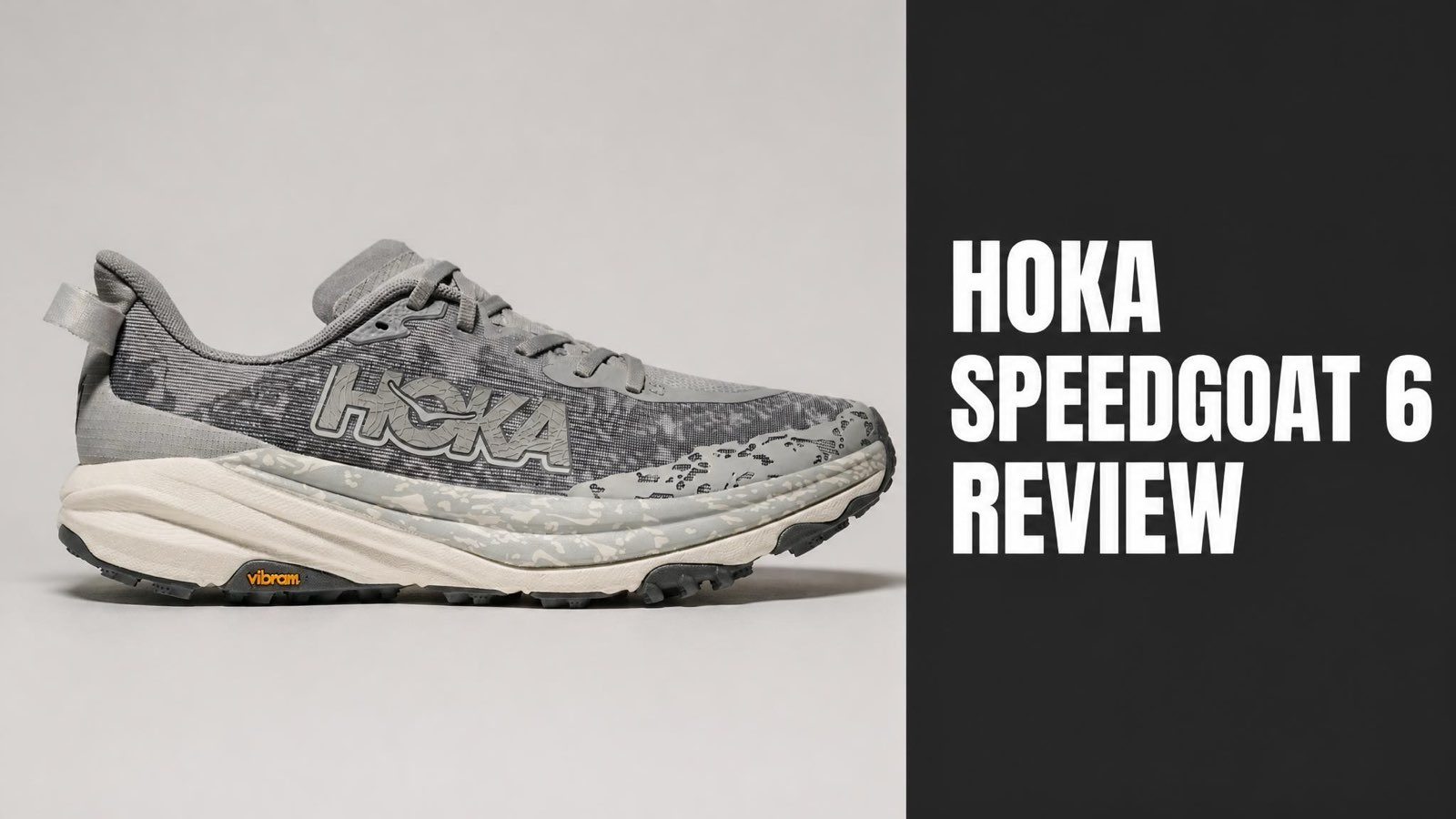
The Hoka Speedgoat 6 is a max-cushioned trail running shoe for technical terrain and long days. It’s named after ultrarunner Karl Meltzer and launched in mid-2024. It retails for $155 and comes in regular and wide widths. Runners and hikers use it for mountain miles, ultras, and fast-and-light trips.
This version adds a taller 40 mm heel, a firmer CMEVA midsole, and a woven upper with an internal cage. Grip comes from a Vibram Megagrip outsole with Traction Lugs. Testers praise its stability, lockdown, and sticky traction on rocky trails. But many find the ride firm, the tongue short, and the toe box snug. So does it still earn the GOAT name?
Here’s the big picture. The Speedgoat 6 is a reliable workhorse, not a plush cruiser. That’s good news for rough trails and long climbs. Below, you’ll learn how the shoe works and how it fits. You’ll also see what reviewers say, how it compares to rivals, and whether it’s worth the money.
What Is the Hoka Speedgoat 6?
The Hoka Speedgoat 6 is a neutral, max-cushioned trail shoe built for technical terrain, long runs, and ultra distances. It retails for $155. Doctors of Running calls it a workhorse that can take a beating. Ian Corless calls the line arguably the best-selling trail shoe in the world. That’s a big reputation to defend. Can the sixth version live up to it?
Where does the name come from? The series honors Karl Meltzer, nicknamed the Speedgoat. WearTesters notes he has won more 100-mile races than any other ultrarunner.
Who is it for? Doctors of Running names trail runners who want a rocker, a secure fit, and lots of cushion. Mountaineer Journey adds that it works as a hiking shoe, too.
What Changed From the Speedgoat 5?
The Speedgoat 6 gains a taller stack, a firmer midsole, a woven upper, an internal cage, and a thicker tongue. Ian Corless reports the stack grew from 33/29 mm to 40/35 mm. The drop rose from 4 mm to 5 mm (0.20 in). Why so many changes? The Speedgoat 5 drew loud complaints about its midsole breaking down far too early. Hoka clearly listened to its fans.
In fact, the upper changed the most. RunningShoesGuru says the old stretchy knit gave way to an engineered woven mesh with zero stretch. It now holds the foot in place.
The tongue and heel improved, too. RunRepeat measured the padded tongue at 5.2 mm, up from 2.3 mm. A finger-loop heel tab finally returns.
Speedgoat 5 vs Speedgoat 6:
| Spec | Speedgoat 5 | Speedgoat 6 |
|---|---|---|
| Stack (brand) | 33 mm / 29 mm | 40 mm / 35 mm |
| Drop | 4 mm (0.16 in) | 5 mm (0.20 in) |
| Weight (men’s) | 10.3 oz (292 g) | 9.8 oz (277 g) |
| Upper | Stretchy knit mesh | Woven mesh with internal cage |
| Tongue padding | 2.3 mm | 5.2 mm |
| Heel tab | None | Finger loop |
How Does the Hoka Speedgoat 6 Work?
The Hoka Speedgoat 6 works by pairing thick CMEVA foam with a Meta-Rocker shape that rolls each step forward. CMEVA stands for compression-molded EVA. RunRepeat notes the midsole has deliberate creases that help the foam compress. The rocker then eases the foot from landing to toe-off with less effort. Simple idea, right? Each stride feels smooth and even.
Here’s the thing about the rocker. RunRepeat says Hoka boosted it slightly in the forefoot. The extra curve offsets the thicker, stiffer midsole.
The foam needs time, though. WearTesters says the midsole softens after 30 to 50 miles (48 to 80 km). Ian Corless felt it settle after about 10 km (6.2 miles).
How the Ride Works:
- The foot lands on the wide CMEVA platform.
- The creased foam compresses to absorb the impact.
- The internal cage and sidewalls hold the foot steady.
- The Meta-Rocker rolls the foot toward a quicker toe-off.
Does the Speedgoat 6 Have a Rock Plate?
No. The Speedgoat 6 has no rock plate and relies on its tall foam stack to block sharp rocks. RunningShoesGuru says the 40 mm (1.57 in) heel and 35 mm (1.38 in) forefoot shield the foot well. The high platform also lifts the toes away from roots and stumps. Does that replace a plate? For most trails, it does. Still, the protection has limits on sharp scree.
The good news? The toe gets extra armor. A small Vibram bumper and welded overlays cover the toebox. WearTesters says the toecap saved them from many rock hits.
Not every tester agrees. BetterTrail rated foot protection just 1.5 out of 5. Its testers felt side impacts on talus and scree.
What Are the Key Features of the Speedgoat 6?
The Speedgoat 6 features a 40 mm heel, a 5 mm drop, a woven upper, and a Vibram Megagrip outsole. Hoka lists the men’s weight at 9.8 oz (277 g). The women’s model weighs 8.2 oz (232 g). RunRepeat confirmed 9.8 oz (278 g) on its own lab scale. That’s impressively light for a max-stack trail shoe, isn’t it? It also comes in a wide fit and a GTX model.
The outsole uses Vibram’s Traction Lugs. These are tiny raised dots on each lug. RunRepeat says they add grip on sharp turns and steep inclines.
The insole is removable and perforated. RunRepeat says it lets heat escape. The shoe is also orthotic friendly and has a reflective Speedgoat logo on the heel.
Hoka Speedgoat 6 Specs:
| Feature | Detail |
|---|---|
| Weight (men’s) | 9.8 oz (277 g) |
| Weight (women’s) | 8.2 oz (232 g) |
| Stack (men’s) | 40 mm (1.57 in) heel, 35 mm (1.38 in) forefoot |
| Stack (women’s) | 38 mm (1.50 in) heel, 33 mm (1.30 in) forefoot |
| Drop | 5 mm (0.20 in) |
| Midsole | CMEVA foam, no plate |
| Outsole | Vibram Megagrip with Traction Lugs |
| Widths | Regular (D) and Wide (2E) |
How Does the Speedgoat 6 Fit?
The Speedgoat 6 fits snug and secure, with a narrow midfoot and a toe box that tapers toward the front. RunRepeat users say it runs slightly small. Doctors of Running found it true to size with lower volume than past models. RunRepeat measured the toe box at 73.0 mm (2.87 in), just under average. So who should size up or go wide? Read on for the details.
Wide feet need the wide version. Hoka sells a 2E width. WearTesters says the midfoot narrows on purpose to improve lockdown.
Feedback varies by foot. RunningShoesGuru felt pinching and got blisters on long runs. BetterTrail testers found the toe box roomy and warned against sizing up.
What Are the Benefits of the Speedgoat 6?
The Speedgoat 6 delivers strong grip, high stability, a tougher upper, and protective cushion for long trail days. Doctors of Running gave it an A for stability. RunRepeat says the midsole kept its feel better than the Speedgoat 5’s. The shoe stays under 10 oz (283 g) despite all the extra foam. What’s the real headline for buyers here? It’s durability.
Short answer: durability came back. RunningShoesGuru says the midsole felt fresh after nearly 100 miles (161 km). The Speedgoat 5 often faded near the 100-mile mark.
The shoe also covers many uses. Doctors of Running calls it a road-to-trail option. Mountaineer Journey wears it for hiking and running alike.
Main Benefits:
- Vibram Megagrip traction on rock, mud, and gravel
- Wide, stable platform for technical terrain
- Locked-in fit from the internal midfoot cage
- Durable woven upper that resists tears
- Light weight for a max-cushioned shoe
Does the Speedgoat 6 Have Good Traction?
Yes. The Speedgoat 6 has excellent traction from its Vibram Megagrip outsole and deep multidirectional lugs. Mountaineer Journey rated traction 8.5 out of 10. Its tester climbed 300 feet (91 m) in heavy rain without slipping once. WearTesters calls the grip elite and top tier. How deep are the lugs? Hoka lists 5 mm (0.20 in). That’s deep enough for mud.
What’s more, lab data backs this up. RunRepeat measured 4.0 mm (0.16 in) lugs. That beats the 3.5 mm average for trail shoes.
There are limits. BetterTrail says exposed foam down the center hurts grip on steep rock. Ian Corless still isn’t confident on wet rock.
Is the Speedgoat 6 Stable?
Yes. The Speedgoat 6 is very stable for a max-stack shoe, thanks to its wide base, stiff chassis, and secure upper. RunRepeat scored its torsional rigidity 5 out of 5 without a plate. The forefoot platform measures 117.7 mm (4.63 in) wide. Doctors of Running calls it hard to beat at this stack height. Who benefits most? Runners on technical descents.
WearTesters felt fully stable through a 28 km race. The course crossed snow and loose rock with 6,500 feet (1,981 m) of climbing.
To be clear, BetterTrail disagrees off-trail. Its testers found the tall stack tippy on talus and boulder fields.
What Do Hoka Speedgoat 6 Reviews Say?
Hoka Speedgoat 6 reviews praise its grip, stability, and durability but criticize its firm ride, short tongue, and limited airflow. RunRepeat scored it 84 out of 100. Mountaineer Journey gave it 7.9 out of 10. BetterTrail rated it 3.6 out of 5 for hiking. Doctors of Running gave it an A- overall. Mixed? A little, but mostly positive. Most testers like it.
Think of it this way: many reviewers call it a reliable workhorse. WearTesters describes it as a blue-collar trail shoe. It’s not flashy, but it gets the job done.
Speedgoat fans see a return to form. Ian Corless quotes early reactions like ‘The King is Back!’ from the trail community.
What Do Runners Like?
Runners like the confident grip, the locked-in fit, and the stable ride on rough trails. Doctors of Running called it possibly the best Speedgoat to date. The tester felt more connected to the ground than in past versions. RunningShoesGuru praised its control at quicker paces. Does the lockdown really matter? On descents, absolutely. It builds confidence.
CleverHiker liked the comfort on steep Tahoe trails. Its testers said their feet felt protected after long days.
WearTesters expects about 400 miles (644 km) of life. That’s solid for a trail shoe at this price.
Pros:
- Outstanding Vibram Megagrip traction
- Secure midfoot lockdown
- High stability on technical terrain
- More durable upper and midsole
- Light for its cushion level
What Are the Common Complaints?
The most common complaints involve a firm, stiff ride out of the box, a short tongue, and poor breathability. WearTesters calls the break-in period an honest effort of about 50 miles (80 km). Several testers say the tongue is too short for comfortable lacing. RunRepeat gave airflow just 2 out of 5. Why so warm? The mesh is dense. It traps heat in summer.
The bad news? Energy return is low. RunRepeat measured 53.5% in the forefoot. The trail shoe average is 59.7%.
Durability reports vary. BetterTrail heard of pairs lasting just 150 to 200 trail miles (241 to 322 km).
Cons:
- Firm and stiff until broken in
- Short tongue causes lace pressure
- Poor breathability in hot weather
- Low energy return for racing
- Narrow toe box for wide feet
How Does the Speedgoat 6 Compare to Rivals?
The Speedgoat 6 offers better stability and traction than most max-cushioned rivals but less softness and bounce. RunRepeat says the Nike Zegama 2 gives springier foam and better airflow. BetterTrail favors the La Sportiva Prodigio Max for durability and grip. The Hoka Stinson 7 adds plush cushion and max comfort. So which is right for you? It depends.
By comparison, the Prodigio Max costs more at $185. But BetterTrail says it held up far better on rocky backpacking trips.
The Topo Athletic Traverse matches the $155 price. BetterTrail’s tester got 650 miles (1,046 km) from it.
Speedgoat 6 vs Competitors:
| Shoe | Price | Drop | Best For |
|---|---|---|---|
| Hoka Speedgoat 6 | $155 | 5 mm | Stable, grippy trail miles |
| La Sportiva Prodigio Max | $185 | Not listed | Durability and rocky terrain |
| Topo Athletic Traverse | $155 | Not listed | Thru-hiking with a rock plate |
| Altra Lone Peak 9 | $145 | 0 mm | Wide feet on easy trails |
Is the Speedgoat 6 Better Than the Altra Lone Peak 9?
Yes. The Speedgoat 6 is the better pick for most trail users, though the Lone Peak 9 suits wide feet better. BetterTrail gives the edge to the Speedgoat. The Lone Peak 9 has a zero-drop design and a 25 mm (0.98 in) stack. The Speedgoat sits at 40 mm (1.57 in). Which feels more precise? The Speedgoat does, especially on uneven ground. Grip also helps.
The Lone Peak has real perks. It costs $145 and has a much wider toe box. BetterTrail calls it as comfortable as a slipper.
Bottom line: grip favors Hoka. BetterTrail says the Lone Peak’s MaxTrac outsole lacks bite on rock.
Who Should Avoid the Hoka Speedgoat 6?
Wide-footed runners, soft-ride fans, and hot-weather racers should consider other shoes before buying the Speedgoat 6. RunRepeat says the tapered toe box rules out square-shaped feet. Mountaineer Journey says skip it if you want a plush footbed. Racers who want bounce will find the foam flat and dull. So who else should pass on it? Read on to find out.
Road runners should look elsewhere. Mountaineer Journey notes that pavement wears down the Vibram outsole faster.
Off-trail hikers need more armor. BetterTrail says the upper leaves feet exposed on scree and talus.
Is the Speedgoat 6 Durable?
Yes. The Speedgoat 6 is more durable than the Speedgoat 5, with a tougher upper and a longer-lasting midsole. RunRepeat scored toebox and heel durability 4 out of 5. Mountaineer Journey saw minimal lug wear after 90 miles (145 km). WearTesters expects around 400 miles (644 km) of use. Any weak spots? Yes, the outsole rubber wears faster. Watch it closely.
RunRepeat found a 1.4 mm dent in its outsole wear test. The trail shoe average is 0.9 mm.
Here’s the part most people miss. Hoka added thicker rubber to compensate. The outsole measures 3.1 mm (0.12 in), well above the 1.9 mm average.
How Much Does the Hoka Speedgoat 6 Cost?
The Hoka Speedgoat 6 costs $155 at full retail, though discounts now bring it well below that price. Running Warehouse lists it at $154.95. Mountaineer Journey found it for as low as $123 on Hoka.com. RunningShoesGuru tracked Amazon prices from $134.94 for men. Why the drop in price? Hoka has since released the Speedgoat 7. Older stock is now on sale.
And it gets better. Women’s pairs fall even lower. RunningShoesGuru spotted them from $99.95 on Amazon. That’s 35% off list price.
A waterproof GORE-TEX version is also available. Mountaineer Journey notes it suits wet, cold conditions.
Where to Buy:
- Hoka.com, from $123 on sale
- Running Warehouse, $154.95
- Amazon, from $99.95 (women’s) and $134.94 (men’s)
Is the Speedgoat 6 Worth the Price?
Yes. The Speedgoat 6 is worth the price for trail runners who value grip, stability, and durability over softness. Doctors of Running gave it an A for value at $155. WearTesters says the updates make it worth the price again. Sale prices make it an even better deal today. Is there a catch? Only if you want plush, soft cushion underfoot. Most won’t.
Mountaineer Journey scored its value 4 out of 5. The tester called versatility and price its biggest strengths.
BetterTrail is less sold. Its testers say dedicated hiking shoes last longer for the money.
Should You Try Eat Proteins?
Yes. Eat Proteins helps trail runners fuel long miles with simple, practical protein guidance. Big climbs and ultra days put real stress on your muscles. Good shoes protect your feet on every descent. Smart protein habits help your legs recover faster. Why not get both right? The right gear and the right fuel work best together. Ready to start today?
Our team at Eat Proteins shares easy protein ideas for active people. You get practical tips you can use this week.
How Can Eat Proteins Help Your Trail Training?
Eat Proteins gives you clear advice on protein timing, recovery meals, and fueling for long runs. Our experts break down what to eat before and after big efforts. You’ll find easy recipes, meal ideas, and honest product reviews. Want the best part? It’s all built for busy runners and hikers. Start with our recovery guides and simple protein tips today.
Don’t let poor recovery slow your next trail day. Join the Eat Proteins community and get your fueling dialed in.