
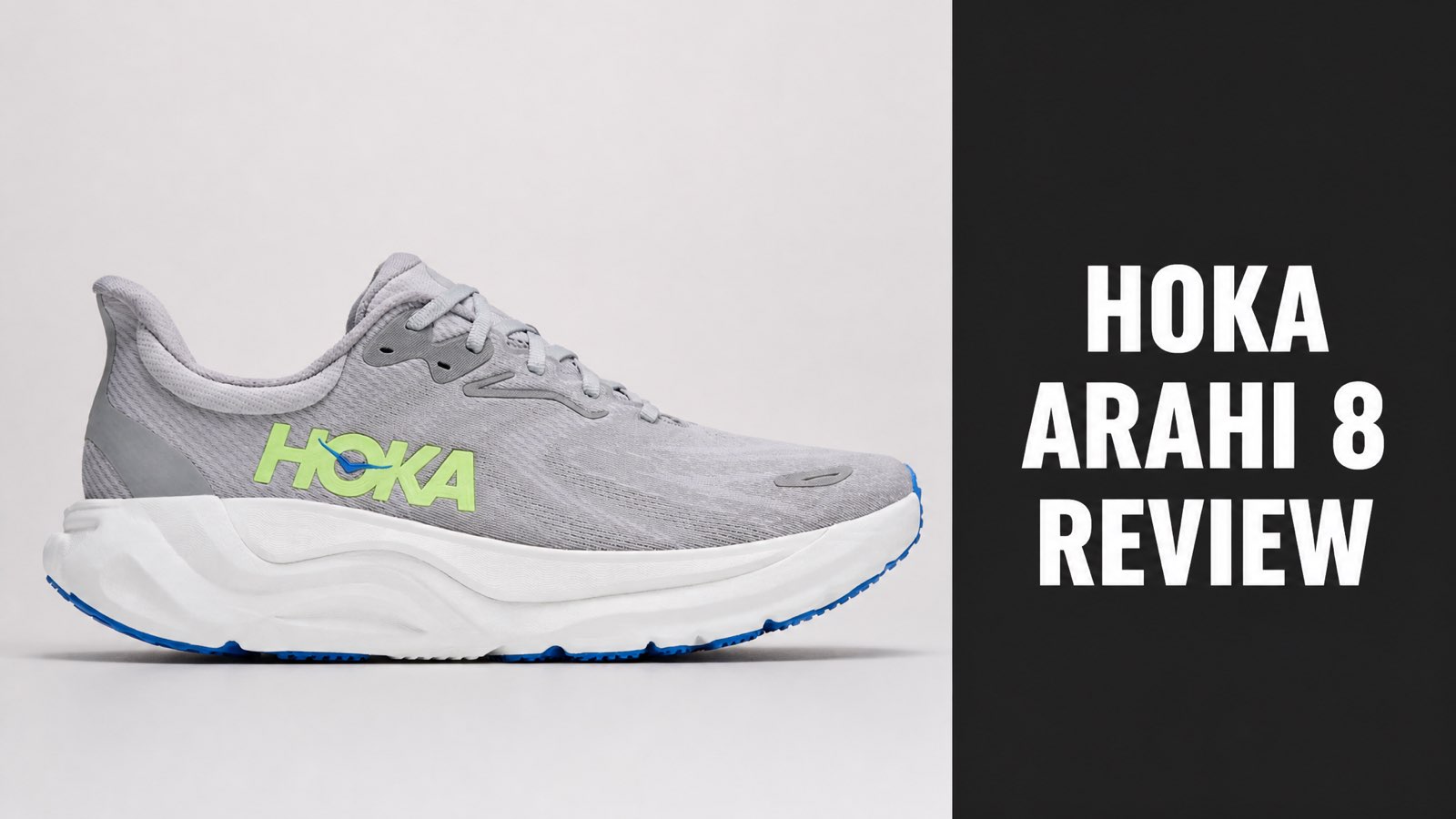
The Hoka Arahi 8 is a moderate stability daily trainer for road running and walking. It’s the eighth version of Hoka’s first stability shoe, which launched in 2017. It costs $150 and comes in regular, wide, and extra-wide widths. Runners who overpronate use it for easy miles, long runs, and recovery days.
This version swaps the old J-Frame for a new H-Frame. It adds 3 mm (0.12 in) of heel foam and moves to an 8 mm drop. A double jacquard mesh upper and a roomier toe box round out the update. Testers praise the smooth rocker ride and calm support. But some find the foam dull and the heel rough. So is it worth buying?
Here’s the big picture. The Arahi 8 is a quiet workhorse, not a flashy speed shoe. That’s great news for steady miles and tired legs. Below, you’ll learn how the H-Frame works and how the shoe fits. You’ll also see what reviewers say, how it stacks up against rivals, and whether it’s worth the money.
What Is the Hoka Arahi 8?
The Hoka Arahi 8 is a cushioned, moderate stability trainer built for daily miles, long runs, and runners who overpronate. It retails for $150. Hoka sells two stability shoes: the Arahi and the more premium Gaviota. RunningShoesGuru calls the Arahi 8 the best version of the series yet. Not bad for an eight-year-old line, right?
Where did it come from? Running Warehouse explains the history. Hoka launched the Clifton first. Then in 2017, it released the Arahi as its very first stability shoe.
Who is it for? Running Warehouse names mild to moderate overpronators who favor long, easy runs. Still, The Run Testers team are neutral runners, and they loved it too.
What Changed From the Arahi 7?
The Arahi 8 gains a new H-Frame, more heel foam, a higher 8 mm drop, and a wider toe box. Find My Footwear reports the drop jumps from 5 mm (0.20 in) to 8 mm (0.31 in). The flat-knit upper is gone. A double jacquard mesh replaces it. Is that a big overhaul? Find My Footwear calls it a total transformation.
The fit changed, too. Alastair Running says the added width and volume are the most obvious upgrade. Wider feet now get more room up front.
The price rose slightly. The Arahi 7 cost $145. The Arahi 8 costs $150, which Find My Footwear notes is still cheap for a daily trainer.
Arahi 7 vs Arahi 8:
| Spec | Arahi 7 | Arahi 8 |
|---|---|---|
| Stability system | J-Frame | H-Frame |
| Drop | 5 mm (0.20 in) | 8 mm (0.31 in) |
| Upper | Flat knit | Double jacquard mesh |
| Toe box | Standard | Wider, more volume |
| Price | $145 | $150 |
How Does the Hoka Arahi 8 Work?
The Hoka Arahi 8 works by pairing a dual-density foam midsole with a curved Meta-Rocker that rolls each step forward. The foam is compression-molded EVA, often shortened to CMEVA. A firmer foam frame sits inside it for support. The rocker moves you from heel to toe with less effort. Simple idea, isn’t it?
Here’s the thing about the rocker. The Run Testers say the shoe relies on its shape more than its foam. The geometry eases you forward at any pace.
The foam needs time, though. RunningShoesGuru says the midsole comes alive after about 25 miles (40 km). After that, the ride feels bouncier and smoother.
How the Ride Works:
- The heel lands on the softer CMEVA foam.
- The firmer H-Frame foam steadies the foot on both sides.
- The Meta-Rocker rolls the foot through midstance.
- The curved forefoot speeds up toe-off with less effort.
What Is the H-Frame?
The H-Frame is a firmer foam structure that supports both the inner and outer sides of the foot. The old J-Frame only curved around the heel and inner arch. Find My Footwear says the H-Frame adds firm foam on both sides for balanced guidance. RunningShoesGuru compares the feel to Brooks GuideRails. Why does that matter? Support kicks in only when you need it.
In plain English, it feels less like a wall. Alastair Running calls it a quiet support net. It keeps the stride aligned when fatigue sets in.
Not everyone agrees, though. OutdoorGearLab found the firm foam noticeable and almost hard under the arch. That firmness left its tester with sore feet.
What Are the Key Features of the Arahi 8?
The Arahi 8 features a tall 41 mm heel, an 8 mm drop, a mesh upper, and a rubber outsole. Running Warehouse lists the stack at 41 mm (1.61 in) heel and 33 mm (1.30 in) forefoot. A men’s US 9 weighs 9.3 oz (264 g). A women’s US 8 weighs just 7.7 oz (218 g). That’s light for a stability shoe, isn’t it?
The outsole uses durable rubber over most of the heel and forefoot. Alastair Running points out a few exposed EVA zones. Those lighter patches will likely wear first.
The upper is enclosed but flexible. It has a padded tongue, a padded heel collar, and an internal heel counter. RunningShoesGuru says the heel slip from older versions is gone.
Hoka Arahi 8 Specs:
| Feature | Detail |
|---|---|
| Weight (men’s US 9) | 9.3 oz (264 g) |
| Weight (women’s US 8) | 7.7 oz (218 g) |
| Stack height | 41 mm (1.61 in) heel, 33 mm (1.30 in) forefoot |
| Drop | 8 mm (0.31 in) |
| Midsole | Dual-density CMEVA with H-Frame |
| Upper | Double jacquard mesh |
| Price | $150 |
How Does the Arahi 8 Fit?
The Arahi 8 fits true to size for most runners, with a secure midfoot and a roomier toe box. Running Warehouse, RunningShoesGuru, and Find My Footwear all call it true to size. Find My Footwear found it more generous than most Hoka shoes. Wide-footed testers at Running Warehouse liked the ample room. Should you size up? Most testers say no.
But fit is personal. OutdoorGearLab found the toe box narrow and the midfoot cramped. The Run Testers also felt it leans a little narrow.
The good news? Hoka sells the Arahi 8 in regular, wide, and extra-wide widths. OutdoorGearLab strongly recommends trying the wider options if your feet are broad.
What Are the Benefits of the Hoka Arahi 8?
The Hoka Arahi 8 delivers gentle stability, smooth rocker transitions, and light cushioning for steady daily miles. Find My Footwear calls it a reliable workhorse with mild stability. The Run Testers found it lighter and more versatile than many rivals. Isn’t that what most runners want from a support shoe?
It also works for walkers. Running Warehouse says the soft cushioning felt great for walking and recovery runs.
It handles heat well, too. Running Warehouse testers ran in it on a nearly 90°F (32°C) day. The mesh stayed breathable yet protective.
Main Benefits:
- Balanced support from the H-Frame
- Smooth heel-to-toe roll from the Meta-Rocker
- Light weight for a stability shoe
- Roomier toe box than older Arahi models
- Durable rubber outsole
Does the Arahi 8 Control Overpronation?
Yes. The Arahi 8 controls mild to moderate overpronation through its H-Frame without forcing the foot into place. Running Warehouse says the H-Frame gives a solid base for mild to moderate overpronators. Alastair Running found less forced correction than in the Arahi 7. It also adds support against outward roll. So who gets the most from it? Runners who need a little help, not a lot.
Find My Footwear tested it on uneven river paths. Every landing felt assured and secure. Its tester never felt pushed around by the shoe.
Severe overpronators may want more. RunningShoesGuru rates its stability as ‘some stability,’ not maximum support.
Is the Arahi 8 Good for Long Runs?
Yes. The Arahi 8 is good for long runs thanks to its steady cushioning, rocker shape, and calm support. RunningShoesGuru says its best runs in the shoe were the longer ones. The Run Testers used it for runs over 30 km (18.6 miles) during marathon training. And here is the kicker: Find My Footwear wore it during a 100-mile (161 km) ultra.
That tester covered miles 40 to 75 in the Arahi 8. That stretch took roughly 12 hours. The shoe gave lightness, protection, and comfort the whole way.
It can speed up, too. The same tester hit 6:10 per mile (3:50 per km) on a progression run. Still, Running Warehouse says it isn’t built for speedwork.
What Do Hoka Arahi 8 Reviews Say?
Hoka Arahi 8 reviews are mostly positive, with praise for the ride and gripes about foam and heels. Find My Footwear scored it 9.3 out of 10. RunningShoesGuru gave it 8 out of 10. OutdoorGearLab was much harsher at 53 out of 100. Why the big gap? Fit and foam feel are personal.
The Run Testers called it an unexpected hit with the whole team. It’s now their top stability pick for runners who skip max cushioning.
Running Warehouse staff split, too. Linda scored it 10 out of 10. Kaitlyn gave it 7 out of 10 and found it too soft.
Hoka Arahi 8 Review Scores:
| Reviewer | Score | Main Takeaway |
|---|---|---|
| Find My Footwear | 9.3/10 | Surprise stability hit |
| RunningShoesGuru | 8/10 | Best Arahi yet |
| Running Warehouse (Linda) | 10/10 | Ideal daily trainer |
| Running Warehouse (Kaitlyn) | 7/10 | Too soft for running |
| OutdoorGearLab | 53/100 | Dull foam, heel rubbing |
What Do Happy Runners Like?
Happy runners like the smooth rocker, the subtle support, and the effortless feel on easy miles. Find My Footwear calls it the surprise shoe of 2025. Its tester found it less blocky than the Arahi 7 and the ASICS Gel-Kayano 32. Linda at Running Warehouse called it her ideal daily trainer. That’s high praise, isn’t it?
Testers also love the comfort. Find My Footwear describes a slipper-like feel that still handles faster miles.
The heel lockdown earns praise, too. RunningShoesGuru says the heel now locks in securely. That fix boosts both comfort and stability.
What Are the Common Complaints?
The common complaints are a long break-in, a dull midsole foam, and heel irritation for some runners. RunningShoesGuru says the foam takes around 25 miles (40 km) to open up. It can also feel bulky during faster efforts. OutdoorGearLab compares the foam to dribbling a deflated basketball. Ouch, right? Its legs felt more beat up after long runs.
Heel rubbing comes up often. OutdoorGearLab needed taller socks to stop Achilles abrasions. Some Running Warehouse testers also felt slight heel collar irritation.
Breathability draws mixed notes. Alastair Running says the double jacquard mesh feels a bit warmer on longer runs.
How Does the Arahi 8 Compare to Rivals?
The Arahi 8 is lighter and more versatile than most stability rivals, though some offer softer or springier foam. The Run Testers rank it above the Saucony Hurricane 25, Puma ForeverRun Nitro 2, and ASICS Gel-Kayano 32. The Hurricane 25 has more foam underfoot. The Nitro 2 feels springier. So what’s the catch? Both rivals are heavier and less versatile.
RunningShoesGuru names the ASICS GT-2000, Brooks Adrenaline, and New Balance 860 as direct rivals. All three aim at the same daily stability runner.
Price favors Hoka, too. The Gel-Kayano 32 lists at $164.95. The Nike Structure 26 lists at $144.95.
Arahi 8 vs Rivals:
| Shoe | List Price | Key Difference |
|---|---|---|
| Hoka Arahi 8 | $149.95 | Light, versatile, rocker ride |
| ASICS Gel-Kayano 32 | $164.95 | Bigger stack, more blocky |
| Nike Structure 26 | $144.95 | Lower expert score |
| Saucony Hurricane 25 | Not listed | Softer, heavier |
| Puma ForeverRun Nitro 2 | Not listed | Springier, heavier |
Arahi 8 vs Clifton 10: Which Is Better?
The Arahi 8 is better for stability, while the Clifton 10 suits neutral runners who want softer cushioning. The Run Testers call the Arahi 8 the stable counterpart to the Clifton 10. The Arahi is more stable and a bit lighter. It also has a thicker outsole. Which one should you pick? It depends on your stride.
The Clifton 10 is softer underfoot. The Run Testers noticed it most in the forefoot. Neutral runners chasing plush comfort will prefer it.
Alastair Running agrees on the feel. The Arahi foam still leans firmer than the Clifton. That firmness is the trade-off for support.
Who Should Avoid the Hoka Arahi 8?
Runners who want a plush or fast shoe should avoid the Arahi 8 and pick softer or lighter options. RunningShoesGuru says shoppers seeking a plush stability trainer should skip it. Running Warehouse says it isn’t built for speedwork. Kaitlyn wanted a firmer, more connected ride. Does that sound like you? Then keep looking.
Runners with sensitive heels need care. OutdoorGearLab and some Running Warehouse testers felt rubbing around the heel collar.
Neutral runners have other options. The Clifton 10 gives a similar ride without the H-Frame.
Skip the Arahi 8 If You:
- Want a plush, max-cushion ride
- Need a lively shoe for speedwork
- Have heels prone to rubbing
- Need maximum overpronation control
- Want a shoe that feels perfect from day one
Is the Arahi 8 Durable?
Yes. The Arahi 8 is durable, with a thicker rubber outsole that shows little wear after early testing. RunningShoesGuru logged over 70 miles (113 km) with minimal visible wear. RunningShoesGuru also rated its durability 9 out of 10. Hoka clearly beefed up the rubber this time. Find My Footwear saw virtually no wear after 65 miles (105 km). Pretty tough, right? Find My Footwear says it’s built for big mileage.
Traction holds up, too. Running Warehouse testers hit heavy rain and stayed upright on wet surfaces.
Watch the exposed foam. Alastair Running expects those EVA zones to wear before the rubber does.
How Much Does the Hoka Arahi 8 Cost?
The Hoka Arahi 8 costs $150 at full retail, but sale prices often drop it close to $100. RunningShoesGuru found it at Zappos from $97.50 in November. Running Warehouse had it from $99.88. Hoka listed it at $120. Why the big discounts? Hoka now sells the newer Arahi 9.
OutdoorGearLab even spotted a 50% off deal at REI. Amazon prices ran higher, from $139 for men’s pairs.
Colors and sizes may run low as stock clears. Buy soon if you find your size on sale.
Where to Buy the Hoka Arahi 8:
| Retailer | Recent Price | Discount |
|---|---|---|
| Zappos | From $97.50 | 35% off |
| Running Warehouse | From $99.88 | 33% off |
| Hoka | From $120 | 20% off |
| Amazon (men’s) | From $139 | 7% off |
Is the Arahi 8 Worth the Price?
Yes. The Arahi 8 is worth the price for overpronators who want a light, reliable stability shoe for daily miles. Find My Footwear calls it really good value for money. RunningShoesGuru rated value 8 out of 10. At around $100 on sale, it’s an easy pick. So is full price fair? For most stability runners, yes.
The value grows with mileage. A durable outsole means more miles per dollar.
Bottom line: buy it for steady easy miles. Skip it if you need speed or plush softness.
Should You Try Eat Proteins?
Yes. Eat Proteins is worth trying if you want simple nutrition advice that helps your body recover from every mile. A stable shoe protects your stride. But your muscles still do the work on every run. Our team at Eat Proteins shares protein guides, easy meals, and honest gear reviews. Why stop at better shoes? Start fueling better, too.
Don’t let sore legs cut your week short. Small changes to your plate add up fast. Our experts make those changes easy to start today.
How Does Eat Proteins Help Runners Recover?
Eat Proteins helps runners recover with clear protein tips that support muscle repair and steady energy. Long, easy miles still break down muscle. Enough protein helps that muscle rebuild before your next run. Our coaches turn the science into quick meals and snacks. Ready to feel stronger on your next long run?
Pair the right shoes with the right fuel. Browse our guides and start with one simple change this week. Your legs will thank you.