
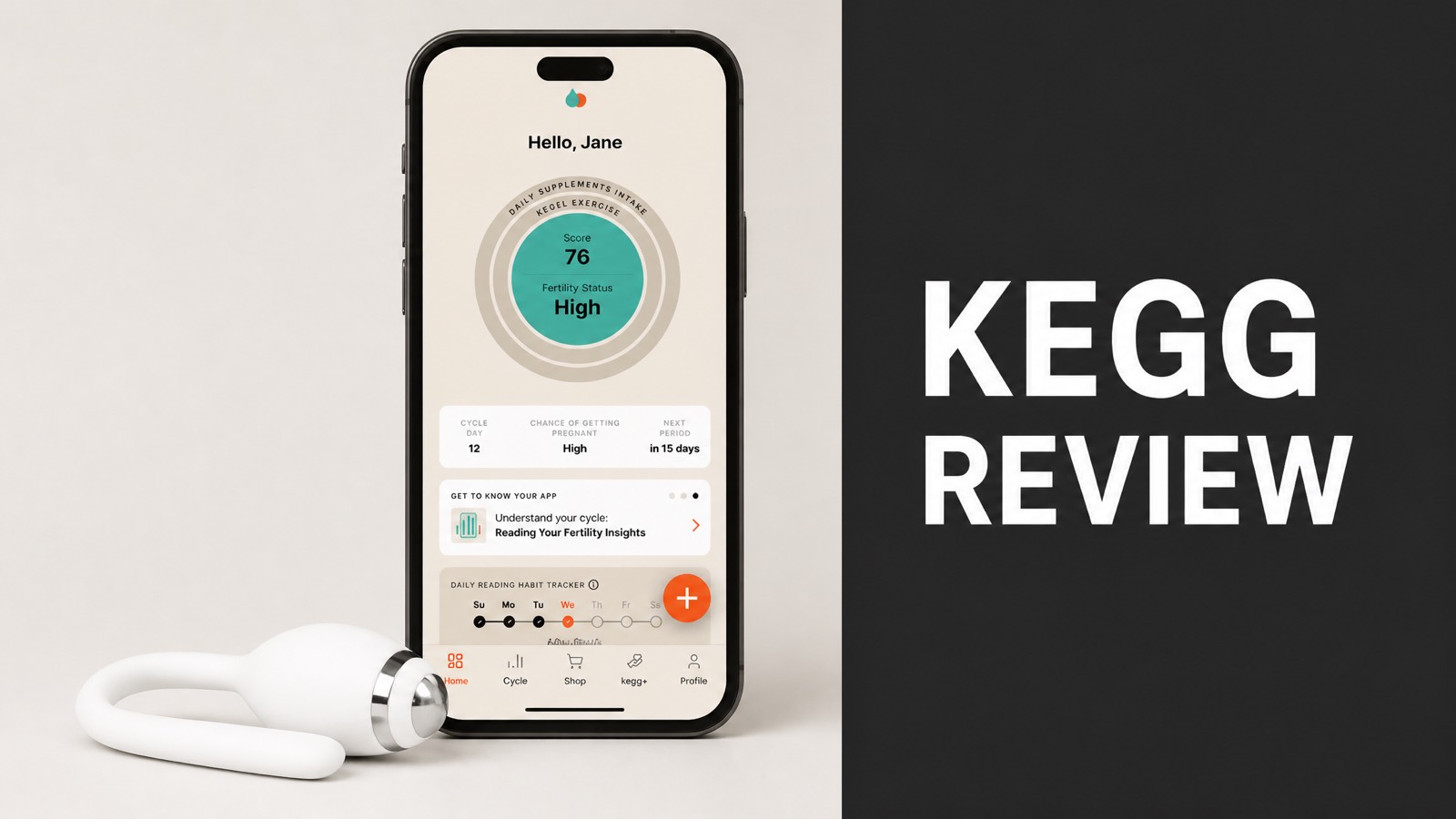
Kegg is a smart fertility tracker made by Lady Technologies, a women’s health tech company that launched it in 2020. You insert it for two minutes a day. It reads the electrolytes in your cervical mucus. Then it sends the data to a free app that maps your fertile window each cycle.
Kegg uses electrical impedance to spot the cervical mucus shifts that come before ovulation. The app turns daily readings into a trendline and a fertile valley. A small pilot study found 63.6% sensitivity and 81.8% specificity. Users praise the easy two-minute routine. Critics point to the high price, the daily insertion, and confusing numbers.
The big picture is clear. Kegg is a safe, one-time purchase with no refills, but it isn’t the most accurate tracker out there. Below, you’ll see how it works and what real users say. You’ll also see how it stacks up against Mira and Inito, and whether it’s truly worth your money.
What Is Kegg?
Kegg is an at-home fertility tracker that reads your cervical mucus to predict your most fertile days. The small, egg-shaped device goes inside the vagina for two minutes each morning. Sensors measure electrolyte changes in the mucus. The kegg app turns those readings into a daily fertility status. It also predicts a fertile window for each new cycle.
Here’s the fun part: the name is a pun. ‘Kegg’ blends egg and Kegel. The device is egg shaped. It tracks ovulation. And it doubles as a Kegel trainer for your pelvic floor.
What does it look like? The body is white with a soft matte finish. A shiny metal electrode cap sits at the tip. The head is about 5 cm (2 inches) long. At its widest, it’s roughly the width of one and a half tampons.
Key Facts:
- Maker: Lady Technologies, launched in 2020
- Method: electrical impedance reading of cervical mucus
- Daily use: about 2 minutes, skipped on period days
- App: free on iOS and Android, no subscription
- Bonus use: guided Kegel exercises
What Comes in the Kegg Box?
The kegg box includes the tracker, a cup-shaped charging base, a USB-C cable, a wall adapter, and a manual. You charge the device by pressing its head firmly into the base. A pulsing orange glow means it’s charging. A steady green glow means it’s full. The setup is simple and takes just a few minutes. Nothing else is needed to get started on day one.
Don’t toss the paperwork. Why not? The manual and brochure carry the QR code and number code. You need one of them to register the device in the app.
Shipping is discreet, too. Innerbody’s order came in a plain brown box. The only clue on the label was the sender name, ‘Lady Technologies LLC.’
How Does Kegg Work?
Kegg works by sending a tiny electrical current through your cervical mucus and measuring its resistance, called impedance. As ovulation nears, rising estrogen makes the mucus thinner, wetter, and richer in electrolytes. Those shifts change the reading. The app tracks the change over days and flags when your fertile window is opening up for the cycle.
Why does mucus matter? The Cleveland Clinic explains it. Near ovulation, mucus turns stretchy and slippery. That texture helps sperm reach the fallopian tubes.
The routine is short. You take one reading a day, inside the same two-hour window. One vibration means the reading started. Two vibrations mean it’s done. The data then moves to your phone over Bluetooth.
How to Take a Reading:
- Open the kegg app and start a new reading.
- Insert the head of the device with the tail pointing up.
- Wait for one vibration to signal the start.
- Stay still until two vibrations signal the end.
- Remove, clean, and let the app sync the result.
What Does the Kegg App Show?
The kegg app shows a light green daily reading line and a dark green trendline that predicts your fertile window. When the lines drop, your mucus is becoming more fertile. Kegg calls that dip the fertile valley. Below the chart, the app lists your cycle day and days until your period. It also shows a fertility status, such as Low or Likely, for that day.
Sounds backward? Here’s a simple way to remember it. A line going down means your pregnancy chances are going up.
The app also has a calendar for notes. You can log bleeding, spotting, sex drive, temperature, and mucus texture. Better yet, nothing sits behind a paywall. You can also set the app for regular or irregular cycles.
What Are the Benefits of Kegg?
Kegg offers a hormone-free way to find your fertile window in just two minutes a day. There are no test strips or refills to buy. You pay once and get the device, the free app, and every feature. You also get a built-in Kegel trainer for your pelvic floor. Plus, a 12-month pregnancy guarantee covers people who use it as directed and still don’t conceive.
Speed is another win. Here’s why: a Mira urine test needs around 20 minutes to give results. Kegg finishes in about two. And you never handle urine at all.
Main Benefits:
- No test strips or monthly refills
- Results in about 2 minutes
- Free app with no premium tier
- Built-in Kegel exercise mode
- 12-month pregnancy guarantee
- FSA and HSA eligible
Does Kegg Predict Your Fertile Window?
Yes. Kegg predicts the fertile window with moderate accuracy, based on a small study the company paid for. In 2022, 11 women aged 18 to 44 used it for three cycles. Blood, urine, and ultrasound checks confirmed ovulation. Kegg showed 63.6% sensitivity and 81.8% specificity. In plain English, it caught most fertile days and ruled out most non-fertile ones.
How does it compare to temperature tracking? It wins. A second company study found kegg 7.14% more sensitive and 20.35% more specific than basal body temperature.
But urine tests still catch more true fertile days. One 2017 review found urine tests can reach 100% sensitivity. Their specificity was only 25%, though. So kegg trades a few missed positives for far fewer false alarms.
Does Kegg Work as a Kegel Trainer?
Yes. Kegg works as a Kegel ball, with guided pelvic floor exercises you can follow in the app during each reading. No other tracker in Innerbody’s comparison does double duty. Kegel training strengthens the muscles that support the bladder, uterus, and rectum. Those muscles help with bladder control during pregnancy and support the extra weight you’ll carry.
Does the research back this up? Partly, yes. A 2004 trial in BMJ tracked pregnant women. Those who did pelvic floor training had fewer long pushing stages, 22 versus 37 deliveries.
Kegg also says Kegels may improve blood flow. In its view, that may help cervical mucus quality. Treat that as a claim, not a proven result.
What Do Kegg Reviews Say?
Kegg reviews are mostly positive, with many users crediting the tracker for helping them get pregnant. The kegg site shows 4.8 out of 5 stars across 1,134 reviews. Amazon is a bit cooler, with 4.0 stars from 508 ratings. Over 100 units sold there last month. Shoppers praise how easy it is to use. Value for money and reading clarity get mixed marks.
Reviewers also rate it. Innerbody gave kegg 4.10 overall. Safety scored highest, and accuracy scored lowest.
Kegg Ratings at a Glance:
| Source | Score | Notes |
|---|---|---|
| kegg website | 4.8 / 5 | 1,134 reviews |
| Amazon | 4.0 / 5 | 508 ratings |
| Trustpilot | 3 / 5 | 3 reviews |
| Innerbody | 4.10 / 5 | Expert review |
What Do Happy Users Report?
Happy users report that kegg is easy to use, fits a morning routine, and finally makes their fertile window clear. Many reviews mention getting pregnant while using it. Some say it happened fast. Others say it worked after months or years of trying other methods. Several also say the readings helped them understand cervical mucus for the first time ever.
One reviewer quoted by Natural Womanhood said she wasn’t a good cervical mucus detective. Kegg did that job for her.
Amazon shoppers echo this. The fertile window gets 66 mentions in Amazon’s review summary. Ease of use gets 57.
What Are the Common Complaints?
Common complaints focus on discomfort, confusing readings, error messages, and the high up-front price. One App Store reviewer said the numbers feel made up because they come as ranges. The same user reported many errors and retests. Some people find daily insertion uncomfortable or even painful. Others feel the price is too high for what they get.
Timing is a pain point too. Is it flexible? Not really. You need to test within the same two-hour window every day. That can clash with travel, shifts, or busy mornings.
Trustpilot has only three reviews, with a 3 out of 5 average. That’s too few to judge.
How Does Kegg Compare to Mira, Inito, and Tempdrop?
Kegg costs more up front than Mira, Inito, or Tempdrop. But it’s often cheaper after a year, since it needs no refills. Mira and Inito read hormones in urine and need new test wands. Tempdrop reads skin temperature on your arm and charges for its premium app. Kegg is the only one of the four that reads cervical mucus and has no ongoing fees at all.
What does that mean for your wallet? Mira’s monthly wands cost close to $60. After about four months, you’ve passed kegg’s price.
Kegg vs Top Rivals:
| Tracker | Method | Starting Price | Ongoing Cost |
|---|---|---|---|
| Kegg | Cervical mucus | $249-$279 | None |
| Mira | Urine hormones | $199 | About $60 per month |
| Inito | Urine hormones | $149 | Test strip refills |
| Tempdrop | Body temperature | $149-$219 | $4.49 per month |
| Clearblue Monitor | Urine hormones | $91.18 | $55.70 per 30 sticks |
Is Kegg Better Than Ovulation Strips?
No. Kegg is not more accurate than ovulation strips at catching true fertile days, but it gives fewer false alarms. Strips detect the LH surge, which shows up 1 to 1.5 days before ovulation. Kegg spots mucus changes earlier in the cycle. So it gives you more lead time. Strips, by contrast, confirm the surge more reliably on the day it actually happens.
So which one should you pick? It depends on your goal. Innerbody suggests urine tests for people trying to conceive. Kegg may suit people who want to learn their cycle.
Some users pair the two. They watch kegg’s valley, then confirm with a strip. That combo covers both strengths.
Is Kegg Safe?
Yes. Kegg is safe for most users and is registered with the FDA as a Class I medical device. Class I means the FDA sees minimal potential for harm to the user, even if the device fails. Kegg also holds FCC registration for wireless devices. It passed IEC 60601-1-2 testing, which confirms its radio emissions stay within a safe range for medical gear.
Safety Credentials:
- FDA-registered Class I medical device
- FCC registered, grantee code 2AVWM
- Passed IEC 60601-1-2 medical EMC testing
- Encrypted, anonymized app data
Here’s the catch: registered isn’t the same as cleared. Kegg has no FDA clearance. Its rival Ava does. That’s why Innerbody still rated kegg’s safety at 9.2 out of 10, not higher.
Privacy looks solid, too. Kegg says it never sells or shares user data. You can register with any name and opt out of research use.
Who Should Avoid Kegg?
People with endometriosis, vaginismus, or other pelvic conditions should talk to a doctor before using kegg. Daily insertion can be quite painful for them. Kegg is also not reliable for spotting the first ovulation after birth. The company says to wait for two periods after giving birth. Women with very irregular cycles may get much less clear readings.
Want a contraceptive? Look elsewhere. Kegg is not FDA cleared as birth control. And its 81.8% specificity leaves room for mistakes.
Worried about data leaks? A rival app, Glow, once exposed data from about 25 million people. An offline monitor like Clearblue avoids that risk.
How Much Does Kegg Cost?
Kegg costs between $249 and $279 as a one-time purchase. The exact price shifts with the store and any current discounts. Innerbody paid $259 direct from the kegg website. Amazon lists it at $279 today. The price covers the device, the charger, and full app access. There are no test strips, no add-ons, and no monthly plan to keep paying for over time.
Can you spread out the cost? Yes. Kegg takes Afterpay, Shop Pay, and Affirm. It also accepts credit cards, PayPal, Venmo, and Google Pay.
Kegg is FSA and HSA eligible, so you can use pre-tax dollars. Check with your plan provider first, though.
Is Kegg Worth the Price?
Yes. Kegg is worth the price for people who plan to track for many months and want no refill costs. Innerbody rated its cost value at 8.7 out of 10. Clearblue users spend about $300 on test sticks in just five months. Mira and Inito pass kegg’s total price even faster. Kegg’s total cost stays flat, no matter how many cycles it takes you to conceive.
And here is the best part: the 12-month pregnancy guarantee. Don’t conceive within a year of consistent use? You can ask for a full refund.
Pregnancy Guarantee Rules:
- You’re at least 21 and of reproductive age
- You’ve stopped hormonal birth control for 3 months and had 2 cycles
- You’re 6 weeks postpartum with 2 cycles since
- You’re not breastfeeding
- You bought from kegg, Amazon, or MyOvaterra
- You used it consistently as directed
Where Can You Buy Kegg?
You can buy kegg from the official kegg website, from Amazon, or from MyOvaterra for international orders. The kegg site is usually the cheapest option. It offers free standard shipping across the contiguous US. Orders placed before 1 p.m. Pacific time ship the same day. Most packages arrive in about four days, in a plain brown box with no branding.
Live outside the US? Kegg doesn’t ship abroad directly. MyOvaterra does, but only to some countries.
Returns are tight. The 30-day money-back window covers only sealed, unused devices. You also pay the return shipping. A one-year warranty covers defects.
Should You Try Eat Proteins?
Yes. Eat Proteins gives you honest product reviews and nutrition guides that support your health while you try to conceive. A tracker tells you exactly when you’re fertile. Your plate shapes how ready your body is. Our team at Eat Proteins breaks down protein, key nutrients, and daily meal habits. Each one supports hormone balance and a healthy cycle.
Don’t spend $279 on timing and ignore the basics. Smart gear works best with smart meals. Start reading Eat Proteins today.
How Does Eat Proteins Support Fertility Nutrition?
Eat Proteins supports fertility nutrition with clear protein guides, simple recipes, and honest reviews of the health gear you buy. Our experts link what you eat to how you feel, sleep, and recover. Bottom line: steady protein, iron, and healthy fats help your body run well. Those daily habits matter long before a positive pregnancy test ever shows up.
You’ve seen the full kegg breakdown. Now take the next step. Check back with Eat Proteins for new reviews, recipes, and real-world nutrition tips that fit your goals.