
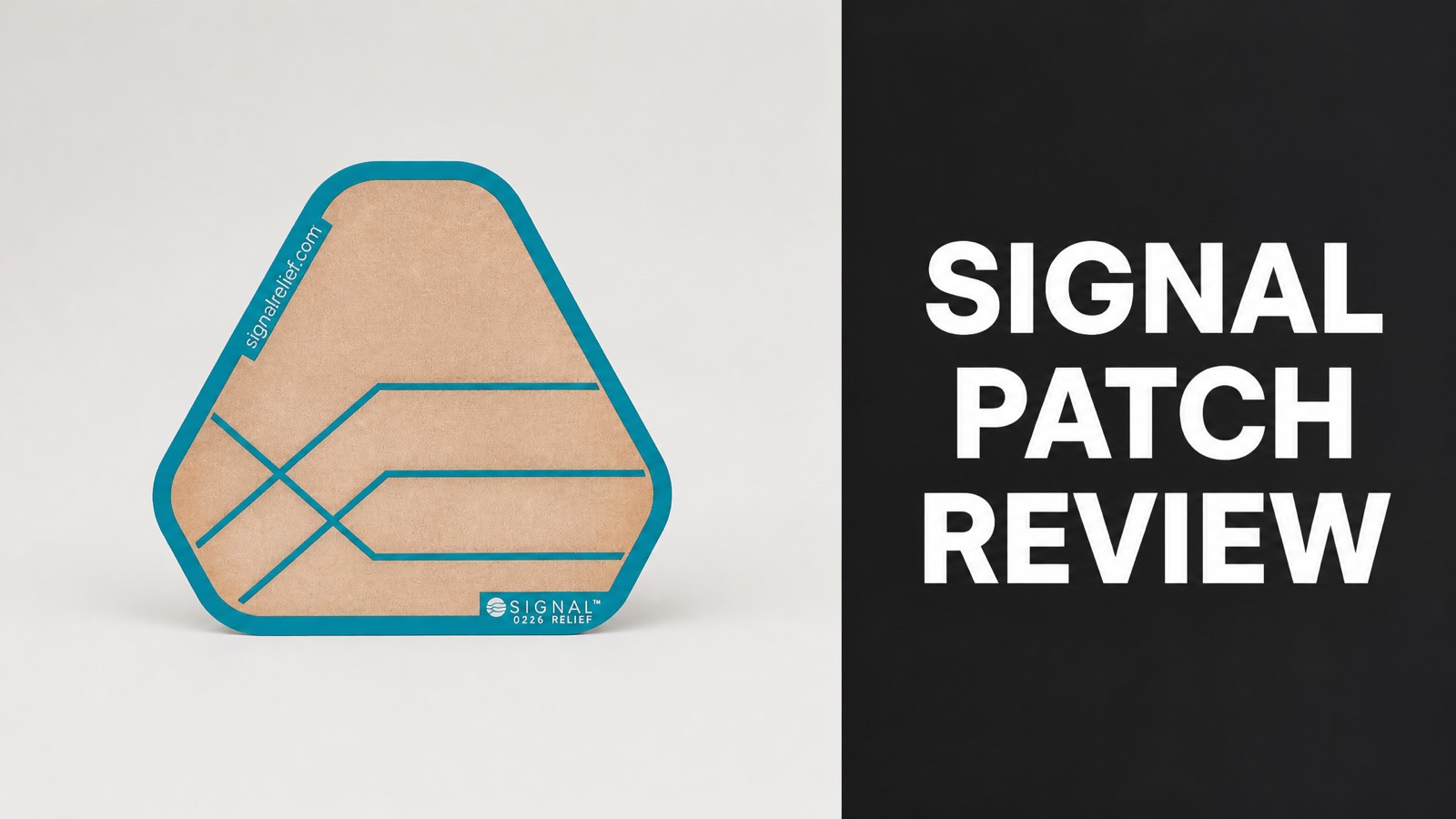
The Signal Relief patch is a reusable, drug-free pain patch from Relief Sciences U.S.A. Limited. The patch uses patent-pending micro-antenna technology and targets everyday back, knee, shoulder, and foot discomfort. The company claims 700,000 patches sold, so this signal patch review tests the claims.
Signal Relief says the patch works with the body’s own nerve signals. A study of 91 people reported relief within 15 minutes for 63 percent of them. ConsumerLab calls the human evidence weak. Buyer reviews split on results, and several complaints target the adhesive. A 45-day refund window and a $143 starting price frame the final buying decision.
The patch earns a cautious verdict. Some users report real relief, and the refund window limits financial risk. Independent proof is thin. The guide covers function, studies, complaints, safety, pricing, and buying options. Readers can then decide with confidence before spending any money.
What Is the Signal Relief Patch?
The Signal Relief patch is a reusable, drug-free patch built to ease everyday muscle and joint discomfort. Relief Sciences U.S.A. Limited sells it online for the back, knees, shoulders, and feet. The 4.5 inch (11.4 cm) patch uses no drugs, chemicals, or batteries. The brand markets it as a wearable option for people who want relief without pills or creams.
In fact, the brand now sells three products. Each one targets a different body area. Every product shares the same micro-antenna technology, so the choice comes down to where the discomfort sits.
Signal Relief Products:
- Signal Relief 4.5 inch Patch for everyday discomfort
- Signal Core for back discomfort
- Signal Step for foot discomfort
Who Makes the Signal Relief Patch?
Relief Sciences U.S.A. Limited makes and sells Signal Relief through its own website. The company lists a BBB business profile in Rexburg, Idaho, and works with surgeons, pain specialists, and physical therapists. An orthopedic surgeon appears as founder and CEO. The company sells direct to consumers and handles returns through its own customer care team.
To be clear, the site also promotes patch donations to veteran organizations. The site lists more than 700,000 patches sold. Our team at Eat Proteins treats that number as a company claim, not an audited fact. Does the number matter? Only as context.
How Does the Signal Relief Patch Work?
The patch works by using thousands of microscopic antennas to quiet nerve signals tied to discomfort. Signal Relief says nerves keep firing after the original strain ends. The patch aims to lower that persistent signal loop without heat or chemicals. The company describes the effect as turning down the volume of pain instead of covering the feeling.
Here’s the catch. The company calls the technology patent pending, and public sources describe the mechanism only in marketing terms. Does that make the patch fake? No. The mechanism simply lacks independent confirmation.
How Do You Use the Patch?
Users hold the patch at or just above the most intense area of discomfort. Signal Relief advises placement between the pain source and the brain. Latex-free adhesives secure the patch to skin, while Signal Core uses a supportive wrap instead of adhesive. Wear time is up to the user, and daily use is common. Cleaning takes only a damp cloth and mild soap.
The company says many people notice a change within 15 minutes to an hour. Some need up to 72 hours (3 days) to find the best placement. So, patience matters.
Steps:
- Find the most intense area of discomfort and hold the patch at or just above it.
- Secure the patch with the included latex-free adhesives.
- Wear the patch daily or as often as needed.
- Clean the patch with a damp cloth and mild soap, then air dry it.
Does the Signal Relief Patch Work?
Yes. The patch delivers relief for a share of users, but independent evidence stays weak. Maker-backed studies report relief in most participants. ConsumerLab found only weak human evidence. Buyer reviews split between strong praise and no effect at all. The honest answer depends on the person. Chronic pain responds differently from one body to the next.
Bottom line: results vary by person. Does that sound vague? It’s honest. Pain has many causes, and one patch won’t fix every one of them.
What Do the Clinical Studies Show?
The company’s study of 91 people with knee and back pain found that 63 percent reported relief within 15 minutes. The same study reports that 85 percent of them felt relief at some point within 72 hours. Signal Relief publishes these figures on its own site. Both figures come from the brand’s own materials. Independent reviewers haven’t confirmed them.
Another summary describes a 2025 placebo-controlled study of people with chronic back or knee pain. In that summary, 71 percent of active-patch users reported less discomfort within 15 minutes. And that figure comes from a retailer partner, not the journal.
Here’s the problem. Self-reported relief measures feelings, not tissue changes. Placebo effects run strong in pain research. So the control group matters more than the headline percentages.
Reported Study Results:
| Result | Figure | Source |
|---|---|---|
| Some relief at 15 minutes | 63% | Signal Relief site, 91 people |
| Relief at some point within 72 hours | 85% | Signal Relief site, 91 people |
| Less discomfort at 15 minutes, active patch | 71% | Flex summary of a 2025 placebo-controlled study |
What Does ConsumerLab Say?
ConsumerLab states that only weak evidence in people supports the patch. Its January 2026 answer reviewed a registered trial, a 2023 DuPree pilot study, and a 2025 Levin case report. A medical doctor reviewed and edited the piece. ConsumerLab is an independent testing company, and medical doctors and doctoral-level experts review all of its content.
The full analysis sits behind a membership wall. What’s more, the public summary repeats the marketing line of drug-free relief for as little as 30 cents per day. Does weak evidence mean zero effect? No. The proof is simply small and early.
What Do Signal Relief Patch Reviews Say?
Signal Relief patch reviews split sharply between enthusiastic users and disappointed buyers. Testimonials on the company site praise daily relief. Facebook group threads and BBB complaints describe no effect, adhesive trouble, or refund delays. Mixed feedback is common for pain products at this price. Smart buyers read both sides before they buy anything.
Think of it this way: chronic pain varies, so one patch can’t match everyone. Do mixed reviews mean the patch fails? Not necessarily. They mean fit and expectations matter.
What Do Positive Reviews Say?
Positive reviewers describe less pain and more daily movement. One site testimonial says the patch lets the user do things without stopping to rest. A self-described nurse in a Facebook thread reported that her back pain was 90 percent gone. Site testimonials also say all three patch designs work equally well. The company curates those quotes itself.
A commenter with spinal stenosis reported getting around much better. Another said decades of low back pain eased. And here’s the kicker: are these reviews proof? No. They’re anecdotes, and company-site testimonials are curated.
What Are the Common Complaints?
Complaints center on weak results, adhesive failure, and slow refunds. BBB lists 20 complaints in the last 3 years and 8 in the last 12 months. Several describe adhesive that bunched or fell apart within hours of use. Refund speed and customer service come up in several threads. Reviewers also say the adhesive fails before the patch does. A rash appears too.
To be fair, BBB marks one adhesive complaint as resolved. The company’s profile shows an A+ rating and accreditation. Some 2025 social posts cited a D- rating, and the current profile no longer shows it.
Common Complaints:
- No pain relief after trying the patch
- Adhesive bunching or losing grip
- Skin rash from the adhesive
- Slow refunds or unclear customer service
How Does Signal Relief Compare to Other Pain Relief Options?
Signal Relief positions itself against heating pads, TENS units, and disposable patches. The company says its patch needs no power source, cords, or chargers. Per the company’s own comparison, competing options often need batteries, warm-ups, or repeat purchases. The comparison is the brand’s own, so it favors the patch. Independent tests are scarce.
Kailo Flex, a wearable copper patch, holds 3.4 of 5 stars from 92 Amazon ratings. A direct star comparison with Signal Relief isn’t possible. The reviewed Amazon results show other patch brands instead.
Signal Relief vs Alternatives:
| Option | Type | Key Detail |
|---|---|---|
| Signal Relief Patch | Micro-antenna patch | Reusable, 45-day refund, no battery |
| Kailo Flex Patch | Copper patch | 5 reusable adhesives, 3.4 of 5 stars on Amazon |
| TENS unit | Electrical device | Needs a power source, per Signal Relief |
| Heating pad | Heat therapy | Needs power or frequent warm-ups, per Signal Relief |
How Does Signal Relief Compare to a Heating Pad?
A heating pad masks discomfort with heat, while Signal Relief claims to work on nerve signaling. Signal Relief says its patch doesn’t mask feeling with heat or chemicals. Heat needs a power source or frequent warm-ups, and the patch needs neither. Heating pads are cheap. The patch costs more, but the company says it goes anywhere and needs no setup.
Which option wins? Short answer: heat has decades of routine use behind it, while the patch has a handful of small studies. Our experts at Eat Proteins treat both as comfort tools, not treatments.
Is the Signal Relief Patch Safe?
Yes. The Signal Relief patch carries a low risk profile for most users because it uses no drugs, chemicals, or batteries. Reported problems stay mostly cosmetic, such as adhesive irritation. The company still advises medical advice for several health conditions. The patch stays outside the body, and users remove it at will. Nothing is ingested or injected.
The reviewed sources show no FDA approval claim. So treat the patch as a consumer wellness product, not a medical treatment. Does that make it unsafe? No. The pain claims simply lack regulatory review in the sources.
Check With a Doctor First If There Is:
- Diabetes
- Circulatory problems
- A skin condition
- A nerve disorder
- An implantable device inside the body
- Pregnancy, where the company says not to use the patch
What Are the Side Effects?
The most common side effect is skin irritation from the adhesive. A Facebook commenter reported a rash on a spouse with spinal stenosis. Other users report adhesive bunching, which ends wear time early. The company lists no drug effects because the patch delivers no medication. Signal Core uses a wrap instead of adhesive, so sensitive skin has an option.
In plain English: the patch carries no drug. Do drug side effects apply? No. Medical conditions still matter. People with implants or circulation problems need a doctor’s advice before applying it.
Is Signal Relief Legit?
Yes. Signal Relief operates as a real company with a BBB accreditation and an A+ rating. The brand lists a business profile, named medical advisors, and a 45-day refund policy. Scam claims on social media target results and service, not the business itself. Service complaints exist, yet BBB lists the company as accredited. Refunds follow a stated policy.
But legit doesn’t mean proven. The business is real, and the pain relief evidence is thin. Is it a scam? The record shows a real product with mixed results and some service complaints.
How Much Does the Signal Relief Patch Cost?
The Signal Relief patch costs $143 for the 4.5 inch (11.4 cm) single patch at current sale pricing. The list price shows $179. Signal Core starts at $239, and Signal Step starts at $159. Prices come from the company site at the time of writing. Promotions change often, so check the live price before ordering the patch. Discounts and bundles vary by season.
Optional Signal Care protection adds a one-time fee from $19 to $59 by order size. A $100 to $199.99 order adds $29. Nothing renews, and no subscription applies.
HSA and FSA funds apply through Flex. And the company lists all three products as eligible. Does that lower the real cost? Yes, because pre-tax dollars pay for it.
Signal Relief Pricing:
| Product | Best For | Sale Price | List Price |
|---|---|---|---|
| Signal Relief 4.5 inch Patch | Everyday discomfort | $143 | $179 |
| Signal Core | Back discomfort | $239 | $299 |
| Signal Step | Foot discomfort | $159 | $199 |
Is the Signal Relief Patch Worth the Price?
Yes. The patch earns its price only because of the 45-day money-back guarantee. A $143 purchase risks little when a refund is available. Without that window, thin independent evidence wouldn’t justify the cost. Buyers who want proof first face a harder call. The patch costs far more than a basic heating pad. Cheaper options exist for simple soreness.
Here’s the kicker: refund complaints exist. One Facebook commenter reported no refund yet after returning a patch. Keep the order number and return confirmation, and photograph the adhesive if it fails.
Where Can You Buy the Signal Relief Patch?
The brand sells its products directly through signalrelief.com. HSA and FSA buyers can pay through Flex at checkout. Amazon search results show many similar patches from other brands, so check the seller name before ordering. The company site lists all three products on its shop page. Other retailers aren’t confirmed in any of the reviewed sources.
Buy direct to keep the guarantee simple. The 45-day refund and 1-year warranty come from the company. Signal Step inserts carry a 6-month warranty instead.
Why Should You Try Eat Proteins?
Eat Proteins gives readers straight answers on products like the Signal Relief patch before they spend. Our team reads the studies, the complaints, and the fine print. You get the verdict without the sales pitch. Don’t buy blind when a clear review exists. We keep every review short, sourced, and honest. Check the facts first, then spend your money.
Now here is the thing: smart buyers compare options and check refund terms first. Browse more Eat Proteins reviews, and decide with facts instead of ads.
What Is Our Verdict on the Signal Relief Patch?
Our verdict is that the Signal Relief patch earns a cautious try, not a confident recommendation. The 45-day refund limits the risk. Independent evidence stays weak, and adhesive problems recur in complaints. The patch isn’t a cure, and the studies are small. Buyers who still want to test it have a fair safety net. The money-back window matters most.
So what does that mean for you? Try it only if you accept an uncertain result. Skip it if you need a proven pain treatment, and talk to a doctor first. Your next step is simple: read the refund terms, then decide.